citizenship through marriage texas

How to Turn Your Wedding Bells into a Citizenship Certificate

May 22, 202613 min read

What You Need to Know About Citizenship Through Marriage Texas

Citizenship through marriage Texas is a two-stage legal journey: first you secure a Green Card as a lawful permanent resident (LPR), then — after 3 years of marriage and residency — you apply for full U.S. naturalization.

Here is a quick overview of the path:

Stage 1 — Get Your Green Card

  • U.S. citizen spouse files Form I-130 to establish the relationship

  • Foreign spouse applies for Adjustment of Status (if in the U.S.) or Consular Processing (if abroad)

  • Attend biometrics and a USCIS interview

  • Receive a conditional (2-year) or permanent (10-year) Green Card

Stage 2 — Apply for Citizenship

  • Live as a lawful permanent resident for 3 continuous years while married to your U.S. citizen spouse

  • Meet physical presence requirements (at least 18 months inside the U.S. during those 3 years)

  • Pass the English and civics tests

  • Attend your naturalization interview and Oath of Allegiance ceremony

Marriage to a U.S. citizen is one of the most common — and most direct — paths to permanent residency and citizenship. During just the first three quarters of 2020 alone, nearly 166,000 spouses of U.S. citizens obtained lawful permanent residency in the United States.

But here is what surprises many people: the process is not automatic. A marriage certificate alone is not enough. USCIS requires substantial proof that your marriage is genuine, that you meet specific residency thresholds, and that you are a person of good moral character.

Texas residents face the same federal requirements as everyone else, but local factors — from which USCIS field office handles your case to Texas's own recognition of common law marriages — can shape your experience in important ways.

This guide walks you through every step, from your first immigration form to the moment you take the Oath of Allegiance.
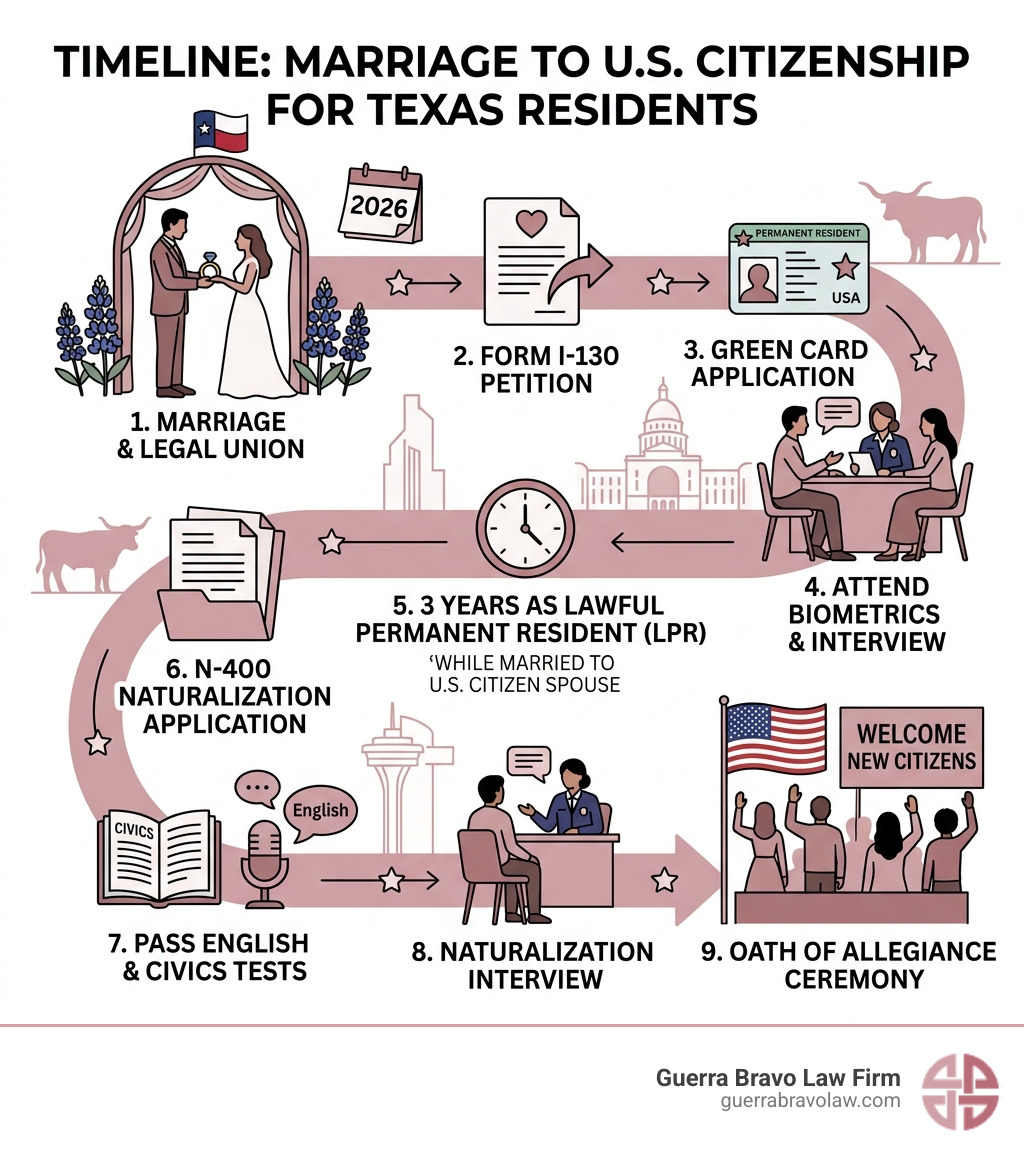
Timeline infographic from marriage to U.S. citizenship Oath of Allegiance ceremony for Texas residents - citizenship through

The Foundation: Securing a Green Card Through Marriage in Texas

Before you can even think about a citizenship certificate, you must first become a Lawful Permanent Resident. In immigration, we often call this "getting your Green Card." For many of our clients in the Rio Grande Valley, this starts with a Family-Based Petition Complete Guide to understand how the U.S. citizen spouse sponsors the foreign spouse.

The primary tool for this is Form I-130, the Petition for Alien Relative. This form tells the government, "Hey, we are legally married, and I want my spouse to live here permanently."

Depending on where the foreign spouse is currently living, the path splits into two directions:

Adjustment of StatusWho it is for: Spouses already inside the U.S. who entered legally (even if they overstayed a visa). • The Benefit: You can often stay in the U.S. while the application is pending and apply for work authorization. • The Process: You file Form I-485 concurrently with the I-130. This is known as Ajuste de Estatus.

Consular ProcessingWho it is for: Spouses currently living outside the United States. • The Process: After the I-130 is approved, the case moves to the National Visa Center (NVC) and eventually to a U.S. Embassy or Consulate in the spouse's home country for an interview.

Understanding the Form I-130 Timeline is crucial, as it can take several months to over a year depending on USCIS backlogs. For those in our local communities like McAllen or Edinburg, knowing How to Get Green Card Texas Immediate Family status means you aren't stuck waiting behind "preference categories"—you are at the front of the line because spouses of U.S. citizens are considered "immediate relatives."

A couple in Texas signing legal documents for their Green Card application - citizenship through marriage texas

Eligibility Requirements for Citizenship Through Marriage Texas

To successfully navigate the citizenship through marriage Texas process, you must meet strict federal eligibility criteria. USCIS isn't just looking for a marriage certificate; they are looking for a partnership built on more than just a desire for a passport.

Core Eligibility CriteriaLegal Validity: Your marriage must be legally recognized in the place where it was performed. • Bona Fide Intent: You must prove the marriage is "bona fide," meaning it was entered into for love and a shared life, not solely for immigration benefits. • Age: The applicant must be at least 18 years old. • LPR Status: You must already hold a Green Card (be a Lawful Permanent Resident).

According to the U.S. Citizenship Through Marriage – USCIS Guide, one of the biggest advantages for spouses is the "3-year rule." While most Green Card holders have to wait 5 years to apply for citizenship, spouses of U.S. citizens can often apply in just 3 years.

If you find yourself asking Top Immigration Marriage Questions, your spouse must have been a U.S. citizen for the entire 3-year period you are relying on for eligibility.

Proving a Genuine Relationship to USCIS

This is where the "paperwork" gets personal. USCIS officers are trained to spot "sham marriages." To win them over, we help our clients gather a mountain of evidence that shows two lives intertwined.

You will need to submit Form I-130A Complete Guide along with the initial petition, which provides supplemental information about the spouse. But the real proof lies in your daily life.

Commonly Accepted EvidenceJoint Financial Assets: Joint bank account statements, credit card statements, and shared tax returns. • Shared Housing: A lease agreement with both names, a mortgage statement, or property deeds. • Insurance and Benefits: Health, life, or auto insurance policies naming each other as beneficiaries. • Family Ties: Birth certificates of children born to the relationship. • The "Fun" Stuff: Photos of the wedding, vacations, and family gatherings, along with travel records like flight itineraries. • Affidavits: Sworn statements from friends or family members who can attest to the relationship.

Providing this evidence upfront can help you avoid a "Request for Evidence" (RFE), which can stall your case for months. For those worried about what happens if things go wrong, it is wise to understand Qué Pasa Si Me Niegan la Residencia por Matrimonio (What happens if residency is denied).

═══

From Resident to Citizen: The 3-Year Naturalization Rule

Once you have your Green Card in hand, the clock starts ticking toward your ultimate goal: U.S. citizenship. If you are searching for Naturalization Lawyers Near Me, you likely already know that the journey toward Ciudadanía por Naturalización is governed by specific sections of the Immigration and Nationality Act (INA).

Under I am Married to a U.S. Citizen | USCIS guidelines, specifically Section 319(a), you can apply for naturalization if you have been a permanent resident for at least 3 years and have been living in "marital union" with your U.S. citizen spouse for that entire time.

The "Good Moral Character" Requirement Throughout these 3 years, you must demonstrate "good moral character." This doesn't mean you have to be a saint, but certain criminal records, tax evasion, or lying to the government can disqualify you. We always recommend a thorough background check before filing your N-400 application.

Continuous Residence and Physical Presence in Texas

Two terms often confuse applicants: "Continuous Residence" and "Physical Presence." They sound similar, but USCIS tracks them differently.

Continuous ResidenceThe Rule: You must have lived in the U.S. as an LPR for at least 3 years immediately preceding the date you file your application. • The Trap: If you leave the U.S. for more than 6 months at a time, you might "break" your continuous residence, resetting your 3-year clock.

Physical PresenceThe Rule: You must be physically present in the U.S. for at least 18 months (548 days) out of the 3 years before filing. • The Calculation: Every day you spend outside the U.S. is subtracted from your total.

According to Chapter 3 - Spouses of U.S. Citizens Residing in the United States | USCIS, you must also have lived for at least 3 months in the state or USCIS district where you are applying. For our neighbors in the Rio Grande Valley, this usually means being a resident of a county like Hidalgo or Cameron for at least 90 days.

The 90-Day Early Filing Rule Did you know you don't have to wait until the exact 3-year anniversary of your Green Card to mail your application? Under INA 334, you can file your Citizenship Application Assistance paperwork up to 90 days before you hit the 3-year mark. This can shave months off your total wait time!

Living in Marital Union for Citizenship Through Marriage Texas

To qualify for the expedited 3-year path, you must be "living in marital union" with your citizen spouse. This typically means you reside in the same house.

What Counts as Marital Union?General Rule: You must actually live with your spouse. • Involuntary Separation: USCIS recognizes that life happens. If you are separated due to military service or a work relocation (like a spouse being stationed at Fort Bliss or working a contract abroad), you may still be considered as living in marital union. • Legal Separation: If you are legally separated or living apart because the marriage is failing, you generally lose the ability to apply under the 3-year rule.

As noted in the I am Married to a U.S. Citizen - USCIS resources, if your spouse passes away or you get divorced before you take the Oath of Allegiance, you usually have to wait for the standard 5-year residency mark to apply for citizenship. However, there are special provisions for surviving spouses of U.S. military members who died while serving.

═══

Navigating the Naturalization Interview and Civics Test

The interview is the final hurdle. It’s natural to be nervous, but knowing What to Bring for Naturalization Interview can give you a huge confidence boost. You'll need your Green Card, your passport, and updated evidence of your ongoing marriage (like recent joint bank statements).

The Two-Part Exam

  1. English Proficiency: You must demonstrate that you can read, write, and speak basic English. The officer will ask you questions about your application and may ask you to write a simple sentence.

  2. Civics Test: You will be asked up to 10 questions from a list of 100 U.S. history and government questions. You must answer 6 correctly to pass.

According to Becoming a U.S. Citizen: The Naturalization Process | Texas Law Help, if you fail either part of the test, you usually get one more chance to retake that specific section within 60 to 90 days.

Once you pass, the final step is the Oath of Allegiance. This is a beautiful ceremony where you renounce loyalty to your former country and swear to support and defend the U.S. Constitution. Only after this ceremony are you officially a U.S. citizen.

Special Exemptions and Provisions for Spouses

Not every case follows the standard 3-year path. There are several "short-cuts" or alternative rules for specific situations.

Section 319(b): Spouses Employed Abroad If your U.S. citizen spouse works for the U.S. government (including the military), a recognized American research institution, or a U.S. firm engaged in foreign trade, you might be eligible for "expedited naturalization." Under Section 319(b), you may not have to meet any specific residence or physical presence requirements. You just need to be an LPR at the time of your interview.

VAWA Self-Petitioners Victims of battery or extreme cruelty at the hands of a U.S. citizen spouse are protected under the Violence Against Women Act (VAWA). These individuals can often apply for citizenship after 3 years of residency even if they are no longer living with the abusive spouse. It is a vital safety net that ensures immigration status isn't used as a tool of abuse.

Military Spouses If you are married to a member of the U.S. Armed Forces, you may be eligible for expedited processing or even naturalization while stationed abroad. We take great pride in helping military families in Texas navigate these complex rules. For more details on the definition of citizenship, see Es Ciudadanía Estadounidense.

═══

Overcoming Challenges in the Texas Immigration Process

No immigration journey is without its bumps. One of the most common challenges is the Conditional Green Card. If you have been married for less than 2 years at the time your Green Card is approved, USCIS will issue a "conditional" card valid for only 2 years.

Removing Conditions (Form I-751) To keep your residency, you and your spouse must file Form I-751 together within the 90 days before that 2-year card expires. If you forget to file, you could face deportation. This step is a common point of confusion, leading many to ask, Do I Need a Lawyer to Apply for Citizenship? While not legally required, having an expert ensures you don't miss these critical deadlines.

Common Law Marriage in Texas Texas is one of the few states that recognizes "informal" or common law marriage. This is a huge benefit for couples who consider themselves married but never had a formal ceremony. For immigration purposes, USCIS will recognize a Texas common law marriage if you can prove you agreed to be married, lived together in Texas as spouses, and represented yourselves to others as a married couple.

═══

Frequently Asked Questions about Citizenship Through Marriage Texas

Does Texas recognize common law marriage for immigration purposes?

Validity: Yes, USCIS recognizes common law marriages if they are legally established according to the laws of the state where the couple lives. • Requirements: In Texas, you must prove three things: you agreed to be married, you lived together in Texas as a married couple, and you represented yourselves to others as being married (often called "holding out"). • Evidence: You can provide a formal "Declaration of Informal Marriage" filed with the county clerk, or secondary evidence like joint tax returns, insurance policies, and affidavits from neighbors.

What happens if my marriage ends before I reach the 3-year citizenship mark?

Divorce Impact: If your marriage ends via divorce or annulment before you file your N-400 or before you are naturalized, you generally lose the right to use the 3-year expedited path. • Standard Path: In most cases, you will simply have to wait until you have been a Lawful Permanent Resident for 5 years before you can apply for citizenship on your own. • Exceptions: If you were the victim of abuse, you may still qualify for the 3-year rule under VAWA provisions, even if the marriage has ended.

Can I apply for citizenship if my spouse is a U.S. citizen employed abroad?

Section 319(b): This is a special provision for spouses of citizens working for the U.S. government, military, or certain qualifying organizations (like the Red Cross or specific research institutions) stationed abroad for at least one year. • No Residency Required: If you qualify under this section, you may be exempt from the standard 3-year continuous residence and physical presence requirements. • Intent: You must be an LPR at the time of the interview and state your intent to reside abroad with your spouse and then return to the U.S. once their employment ends.

═══

Conclusion

The path to citizenship through marriage Texas is full of legal nuances, but it is one of the most rewarding journeys a family can take. From filing the first I-130 to standing in a courtroom for your Oath of Allegiance, every step brings you closer to the full rights and protections of being an American.

At Guerra Bravo Law Firm, we understand that these aren't just "cases"—they are your lives. Attorney Iris Guerra Bravo brings over 14 years of "insider" experience from her time with ICE and DHS. This background gives us a unique perspective on how the government evaluates cases, allowing us to build battle-tested strategies for our clients in McAllen, Brownsville, and across the Rio Grande Valley.

Whether you need a Naturalization Lawyers Near Me to review your N-400 or comprehensive Citizenship Application Assistance, we are here to help. Don't leave your future to chance or a Google search. For a deep dive into the legal requirements, check out our Attorney for Citizenship Complete Guide.

Ready to turn your wedding bells into a citizenship certificate? Contact us today to schedule a consultation and let's start building your future together in the United States.

Guerra Bravo Law Firm is a Texas-based immigration law firm led by experienced attorneys dedicated to helping individuals, families, and businesses navigate complex immigration challenges. 

With years of hands-on experience and a deep understanding of U.S. immigration law, our team is committed to providing accurate information, practical guidance, and compassionate advocacy through every stage of the legal process.

Guerra Bravo Law Firm

Guerra Bravo Law Firm is a Texas-based immigration law firm led by experienced attorneys dedicated to helping individuals, families, and businesses navigate complex immigration challenges. With years of hands-on experience and a deep understanding of U.S. immigration law, our team is committed to providing accurate information, practical guidance, and compassionate advocacy through every stage of the legal process.

Instagram logo icon
Youtube logo icon
Back to Blog