

Citizenship Journey: Do You Need an Attorney?
Is Becoming a U.S. Citizen Harder Than It Looks?
Quick Answer: Do You Need an Attorney for Citizenship?
You can file on your own — but here's when you really should hire an attorney:
You have a criminal record (including DUI, DWI, or old arrests)
You spent long periods outside the U.S.
You've had a prior immigration denial or visa violation
You have unpaid taxes or child support issues
You received a Request for Evidence (RFE) from USCIS
Your case involves complex family situations or military service
If none of the above apply, self-filing is possible. If any do apply, professional help can be the difference between approval and denial.
Over a million permanent residents apply for U.S. naturalization every year. Many assume it's a simple process — fill out a form, show up, and take an oath. But the reality is more complicated.
The path to citizenship involves strict eligibility rules, a multi-step USCIS process, English and civics testing, background checks, and interviews where the wrong answer can derail your entire case. For anyone with a complicated history — even something as common as a past traffic incident abroad or a gap in tax filings — the stakes are very high.
An attorney for citizenship doesn't just fill out paperwork. They evaluate your full immigration history, spot problems before USCIS does, and build a strategy around your specific situation.
At Guerra Bravo Law Firm, we understand that this isn't just a legal process. It's your future, your family, and your place in this country.
This guide walks you through everything you need to know — from eligibility rules and the N-400 application to test prep, common pitfalls, and what to do if things go wrong.
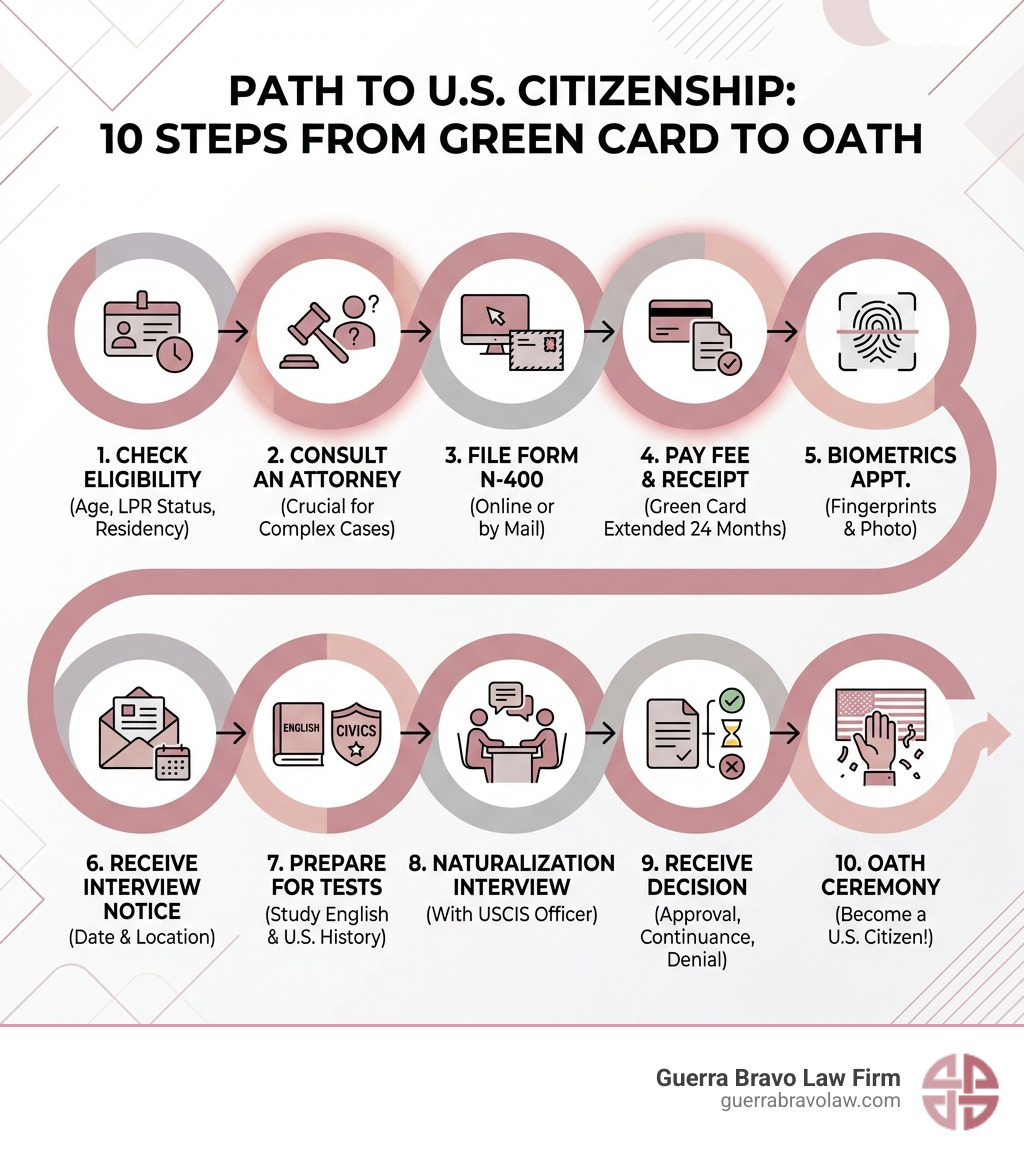
Understanding the Role of an Attorney for Citizenship
When you decide to move from a Green Card holder to a U.S. citizen, you aren't just filling out a form; you are opening your entire life story to the federal government for review. This is where an attorney for citizenship becomes your most valuable ally.
Our role is to act as a shield and a guide. We don't just "check boxes." We perform an early, deep-dive evaluation of your immigration history, criminal records, and travel logs to identify risks before the government does.

Why hire an attorney for citizenship for complex cases?
If your history is "clean" — no arrests, no long trips, no tax issues — you might feel comfortable flying solo. However, for many in the Rio Grande Valley, life is rarely that simple. Here is why professional help is decisive:
1. Evidence Gathering and DHS Records We don't guess what the government knows; we find out. Using our 14+ years of insider experience with ICE and DHS, we know how to request and review your complete immigration file. This allows us to spot inconsistencies in past filings that could trigger a fraud investigation during your naturalization interview.
2. Strategic RFE Responses If USCIS sends a Request for Evidence (RFE), the clock starts ticking. A weak response can lead to an immediate denial. We craft legally sound narratives, backed by exhibits like tax transcripts, lease records, and certified court dispositions, to satisfy the officer's concerns.
3. Interview Preparation and Representation The naturalization interview is not just a chat; it's a legal proceeding. We conduct mock interviews to prepare you for the English and civics components, and more importantly, we attend the interview with you. Having an attorney for citizenship present ensures the officer stays within legal bounds and that your rights are protected.
4. USCIS Online Account Management Modern immigration law is digital. We manage your case through a professional USCIS online account. This allows us to:
Link paper-filed cases to your digital profile using a USCIS Online Account Number.
Receive real-time "action required" alerts for appointments or RFEs.
Submit Form G-28 (Notice of Entry of Appearance) so the government communicates directly with us.
Provide you with a secure one-time passcode to review and digitally sign your application before we pay and submit it.
If you are looking for local resources to start your search, you can visit the American Bar Association's guide on finding an attorney in your state.
Authorized representation vs. unauthorized scams
In our community, we often hear about "notarios" or "immigration consultants" offering cheap help. Be extremely careful. In the United States, a "notario" is not an attorney. They cannot give legal advice, they cannot represent you in an interview, and they often cause irreparable damage to cases.
How to verify your representative:
Bar Standing: An attorney must be a member in good standing of a U.S. state bar.
DOJ Accreditation: If they aren't a lawyer, they must be a DOJ-accredited representative working for a recognized non-profit. You can check the List of Recognized Organizations and Accredited Representatives to be sure.
Scam Alerts: Beware of anyone asking for payment via WhatsApp or claiming they have "special connections" to get you approved. Legitimate firms like ours use formal contracts and secure payment portals.
═══
Eligibility Requirements for U.S. Naturalization
Before you file Form N-400, you must ensure you meet the "Big Five" requirements. Missing even one can lead to a denial and loss of your filing fee. For more details, you can read the Commonly Asked Questions About the Naturalization Process | USCIS.
Statutory periods and residency rules
1. The Age and Status Rule You must be at least 18 years old and a Lawful Permanent Resident (Green Card holder).
2. The 5-Year Rule (or 3-Year Rule)
General Rule: You must have been a permanent resident for at least 5 years.
Marriage Exception: If you are married to a U.S. citizen and have been living with them, you can apply after only 3 years.
3. Continuous Residence This means you have maintained the U.S. as your primary home. If you leave the country for more than 6 months (180 days), USCIS presumes you have "disrupted" your residence. If you stay away for more than a year, you may have "abandoned" your residency entirely.
4. Physical Presence You must have been physically present in the U.S. for at least half of the required time. For the 5-year rule, that's 30 months; for the 3-year rule, it's 18 months.
5. State Residency You must have lived in the USCIS district where you are applying (like the Rio Grande Valley area) for at least 3 months before filing.
Good Moral Character (GMC)
This is the most subjective part of the application. USCIS looks at your conduct during the "statutory period" (the last 3 or 5 years). However, they can look further back if they choose. Things that can hurt your GMC include:
Unpaid taxes or child support.
Lying to an immigration officer.
Certain criminal convictions.
Failing to register for Selective Service (for males aged 18–26).
Special exemptions and the attorney for citizenship's role
Not everyone has to take the English or civics test in the same way. We help clients qualify for "age-plus-residency" waivers:
50/20 Waiver: If you are over 50 and have lived in the U.S. as an LPR for 20 years, you can take the civics test in your native language.
55/15 Waiver: If you are over 55 and have been an LPR for 15 years, you can also use an interpreter.
65/20 Rule: If you are over 65 and have been an LPR for 20 years, you get a simplified version of the civics test.
Medical Disability (N-648): If you have a physical or developmental disability or mental impairment that prevents you from learning English or civics, we can help you file Form N-648 for a full exemption.
═══
Navigating the USCIS Application Process and Form N-400
The naturalization process is a marathon, not a sprint. It typically takes between 6 to 12 months from start to finish.
The Filing Phase
When we file your Form N-400, accuracy is everything. Since December 2022, a very helpful rule has been in place: your N-400 receipt notice automatically extends the validity of your Green Card for 24 months. This means you don't have to worry about renewing your Green Card while your citizenship case is pending.
Biometrics and Background Checks
Shortly after filing, you’ll attend a biometrics appointment where your fingerprints and photo are taken. The FBI then runs a background check. This is often where old, "forgotten" arrests from years ago surface. If we are your attorney for citizenship, we will have already discussed these with you to ensure our strategy accounts for them.
Preparing for the Interview and English Test
The interview is the "final exam." It consists of four parts:
Application Review: The officer goes through your N-400 to ensure everything is true.
Speaking Test: Your ability to understand and respond to the officer's questions.
Reading Test: You must read one out of three sentences correctly.
Writing Test: You must write one out of three sentences correctly.
The 2025 Civics Test Requirements
For applications filed in 2025, the civics test is oral.
The officer will ask up to 20 questions from a list of 128.
You must answer 12 correctly to pass.
The questions cover U.S. history, the Constitution, and how the government works.
═══
Overcoming Common Obstacles and Legal Challenges
Even a "perfect" applicant can hit a speed bump. Here is how we handle the most common legal challenges:
Criminal Records (DUI, DWI, and Felonies)
A criminal record doesn't always mean a denial, but it always means you need a lawyer.
Aggravated Felonies: These are often a permanent bar to citizenship and can lead to deportation.
DUI/DWI: While a single DUI might not disqualify you, it can impact your "Good Moral Character." We often advise clients to wait until the "look-back" period has passed before filing.
Traffic Violations: Routine tickets usually aren't a problem, but they must be disclosed if they involve fines over $500 or alcohol/drugs.
Addressing absences and residence disruption
If you stayed outside the U.S. for 7 or 8 months due to a family emergency or a job, USCIS might say you broke your "continuous residence." We help you rebut this by gathering evidence that you never intended to leave for good, such as:
U.S. tax transcripts.
Active lease or mortgage payments.
Bank statements showing local activity.
Pay stubs from a U.S. employer.
Handling Denials and the Appeals Process
If your application is denied, it’s not necessarily the end of the road.
Form N-336: You have 30 days to file an appeal and request an administrative hearing with a different officer.
De Novo Review: If the administrative appeal fails, we can take the case to a U.S. District Court for a fresh look.
Reapplication: Sometimes, the best strategy is to wait a year and reapply with a stronger record.
═══
Frequently Asked Questions
Do I need a lawyer to apply for U.S. citizenship?
While you can file Form N-400 yourself, an attorney for citizenship is highly recommended if you have a criminal record, long absences from the U.S., or prior immigration violations. An error on this form doesn't just lead to a denial; it can trigger deportation proceedings for permanent residents with certain types of history.
How long does the naturalization process take?
The process typically takes 6 to 12 months from the time of filing to the Oath of Allegiance. However, this varies depending on the workload of your local field office (like the ones serving McAllen or Harlingen) and the complexity of your background check.
What happens if I fail the citizenship test?
Don't panic! If you fail the English or civics portion, USCIS will schedule a second attempt within 60 to 90 days. You only have to retake the part you failed. If you fail a second time, your application will be denied, and you will need to file a new N-400 and pay the fees again.
Can I apply if I have unpaid taxes?
Yes, but you must show that you have entered into a formal payment agreement with the IRS and are making your payments on time. We can help you document this to satisfy the "Good Moral Character" requirement.
═══
Conclusion: Your Future Starts Here
Becoming a U.S. citizen is the ultimate goal of the immigration journey. It grants you the right to vote, the ability to sponsor family members faster, protection from deportation, and the security of a U.S. passport.
At Guerra Bravo Law Firm, we don't believe in a "one-size-fits-all" approach. Whether you are in McAllen, Brownsville, or anywhere in the Rio Grande Valley, we provide individualized legal strategies. Attorney Iris Guerra Bravo’s 14+ years of insider experience with ICE and DHS gives our clients a unique advantage—we know how the government thinks because we’ve been on the inside.
If you’re thinking about taking this final step, don’t leave your future to chance. Let’s make sure your application is "battle-tested" and ready for success. Visit our page on U.S. Citizenship Claims to learn more.
The Path to Your American Dream ═══
Step 1: Eligibility Screening – We ensure you meet all residency and character requirements before you spend a dime on filing fees.
Step 2: Strategic Filing – We submit a complete Form N-400 with all necessary supporting evidence through our secure digital portal.
Step 3: Interview Mastery – We coach you for the civics test and English exam and stand by your side during the USCIS interview.
Step 4: The Oath – You finalize your journey, take the oath, and finally unlock the full benefits of being a U.S. citizen.