

Adjusting Status Made Easy: A Guide to the I-485 Application
What the I-485 Form Is — and Why It Matters for Your Green Card
The i 485 form — officially called the Application to Register Permanent Residence or Adjust Status — is the form you file with USCIS to apply for a Green Card while you are already inside the United States.
In plain terms: it is how you change your immigration status from a temporary visa holder (or other qualifying status) to a lawful permanent resident.
Quick answer — what you need to know:
What it is:
Official USCIS form to apply for a Green Card from inside the U.S.
Who files it:
Anyone physically present in the U.S. who qualifies through family, employment, asylum, or other special categories
What it costs:
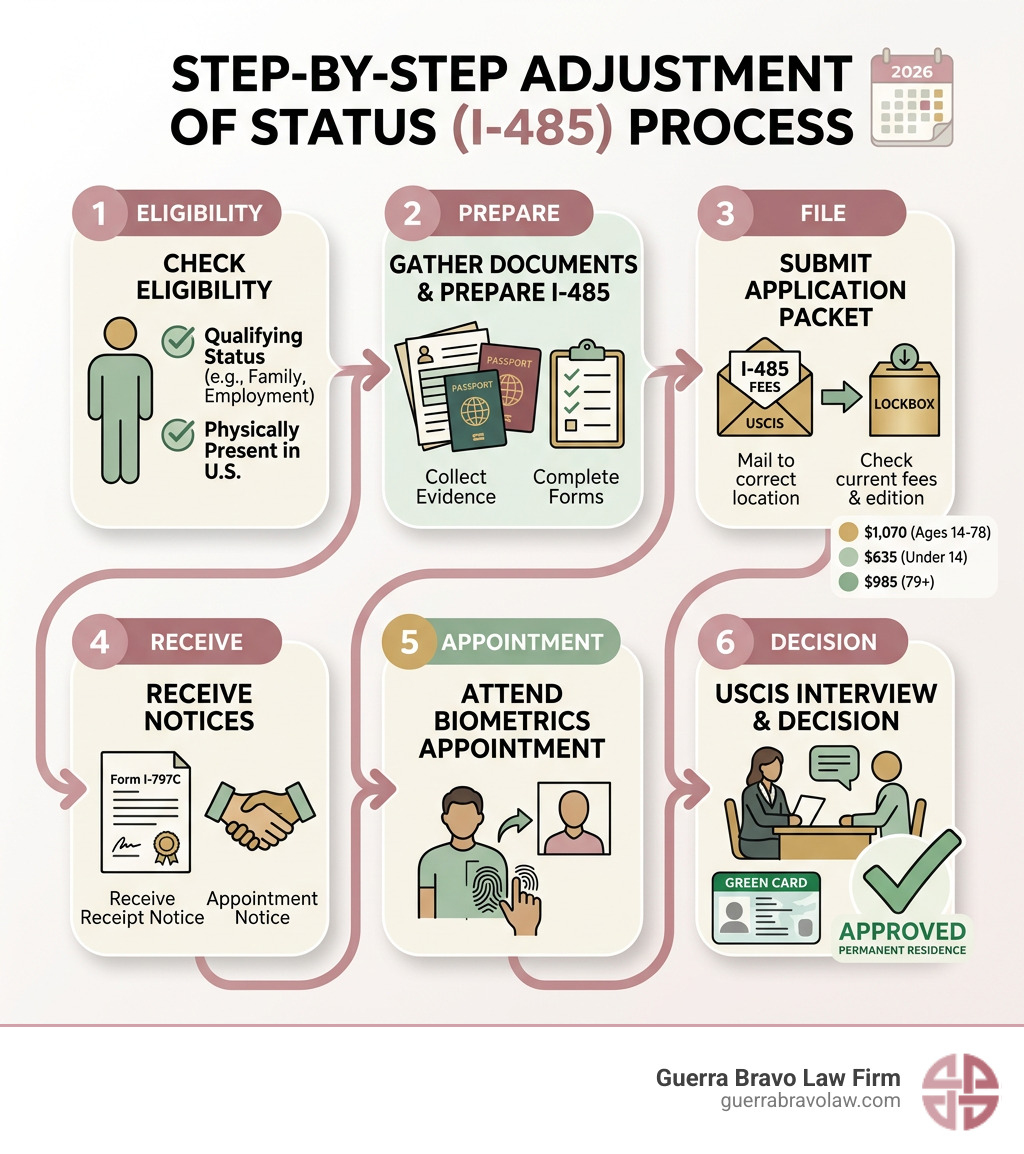
$1,070 for most applicants (ages 14–78)
$635 for children under 14
$985 for applicants 79 or older
Current edition:
Edition 01/20/25 (expires 10/31/2027) — make sure you are not using an older version
Where to file:
By mail to a USCIS Lockbox facility — the address depends on your category and location
For many people, this is one of the most important immigration steps they will ever take. A single missing document, wrong fee, or outdated form edition can delay or derail the entire process.
This guide walks you through every part of the I-485 — from gathering documents to mailing your finished packet — so you can file with confidence.
What is the I-485 Form and Who Can File?
At its core, the i 485 form is the bridge between your current temporary stay and your permanent future in the United States. When we talk about "Adjustment of Status," we are referring to the legal process of becoming a permanent resident without having to return to your home country for an interview at a U.S. consulate.

Understanding the Purpose of the i 485 form
The primary purpose of this form is to allow USCIS to vet you. They want to ensure you meet the legal requirements for a Green Card and that you aren't "inadmissible" due to criminal history, security risks, or health issues.
Under INA Section 245, you generally must meet three basic requirements to file:
You must be physically present in the United States.
you must have been "inspected and admitted" or "inspected and paroled" into the U.S. (though there are some exceptions for VAWA applicants or those qualifying under Section 245(i)).
An immigrant visa must be immediately available to you at the time of filing.
If you want to dive deeper into the legal nuances of this process, you can read more about ajuste de estatus on our blog.
Eligibility Categories and Filing Types
Not everyone can just download the form and file it. You need an underlying "basis" for your application. Here are the most common categories:
Family-Based This is the most common path. It includes spouses, children (unmarried and under 21), and parents of U.S. citizens. It also includes "preference" relatives, such as the spouses and children of Green Card holders.
Employment-Based If you are a priority worker, a professional with an advanced degree, or a skilled worker with a valid job offer, you may file based on an approved or pending I-140 petition.
Special Categories This includes individuals who have been granted asylum or refugee status at least one year ago, VAWA (Violence Against Women Act) self-petitioners, and victims of human trafficking (T visa) or certain crimes (U visa).
Afghan SIV and Parolees There are specific rules for Afghans who worked for or on behalf of the U.S. government. You can find more details on Special Immigrant Visas for Afghans.
Visa Availability Before you file, you must check the Department of State’s Visa Bulletin. If your "priority date" isn't current, USCIS will reject your i 485 form. Think of it like a "Save My Spot" line at a popular restaurant—you can't sit down until your number is called!
Essential Documents and the Role of Secondary Evidence
Filing the i 485 form is about 20% filling out the form and 80% gathering the "mountain" of evidence required to prove your claims.
Step 1: Gathering Documents for Your i 485 form Packet
We always tell our clients in McAllen and the Rio Grande Valley that organization is key. For a comprehensive look at the entire process, check out our complete guide to green card applications. At a minimum, your packet must include:
Identity and Arrival Proof
Birth Certificate: A long-form birth certificate with a certified English translation.
Passport: Photocopies of your entire passport, including the bio page and all entry/exit stamps.
I-94 Record: Your "Arrival/Departure Record" proving you entered the country legally.
Medical and Financial Evidence
Form I-693: This is your medical exam. It must be completed by a USCIS-designated "civil surgeon" and kept in a sealed envelope. If you open it, it’s void!
Form I-864: The Affidavit of Support, where your sponsor proves they have enough income to support you so you don't become a "public charge."
Photos
You need two identical color passport-style photos. They must be 2x2 inches, taken within the last 30 days, with a plain white background. Pro tip: Write your name and A-Number (if you have one) lightly in pencil on the back of each photo.
Using Secondary Evidence for Missing Records
What happens if your home country's records were destroyed in a fire, or your birth was never officially registered? USCIS allows "secondary evidence," but there is a very specific hierarchy you must follow:
Non-availability Statement: You must first get an official letter from the government authorities in your home country stating that the record does not exist or cannot be found.
Alternative Records: Once you have the non-availability statement, you can submit baptismal certificates, school records, or even hospital birth records.
Affidavits: If no other records exist, you can submit written statements (affidavits) from at least two people (like parents or older relatives) who have personal knowledge of your birth. These must include the affiant's full name, address, date of birth, and a detailed explanation of how they know the facts of your birth.
Completing the Application: A Part-by-Part Breakdown
The i 485 form is long—24 pages to be exact. You should always type the form or print very clearly in black ink.
Detailed Form Navigation
Part 1: Information About You This section asks for your legal name, any nicknames or aliases you've used (include maiden names!), and your A-Number. It also requires a full 5-year address history. Don't leave gaps! If you lived in an apartment for two months, list it.
Part 2: Application Type This is where you tell USCIS why you are eligible. You will select your filing category and provide information about your underlying petition (like the receipt number for your I-130 or I-140).
Parts 3-7: Personal History These sections cover your parents' information, your marital history (including all prior marriages and how they ended), and information about all of your children, regardless of their age or immigration status.
Part 8: Biographic Information USCIS uses this for background checks. You'll need to provide your ethnicity, race, height, weight, and even your eye and hair color.
Special Requests
SSN: You can now request an original or replacement Social Security card directly on the I-485.
Disabilities: If you need an accommodation for your interview (like a sign language interpreter), Part 11 is the place to ask.
Addressing Inadmissibility and Public Charge Requirements
This is the most "dangerous" part of the form. Part 9 contains dozens of "Yes/No" questions designed to see if you are legally barred from getting a Green Card.
Navigating Part 9: Eligibility and Inadmissibility
If you are unsure about any of these questions, please seek help with green card applications from a qualified attorney.
Criminal Records You must disclose all arrests, citations, and convictions, even if they were expunged or happened when you were a minor. Traffic tickets that didn't involve an arrest and were under $500 generally don't need full documentation, but almost everything else does.
Immigration Violations USCIS asks if you have ever worked without authorization or stayed in the U.S. past your visa expiration. Unlawful presence of more than 180 days can trigger a 3-year or 10-year bar to re-entry, which is why the timing of your filing is so critical.
Handling "Yes" Answers Answering "Yes" doesn't always mean an automatic denial, but it does mean you need to provide a detailed explanation in Part 14 (Additional Information) and likely submit supporting evidence or a waiver.
The Public Charge Ground of Inadmissibility
The "Public Charge" rule asks whether you are likely to become primarily dependent on the government for subsistence. USCIS looks at your "totality of circumstances," including your age, health, family status, and financial assets.
Household Income and Assets The form asks you to identify where your household income falls. Typical brackets include:
$0 - $27,000
$27,001 - $52,000
$52,001 - $85,000
$85,001 - $141,000
Over $141,000
They also look at assets (like savings or real estate) and liabilities (like mortgages or large debts).
Exemptions Many people are exempt from the public charge rule, including asylees, refugees, VAWA self-petitioners, and T/U visa holders. If you fall into these categories, you don't need to worry about the income thresholds.
Fees, Concurrent Filings, and Mailing Instructions
Money and mailing—two places where simple mistakes lead to rejected applications.
Understanding the Filing Fee Structure
The fees for the i 485 form are non-refundable, so you want to get the math right the first time.
Fee Breakdown:
Standard (Ages 14–78): $1,070 (This includes the $1,140 filing fee and $85 biometrics fee in some older structures, but currently, it is generally a flat $1,070 for most).
Under 14 (filing with a parent): $635.
79 Years or Older: $985 (No biometrics fee required).
Payment Method: You can pay with a personal check, cashier's check, or money order. Make it payable to "U.S. Department of Homeland Security." Do not use abbreviations like "USDHS" or "DHS."
Concurrent Forms and Recent Updates
Many applicants file the I-485 along with other forms to get "interim benefits."
Form I-765: Application for Employment Authorization (Work Permit).
Form I-131: Application for Travel Document (Advance Parole).
Important Note: As of April 1, 2024, there are often separate fees for these forms if filed with an I-485. Always check the current USCIS fee schedule before writing your checks.
Edition Changes: USCIS recently updated the form. While the 12/23/22 edition is still accepted until late 2025, the newest edition is dated 01/20/25. We always recommend using the newest version to avoid any issues with expiration.
Mailing Instructions
You do not mail your form to a local field office in Edinburg or Harlingen. Instead, you mail it to a USCIS Lockbox. The specific address depends on your eligibility category and where you live. You can find the USCIS Lockbox Filing Locations on their official website. We strongly recommend using a trackable mailing service like USPS Certified Mail, FedEx, or UPS.
Common Mistakes to Avoid When Filing the i 485 form
Even the smartest people make "silly" mistakes on immigration forms. Here is what to watch out for:
Missing Signatures: This is the #1 reason for rejection. Ensure you sign in Part 10. If a child is under 14, a parent or guardian must sign for them.
Incorrect Fees: If your check is even one dollar off, USCIS will send the whole packet back.
Unsealed Medicals: If the envelope from the civil surgeon is torn or taped back together, USCIS will reject the I-693.
Outdated Editions: USCIS periodically "retires" old versions of the i 485 form. If you use one, they won't even process it.
Leaving Blank Fields: If a question doesn't apply to you, write "N/A" or "None" instead of leaving it empty. This shows USCIS you didn't just skip the question.
For more answers to common hurdles, see our preguntas frecuentes sobre la green card.
Frequently Asked Questions about the I-485
Can I travel outside the U.S. while my I-485 is pending?
Generally, no—not unless you have an approved Form I-131 (Advance Parole). If you leave the U.S. without this document, USCIS will consider your i 485 form "abandoned" and deny it. There are some exceptions for H-1B or L-1 visa holders, but you should always consult an attorney before booking a flight.
What happens if my I-485 is denied?
A denial can happen for many reasons, from missing a deadline to being found inadmissible. If this happens, you may be placed in removal proceedings. It is critical to understand what happens if residency is denied so you can act quickly to appeal or refile.
Do I need to file a G-325A with the current I-485?
No. In the past, applicants had to file a separate Form G-325A for biographic information. USCIS has since integrated those questions directly into the modern i 485 form (specifically in Parts 1 and 4), so the G-325A is no longer required for adjustment of status.
Conclusion
Filing the i 485 form is more than just a paperwork exercise—it is the final step in a long journey toward making the United States your permanent home. While the process is complex, you don't have to navigate it alone.
At Guerra Bravo Law Firm, we specialize in helping families throughout McAllen, Brownsville, and the entire Rio Grande Valley achieve their immigration goals. Our founding attorney, Iris Guerra Bravo, brings over 14 years of "insider" experience with ICE and DHS to every case. We use that battle-tested knowledge to build individualized strategies for even the most complex adjustment of status cases.
Whether you are just starting your journey or have run into a roadblock, we are here to help. Start your family petition today and take the first step toward your Green Card with a team that knows the system from the inside out.