

February 19, 2026
Navigating Naturalization: When to Hire an Immigration Attorney (and When Not To)
Navigating Naturalization: When to Hire an Immigration Attorney (and When Not To)
Why the Citizenship Application Decision Matters More Than You Think
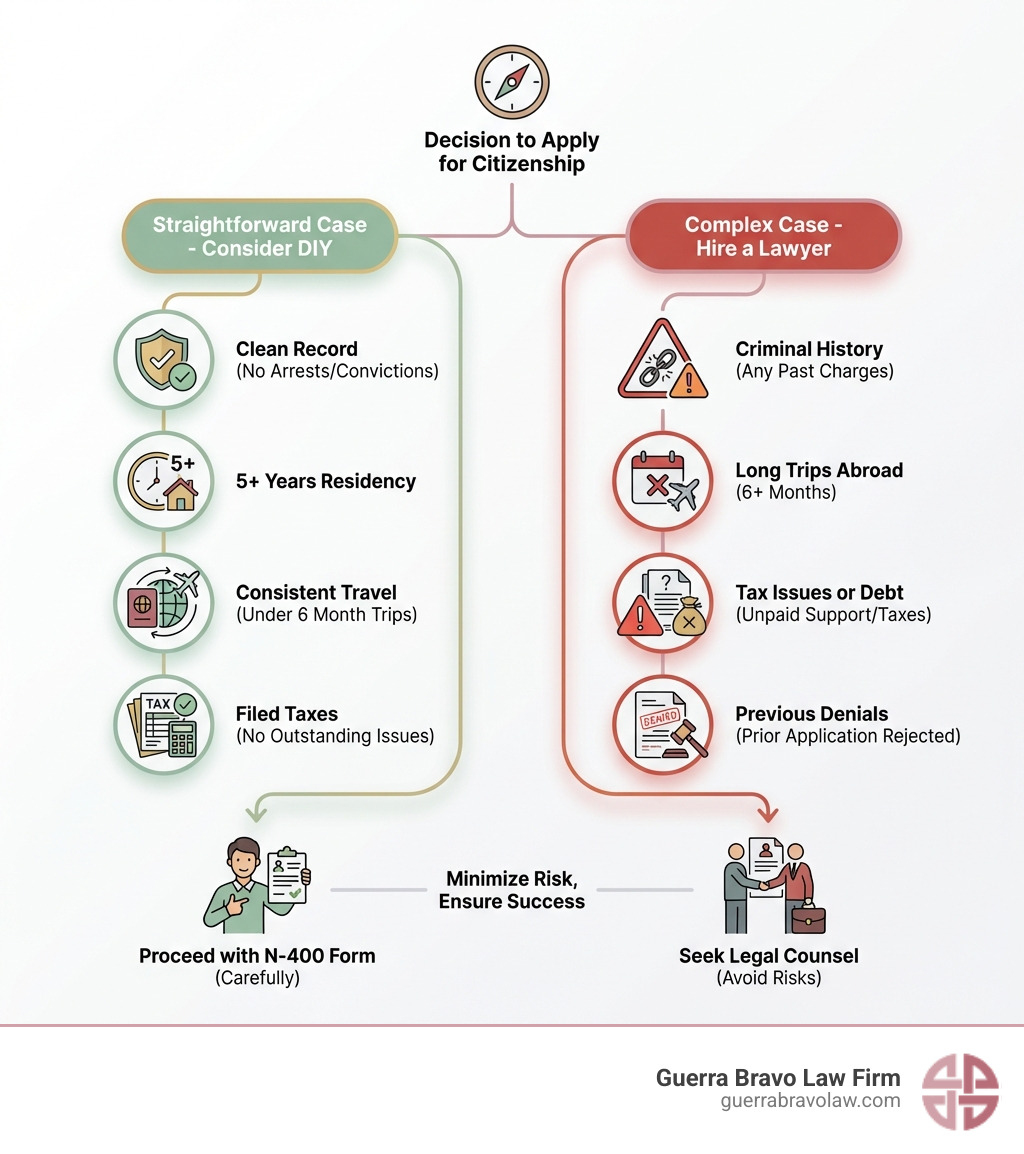
Do I need a lawyer to apply for citizenship? The short answer is: it’s not legally required, but for many applicants, it’s the smartest decision you can make. Here’s the quick breakdown:
You Likely Don’t Need a Lawyer If:
-
You’ve been a lawful permanent resident for 5+ years (or 3+ if married to a U.S. citizen)
-
You have a clean criminal record with no arrests or convictions
-
You’ve never taken trips outside the U.S. lasting 6+ months
-
You’ve filed all your taxes with no outstanding debt or child support issues
-
You’re confident answering all questions on Form N-400 accurately
You Should Seriously Consider a Lawyer If:
-
You have any criminal history (even expunged or dropped charges)
-
You’ve spent significant time outside the U.S. and have residency concerns
-
You have past tax issues or failed to pay child support
-
Your previous citizenship application was denied
-
You want to minimize the risk of denial and potential deportation proceedings
The path to U.S. citizenship is one of the most important journeys you’ll take. With 97,000 naturalization applications denied in 2019 and wait times now ranging from 10 to 31 months, the stakes have never been higher. The 20-page Form N-400 involves over a hundred questions that can be confusing and difficult to answer correctly without guidance.
While you can file for citizenship on your own, the real question isn’t whether it’s legally required to hire an attorney. The real question is: given your unique situation, can you afford the risk of doing it alone?
A denied application doesn’t just mean lost filing fees. It can trigger removal proceedings and put your entire future in the United States at risk. For straightforward cases, the DIY approach may work fine. But if there’s any complexity in your background, an experienced immigration attorney can be the difference between approval and denial.
The U.S. Naturalization Process: A Step-by-Step Overview
Becoming a U.S. citizen through naturalization is a significant milestone, offering profound opportunities and protection. This process is how individuals who aren’t already U.S. citizens by birthright or parentage obtain citizenship. To begin, you must be at least 18 years old and typically have been a Green Card holder (lawful permanent resident) for a specified period, usually five years, or three years if married to a U.S. citizen.
The journey involves several crucial steps, each with its own set of requirements and potential complexities. USCIS provides a clear 10 Steps to Naturalization guide, which we encourage all applicants to review.
Key Steps in the Naturalization Process:
-
Meet Eligibility Criteria: We assess your residency duration, age, good moral character, and commitment to the U.S. Constitution. This includes ensuring you meet physical presence and residency conditions.
-
Complete and Submit Form N-400: This is the Application for Naturalization, a comprehensive document requiring accurate and detailed personal information. You can find the form and instructions on the USCIS Form N-400 page.
-
Biometrics Appointment: After submitting your application, you’ll be scheduled for a biometrics appointment to provide fingerprints, photographs, and a signature.
-
Naturalization Interview: An interview with a USCIS officer is a critical step. During this naturalization interview, your application and background are reviewed, and you’ll be tested on your English language skills and knowledge of U.S. history and government (civics).
-
Oath of Allegiance Ceremony: If approved, the final step is to take the Oath of Allegiance ceremony, publicly declaring your commitment to the United States and officially becoming a U.S. citizen.
While the process may seem straightforward on paper, even minor discrepancies or overlooked details can lead to significant delays or even denial. This is where professional Citizenship Application Assistance becomes invaluable.
Do I Need a Lawyer to Apply for Citizenship? A Clear Breakdown
The question of whether to hire an attorney for your U.S. citizenship application often boils down to balancing the perceived cost of legal fees against the potential risks of a do-it-yourself approach. While USCIS doesn’t legally require you to have a lawyer, the reality of the application process makes legal assistance a practical necessity for many.
The complexity of the application, coupled with rising denial rates and extensive processing times, means that every detail matters. In 2019 alone, 97,000 naturalization applications were denied, nearly twice the amount of green card applications denied. There are currently close to 650,000 pending naturalization applications nationwide, and wait times have doubled in the past two years, now ranging from 10 to 31 months. This environment underscores the need for meticulous preparation and expert guidance to ensure your application stands the best chance of success.
Deciding on the answer to the question, “do I need a lawyer to apply for citizenship?” is about your peace of mind and minimizing risk.
When You Might Not Need a Lawyer (Straightforward Cases)
If your history aligns perfectly with the eligibility criteria and presents no potential complications, you might consider navigating the process on your own. These are the ideal scenarios where the DIY approach has the highest chance of success:
-
Your Situation: You have been a lawful permanent resident for 5+ years (or 3+ if married to a U.S. citizen) and meet all other basic eligibility requirements without exception. Your path to obtaining your green card was simple and without any issues or waivers.
-
Your History: You have a clean criminal record with no arrests, charges, or convictions of any kind, anywhere in the world. This means no traffic violations beyond minor speeding tickets, no expunged records, and no past interactions with law enforcement that could raise questions about your good moral character.
-
Your Travel: You have not taken any trips outside the U.S. lasting six months or longer, and you can easily document your physical presence in the country for the required period. Your travel history is simple and clearly within USCIS guidelines.
-
Your Finances: You have consistently filed your taxes as required by law and have no outstanding tax debt or child support obligations. You can readily provide proof of compliance with all financial responsibilities.
-
Your Application: You are confident you can understand and accurately answer every question on the 20-page Form N-400 without confusion or ambiguity. You are comfortable gathering all supporting documents and preparing them according to USCIS specifications.
If you genuinely fit all these criteria, you may find the process manageable independently.
When to Seriously Consider an Attorney (Complex Cases)
However, for a vast majority of applicants, some level of complexity exists in their history or application. This is when the question “do I need a lawyer to apply for citizenship” shifts from a preference to a strong recommendation.
-
Your Situation: You have any doubts about your eligibility or the answers you must provide on your application. Perhaps your lawful permanent residency was obtained through a complex process, or you’re unsure about specific dates or details in your past.
-
Your History: Your path to getting a green card was complicated, or you have a past arrest or immigration violation. Even minor issues, like an old arrest that was dismissed, can be misinterpreted by USCIS if not properly explained and documented.
-
Your Travel: You have spent significant time outside the U.S. and are concerned about meeting continuous residence and physical presence requirements. Calculating these periods correctly can be tricky, and missteps can lead to denial.
-
Your Goal: You want to minimize the risk of denial, which can have severe consequences, including placing you in removal proceedings. The potential for a denied application to escalate into deportation proceedings is a risk no applicant should take lightly.
-
Your Support: You need an Experienced Immigration Lawyer to steer the process and provide peace of mind. Our attorneys, particularly with Iris Guerra Bravo’s 14+ years of insider experience with ICE and DHS, offer battle-tested, individualized legal strategies that anticipate challenges and proactively address them.
Red Flags: When You Absolutely Should Hire a Citizenship Attorney
Some situations are clear indicators that attempting to apply for citizenship without legal counsel is a high-risk endeavor. These “red flags” signal potential roadblocks that can lead to application denial, or worse, trigger deportation proceedings under US Immigration Law.

Criminal History (Even Minor or Expunged Records)
A past criminal issue is arguably the most critical reason to seek legal counsel. USCIS thoroughly investigates an applicant’s background, and what might seem minor to you could be a significant hurdle for your application.
-
Any arrest, even if charges were dropped: Even if you were never convicted, an arrest on your record must be disclosed and explained. USCIS will want to understand the circumstances.
-
Any conviction, no matter how long ago: This includes misdemeanors, felonies, or any other criminal offense. The nature of the crime, the sentence, and the date of conviction all play a role in determining eligibility.
-
Sealed or expunged records: Many applicants mistakenly believe they don’t need to disclose expunged records. However, USCIS views these differently, and failure to disclose them can be considered misrepresentation, leading to denial and severe penalties.
-
Crimes that could affect your good moral character: USCIS has strict definitions for what constitutes “good moral character,” a non-negotiable requirement for naturalization. Certain crimes, regardless of how long ago they occurred, can permanently bar you from citizenship. For example, being on probation at the time of your naturalization interview will prevent naturalization. A lawyer can help determine if your past issues impact this critical requirement and how best to present your case.
Complications with Residency or Travel
USCIS strictly enforces continuous residence and physical presence rules. Miscalculations or misunderstandings of these requirements are common reasons for denial. An attorney is highly recommended if:
-
You have taken trips abroad lasting more than 6 months but less than a year: Such trips create a presumption that you have broken your continuous residence. While this presumption can be overcome, it requires strong evidence and a compelling explanation.
-
You have been outside the U.S. for a year or more: An absence of a year or more automatically breaks continuous residence, requiring you to restart the residency period for naturalization unless you qualify for a specific exception.
-
You are unsure if you meet the physical presence and residency conditions: These rules can be complex, especially with multiple trips or extended stays abroad. An attorney can carefully review your travel history and advise on potential impacts and solutions.
Financial Issues or Previous Application Denials
Certain financial or past immigration issues can be automatic grounds for denial without proper handling. These are areas where a lawyer’s expertise is crucial:
-
Failing to file taxes or owing back taxes to the IRS: Failure to file taxes when required is a crime and can be interpreted as a lack of good moral character. If you owe taxes, you must demonstrate a repayment plan with the IRS or relevant agency and be up-to-date on payments.
-
Willful failure to pay child support: Similar to taxes, USCIS considers the fulfillment of child support obligations as a measure of good moral character.
-
A previously denied naturalization application: If your application was denied in the past, understand why before reapplying. A lawyer can analyze the denial reason and help you address the underlying issues to strengthen a new application.
-
Making a false claim to U.S. citizenship in the past (e.g., by registering to vote): Even an accidental or mistaken claim of U.S. citizenship can have severe, often permanent, negative consequences for your naturalization eligibility and even your green card status. The questions in Part 9 of Form N-400 are specifically designed to uncover such issues.
How an Experienced Immigration Lawyer Maximizes Your Success
For those navigating complex naturalization cases in the Rio Grande Valley, including McAllen, Brownsville, Edinburg, and surrounding areas, an experienced immigration lawyer is not just an advisor; they are an indispensable advocate. Our firm’s unique advantage comes from attorney Iris Guerra Bravo’s 14+ years of insider experience with ICE and DHS, providing battle-tested strategies and an intimate understanding of how immigration agencies operate. This “insider experience” translates into a proactive and robust approach to your case, maximizing your chances of success.

Ensuring a Flawless Application
The foundation of a successful naturalization case is a perfectly prepared application. An attorney helps you avoid costly mistakes that lead to delays or denials, especially crucial given the current long wait times.
-
Thoroughly review your history to identify potential issues before you file: We conduct a comprehensive legal assessment of your entire immigration and personal history, anticipating any red flags that USCIS might raise. This proactive approach helps us address potential problems head-on, rather than reacting to them after a denial.
-
Ensure your citizenship application Form N-400 is completed accurately and supported by the correct documentation: The N-400 is a lengthy and detailed form. Even minor errors or omissions can cause significant delays or lead to a Request for Evidence (RFE). We carefully prepare your application, ensuring every question is answered truthfully and precisely, backed by all necessary supporting documents.
-
Prepare a legal brief or explanation for any complex issues in your case: For cases involving criminal history, extended travel, or other complexities, we prepare detailed legal arguments and explanations to present to USCIS, clarifying your situation and demonstrating your eligibility.
Preparing You for the Citizenship Interview and Test
The naturalization interview is a pivotal moment where a USCIS officer scrutinizes your application and assesses your English and civics knowledge. Having an attorney prepare you can significantly boost your confidence and performance.
-
Conducting mock interviews to prepare you for difficult questions: We simulate the interview environment, asking the types of questions USCIS officers typically pose, including those about your background, good moral character, and responses on the N-400. This practice helps you articulate clear and consistent answers.
-
Ensuring you know What to Bring for Naturalization Interview: We provide a comprehensive checklist of all original documents and additional evidence you’ll need to bring, preventing delays due to missing paperwork.
-
Providing strategies for the English and civics tests, including the updated 2025 test format: We offer guidance and resources to help you prepare for both the English language assessment (reading, writing, and speaking) and the civics test. With the upcoming 2025 Naturalization Civics Test introducing a broader range of questions and requiring a deeper understanding of concepts, our strategies are crucial for effective preparation.
Representing You and Handling Complications
Having an attorney by your side provides a critical advantage, especially when unexpected issues arise. Our presence signals to USCIS that your case is being handled professionally and seriously.
-
Attend the naturalization interview with you to clarify legal issues: We can accompany you to your interview in McAllen, Edinburg, or any other USCIS field office serving the Rio Grande Valley. Our role is to ensure fair treatment, clarify any misunderstandings, and object to improper questioning, providing an invaluable layer of protection.
-
Communicate directly with USCIS on your behalf to resolve problems: We act as your liaison with USCIS, handling all correspondence, inquiries, and follow-ups, saving you time and stress. This ensures all communications are handled professionally and accurately.
-
Respond to a Request for Evidence (RFE) or Notice of Intent to Deny (NOID): If USCIS requests additional information or signals an intent to deny your application, we prepare a robust and timely response, ensuring all necessary evidence and legal arguments are presented effectively.
-
File an appeal if your application is wrongly denied: If, despite all efforts, your application is denied, we can analyze the reasons for denial and advise you on the best course of action, including filing an appeal or seeking other remedies.
Frequently Asked Questions about Hiring a Citizenship Lawyer
What is the cost if I need a lawyer to apply for citizenship?
The cost of hiring an immigration lawyer for a citizenship application varies depending on the complexity of your case and the services required. While there are attorney fees in addition to the USCIS filing fees (currently $725, including biometrics, though fee waivers are available for eligible applicants via Form I-912, Request for Fee Waiver), it’s an investment in your future. The expense of legal fees is often far less than the financial and emotional cost of a denied application. A denial means losing your application fees, having to reapply (and pay again), and potentially facing removal proceedings, which can be significantly more expensive and stressful to resolve. For those in McAllen, the peace of mind and increased likelihood of success often outweigh the initial legal costs.
Can a lawyer speed up my citizenship application?
While a lawyer cannot change official USCIS processing times - which can vary considerably by field office and currently range from 10 to 31 months nationwide - they can prevent unnecessary delays. Many delays are caused by incomplete applications, missing documents, or inadequate responses to USCIS requests. By submitting a complete, error-free application from the outset, promptly responding to USCIS inquiries, and proactively addressing potential issues, an attorney ensures your case moves as efficiently as possible through the system. This meticulous approach can significantly reduce the overall time your application spends in processing compared to a self-filed application with errors.
What happens if my citizenship application is denied?
If your citizenship application is denied, it’s a serious matter, but not necessarily the end of your journey. An attorney can help you understand the specific reasons for the denial, which USCIS will outline in a written decision. Based on this, we can determine the best path forward. This may involve:
-
Filing an Appeal: If we believe USCIS made an error in denying your application, we can file a Form N-336, Request for a Hearing on a Decision in Naturalization Proceedings. This requests a review by a different USCIS officer.
-
Re-applying: In many cases, it’s more strategic to correct the issues that led to the denial and re-apply for naturalization. We can help you strengthen your new application by addressing the previous deficiencies.
-
Addressing Underlying Issues: Sometimes, a denial reveals a deeper immigration issue that needs to be resolved before citizenship is possible. Our firm, with its deep understanding of immigration enforcement and complex cases, is uniquely positioned to help you steer these underlying challenges.
Your Path to Citizenship: Making the Right Choice
Deciding “do I need a lawyer to apply for citizenship” is a critical first step on your journey to becoming a U.S. citizen. While a straightforward case may not legally require professional legal help, the stakes are too high to risk going it alone if you have any complications in your background or if you simply want the highest chance of success. The process is intricate, and the consequences of errors - ranging from delays to outright denial and even potential deportation proceedings - are significant.
An experienced attorney provides more than just paperwork assistance; they offer strategic guidance based on years of experience, battle-tested strategies, and an insider’s understanding of immigration law and enforcement. This expertise is particularly invaluable in areas like the Rio Grande Valley, where complexities in immigration cases are common. Our firm is dedicated to protecting your dream of becoming a U.S. citizen by providing individualized legal strategies custom to your unique situation.
Ready to secure your future in the United States? Don’t leave your path to citizenship to chance. Contact us today to discuss your US Citizenship Claims and let us help you steer this important journey with confidence.
[