

February 25, 2026
The I-130A Lowdown: All About Supplemental Information for Spouses
The I-130A Lowdown: All About Supplemental Information for Spouses
Why Form I-130A Matters for Your Marriage-Based Green Card
Form I-130A is a required supplemental document that all spouse beneficiaries must complete when a U.S. citizen or lawful permanent resident files a marriage-based green card petition. It collects detailed background information about the foreign spouse, including five years of address and employment history, to help USCIS verify the authenticity of the relationship.
Quick Facts About Form I-130A:
-
Official Name: Supplemental Information for Spouse Beneficiary
-
Who Files It: The foreign spouse (beneficiary) being sponsored
-
When to File: With Form I-130, Petition for Alien Relative
-
Cost: No separate fee (included with I-130 filing fee)
-
Length: Six pages
-
Signature Required: Only if the spouse is in the U.S.; spouses abroad submit it unsigned
-
Processing Time: Same as Form I-130 (typically 7 months to 2+ years)
Applying for a marriage-based green card can feel overwhelming, especially with the stack of forms needed to get started. One essential form is Form I-130A, or the Supplemental Information for Spouse Beneficiary. This form replaced the older G-325A and is now mandatory for all spousal petitions, whether you’re a U.S. citizen or green card holder sponsoring your husband or wife.
The form requires a complete and accurate five-year history of addresses and employment without any gaps. Most people don’t keep perfect five-year records of their addresses and jobs, making this one of the most challenging parts of the application.
Filing Form I-130A correctly is critical. Failing to complete it or submit it with your I-130 petition can lead to USCIS denying your entire family petition. Providing false information can permanently harm your immigration prospects and lead to fraud accusations.
What is Form I-130A and Who Must File It?
Navigating the U.S. immigration system feels like learning a new language of acronyms and forms. A key form for a marriage-based green card is Form I-130A, “Supplemental Information for Spouse Beneficiary.” What is it, and why is it so crucial?
Form I-130A is a vital tool for U.S. Citizenship and Immigration Services (USCIS) to gather detailed background information on the foreign spouse (the “beneficiary”) seeking a green card via marriage. Its primary purpose is to help USCIS validate the marriage’s authenticity and ensure the beneficiary meets all eligibility criteria. It acts as a detailed personal history report complementing the main petition.
This form collects specific data points about the spouse beneficiary, including their past addresses, employment history, and information about their parents. This information allows USCIS to conduct thorough background checks and verify the legitimacy of the relationship, which is a cornerstone of any marriage-based immigration case. Without this supplemental information, USCIS cannot get a complete picture of the beneficiary’s life and history, making it difficult to approve the underlying Form I-130 petition.
For a comprehensive overview of the entire green card application process, you might find our Green Card Application Complete Guide helpful.
The Key Difference Between Form I-130 and I-130A
It’s easy to confuse Form I-130 and Form I-130A since they’re filed together. However, they serve distinct purposes:
-
Form I-130, Petition for Alien Relative: This is the primary form that the U.S. citizen or lawful permanent resident (the “petitioner”) files to establish a qualifying family relationship with an eligible alien relative. It focuses on the petitioner’s information and their relationship to the beneficiary. For example, it asks for details about the petitioner’s citizenship or permanent residency, their current address, and information about the marriage itself.
-
Form I-130A, Supplemental Information for Spouse Beneficiary: This form is an addendum to the Form I-130, specifically for spouse beneficiaries. While the Form I-130 establishes who is being petitioned for and by whom, the Form I-130A dives deep into the background of the spouse beneficiary. It collects personal details, residential history, and employment history directly from the beneficiary, providing USCIS with the necessary supplemental information to make a decision on the overall petition.
Form I-130 is the “petition” establishing the relationship, and Form I-130A is the “supplement” providing crucial background about the sponsored spouse. They are two pieces of a single puzzle, designed to be submitted as a complete package.
Who is Required to Complete the Form?
The requirement for Form I-130A is very specific: it must be completed by the spouse beneficiary in all marriage-based green card applications. This applies whether the petitioner is a U.S. citizen or a lawful permanent resident (green card holder) who is sponsoring their husband or wife.
So, if you are the foreign spouse being sponsored for a green card, you are the one who needs to fill out and provide the detailed information requested on Form I-130A. While your sponsoring spouse (the petitioner) will file the main Form I-130, your active participation in completing Form I-130A is absolutely essential.
Who is Exempt from Filing?
Good news! Not every family-based immigration petition requires a Form I-130A. This form is exclusively for spouses.
You are exempt from filing Form I-130A if the family sponsorship form (Form I-130) is being filed for relatives other than a spouse. This includes:
-
Parents of U.S. citizens: If a U.S. citizen is petitioning for their mother or father, Form I-130A is not needed.
-
Children of U.S. citizens or lawful permanent residents: Whether it’s an unmarried child under 21, an adult child, or a married child, Form I-130A is not required. You can learn more about this process in our guide on Green Card for Adult Children.
-
Siblings of U.S. citizens: If a U.S. citizen is petitioning for their brother or sister, Form I-130A is not part of the application.
The “A” in I-130A stands for “Additional Information for Spouse Beneficiary.” If the beneficiary isn’t a spouse, the form isn’t applicable.
A Deep Dive into the Form I-130A Requirements
Once you understand what Form I-130A is and who needs to file it, the next step is understanding its content. This six-page document is designed to collect a wealth of personal and historical information, and accurately completing every section is paramount.

We cannot stress enough the importance of accuracy and completeness when filling out Form I-130A. Any missing information, inconsistencies, or errors can lead to delays, Requests for Evidence (RFEs), or even denial of your entire Form I-130 petition. Furthermore, providing false information on any government form carries severe penalties, including potential fines, imprisonment, and permanent bars from future immigration benefits. USCIS takes this very seriously, and so should you.
Information Collected on the Form
Form I-130A is structured to gather a comprehensive picture of the spouse beneficiary. Here’s a breakdown of the key information you’ll need to provide:
-
Personal Details: This includes your full legal name, any other names you’ve used, your A-Number (if you have one), date and place of birth, and sex. You’ll also provide contact information, including your daytime phone number, mobile number, and email address.
-
Parent’s Information: You’ll need to provide details about your mother and father, including their full names, dates of birth, and current country of residence.
-
Five-Year Address History: This is a critical section. You must list all physical addresses where you have lived for the past five years, both inside and outside the United States. You need to start with your most current address and work backward, ensuring there are no gaps in the timeline. USCIS is looking for a complete, unbroken record of your residences.
-
Five-Year Employment History: Similar to the address history, you must provide a complete record of your employment for the past five years, starting with your current job. This includes employer names, occupations, dates of employment, and the location of your workplaces (both in and outside the U.S.). If you had periods of unemployment, were a student, or were self-employed, these activities must also be accurately listed to account for any gaps.
Finding Old Records: We understand that digging up five years of address and employment history can be a daunting task. Most people don’t keep perfect records! But don’t worry, there are ways to reconstruct this information. Consider looking through:
-
Bank statements or credit card statements
-
Utility bills
-
Lease agreements or mortgage statements
-
Tax returns (W-2s, 1099s)
-
School transcripts or enrollment records
-
Employment letters or pay stubs
-
Social media check-ins (as a last resort for dates, but not primary evidence)
-
Old appointment books or calendars
The official Form I-130A and its instructions are always available directly from USCIS. You can Download Form I-130A (PDF) to ensure you’re using the most current version.
Costs and Processing Times for Form I-130A
Good news on the cost front! There is no separate filing fee associated with Form I-130A. It’s considered a supplemental document to Form I-130, and its cost is included within the filing fee for the main petition.
However, you will need to pay the filing fee for Form I-130, which currently stands at $625 if you file online or $675 if you file by mail. This fee covers the processing of both the Form I-130 and its necessary supplement, Form I-130A.
Regarding processing times, there isn’t a separate timeline for Form I-130A. Since it’s filed concurrently with Form I-130, its processing time is intrinsically linked to the main petition. The processing time for Form I-130 (and therefore Form I-130A) can vary significantly, ranging from approximately 7 months to over 2 years, or even longer in some cases.
Several factors influence these timelines:
-
USCIS Service Center: Different service centers have varying workloads and processing backlogs.
-
Relationship Category: Petitions for “immediate relatives” (spouses, unmarried children under 21, and parents of U.S. citizens) generally process faster than “family preference” categories (such as married children or siblings of U.S. citizens), although even immediate relatives can experience long wait times for the I-130 portion.
-
Completeness of Application: A well-prepared, complete application with all required supporting documents can help avoid delays.
These are just estimates. We always recommend checking the official USCIS website for the most current processing times specific to your petition type and service center.
Required Supporting Documents
When it comes to supporting documents, Form I-130A itself doesn’t typically require separate supporting documents beyond what’s already submitted with the main Form I-130 petition. Since both forms are part of the same application package, you do not need to provide duplicate documents.
The supporting documents are primarily aimed at proving two things for the Form I-130:
-
The Petitioner’s U.S. Citizenship or Lawful Permanent Resident Status: This might include a U.S. birth certificate, naturalization certificate, U.S. passport, or green card (Form I-551).
-
The Bona Fide Nature of Your Marriage: This is where the bulk of the evidence comes in for a marriage-based green card. USCIS wants to see that your marriage is real and not just for immigration purposes. Evidence of a bona fide marriage can include:
-
Marriage Certificate: The official document proving your legal union.
-
Proof of Termination of Prior Marriages: If either spouse was previously married, you’ll need divorce decrees or death certificates for all prior marriages.
-
Documentation Showing Joint Ownership of Property: Deeds, titles, or mortgage statements for shared homes or vehicles.
-
Evidence of Shared Financial Resources: Joint bank accounts, credit card statements, utility bills addressed to both spouses, joint tax returns, life insurance policies with each other as beneficiaries.
-
Proof of Shared Residence: Lease agreements, utility bills, or driver’s licenses showing the same address.
-
Birth Certificates of Children Born to the Marriage: If applicable.
-
Affidavits from Friends and Family: Letters from people who know you and can attest to the legitimacy of your relationship.
-
Photographs: Pictures together from various times, including your wedding, vacations, and daily life.
-
The more evidence you can provide to demonstrate the authenticity of your marriage, the stronger your case will be. For more help with gathering documents, check out our Green Card Application Help.
How to File and Common Mistakes to Avoid
Once you’ve carefully completed Form I-130A and gathered all your supporting documents, the next crucial step is filing. The filing process for Form I-130A is straightforward because it’s always submitted alongside Form I-130.
You’ll file Form I-130A with Form I-130 in a single application package. The specific mailing address for this package depends on several factors:
-
Where you live: Your state of residence.
-
Whether you’re filing a “standalone” I-130: This means only the I-130 petition, typically when the beneficiary is abroad.
-
Whether you’re filing concurrently with a green card application (Form I-485): If the spouse beneficiary is already in the U.S. and eligible to adjust their status, you might file Form I-130, Form I-130A, and Form I-485 (Application to Register Permanent Residence or Adjust Status) together. This is known as concurrent filing. For more details on this, see our article on Adjustment of Status.
USCIS provides a chart on its website to help you determine the correct filing address based on your specific situation. Always refer to the official USCIS filing addresses to ensure your package goes to the right service center.
Can I file Form I-130A online? Yes, you can! If the petitioner files Form I-130 online, the spouse beneficiary can fill out Form I-130A in PDF form, sign and date it (if in the U.S.), and then upload it to the sponsor’s online USCIS Form I-130 application under the “I-130A” tab.
Signing Requirements: In the U.S. vs. Abroad
The signature on Form I-130A is a small detail that can cause big problems if handled incorrectly. The requirement depends on where the spouse beneficiary is located at the time of filing:
-
If the spouse beneficiary is residing in the U.S.: The spouse beneficiary must sign and date Form I-130A themselves. This signature certifies that the information provided is true and correct to the best of their knowledge.
-
If the spouse beneficiary is residing abroad (outside the U.S.): The spouse beneficiary still needs to complete Form I-130A, but they do not need to sign it. An unsigned Form I-130A can be submitted with the Form I-130 petition.

This distinction is important, so double-check the beneficiary’s location before submitting the form. A missing signature when one is required is a common reason for RFEs and delays.
Common Errors and How to Prevent Them
Filling out immigration forms can be tricky, and even a small oversight on Form I-130A can lead to significant headaches. Here are some common mistakes we see and how to prevent them:
-
Incomplete Address or Employment History: This is perhaps the most frequent error. USCIS requires a complete five-year history without any gaps. If you moved frequently or had periods of unemployment, you must still account for every month. Don’t leave any blanks! If you were unemployed, list “unemployed” and the relevant dates. If you were a student, list the school and dates.
- Prevention: Start gathering this information well in advance. Use the tips we mentioned earlier (bank statements, tax records, etc.) to piece together your history. Create a chronological list and ensure every month is accounted for.
-
Inaccurate Personal Details: Simple typos in names, dates of birth, or places of birth can flag your application.
- Prevention: Double-check every piece of personal information against your official documents (passport, birth certificate). Have someone else review the form for errors.
-
Missing Signature (when required): As discussed, if the beneficiary is in the U.S., their signature is mandatory.
- Prevention: Always review the signature requirements based on the beneficiary’s location before mailing or uploading.
-
Forgetting to File Form I-130A Altogether: Sometimes, applicants focus so much on the Form I-130 that they forget its essential companion.
- Prevention: Treat Form I-130A as an integral part of your Form I-130 package. Use a checklist to ensure all required forms are included.
What are the implications of not providing accurate information on Form I-130A?
The consequences of providing incomplete or inaccurate information on Form I-130A can range from minor annoyances to severe, life-altering immigration problems:
-
Application Delays: At best, USCIS will issue a Request for Evidence (RFE) asking for the missing or corrected information. This adds weeks or months to your processing time.
-
Denial of Form I-130: If you fail to respond to an RFE, or if the errors are significant enough, USCIS can deny your entire Form I-130 petition. This means you’d have to start the entire process over, including paying new filing fees.
-
Potential Fraud Accusations: Intentionally providing false information is considered immigration fraud. This can lead to criminal charges, fines, imprisonment, and a permanent ban from receiving any future U.S. immigration benefits. USCIS has sophisticated methods to verify information and takes fraud very seriously.
-
Consequences for Immigration Status: USCIS has issued warnings that information provided on forms like Form I-130A can be used to identify individuals who are not in lawful immigration status in the U.S. If it’s determined that an alien beneficiary is otherwise removable (e.g., they overstayed a visa or entered without inspection), the information on the form could potentially lead to removal proceedings. This highlights the critical importance of being completely truthful and, if you have any concerns about your status, consulting with an experienced immigration attorney before filing.
In short, take Form I-130A seriously. Your immigration future depends on it.
After Filing: Next Steps and Frequently Asked Questions
Once you’ve carefully completed and submitted your Form I-130 and Form I-130A package, you might feel a mix of relief and anticipation. What happens next?
First, USCIS will mail you a receipt notice (Form I-797C, Notice of Action), usually within a few weeks. This notice confirms that they have received your application and provides a receipt number. You can use this number to track the status of your case online through the Case Status Tracking Tool on the USCIS website. We highly recommend using this tool to stay informed about any updates or actions on your petition.
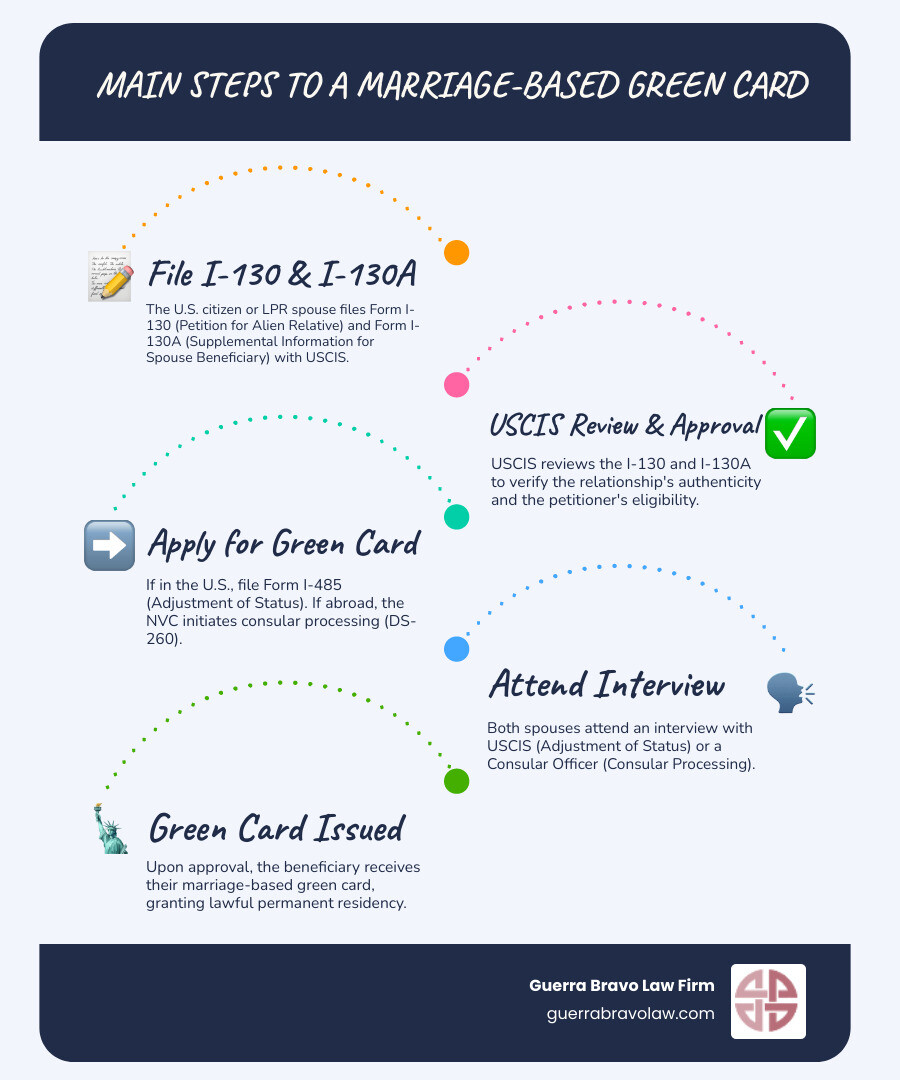
Receiving an approval notice for your Form I-130 and Form I-130A is a significant milestone, but it’s important to understand that it’s only the first step in the marriage-based green card process. An approved petition does not automatically grant the beneficiary lawful permanent resident status or permission to immediately immigrate. It simply establishes that USCIS recognizes the qualifying family relationship.
What happens next largely depends on whether the spouse beneficiary is already in the United States or residing abroad.
What are the next steps after Form I-130A is filed and approved?
The path forward after Form I-130A (and Form I-130) approval diverges based on the beneficiary’s location:
-
If the spouse beneficiary is already in the U.S. and eligible to adjust status: They will typically file Form I-485, Application to Register Permanent Residence or Adjust Status. This is known as “Adjustment of Status.” Many eligible beneficiaries choose to file Form I-485 concurrently with Form I-130 and Form I-130A to expedite the process. If not filed concurrently, they will file Form I-485 after the Form I-130 is approved. This process culminates in an interview at a USCIS office, often in Texas, where the couple will meet with an immigration officer.
-
If the spouse beneficiary is residing abroad (outside the U.S.): Their case will proceed through “Consular Processing.” After Form I-130 approval, USCIS sends the petition to the Department of State’s National Visa Center (NVC). The NVC will then contact the petitioner and beneficiary with instructions to begin the immigrant visa application process, which involves:
-
Paying fees.
-
Submitting financial sponsorship documents (Affidavit of Support).
-
Completing Form DS-260, Immigrant Visa Application, online.
-
Submitting civil documents (birth certificates, marriage certificates, police certificates, etc.).
-
Attending an immigrant visa interview at a U.S. Embassy or Consulate in their home country. If the interview is successful, they will receive an immigrant visa to enter the U.S. as a lawful permanent resident.
-
How long does it take for an I-130A to be approved?
As we discussed, Form I-130A does not have a separate approval process. It is reviewed and approved concurrently with the Form I-130 petition. Therefore, the processing time for Form I-130A is identical to that of Form I-130.
Based on recent trends, these processing times can range from approximately 7 months to over 2 years. These estimates depend heavily on:
-
The specific USCIS service center handling your petition.
-
The type of relationship (e.g., spouses of U.S. citizens are “immediate relatives” and don’t face visa backlogs, but the Form I-130 itself still takes time to process).
-
The completeness and accuracy of your submission, as RFEs can significantly prolong the process.
We encourage you to monitor the official USCIS website for the most up-to-date processing times, which are regularly updated.
What happens if I forgot to file Form I-130A with my I-130 petition?
Don’t panic, but act quickly! If you submitted your Form I-130 without the required Form I-130A, USCIS will almost certainly issue a Request for Evidence (RFE). This RFE will instruct you to submit the missing Form I-130A.
Here’s what you should do:
-
Respond Promptly: The RFE will have a deadline, usually 87 days. It is critical to respond within this timeframe.
-
Complete Form I-130A: Fill out Form I-130A completely and accurately, ensuring the spouse beneficiary signs it if they are in the U.S.
-
How to Submit:
-
If you filed your I-130 online: You can typically upload the signed Form I-130A to your online USCIS account under the “I-130A” tab, as instructed in the RFE.
-
If you filed your I-130 by mail: Mail the signed Form I-130A to the USCIS Service Center that issued the RFE, ensuring you include the RFE notice as instructed.
-
Failure to submit Form I-130A in a timely manner in response to an RFE might lead to the denial of your Form I-130 petition. This would mean a significant delay and the need to refile the entire petition from scratch.
Get Expert Guidance on Your Family Petition
Navigating the intricacies of Form I-130A and the entire marriage-based green card process can be complex, time-consuming, and frankly, a bit stressful. The journey involves meticulous document preparation, adherence to strict deadlines, and a deep understanding of changing immigration laws. Making a mistake on a form like Form I-130A can have serious consequences, from delays to outright denial of your petition.
This is where expert legal guidance becomes invaluable. At Guerra Bravo Law Firm, we understand the emotional and practical challenges you face. We believe that every family deserves a clear, battle-tested, and individualized legal strategy to achieve their immigration goals. Our comprehensive immigration legal services are designed to explain this process for you.
Our founder, attorney Iris Guerra Bravo, brings over 14 years of insider experience working with Immigration and Customs Enforcement (ICE) and the Department of Homeland Security (DHS). This unique background provides us with unparalleled insight into how these agencies operate, allowing us to anticipate potential issues and build stronger cases for our clients. We know the questions they ask, the evidence they seek, and the common pitfalls to avoid.
Whether you’re starting your Form I-130A and Form I-130 petition, responding to an RFE, or preparing for an interview, we can help ensure your application is as strong and accurate as possible. We serve families across the Rio Grande Valley, including McAllen, Brownsville, Edinburg, Harlingen, Mission, Pharr, Weslaco, Mercedes, Alamo, San Juan, Donna, Hidalgo, Palmview, La Joya, and Penitas, Texas.
Don’t leave your family’s future to chance. Let us put our experience to work for you. For more information about how we can assist with your family immigration needs, please visit our page on Family Petitions. We’re here to guide you every step of the way.
[