

March 3, 2026
Unlock Your Family's Future with a Family Based Petition
Unlock Your Family’s Future with a Family Based Petition
Bringing Your Family Home: Understanding the Family Based Petition
A Family based petition is how U.S. citizens and lawful permanent residents help their loved ones immigrate to the United States. It’s one of the most common ways people get a Green Card. This process allows families to reunite and build a life together in America.
So, what exactly is a family-based petition?
-
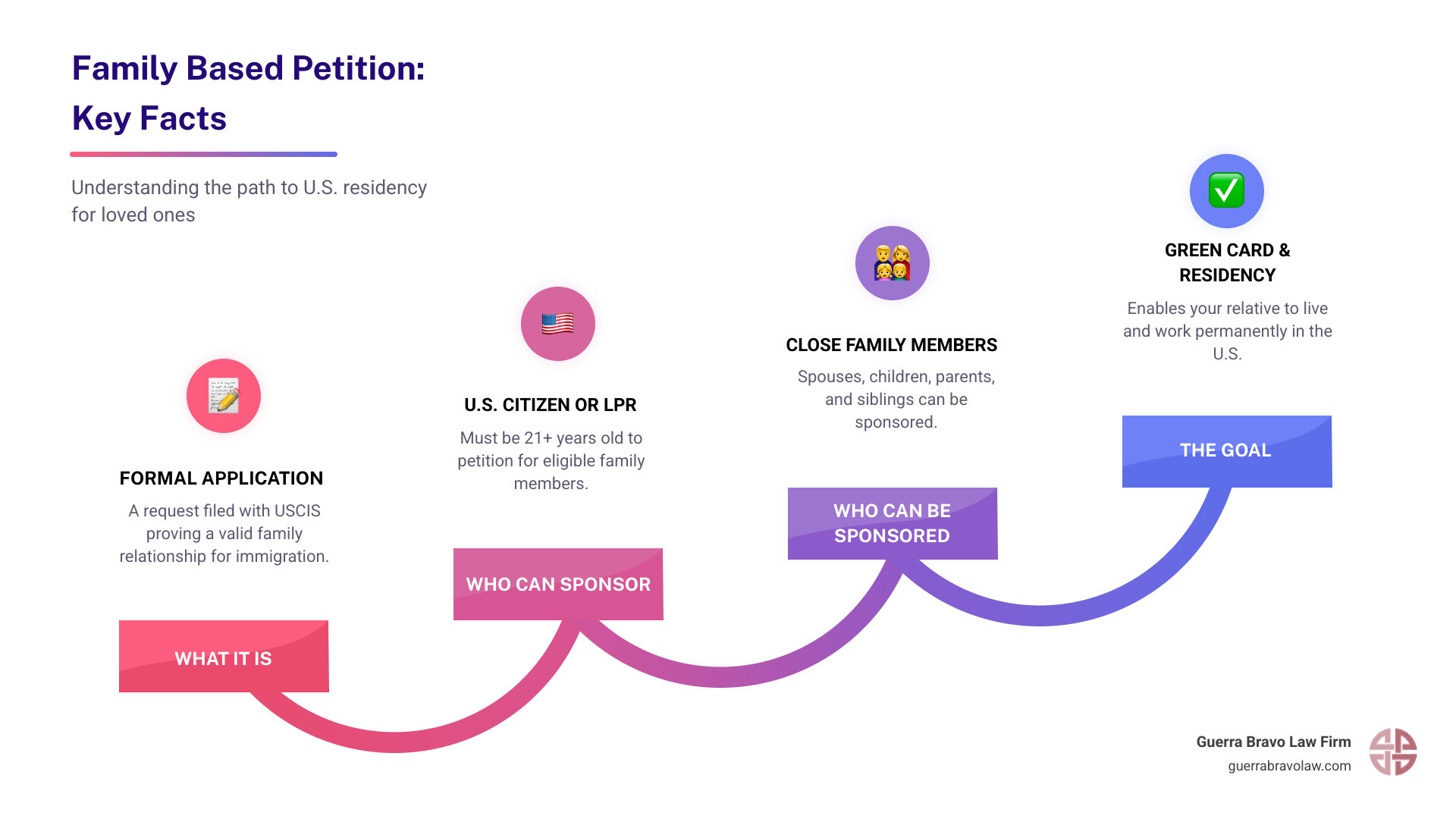
What it is: A formal request filed with the U.S. government (USCIS) to establish a qualifying family relationship. This is the first step for a foreign relative to seek permanent residency in the U.S.
-
Who can sponsor: You must be a U.S. citizen or a Lawful Permanent Resident (Green Card holder) and at least 21 years old.
-
Who can be sponsored: Close family members, such as spouses, children, parents, and siblings.
-
Goal: To help your family member obtain an immigrant visa and eventually a Green Card, allowing them to live and work permanently in the U.S.
This guide will walk you through each step. We’ll cover who can apply, what forms you need, and what to expect along the way. Our goal is to make this complex process clear and manageable for you.
Understanding Family-Based Immigration: Who Can You Sponsor?
Family-based immigration is a cornerstone of the U.S. immigration system, providing a pathway for countless individuals to achieve lawful permanent residency. But who exactly can initiate this journey, and for whom? The answer largely depends on your immigration status and the nature of your relationship with the relative you wish to sponsor.
To begin a family based petition, the sponsor (also known as the petitioner) must be at least 21 years of age and be either a U.S. citizen or a U.S. Lawful Permanent Resident (LPR), often referred to as a Green Card holder. Your status as a U.S. citizen versus an LPR determines which family members you can petition for and significantly impacts how quickly your family member can immigrate.
U.S. immigration law categorizes family relationships into two main groups: Immediate Relatives and Family Preference categories. This distinction is crucial because it dictates whether your loved one will face annual visa limitations and potentially long wait times.
Immediate Relative (IR) Category
This category is reserved for the closest family members of U.S. citizens.
-
Definition: Immediate Relative visas are based on a close family relationship with a U.S. citizen. These relationships are considered fundamental for family unity, and thus, receive preferential treatment under immigration law.
-
Visa Limits: One of the most significant advantages of this category is that the number of immigrant visas issued to Immediate Relatives is unlimited each fiscal year. This means there are no annual quotas for these visas, generally leading to faster processing times once the petition is approved.
-
Wait Times: Because visas are always available, Immediate Relatives do not typically experience visa backlogs. While there are still processing times for USCIS and consular offices, the absence of a visa quota means the wait is usually much shorter compared to other categories.
-
Who Qualifies: Only U.S. citizens can petition for:
-
Spouses of U.S. citizens.
-
Unmarried children under 21 of U.S. citizens.
-
Parents of U.S. citizens (provided the U.S. citizen petitioner is 21 years of age or older).
-
-
Sponsor: Solely U.S. citizens are eligible to petition for Immediate Relatives. Lawful Permanent Residents cannot petition for their family members under this category.
Family Preference (F) Category
This category includes other family relationships, both with U.S. citizens and LPRs, but these relationships are subject to annual limits.
-
Definition: Family Preference visas are for specific, more distant family relationships with a U.S. citizen and some specified relationships with a Lawful Permanent Resident (LPR). These categories are subject to numerical limitations set by Congress each year.
-
Visa Limits: The number of immigrants in Family Preference categories is limited each fiscal year. This limitation means that often, there are more eligible applicants than available visas, leading to backlogs.
-
Wait Times: Due to annual visa limits and high demand, wait times can be substantial, ranging from several years to over a decade, especially for certain nationalities and categories. For example, petitioning for siblings falls under the Fourth Preference Family category (F4) and can involve wait times of several years or even over a decade due to annual visa limits and high demand. We highly recommend checking the monthly Visa Bulletin published by the U.S. Department of State for current priority dates and to understand projected wait times.
-
Who Qualifies: Both U.S. citizens and Lawful Permanent Residents can petition for family members under these categories:
-
F1 Preference: Unmarried sons and daughters (who are 21 years of age or older) of U.S. citizens.
-
F2A Preference: Spouses and children (who are unmarried and under 21 years of age) of Lawful Permanent Residents.
-
F2B Preference: Unmarried sons and daughters (who are 21 years of age or older) of Lawful Permanent Residents.
-
F3 Preference: Married sons and daughters of U.S. citizens.
-
F4 Preference: Brothers and sisters of U.S. citizens (provided the U.S. citizen petitioner is 21 years of age or older).
-
-
Sponsor: Both U.S. citizens and LPRs can petition for relatives under these preference categories.
Understanding which category your family member falls into is the first critical step in managing expectations regarding the immigration timeline. The difference in visa availability between Immediate Relatives and Family Preference categories is a key differentiator, making the Immediate Relative path generally faster.
The Core of Your Family Based Petition: Forms and Documentation

At the heart of every successful family based petition is the meticulous preparation and filing of specific forms and supporting documentation. This step establishes the validity of the family relationship to the U.S. government, which is paramount for your loved one’s immigration journey. Accuracy and completeness here are not just important; they are crucial to avoid delays or even denial.
The Initial Filing: Form I-130
The journey for most family-based immigrants begins with this foundational document.
-
What it is: The I-130, Petition for Alien Relative, is the primary form you, as the petitioner, will file with U.S. Citizenship and Immigration Services (USCIS). Its purpose is to demonstrate that a qualifying relationship exists between you (the petitioner) and your eligible alien relative (the beneficiary) who wishes to come to or stay in the United States permanently.
-
Filing: You can often File Online for convenience, or submit a paper application. We always recommend consulting official USCIS instructions for the most up-to-date filing procedures.
-
Purpose: The filing or even approval of an I-130 does not grant your relative any immigration status or benefit itself. Instead, it serves to establish the relationship and secures your relative’s place in line to apply for an immigrant visa. Think of it as getting a ticket to enter a queue; you still need to wait for your number to be called.
Essential Supporting Documents
Beyond the Form I-130 itself, you will need to provide a collection of documents to prove your eligibility as a petitioner and to establish the bona fide (genuine) nature of your relationship with the beneficiary. These documents are vital for the USCIS to verify your claims.
-
Proof of Sponsor’s Status: As the petitioner, you must prove your U.S. citizenship or lawful permanent resident status. This can include:
-
A copy of your U.S. birth certificate.
-
A copy of your valid U.S. passport.
-
A copy of your naturalization certificate.
-
A copy of the front and back of your Green Card (Form I-551, Permanent Resident Card).
-
-
Proof of Relationship: This is arguably the most critical part of the documentation. The specific documents needed will vary based on the relationship:
-
For Spouses: You will need your marriage certificate. Additionally, you should provide evidence of a bona fide marriage, such as:
-
Joint bank accounts or financial records.
-
Lease agreements or mortgage statements showing joint residency.
-
Birth certificates of children born to both of you.
-
Affidavits from third parties confirming the relationship.
-
Photographs together (e.g., wedding photos, family outings).
-
Communication records (emails, messages, call logs) if applicable.
-
For Children (by a parent):
-
The beneficiary’s birth certificate listing the petitioner as a parent.
-
If the petitioner is the father and the child was born out of wedlock, proof of the father’s legitimization, recognition, or a bona fide parent-child relationship (e.g., evidence of support and emotional ties before the child turned 21).
-
For Parents (by a U.S. citizen child):
-
The petitioner’s birth certificate listing the beneficiary as a parent.
-
If the petitioner was born out of wedlock to the father, proof of the father’s legitimization or a bona fide parent-child relationship.
-
For Siblings (by a U.S. citizen sibling):
-
Birth certificates for both the petitioner and the beneficiary, showing at least one common parent.
-
-
Other Documents:
-
Copies of any legal name change documents for you or the beneficiary.
-
Copies of divorce decrees, death certificates, or annulment decrees for any prior marriages for both the petitioner and beneficiary, to prove the termination of those marriages.
-
Passport-style photos of both the petitioner and the beneficiary, adhering to USCIS specifications.
-
Gathering these documents can be a treasure hunt, but it’s an essential part of laying a strong foundation for your family based petition. We often advise our clients in McAllen, Brownsville, and across the Rio Grande Valley to start collecting these items early in the process.
Navigating the Petition Process: From Filing to Green Card
Once your Form I-130 family based petition is carefully prepared and filed, you start on a multi-stage journey that involves various government agencies. The path your case takes will largely depend on whether your sponsored relative is already in the United States or residing abroad.
General Steps of the Process
While the specifics may vary, the overall flow of a family-based immigration case typically follows these steps:
-
Step 1: File Form I-130: As the U.S. citizen or LPR petitioner, you file the I-130, Petition for Alien Relative, with USCIS. This establishes the qualifying family relationship.
-
Step 2: USCIS Review and Approval: USCIS will review your petition and supporting documents. If they are satisfied that a qualifying relationship exists, they will approve the I-130. You can always Check Processing Times online on the USCIS website for an estimate, but a petition filed with USCIS may generally be processed and approved within 12-24 months.
-
Step 3: National Visa Center (NVC) Processing: Once your I-130 is approved, especially if your relative is abroad, the case is forwarded to the National Visa Center (NVC), which is part of the Department of State. The NVC collects additional fees and documents, including the Affidavit of Support (Form I-864) and civil documents, and prepares the case for an interview.
-
Step 4: Final Adjudication (Two Paths): After NVC processing (if applicable), the case moves to its final stage: either Adjustment of Status within the U.S. or Consular Processing abroad.
Path 1: Adjustment of Status (AOS)
This path is often preferred for those already in the U.S.
-
Who: Adjustment of Status is available for beneficiaries who are already inside the United States and meet specific eligibility requirements, typically having entered the country lawfully.
-
What it is: This process allows an eligible individual to apply for a Green Card without having to leave the U.S. It converts their current nonimmigrant status (like a tourist or student visa) to lawful permanent resident status.
-
Eligibility: To be eligible for adjustment of status, the beneficiary must meet several criteria:
-
They must have been inspected and admitted or paroled into the U.S. This means they entered lawfully and were processed by an immigration officer (e.g., at an airport or border crossing).
-
An immigrant visa must be immediately available to them. This is always true for Immediate Relatives of U.S. citizens, meaning they don’t have to wait for a visa number. For Family Preference categories, visa availability is determined by the Visa Bulletin and their priority date.
-
The family relationship must still exist.
-
They must not be subject to any “bars to adjustment” or “grounds of inadmissibility” (we’ll discuss these below).
-
-
Forms: The core form for this path is Form I-485, Application to Register Permanent Residence or Adjust Status. For Immediate Relatives, Form I-485 can often be filed concurrently (at the same time) with Form I-130, or after the I-130 is pending or approved.
Path 2: Consular Processing
This path is for those who are outside the U.S. or ineligible for AOS.
-
Who: Consular Processing is the pathway for beneficiaries who are living outside the United States or who are ineligible to adjust status from within the U.S.
-
What it is: This process involves applying for an immigrant visa at a U.S. embassy or consulate in their home country (or another country where they have a legal right to reside).
-
The Interview: After the NVC processes the case, the beneficiary will be scheduled for an interview at a U.S. embassy or consulate. A consular officer will review their application and documents and make the final decision on whether to issue the immigrant visa. Post-petition approval, there may be an additional wait time of 12-18 months prior to obtaining an interview.
-
Derivative Beneficiaries: An important aspect of consular processing, particularly for Family Preference categories, is the concept of derivative beneficiaries. For most preference categories (F1, F2A, F2B, F3, F4), the principal beneficiary’s spouse and unmarried children under 21 can typically immigrate with them, or “derive” their status from the principal applicant. This allows families to stay together. However, this concept generally does not apply to Immediate Relatives, as each Immediate Relative must have their own I-130 filed by the U.S. citizen petitioner.
No matter which path your family’s family based petition takes, careful preparation and adherence to all instructions are essential. We assist families in Edinburg, Harlingen, and throughout the Rio Grande Valley in navigating these intricate steps.
Overcoming Problems: Inadmissibility, Waivers, and Special Cases

The journey to a Green Card through a family based petition can sometimes encounter significant problems. Immigration law is notoriously complex, and various factors can complicate, delay, or even bar a relative from obtaining their immigrant visa or adjusting their status. Understanding these potential challenges – and the solutions available – is crucial.
Understanding Inadmissibility in a Family Based Petition
Not everyone is automatically eligible for a Green Card, even with an approved petition.
-
What it is: Certain conditions or past actions can make a person ineligible to receive a visa or Green Card, or to enter the United States. These are legally defined as “grounds of inadmissibility.” They are designed to protect national security, public safety, and public health.
-
Common Grounds: The comprehensive list of grounds of inadmissibility is found in INA 212(a) of the Immigration and Nationality Act. Some common examples include:
-
Health-related grounds: Certain communicable diseases, failure to get required vaccinations.
-
Criminal grounds: Convictions for certain crimes, drug trafficking, multiple criminal convictions.
-
Security-related grounds: Terrorism, espionage.
-
Public charge grounds: Likelihood of becoming primarily dependent on the government for subsistence.
-
Illegal entry and immigration violations: Unlawful presence in the U.S., misrepresentation to gain immigration benefits, previous deportations.
-
-
Bars to Adjustment: In addition to general inadmissibility, specific actions can prevent an individual from adjusting their status within the U.S. (i.e., using Form I-485). These “bars to adjustment” are outlined in section 245(c) of the Immigration and Nationality Act (INA). For example, entering the U.S. without inspection (EWI) or working without authorization can be bars to adjustment for many, though there are exceptions like INA 245(i) for certain individuals who had a petition filed on their behalf by a specific date.
Waivers and Special Protections
When inadmissibility is an issue, hope is not always lost.
-
Waivers of Inadmissibility: For many grounds of inadmissibility, it may be possible to apply for a waiver. A waiver essentially asks the government to overlook the ground of inadmissibility due to compelling circumstances. For example, a common waiver is Form I-601, Application for Waiver of Grounds of Inadmissibility. To be granted, waivers often require proving “extreme hardship” to a qualifying U.S. citizen or LPR spouse, parent, or child. Each waiver has specific eligibility criteria, and there’s no guarantee of approval. You can learn more about Common Waivers of Inadmissibility from expert resources.
-
Child Status Protection Act (CSPA): This vital law provides a mechanism to protect certain children from “aging out.” “Aging out” occurs when a child turns 21 while waiting for their immigrant visa to become available, which could move them from a faster Immediate Relative or F2A category to a slower, less favorable preference category (like F1 or F2B). The CSPA provides a formula to “freeze” a child’s age for immigration purposes, allowing them to retain eligibility in the original category. It’s a complex calculation, and we often help families in Mission, Pharr, and throughout the Rio Grande Valley understand if their child qualifies.
Common Challenges in a Family Based Petition
Even without inadmissibility issues, other factors can make the process difficult.
-
Processing Times: Patience is a virtue in immigration. While immediate relative visas are unlimited, the administrative process still takes time. A family based petition (Form I-130) filed with USCIS may generally be processed and approved within 12-24 months. For those undergoing consular processing abroad, there may be an additional wait time of 12-18 months post-petition approval prior to obtaining an interview. For Family Preference categories, wait times for visa availability can range from 7-15 years, depending on the beneficiary’s country of origin and the specific preference category.
-
Financial Sponsorship: The petitioner has a significant financial responsibility. They must file Form I-864, Affidavit of Support, promising to financially support the beneficiary. This requires demonstrating an income at least 125% of the Federal Poverty Guidelines for their household size. If the petitioner doesn’t meet this threshold, a joint sponsor might be required.
-
Documentation Errors: Incomplete or incorrect paperwork is a leading cause of delays, Requests for Evidence (RFEs), and even denials. Every piece of information must be accurate, and all required supporting documents must be submitted in the correct format.
-
Required Forms for Adjustment of Status: If your relative is eligible for Adjustment of Status within the U.S., they will generally need to file:
-
Form I-485, Application to Register Permanent Residence or Adjust Status.
-
Form I-693, Report of Medical Examination and Vaccination Record.
-
Form I-765, Application for Employment Authorization (optional, to work while I-485 is pending).
-
Form I-131, Application for Travel Document (optional, for Advance Parole to travel abroad while I-485 is pending).
-
Navigating these complexities requires a thorough understanding of immigration law and policy. We at Guerra Bravo Law Firm are well-versed in the nuances of waivers and special cases, having served clients in Weslaco, Mercedes, Alamo, and beyond, helping them overcome formidable challenges.
Conclusion: Secure Your Family’s Future
A family based petition is a powerful tool for reuniting with your loved ones, but it is a meticulous and often lengthy legal process. From proving your relationship and meeting financial requirements to overcoming complex grounds of inadmissibility, every step requires precision and a deep understanding of immigration law. While the dream of bringing family together is universal, the path through U.S. immigration can be filled with bureaucratic problems and legal intricacies.
Navigating this journey alone can be daunting. The experienced team at Guerra Bravo Law Firm, leveraging over 14 years of insider knowledge from working with ICE and DHS, can provide the battle-tested legal strategy your family deserves. Our attorney, Iris Guerra Bravo, brings a unique perspective and a deep commitment to individualized legal strategies for complex cases. We are here to guide you through every form, every document, and every interview, ensuring your family based petition has the best possible chance of success in McAllen, Brownsville, Edinburg, and across the entire Rio Grande Valley.
To ensure your petition is handled with the care and expertise it requires, explore our comprehensive immigration services. Let us help you open up your family’s future in the United States.
[