
February 9, 2026
Don't Get Lost in the Forms: How to Successfully File Your I-130 Petition
Don’t Get Lost in the Forms: How to Successfully File Your I-130 Petition
Your First Step to Family Reunification
Form I-130, officially called the “Petition for Alien Relative,” is the first step for bringing your family members to live permanently in the United States. If you’re a U.S. citizen or green card holder, this form allows you to sponsor certain relatives for a Green Card. But here’s the catch: filing it correctly requires careful attention to detail, and mistakes can mean months of delays or even denial.
Quick Answer: What You Need to Know About Form I-130
-
Purpose: Establishes your relationship with a family member who wants to immigrate to the U.S.
-
Who Can File: U.S. citizens and lawful permanent residents (green card holders)
-
Who You Can Sponsor: Depends on your status (spouses, children, parents, siblings)
-
Filing Fee: $675 by mail or $625 online (as of 2024)
-
Processing Time: Average 14 months, but varies by relationship type and location
-
What It Does: Creates a “place in line” for your relative - it does NOT grant immediate status
-
Where to File: Online through USCIS account or by mail to USCIS Chicago Lockbox
-
Next Steps: After approval, your relative applies for a Green Card through adjustment of status (if in U.S.) or consular processing (if abroad)
The approval rate for Form I-130 is above 99% for immediate relatives, but that doesn’t mean it’s simple. The form itself is just one part of a complex process that involves proving your relationship, demonstrating financial support, and navigating different visa categories with varying wait times.
Many families get stuck because they don’t understand the difference between immediate relatives (who can immigrate right away after approval) and family preference categories (who may wait years for a visa number). Others submit incomplete evidence or make errors that trigger delays.
This guide will walk you through every step of the I-130 process, from determining eligibility to handling potential problems. We’ll show you exactly what documents you need, how to fill out the form correctly, and what happens after you file.
Who Can File and For Whom? Understanding Petitioner and Beneficiary Eligibility
Before you even touch a pen or click a mouse, it’s crucial to understand if you, as the petitioner, are eligible to file Form I-130, and if your family member, the beneficiary, qualifies for sponsorship. This process is all about establishing a “qualifying relationship” with an eligible alien relative. The type of relationship you have directly impacts how quickly your family member can immigrate, if at all.
Let’s break down who can petition for whom, based on your status:
U.S. Citizen Petitioners
As a U.S. citizen, you have the broadest range of relatives you can sponsor. We often refer to these in two main groups: Immediate Relatives and Family Preference Categories.
-
Immediate Relatives (No Visa Wait Time)
-
Spouse: You can petition for your husband or wife. For more detailed information on this process, you can refer to our guide on sponsoring a spouse.
-
Unmarried children under 21: This includes your biological children, stepchildren (if the marriage creating the step-relationship occurred before the child’s 18th birthday), and adopted children (who meet specific legal requirements).
-
Parents (if the U.S. citizen is 21 or older): If you are at least 21 years old, you can petition for your mother or father. Our comprehensive guide on sponsoring a parent offers further insights.
Key Insight: Immediate Relatives are a special category because there are no annual limits on the number of immigrant visas issued to them. This means that once their Form I-130 is approved, they don’t have to wait for a visa number to become available, significantly speeding up their path to a Green Card.
-
-
Family Preference Categories (Visa Wait Times Apply)
-
Unmarried sons or daughters 21 or older: These are your adult children who are not married.
-
Married sons or daughters of any age: This includes your adult children, regardless of their marital status.
-
Brothers or sisters (if the U.S. citizen is 21 or older): You must be at least 21 years old to petition for a sibling.
Key Insight: For these categories, there are annual limits on the number of visas available. This means that even after your Form I-130 is approved, your family member will likely face a waiting period, sometimes several years, until a visa number becomes available. Their place in line is determined by their “priority date,” which is the date USCIS officially receives your Form I-130.
-
Lawful Permanent Resident (Green Card Holder) Petitioners
If you are a lawful permanent resident (LPR), you can also petition for certain family members, though the categories are more limited than for U.S. citizens, and all LPR-sponsored relatives fall under Family Preference Categories.
-
Family Preference Categories (Visa Wait Times Apply)
-
Spouse: Your husband or wife.
-
Unmarried children under 21: Your unmarried biological, step, or adopted children who are under 21 years old.
-
Unmarried sons or daughters 21 or older: Your adult unmarried children.
Key Insight: All relatives sponsored by LPRs are subject to annual visa limits and will experience waiting periods. There is no “immediate relative” category for LPR petitioners in the same way there is for U.S. citizens. This is a critical distinction that can impact your family’s immigration timeline.
-
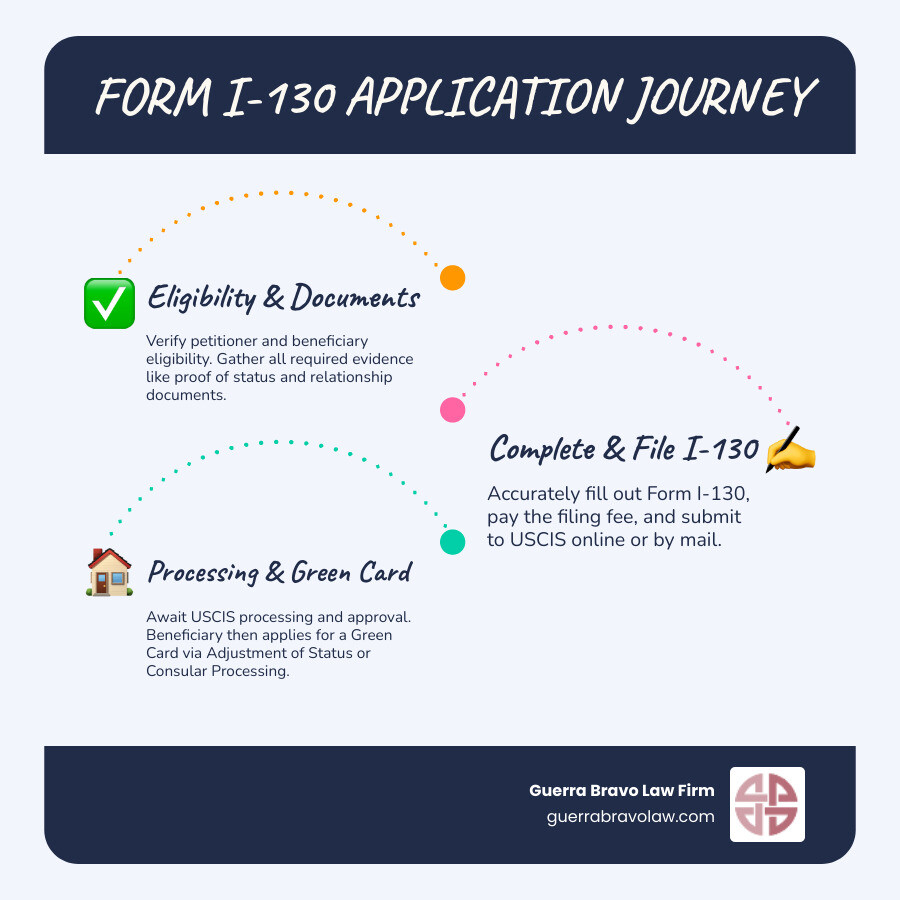
A Step-by-Step Guide to Filing Form I-130
Filing Form I-130 can feel like a daunting task, but breaking it down into manageable steps makes the process much clearer. Our goal at Guerra Bravo Law Firm is to explain this journey for families in McAllen, Brownsville, and across the Rio Grande Valley.

Step 1: Gather Your Required Documents
The success of your Form I-130 petition heavily relies on submitting a complete and accurate package of supporting documents. Think of these documents as the evidence proving your eligibility and the bona fide nature of your relationship. Missing a single piece of evidence can lead to delays or even a Request for Evidence (RFE), which can prolong the process significantly.
Here’s a list of essential documents you’ll likely need:
-
Proof of Petitioner Status
-
U.S. Passport: Copy of your unexpired U.S. passport.
-
Birth Certificate: Copy of your birth certificate showing birth in the U.S.
-
Naturalization Certificate: Copy of your Certificate of Naturalization.
-
Green Card: Copy of both sides of your Permanent Resident Card (Form I-551).
-
Consular Report of Birth Abroad (FS-240): If you were born abroad to U.S. citizen parents.
-
-
Proof of Relationship
-
Marriage Certificate: For spouse petitions, a copy of your civil marriage certificate.
-
Divorce Decrees/Death Certificates: If either you or your spouse were previously married, copies of documents showing the legal termination of all prior marriages (divorce decrees, annulment certificates, or death certificates).
-
Beneficiary’s Birth Certificate: For child or parent petitions, a copy of the beneficiary’s birth certificate showing the names of both parents.
-
Petitioner’s Birth Certificate: For parent petitions, a copy of your birth certificate showing the names of both parents.
-
Adoption Decree: For adopted children, a copy of the final adoption decree.
-
Passport-style Photos: For spouse petitions, two identical passport-style photos of yourself and two of your spouse.
-
-
Proof of Bona Fide Relationship (for spouse petitions): This is crucial to demonstrate your marriage is real and not just for immigration purposes. We recommend submitting a variety of evidence, such as:
-
Joint bank account statements
-
Joint utility bills or leases/mortgages
-
Joint insurance policies
-
Photos together over time (wedding, vacations, family events)
-
Children’s birth certificates (if applicable)
-
Affidavits from friends or family members
-
Correspondence (emails, texts, cards)
-
Important Tip: Always submit legible photocopies of your documents, not originals, unless USCIS specifically requests them. If a primary document (like a birth certificate) is unavailable, you’ll need to submit a letter from the appropriate civil authority stating its unavailability, along with secondary evidence (e.g., religious records, school records, affidavits from people with personal knowledge). Ensure all foreign language documents are accompanied by a full English translation certified by the translator.
For a more comprehensive understanding of the entire Green Card application process, we encourage you to read our complete guide to the Green Card application.
Step 2: Complete the Form I-130 and I-130A
Now that you have your documents in hand, it’s time to tackle the forms themselves. Accuracy is paramount here!
-
Form I-130, Petition for Alien Relative: This is the main form you, as the petitioner, will complete. You can download the latest version from the USCIS website. We strongly recommend typing your answers or printing legibly in black ink. Answer every question truthfully and completely. If a question doesn’t apply, write “N/A” (Not Applicable) or “None.” Use the standard mm/dd/yyyy format for all dates.
-
Form I-130A, Supplemental Information for Spouse Beneficiary: If you are petitioning for your spouse, they must also complete and sign Form I-130A. This form gathers additional biographical information about your spouse. Even if your spouse is overseas, they must complete and sign this form.
Signatures: Don’t forget to sign and date your Form I-130! A stamped or typewritten name is not acceptable. Your signature is a declaration that all information provided is true and correct under penalty of perjury. If an interpreter or preparer assisted you, they must also complete and sign their respective sections.
For the official instructions and the latest version of the form, always refer to the Official USCIS Form I-130 Page.
Step 3: Choose Your Filing Method and Pay the Fee
You have two primary options for submitting your Form I-130: online or by mail.
- Online Filing: USCIS encourages online filing for many forms, including Form I-130. To file online, you’ll need to create a USCIS online account. This platform allows you to complete the form digitally, upload supporting documents, and pay the filing fee electronically. As of 2024, the fee for filing Form I-130 online is $625. Online filing can make it easier to track your case status and receive updates.
-
Mail Filing: If you prefer the traditional paper process, you can mail your completed Form I-130 and supporting documents. As of 2024, the filing fee for mailing Form I-130 is $675. This fee is non-refundable, even if your petition is denied. We always advise clients to pay with a check, money order, or by credit card using Form G-1450, Authorization for Credit Card Transactions.
Where to Mail: It’s critical to send your application to the correct USCIS Lockbox facility. The specific address depends on where you live and whether you are filing other forms concurrently. For residents of Texas, you will typically send it to a Chicago Lockbox facility. Always check the most current filing addresses on the USCIS filing addresses page to ensure you send it to the right place. Sending it to the wrong address can cause significant delays.
-
Fee Waivers: In certain situations, you might be eligible for a fee waiver or reduction if you can demonstrate financial hardship. This typically requires submitting Form I-912, Request for Fee Waiver, along with your petition.
After You File: Navigating Processing Times and Next Steps
Once you’ve submitted your Form I-130, the waiting game begins. But “waiting” doesn’t mean doing nothing! You’ll need to monitor your case and be prepared for the next stages of the immigration process.
First, you’ll receive a receipt notice (Form I-797C, Notice of Action) from USCIS, acknowledging that they’ve received your petition. This notice will contain your case number, which is essential for tracking your application’s progress online. We recommend keeping a copy of everything you submit for your records.
Understanding Form I-130 Processing Times
“How long will this take?” is one of the most common questions we hear, and for good reason! Processing times for Form I-130 can vary widely, influenced by several factors:
-
Relationship Type: This is the biggest factor.
-
Immediate Relatives of U.S. Citizens: While there’s no visa number waiting period, the Form I-130 itself still needs to be processed. The average processing time for Form I-130 is around 14 months. Some sources indicate immediate relatives might see approvals within 6-12 months, but overall processing to Green Card can take 12-24 months.
-
Family Preference Categories: These categories, which include relatives sponsored by LPRs and more distant relatives sponsored by U.S. citizens, face annual visa limits. This means that even after the Form I-130 is approved, your family member will likely have to wait for a visa number to become available, which can take several years.
-
-
USCIS Caseload: The volume of applications USCIS receives can fluctuate, impacting how quickly they process petitions.
-
Service Center: Different USCIS service centers may have varying backlogs and processing speeds.
We understand that waiting can be stressful. You can always check the current estimated processing times for your specific type of petition by visiting the Check USCIS Processing Times page on the USCIS website.
After Approval: The Path to a Green Card
An approved Form I-130 is a monumental step, but it does not grant your relative any immigration status or immediate benefits. It simply establishes the qualifying relationship and, for preference categories, secures their “priority date” (their place in line).
What happens next depends on whether your relative is already in the United States or abroad:
-
For Relatives in the U.S. (Adjustment of Status): If your relative is legally present in the U.S. and an immigrant visa number is immediately available (always the case for immediate relatives of U.S. citizens), they can apply to adjust their status to a lawful permanent resident by filing Form I-485, Application to Register Permanent Residence or Adjust Status. This is often filed concurrently with Form I-130 for immediate relatives.
-
For Relatives Abroad (Consular Processing): If your relative is outside the U.S., or if they are in the U.S. but not eligible for adjustment of status, their approved Form I-130 petition will be sent to the National Visa Center (NVC). The NVC will then collect additional documents and fees, and schedule an interview at a U.S. embassy or consulate in their home country. This is known as consular processing. NVC processing can take an additional 3 to 6 months after Form I-130 approval.
Priority Dates and the Visa Bulletin: For family preference categories, the NVC process won’t begin until a visa number is available. You’ll need to regularly check the Visa Bulletin published by the U.S. Department of State. This bulletin shows which priority dates are current for each preference category and country, indicating when your relative can move forward with their application.
Common Problems: Denials, RFEs, and Special Circumstances
Even with meticulous preparation, challenges can arise during the Form I-130 process. We’ve seen it all, and being prepared for potential pitfalls can save you a lot of heartache and time.
Top Reasons for an I-130 Denial
While the approval rate for Form I-130 is generally high, denials do happen. Here are some of the most common reasons:
-
Insufficient Evidence of Relationship: This is particularly common in marriage-based petitions where USCIS suspects the marriage is not bona fide. You must provide clear and convincing evidence that your relationship is genuine.
-
Petitioner Ineligibility: Forgetting to include proof of your U.S. citizenship or lawful permanent resident status, or not meeting age requirements (e.g., being under 21 to petition for a parent or sibling).
-
Beneficiary Ineligibility: The beneficiary does not meet the definition of an eligible relative for your status, or they have inadmissibility issues (e.g., certain criminal convictions, prior immigration violations).
-
Form Errors: Simple mistakes like unanswered questions, incorrect dates, missing signatures, or submitting an outdated version of the form can lead to rejection or denial.
-
Missed Deadlines: Failing to respond to a Request for Evidence (RFE) or other USCIS notices by the specified deadline.
If USCIS needs more information, they’ll send you a Request for Evidence (RFE). This is a chance to provide additional documents or clarification. If they intend to deny your petition, they might send a Notice of Intent to Deny (NOID), giving you a final opportunity to present your case.
Penalties for Fraud
Immigration fraud is a serious offense with severe consequences. USCIS is vigilant in detecting fraudulent petitions, especially in marriage-based cases.
-
Bona Fide Marriage: You must prove that your marriage is legitimate and was not entered into solely for immigration purposes. USCIS officers are trained to spot red flags.
-
Stokes Interview: If USCIS suspects marriage fraud, they may require a “Stokes interview.” This is a rigorous, separate interview for each spouse, often asking identical questions to compare answers and uncover inconsistencies. It can be an intimidating experience designed to test the authenticity of your relationship.
-
Severe Penalties: Knowingly providing false information or submitting fraudulent documents can lead to the denial of your Form I-130 and any other immigration benefits. It can also result in fines, imprisonment, and even permanent inadmissibility to the United States for the beneficiary.
What Are Your Options if Denied?
Receiving a denial can be heartbreaking, but it’s not always the end of the road. You may have several options, depending on the reason for the denial:
-
Motion to Reopen: If the denial was based on a lack of evidence that was actually available at the time of filing, you might file a motion to reopen.
-
Motion to Reconsider: If you believe the denial was based on an incorrect application of law or policy, you could file a motion to reconsider.
-
Appeal to the BIA: For Form I-130 denials, you generally have the right to appeal the decision to the Board of Immigration Appeals (BIA) by filing Form EOIR-29. This is a formal legal process where the BIA reviews your case.
-
Filing a New Petition: In some cases, if the issue leading to the denial can be resolved (e.g., gathering missing documents, correcting eligibility), you might be able to file a new Form I-130 petition.
Navigating a denial can be incredibly complex. This is where expert legal guidance becomes invaluable. For assistance with appeals or understanding your options, our team at Guerra Bravo Law Firm is here to help. You can find more information in our guide to finding a family immigration lawyer.
Frequently Asked Questions about Form I-130
We’ve gathered some of the most common questions our clients ask about Form I-130 to help clarify key aspects of the process.
Can I file Form I-130 if my relative is already in the U.S.?
Yes, absolutely! Many petitioners file Form I-130 for relatives who are already in the United States. If your relative entered the U.S. legally and an immigrant visa number is immediately available (which is always the case for immediate relatives of U.S. citizens), they might be eligible for Adjustment of Status by filing Form I-485 concurrently with, or after, the Form I-130 is approved.
However, if your relative entered without inspection or overstayed a visa, their eligibility for adjustment of status becomes more complicated, and they might face inadmissibility issues. It’s crucial to consult with an immigration attorney to understand the specific implications of their presence in the U.S.
What happens if the petitioner or beneficiary’s situation changes?
Life happens, and changes in circumstances are common. Here’s how some common changes can affect your Form I-130 petition:
-
Petitioner Becomes a U.S. Citizen: If you filed as a lawful permanent resident and later naturalize to become a U.S. citizen, your petition for your relative (spouse, child, or adult child) can automatically convert to a more favorable category, often speeding up the process. For example, an LPR petition for a spouse (F2A category) would convert to an immediate relative petition (IR1/CR1) upon the petitioner’s naturalization, eliminating the visa wait time.
-
Beneficiary Gets Married: If your unmarried child (sponsored by either a U.S. citizen or LPR) gets married before receiving their Green Card, their petition may be automatically revoked or converted to a less favorable preference category with a longer wait time.
-
Beneficiary Has a Child: If the beneficiary has a child, that child may be eligible to immigrate as a “derivative beneficiary” along with the principal beneficiary, without needing a separate Form I-130 filed for them.
It’s vital to notify USCIS of any significant changes in circumstances that may affect your eligibility or the beneficiary’s.
Does an approved I-130 provide any legal status?
No, an approved Form I-130 does not, by itself, provide any legal status, work authorization, or permission to live in the United States. Think of it as a pre-approval, a stamp of recognition from USCIS that they acknowledge your qualifying family relationship.
It’s merely the first step in a multi-stage process. Your relative still needs to apply for and be granted a Green Card through either adjustment of status or consular processing. Until that final step is completed, they do not have lawful permanent resident status.
Conclusion: Secure Your Family’s Future in the U.S.
Navigating the complexities of Form I-130 and the broader family-based immigration process can feel overwhelming. We’ve seen how challenging it can be for families in McAllen, Brownsville, and across the Rio Grande Valley to reunite. From understanding eligibility nuances to carefully gathering documents and adhering to strict deadlines, each step demands precision and knowledge.
The key takeaways are clear: accuracy, completeness, and persistence are your best allies. While the approval rate for Form I-130 is high, errors can lead to frustrating delays or even denials, costing you precious time and resources.
At Guerra Bravo Law Firm, we pride ourselves on providing comprehensive immigration legal services. Our unique strength comes from attorney Iris Guerra Bravo’s 14+ years of insider experience with ICE and DHS. This battle-tested background allows us to offer individualized legal strategies, ensuring your family’s case is handled with the utmost care and expertise. We understand the intricacies of immigration law and are dedicated to helping families like yours achieve their dream of living together in the United States.
Don’t let the paperwork or legal jargon stand between you and your loved ones. Let us guide you through the process, offering peace of mind and clarity every step of the way.
Start your family petition with expert guidance
[