

March 15, 2026
Watching the Clock: Navigating Your Form I-130 Journey
Watching the Clock: Navigating Your Form I-130 Journey
Why Understanding the Form I-130 Timeline Matters for Your Family
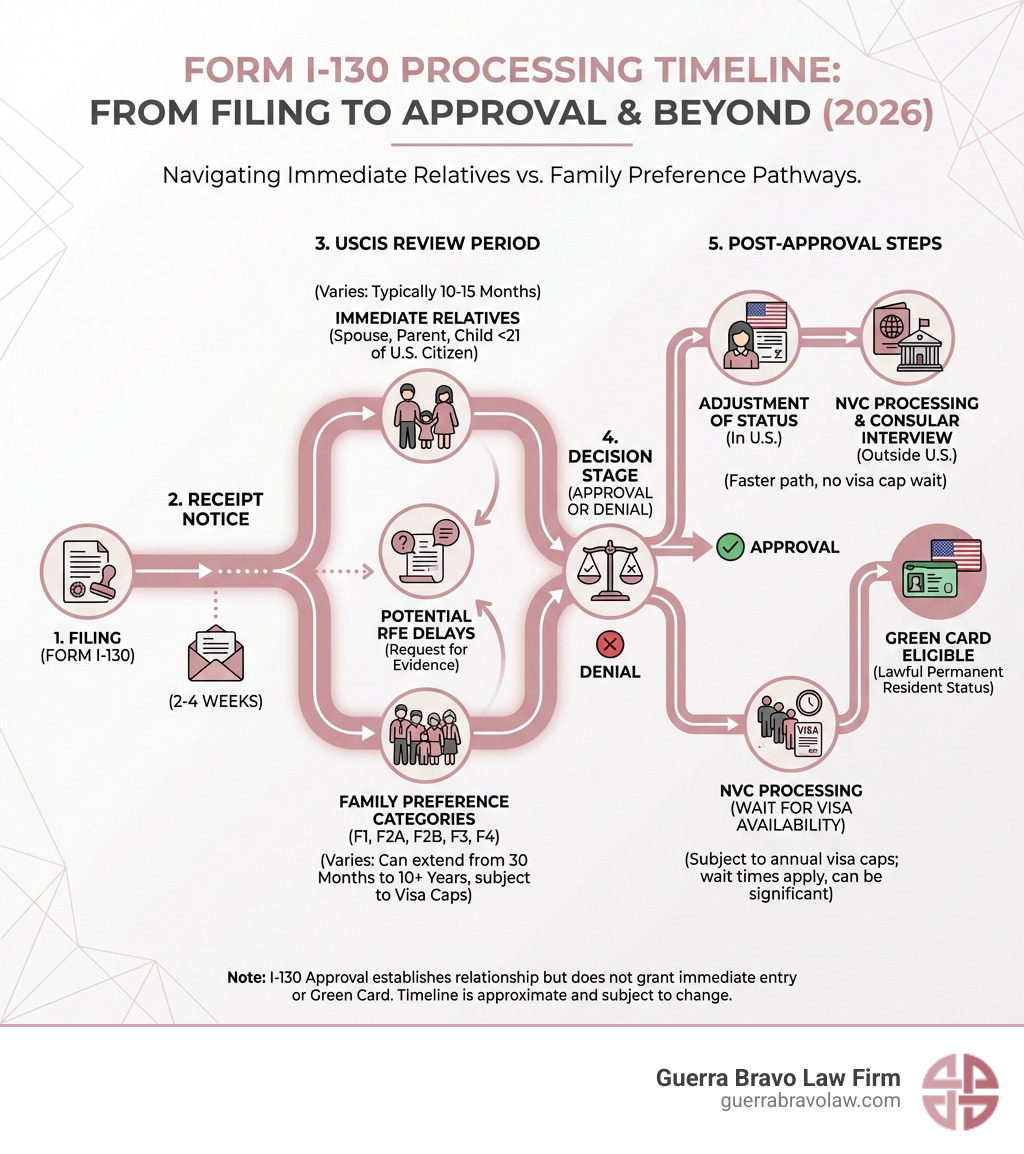
The form i-130 timeline typically takes 10 to 15 months for immediate relatives of U.S. citizens, but can extend from 30 months to over 10 years depending on your relationship category and immigration status. Here’s what you need to know right now:
Quick Timeline Overview:
-
Immediate Relatives (spouse, parent, child under 21 of U.S. citizen): 10-15 months
-
F2A (spouse/child of green card holder): 30-38 months
-
F1 (unmarried adult child of U.S. citizen): 5-6.5 years
-
F2B (unmarried adult child of green card holder): 5.5-7.5 years
-
F3 (married child of U.S. citizen): 6-10 years
-
F4 (sibling of U.S. citizen): 8-11+ years
One Reddit user captured the frustration many families feel: “US citizens waiting over 15 months just to have their marriage RECOGNIZED by the government and begin the visa process.” This reality hits hard when you’re separated from loved ones, unable to plan your future, or watching important milestones pass by.
The Form I-130 is your first step toward bringing a family member to the United States. It’s officially called the “Petition for Alien Relative,” and it establishes the qualifying relationship between you and your relative. But here’s what catches most people off guard: I-130 approval is just the beginning. It doesn’t grant a green card or allow your relative to enter the U.S. immediately.
The timeline from filing to green card depends on two separate factors: how long USCIS takes to process your petition, and whether a visa is available for your relative’s category. Immediate relatives don’t face visa waiting periods. But if you’re petitioning a sibling, the wait can stretch beyond a decade due to annual visa caps.
Understanding where you fall in this process helps you set realistic expectations and plan accordingly. You’ll know when to gather additional documents, when to check your case status, and when delays might signal a problem requiring action.
What is Form I-130 and Its Purpose?
At its core, Form I-130, Petition for Alien Relative is the legal bridge that connects a U.S. petitioner to a foreign beneficiary. We often tell our clients in McAllen and the Rio Grande Valley that this form is the government’s way of asking, “Prove to us that this person is actually your spouse, parent, child, or sibling.”
The Primary Goals of the I-130:
-
Establish a Qualifying Relationship: You must prove through birth certificates, marriage licenses, or adoption papers that the relationship is legally recognized.
-
Verify Petitioner Status: The person filing must be either a U.S. citizen or a Lawful Permanent Resident (green card holder).
-
Secure a Priority Date: This is essentially your “place in line.” For categories with limited visas, this date is everything.
It is important to remember that the I-130 is strictly a petition to recognize a relationship. It does not provide the beneficiary with the right to work, live, or even enter the U.S. While we wish it were a “golden ticket,” it’s more like the ticket that lets you stand in the correct line at the theme park.
Current I-130 Processing Times in 2026
As we navigate through 2026, the form i-130 timeline has seen some significant shifts. While USCIS has implemented new technologies, the sheer volume of applications has kept wait times substantial. If you feel like the process is moving at the speed of a snail on a leisurely vacation, you aren’t alone.
Average Median Timelines (Fiscal Year 2026 Data):
-
Immediate Relatives of U.S. Citizens: Currently averaging 14.8 months. This includes spouses, parents, and unmarried children under 21.
-
Spouses and Children of Green Card Holders (F2A): These cases are currently taking approximately 35 months.
-
Siblings of U.S. Citizens (F4): These can take anywhere from 56 to 121 months (4.5 to 10+ years) just for the I-130 approval, and often much longer for the actual visa availability.
In late 2024, we saw processing times for certain service centers reaching 15.5 months for routine spouse petitions. This is a far cry from the 1990s when families were often reunited in six months, or even the Obama era when I-130s were sometimes approved in just 2 or 3 months.
Factors Influencing Your I-130 Timeline
Why does one family get an approval in 10 months while another waits 18? It’s rarely random. Several logistical factors dictate the speed of your case.
Key Influencing Factors:
-
Petitioner’s Immigration Status: U.S. citizens generally experience faster processing because their immediate relatives are not subject to annual visa caps. Green card holders (LPRs) face longer waits because their relatives fall into “preference categories.”
-
The Assigned USCIS Service Center: Each center (Texas, Nebraska, Potomac, California, or Vermont) has a different workload. Knowing which one has your file helps you check the status of your case online more accurately.
-
Case Complexity and Evidence Quality: A “clean” case with perfect documentation moves faster. If USCIS issues a Request for Evidence (RFE), it puts a “pause” on your timeline.
-
Background Checks: Every beneficiary undergoes security checks. If your relative has a common name or has lived in multiple countries, these checks can take longer to clear.
Immediate Relatives vs. Family Preference Categories
Understanding the difference between these two groups is vital for managing your expectations regarding the form i-130 timeline.
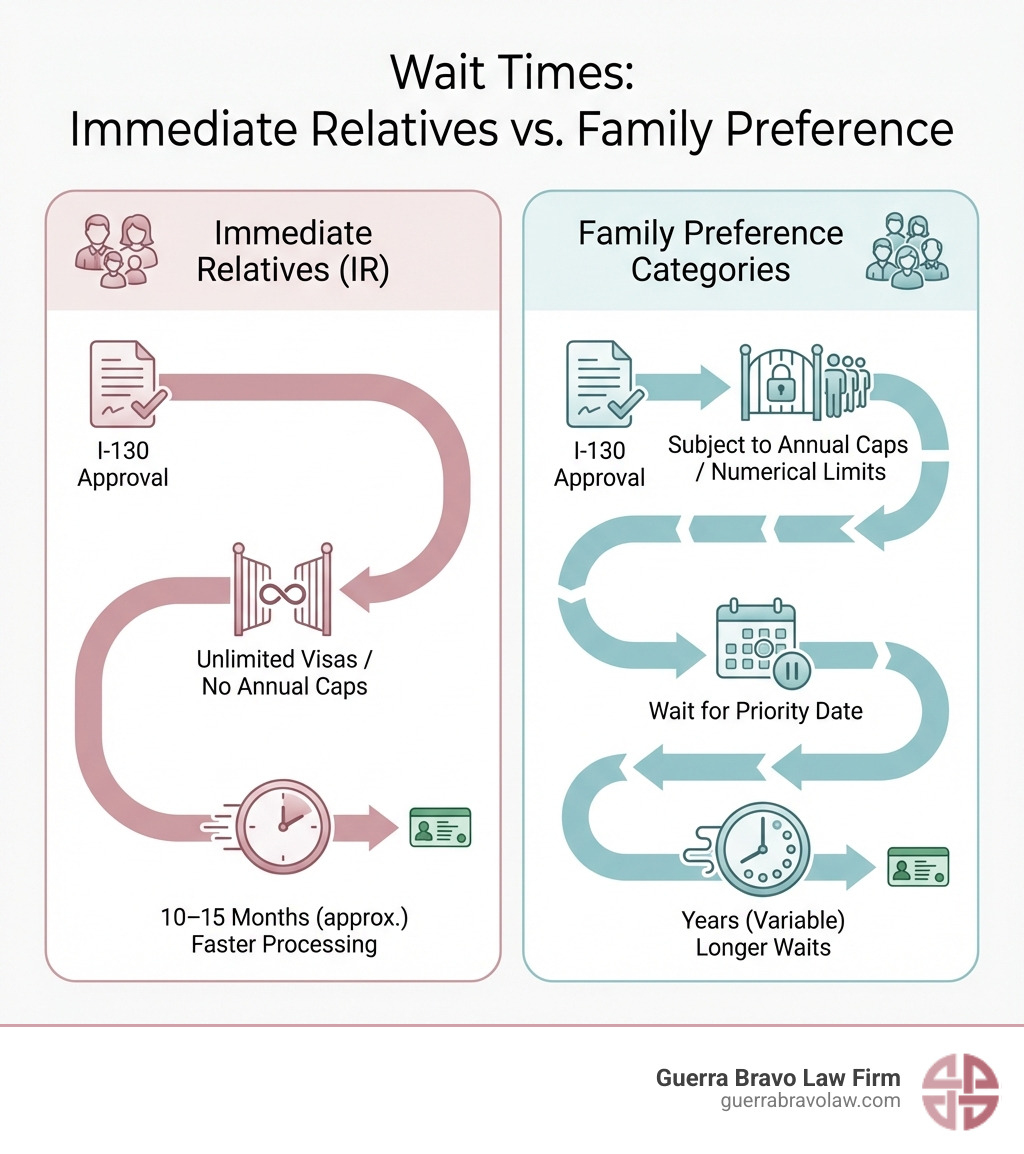
Immediate Relatives (IR):
-
Who they are: Spouses, unmarried children under 21, and parents of U.S. citizens.
-
The Perk: There is an unlimited number of visas available. Once the I-130 is approved, they can move straight to the green card application.
-
Current Wait: Roughly 10-15 months for I-130 approval.
Family Preference Categories:
-
F1: Unmarried adult children (21+) of U.S. citizens.
-
F2A: Spouses and unmarried children (under 21) of green card holders.
-
F2B: Unmarried adult children (21+) of green card holders.
-
F3: Married children of U.S. citizens.
-
F4: Siblings of U.S. citizens.
-
The Catch: These are subject to annual caps. Relatives might wait years for their “priority date” to become current on the Department of State’s Visa Bulletin.
Required Documents and Avoiding RFEs
One of the most common reasons for a stalled form i-130 timeline is the dreaded Request for Evidence (RFE). When USCIS sends an RFE, your case sits on a shelf until you respond.
To keep your case moving, you must submit Form I-130 Required Documents correctly the first time:
Essential Documentation Checklist:
-
Proof of Petitioner’s Status: A copy of your U.S. passport, birth certificate, or green card.
-
Proof of Relationship: Marriage certificates, birth certificates for children, or adoption decrees.
-
Evidence of Bona Fide Marriage: Joint bank statements, photos together, joint lease agreements, and affidavits from friends/family.
-
Certified Translations: Any document not in English must have a certified translation.
If you are missing primary documents, you can submit “secondary evidence” such as school records or religious documents, accompanied by a letter from the relevant government authority stating why the primary document is unavailable.
How to Check Your I-130 Status and Estimate Wait Times
We know the anxiety of waiting. Fortunately, there are tools available to help you keep tabs on your petition.
Using the USCIS Online Tools:
-
The Receipt Number: Once you file, you’ll receive an I-797C Notice of Action containing a 13-character receipt number (e.g., IOE1234567890).
-
Case Status Tracker: Enter this number into the USCIS case status online tool to see if your case is “Received” or “Approved.”
-
Processing Times Tool: Use the USCIS Case Processing Times tool to see the average wait for your specific form and service center.
A Note on “Estimated Time Remaining”: If you have a USCIS online account, take the “Estimated time until case decision” with a grain of salt. It is an automated estimate, not a guarantee from an officer.
What Happens After I-130 Approval?
Congratulations! Your relationship is officially recognized. The path splits depending on where your relative is currently located.
Scenario A: Consular Processing (Relative is Outside the U.S.)
-
NVC Transfer: USCIS sends your approved petition to the National Visa Center (NVC).
-
Fee Payment & DS-260: You’ll pay immigrant visa fees and file the DS-260 form online.
-
Affidavit of Support: You must prove you can financially support your relative.
-
Interview: Your relative will attend an interview at a U.S. Embassy or Consulate.
Scenario B: Adjustment of Status (Relative is Inside the U.S.)
-
Form I-485: If your relative entered the U.S. legally and is an immediate relative, they may be able to file to “adjust status” without leaving.
-
Concurrent Filing: Filing the I-130 and I-485 at the same time can sometimes lead to a faster overall green card timeline.
Filing Fees and Additional Costs
Immigration is a financial commitment. As of 2026, the Form I-130 Cost is $675.
Important Fee Facts:
-
Non-refundable: Even if the petition is denied, the government keeps the money.
-
Payment Methods: You can pay via check, money order, or credit card (using Form G-1450).
-
Separate Fees per Relative: If you are petitioning for multiple relatives, you must file separate I-130s and pay separate fees for each.
Anticipated Additional Costs:
-
Medical Exams: Usually $200-500.
-
NVC/Consular Fees: Roughly $445 per person.
-
I-485 Filing Fees: If adjusting status, this costs $1,440 (for most adults).
-
Legal Fees: Hiring an experienced attorney to ensure everything is done right the first time.
Eligibility: Who Can and Cannot Be Petitioned?
Not every family member is eligible for a green card through the I-130.
Who CAN file (The Petitioner):
-
U.S. Citizens: Can petition spouses, children, parents, and siblings.
-
Lawful Permanent Residents: Can petition spouses and unmarried children.
Who CANNOT be petitioned:
-
Grandparents: You cannot petition for a grandmother or grandfather directly.
-
Cousins, Aunts, and Uncles: These relationships do not qualify for family-based green cards.
-
Nieces and Nephews: Generally excluded, though they may sometimes qualify as derivatives on a parent’s sibling petition (F4).
-
Step-relatives: Only eligible if the marriage creating the step-relationship occurred before the child turned 18.
What to Do if Processing Exceeds Normal Estimates
When your form i-130 timeline stretches past what USCIS says is “normal,” you need to be proactive. The government won’t send you a courtesy email explaining the delay.
Steps to Take for Delayed Cases:
-
File an e-Request
-
If your receipt date is past the “Case Inquiry Date” shown on the USCIS tool, file an official USCIS Case Inquiry online.
-
This forces someone at USCIS to look at your file and provide a response.
-
-
Call the USCIS Contact Center
-
Reach them at 1-800-375-5283.
-
While hold times are long, you may be able to submit a service request or escalate your case to a supervisor.
-
-
Submit a Congressional Inquiry
-
Your local U.S. Senator or Congressperson has staff who specialize in helping constituents with federal agencies.
-
USCIS tends to respond to these inquiries faster than individual requests.
-
-
File a Writ of Mandamus
-
When delays become extreme and unreasonable, we can file a lawsuit in federal court asking a judge to order USCIS to make a decision.
-
This is a powerful tool used when the government has stopped moving on a file for no justifiable reason.
-
At Guerra Bravo Law Firm, attorney Iris Guerra Bravo’s 14+ years of insider experience with ICE and DHS means we know exactly which pressure points to push to get your case moving.
Historical Trends: How Processing Times Have Changed
Looking back helps us understand why the current form i-130 timeline feels so heavy. Data from the USCIS Historical Average Processing Times shows a clear upward trend.
The Median Wait (Immediate Relatives):
-
2016: 4.9 months
-
2019: 8.6 months
-
2021: 10.2 months
-
2023: 11.8 months
-
2024: 11 months
-
2026: 14.8 months (projected median)
The increase is largely attributed to post-pandemic backlogs, increased security screening protocols, and a massive surge in the total volume of applications filed globally.
Common Mistakes That Delay the Process
Sometimes, the delay is “self-inflicted.” Avoid these pitfalls to keep your timeline on track:
-
Missing Signatures: If you forget to sign the form, USCIS will reject the entire package.
-
Incorrect Fees: Sending the wrong amount or an expired check will lead to an immediate rejection.
-
Inconsistent Data: Discrepancies between your I-130 and supporting documents (like marriage dates) will cause USCIS to pause the case.
-
Poor Organization: A messy application makes it harder for the officer to find what they need. Use cover letters and clearly labeled tabs.
-
Failure to Update Address: If you move and don’t tell USCIS, your approval notice or RFE might go to your old house.
Filing Options: Online vs. Mail
You have two choices for how to submit your petition. Both have pros and cons.
Online Filing:
-
Pros: Instant submission, immediate receipt notice, and you can easily upload additional evidence later.
-
Cons: Requires a USCIS online account and reliable internet.
Mail Filing:
-
Pros: Some people prefer having a physical paper trail and “wet” signatures on all documents.
-
Cons: You must find the correct address based on where you live. Sending it to the wrong Lockbox will cause delays.
I-130 Processing vs. Total Green Card Wait Time
This is the most important distinction to make. The form i-130 timeline is just “Step 1.”
-
I-130 Time: How long it takes for the government to recognize the relationship.
-
Visa Wait Time: How long you wait for a green card “slot” to open up (applies to preference categories).
-
Consular/I-485 Time: How long it takes to process the actual green card application after the I-130 is approved.
For certain categories, the I-130 might be approved in 3 years, but the total wait for a green card might be 20 years. Always check the Visa Bulletin to understand the total wait time.
Expedite and Premium Processing Options
We are often asked, “Can I pay extra to speed this up?”
The Short Answer: No. Currently, there is no premium processing available for Form I-130. You cannot pay a fee to get a 15-day turnaround like you can with some work visas.
The Long Answer: Maybe (Expedite). You can request an “expedite” for free if you meet very strict criteria:
-
Severe financial loss to a company or person.
-
Urgent humanitarian reasons (e.g., terminal illness).
-
U.S. government interests.
-
Clear USCIS error.
Expedite requests are rarely granted and require massive amounts of evidence. If you believe your situation is an emergency, we can help you build the strongest possible request.
How Guerra Bravo Law Firm Can Help
Navigating the form i-130 timeline is more than just filling out a form; it’s about protecting your family’s future. With over 14 years of “insider” experience at ICE and DHS, attorney Iris Guerra Bravo understands exactly how the government reviews these cases. We don’t just file papers; we build battle-tested strategies to minimize delays and overcome complex hurdles.
Whether you are in McAllen, Brownsville, or anywhere in the Rio Grande Valley, we are here to provide individualized legal support. Don’t let a simple mistake turn a 14-month wait into a 4-year nightmare.
[