
Family Reunion: How to Petition for Your Siblings with Form I-130
What You Need to Know About Filing an I-130 for a Sibling
Filing an i 130 for sibling sponsorship is the first — and most important — step to bringing your brother or sister to live permanently in the United States as a Green Card holder.
Here is a quick overview of the process:
Who can file:
Only U.S. citizens who are at least 21 years old
Green Card holders (lawful permanent residents) cannot sponsor siblings
What form to file:
Form I-130, Petition for Alien Relative
What category siblings fall under:
Fourth Preference (F4) — a limited family preference category with annual visa caps
How long it takes:
The I-130 itself takes months to process
But the total wait for a visa number can range from 10 to 25+ years, depending on your sibling's country of birth
What it costs:
$625 to file online, or $675 by paper (as of 2026)
This process is one of the longest in U.S. family immigration law. Siblings from countries like Mexico or the Philippines can face waits of 20 years or more due to per-country visa backlogs. That means every detail of your petition matters — a small error early on can cost years of additional delay.
This guide walks you through exactly how the process works, what documents you need, and what to expect at each stage.
Who is Eligible to File an i 130 for sibling?

When we talk about bringing family together in the Rio Grande Valley, the first thing we look at is the petitioner's status. Not everyone with a Green Card can just bring their brother or sister over for a backyard barbecue in McAllen. The rules are very specific, and USCIS doesn't leave much room for "close enough."
To start an i 130 for sibling petition, you must meet the "Golden Rule" of sibling sponsorship: you must be a U.S. citizen. If you are currently a Lawful Permanent Resident (Green Card holder), you unfortunately cannot petition for a sibling. Our advice? If you’re eligible for naturalization, let's get that citizenship sorted out first so you can unlock the ability to sponsor your family.
Eligibility Requirements for the Petitioner
Must be a U.S. citizen: As mentioned, Green Card holders are ineligible.
Must be at least 21 years of age: Even if you are a citizen at 18, you have to wait until your 21st birthday to file for a sibling.
Must provide proof of citizenship: This usually means a copy of your U.S. birth certificate, your Naturalization Certificate, or a valid U.S. Passport.
Must have a qualifying relationship: You must be able to prove that you and the beneficiary are actually siblings.
For more details on how residency affects your ability to help family, check out our guide on PR Family Sponsorship.
Qualifying Sibling Relationships
The term "sibling" is broader than you might think under U.S. immigration law, but each type has its own set of evidentiary "hoops" to jump through.
Biological siblings: You share at least one common parent.
Step-siblings: You can petition for a step-brother or step-sister if the marriage that created the step-relationship occurred before both you and the sibling turned 18.
Adopted siblings: The adoption must have been finalized before the sibling (and in some cases, you) turned 16 years old.
Half-siblings: These are siblings who share only one biological parent.
If you are a U.S. citizen looking to bring a relative home, you can find more specific guidance on our page about Bringing Siblings to Live in the United States as Permanent Residents | USCIS and how a Family-Based Immigration Attorney can help streamline the process.
Essential Requirements and Documents for Sibling Petitions
Think of your i 130 for sibling petition as a story you are telling USCIS. You are trying to prove, beyond a shadow of a doubt, that you and your sibling are related. Because sibling visas are so highly sought after, USCIS is very strict about the evidence. If the story has holes, they will send a Request for Evidence (RFE), which can add months to an already long wait.
Proving the Relationship for an i 130 for sibling
The "gold standard" of evidence is a birth certificate. However, depending on your family structure, you might need a small mountain of paperwork.
Birth certificates: You need copies of your birth certificate and your sibling’s birth certificate showing that you share at least one common parent.
Marriage certificates: If you are half-siblings sharing a father but different mothers, or if you are step-siblings, you must provide the marriage certificates of the parents.
Termination of prior marriages: You must prove that any previous marriages for either parent were legally ended (via divorce decrees or death certificates) before the new marriage that created the sibling relationship took place.
Secondary Evidence: If birth certificates are unavailable, you might need school records, census records, or even Department of State’s DNA Testing Guidance to establish the biological link.
For a deep dive into the paperwork, see our Form I-130 Complete Guide.
Special Rules for Non-Traditional Sibling Bonds
We often see complex family trees here in South Texas, from Edinburg to Brownsville. Here is how the law handles different bonds:
Step-siblings: You must show the parents' marriage was legally valid. If the parents divorced later, the relationship might still count as long as it was established before the age of 18.
Adopted siblings: This is technical. You need the adoption decree and evidence that the child was in the legal custody of, and resided with, the adopting parent(s) for at least two years.
Half-siblings: If you share a mother, it’s usually straightforward. If you share a father but have different mothers, you must show that the father was married to the mothers or had a legitimate parental relationship with both children.
You can read the full legal definitions in 8 U.S.C. Section 1101 Legal Definitions.
How to File the i 130 for sibling: A Step-by-Step Guide
Now that you have your documents in order, it’s time to actually file. You have two choices: the modern way (online) or the "old school" way (paper). At Guerra Bravo Law Firm, we generally recommend online filing because it’s harder to accidentally leave a field blank, and you get an immediate receipt number.
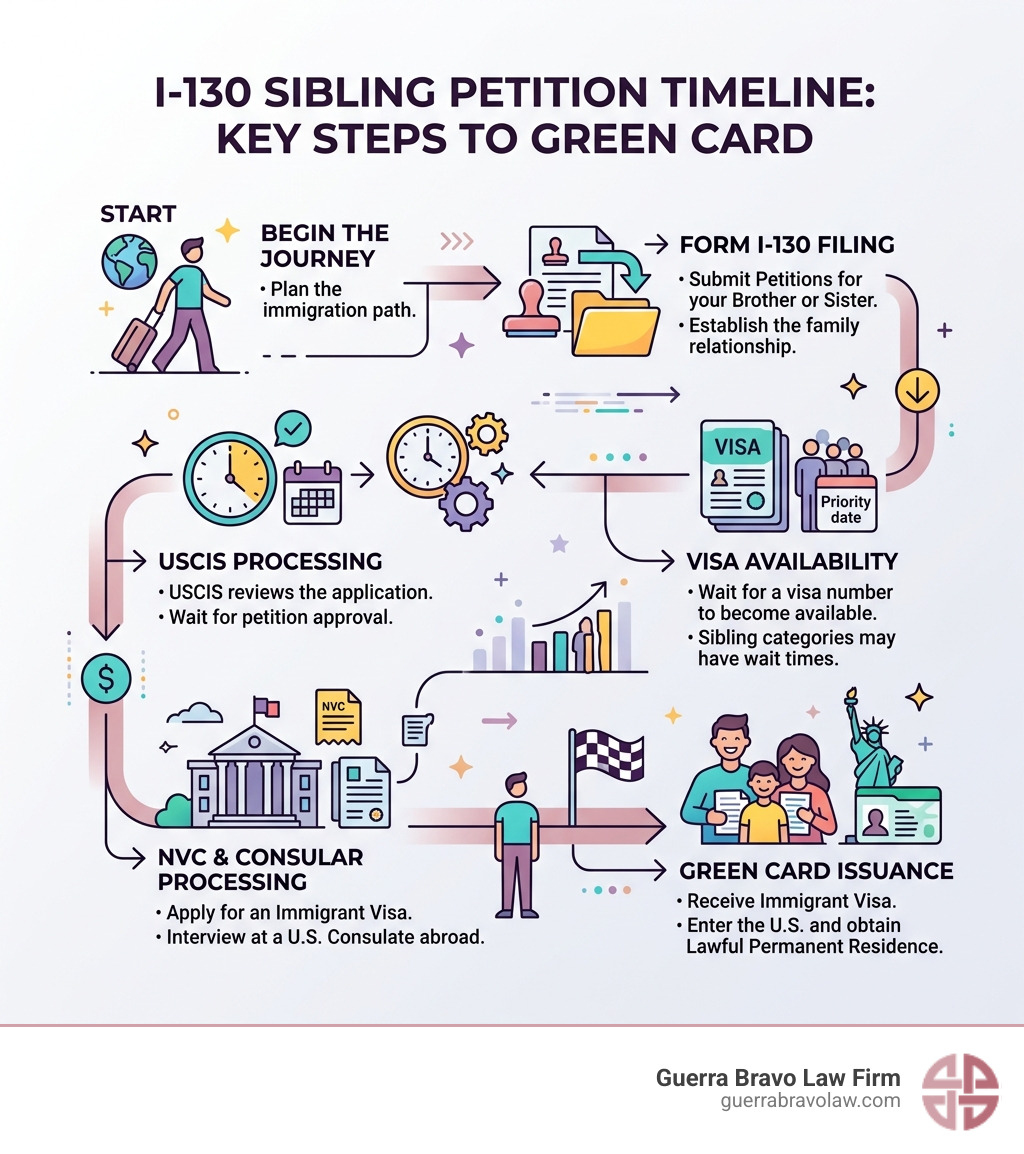
Step 1: Complete Form I-130
Make sure you are using the most recent version of the form (currently the 04/01/2024 edition). USCIS is notorious for rejecting forms just because a new version was released a week prior.
Be Thorough: Every field matters. If a question doesn't apply to you, type "N/A" or "None."
Choose the Path: In Part 4, you must decide if your sibling will apply for "Adjustment of Status" (if they are already legally in the U.S.) or "Consular Processing" (if they are abroad). Do not fill out both. This is a common mistake that causes major confusion at USCIS.
Check the Timeline: You can see what to expect next in our Form I-130 Timeline.
Step 2: Pay the Filing Fee
The government doesn't work for free! As of 2026, the fees are tiered based on how you file.
Online Filing: $625. You’ll pay this directly through your myUSCIS account using a credit card or bank transfer.
Paper Filing: $675. You can pay via check or money order, or use Form G-1450, Authorization for Credit Card Transactions.
Verify Always: Fees change. Check the USCIS Fee Schedule before you hit send.
Step 3: Submit the Evidence Packet
If you file by mail, you’ll send your packet to a USCIS "Lockbox." If you file online, you’ll upload digital copies.
Translations: If your sibling's birth certificate is in Spanish (very common for our clients from Mexico), you must provide a certified English translation.
Photocopies: Never send original documents (like your actual birth certificate) unless USCIS specifically asks for them. They may not return them!
For our Spanish-speaking community, we have a specific guide: Ciudadano americano pedir a un hermano vivir a EE.UU..
Understanding the F4 Category and Priority Dates
This is the part of the i 130 for sibling process that requires the most patience. Because the number of sibling visas is capped every year, there is a massive "backlog." Your sibling is placed in the Fourth Preference (F4) category.
What is a Priority Date?
Your "Priority Date" is simply the day USCIS receives your I-130 petition. Think of it as your ticket number at a very, very busy deli. You can’t get your "sandwich" (the visa) until your number is called.
You must track this date every month by looking at the Visa Bulletin issued by the Department of State. When the date on the bulletin matches or passes your priority date, your visa is finally available.
Current Wait Times and Backlogs
Wait times fluctuate based on how many people from a specific country are applying. The U.S. has "per-country limits," meaning no single country can hog all the visas.
General/China/India: The wait is often 14 to 16 years.
Mexico: Because of the high volume of applicants, the wait for siblings from Mexico can exceed 20 to 25 years.
Philippines: Similar to Mexico, the backlog often stretches past 20 years.
While you wait, you can Check the status of the case online to ensure the I-130 itself has been approved. For a deeper understanding of these categories, see our Family-Based Petition Complete Guide.
What Happens After Your Sibling’s I-130 is Approved?
Approval of the i 130 for sibling petition is a major milestone, but it doesn't mean your sibling can hop on a plane tomorrow. It simply means USCIS agrees that you are siblings.
The Role of the National Visa Center (NVC)
Once the I-130 is approved, USCIS sends the file to the National Visa Center (NVC). The NVC is like a waiting room. They will hold the petition until your priority date is close to becoming "current."
When the time comes, the NVC will send a "Welcome Letter." This is the signal to start the second half of the race. You’ll pay more fees and submit more forms (like the DS-260). If you have questions for them, you can use the NVC Contact Information.
The Final Steps to Residency
Form I-864, Affidavit of Support: You (the petitioner) must prove you can financially support your sibling. Your income must be at least 125% of the U.S. poverty level. If you don't make enough, you might need a joint sponsor.
Medical Examination: Your sibling will visit an authorized doctor in their home country to ensure they don't have communicable diseases that would make them "inadmissible."
Consular Interview: Your sibling will go to the U.S. Embassy or Consulate (like the one in Matamoros or Ciudad Juárez) for an interview with a consular officer.
If you need to update the NVC or check on a delayed case, you can use the Public Inquiry Form for NVC. You can also learn more about Family Petitions on our site.
Frequently Asked Questions about Sibling Green Cards
Can my sibling stay in the U.S. while the petition is pending?
This is a huge point of confusion. Filing an i 130 for sibling does not give your sibling any legal right to be in the U.S. It is not a travel document or a work permit.
If your sibling is already here on a student visa or a work visa, they must maintain that status independently. If they stay in the U.S. without status while the I-130 is pending, they could be deported and barred from returning for up to 10 years, effectively ruining their chance at the Green Card they’ve waited two decades for.
What are common mistakes to avoid when filing?
The "Double Dip": Filling out both the Adjustment of Status and Consular Processing sections. Pick one!
Missing Signatures: If you file by paper and forget to sign, USCIS will send the whole thing back.
Name Change Neglect: If you or your sibling changed your name (usually through marriage), you must include the legal document proving that change. If the names on the birth certificates don't match the names on the form, USCIS will get suspicious.
Can I appeal if the I-130 petition is denied?
Yes, you can appeal to the Board of Immigration Appeals (BIA). However, appeals are slow and expensive. In many cases, if the denial was for a simple mistake (like a missing document), it is often faster to just file a brand-new i 130 for sibling petition with the correct information.
Conclusion
Navigating the i 130 for sibling process requires more than just filling out a form; it requires a long-term strategy and extreme attention to detail. Because you could be waiting 15 to 20 years for a visa to become available, the last thing you want is a denial or a complication two decades from now because of a mistake made today.
At Guerra Bravo Law Firm, we understand the stakes. Attorney Iris Guerra Bravo brings over 14 years of "insider" experience from her time with ICE and DHS. We use that battle-tested knowledge to build individualized legal strategies for families across the Rio Grande Valley—from McAllen and Mission to Pharr and Weslaco. We don't just see paperwork; we see a family that deserves to be together.
If you are ready to start the journey of bringing your brother or sister to the United States, don't leave it to chance. Professional guidance can ensure your petition stands the best possible chance of success.