

family reuniting at airport - family based immigration attorney

Don't Go It Alone: Find Your Family Based Immigration Attorney Today

March 20, 202610 min read

Why Reuniting with Family Requires Expert Legal Guidance

A family based immigration attorney helps U.S. citizens and lawful permanent residents bring loved ones to the United States by navigating complex visa petitions, sponsorship requirements, and immigration interviews.

Quick Answer: What Does a Family Based Immigration Attorney Do?

  • Files petitions for spouses, children, parents, and siblings

  • Prepares financial documents to meet sponsorship income requirements

  • Guides clients through consular interviews or adjustment of status

  • Handles refusals and appeals when cases are denied

  • Overcomes inadmissibility issues like criminal history or prior overstays

Bringing a family member to the United States is one of the most personal and high-stakes legal processes you can undertake. The immigration system is built around family reunification, but it's also filled with strict deadlines, confusing forms, and potential pitfalls that can delay your case by months—or even years.

One small mistake on a petition can trigger a Request for Evidence (RFE) or outright denial. A missing document at your interview can send you back to square one. And if you're dealing with past immigration violations, criminal history, or a refusal, the path forward becomes even more complicated.

That's where a family based immigration attorney makes all the difference. They don't just fill out forms—they build your case, anticipate problems before they arise, and fight for your family when things go wrong.

Whether you're sponsoring a spouse, bringing your children to safety, or petitioning for aging parents, you deserve clear answers and a strategy that works. This guide will walk you through everything you need to know about hiring the right attorney, understanding the sponsorship process, and avoiding the mistakes that lead to delays or denials.
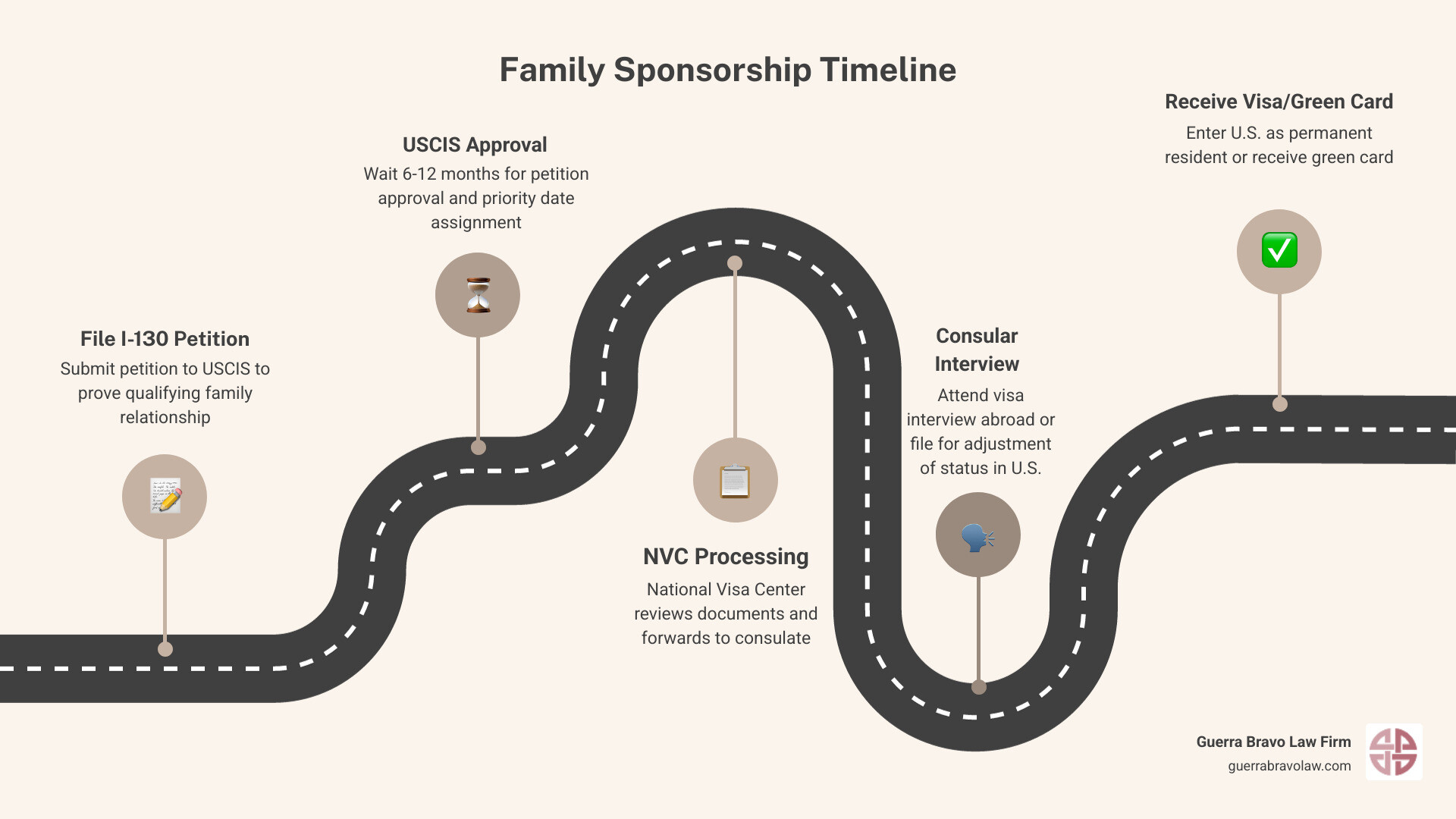
Infographic showing the family sponsorship timeline: Step 1 - File I-130 petition with USCIS, Step 2 - Wait for approval (6-12 months), Step 3 - National Visa Center processes case, Step 4 - Attend consular interview or file for adjustment of status, Step 5 - Receive immigrant visa or green card - family based immigration attorney infographic roadmap-5-steps

═══

Understanding the Role of a Family Based Immigration Attorney

Navigating the U.S. immigration system can feel like trying to find your way through a maze where the walls keep moving. Laws change, policies shift with new administrations, and government backlogs can turn a one-year wait into a five-year ordeal. A family based immigration attorney acts as your professional navigator, ensuring you don't take a wrong turn that results in a permanent bar or a heartbreaking separation.

attorney reviewing complex immigration documents with a client - family based immigration attorney

In places like McAllen and across the Rio Grande Valley, we see how high the stakes are. Whether you are dealing with U.S. Citizenship and Immigration Services (USCIS) or the National Visa Center (NVC), the paperwork must be flawless. An attorney provides more than just a signature; they provide a procedural strategy tailored to your family's unique history.

Core Legal Services Provided:

  • Case Evaluation: We don't just look at names and dates. We analyze relationship eligibility, potential grounds for inadmissibility (like prior unlawful presence), and whether a specific visa category is actually the fastest path for your loved one.

  • Document Preparation: Gone are the days of just sending in a marriage license. Today, you need a mountain of "bona fide" evidence—birth certificates, financial records, photos, and affidavits—all organized exactly how the government wants to see them.

  • Communication Liaison: When you hire an attorney, we become the primary point of contact. This means we handle the "Requests for Evidence" (RFEs) and ensure that no notice from the government goes unanswered.

  • Interview Coaching: The interview is often the most nerve-wracking part of the process. We prepare families for high-stakes consular or adjustment of status interviews, helping you understand what questions to expect and how to answer honestly and confidently.

═══

Qualifying Relationships and Sponsorship Categories

Not every family relationship qualifies for a green card. The U.S. government has very specific definitions of who counts as a "relative" for immigration purposes. Understanding these categories is the first step in determining how long your family will be waiting.

Sponsorship Eligibility in the U.S. and Canada:

While we focus on U.S. law here in Texas, it is helpful to see how our neighbors compare, especially for families with members on both sides of the border.

  • Spouses and Partners:

    • United States: The U.S. recognizes same-sex marriages for all immigration benefits (since 2013). However, unlike Canada, the U.S. does not recognize common-law partnerships for immigration sponsorship. You must have a legal marriage certificate.

  • Children:

    • In the U.S., this generally includes unmarried children under the age of 21. Once a child turns 21 or gets married, they move into a different (and much slower) visa category.

  • Parents and Grandparents:

    • U.S. citizens who are at least 21 years old can petition for their parents. There is no "lottery" like there is in Canada; if you meet the requirements, a visa is always available for a parent of a U.S. citizen.

Immediate Relatives vs. Preference Categories for a Family Based Immigration Attorney

The "waiting line" is the biggest source of frustration for our clients. The U.S. system divides family members into two main groups:

1. Immediate Relatives (No Annual Cap) These visas are always available. There is no "line" other than the time it takes the government to process the paperwork. This group includes:

  • Spouses of U.S. citizens.

  • Unmarried children (under 21) of U.S. citizens.

  • Parents of U.S. citizens (if the citizen is over 21).

2. Family Preference Categories (Subject to Annual Limits) These relatives must wait for a "priority date" to become current on the Visa Bulletin. Depending on the country of origin (especially for those from Mexico), the wait can be decades.

  • F1: Unmarried adult sons and daughters of U.S. citizens.

  • F2A: Spouses and unmarried children of Lawful Permanent Residents (Green Card holders).

  • F2B: Unmarried adult sons and daughters of Lawful Permanent Residents.

  • F3: Married sons and daughters of U.S. citizens.

  • F4: Brothers and sisters of adult U.S. citizens.

═══

Navigating the Application Process: From Filing to Interview

The journey to a green card is a multi-step process that requires precision at every stage. Whether your family member is already in the U.S. (Adjustment of Status) or waiting abroad (Consular Processing), the requirements are rigorous.

Key Procedural Steps:

  • The Petition (Form I-130): This is the "foundation" of your case. It proves to the government that a qualifying relationship exists. Filing this incorrectly can lead to years of delays.

  • Financial Sponsorship (Affidavit of Support): This is where many DIY applications fail. U.S. sponsors must prove they can support their relative at 125% of the Federal Poverty Guidelines. If your income isn't high enough, you may need a joint sponsor. We help you navigate these complex tax and income requirements to ensure your relative isn't found "inadmissible" on public charge grounds.

  • The Interview: This is the "final exam." For spouses, the officer is looking for "marriage fraud." They will ask about your daily lives, your history together, and your future plans. We make sure you are prepared with the right evidence to prove your relationship is real.

  • Conditional Residency: If you have been married for less than two years when the green card is approved, your spouse will receive a "conditional" green card valid for only two years. You must file a petition to remove these conditions within the 90 days before the card expires. Failing to do this can lead to deportation.

═══

Overcoming Challenges: Inadmissibility, Refusals, and Appeals

Sometimes, even a perfect application isn't enough. If a family member has a "black mark" on their record, the government may deny the visa. This is where a family based immigration attorney with litigation experience becomes essential.

Common Pitfalls and Solutions:

  • Inadmissibility: This can be caused by health issues, a criminal record, or "unlawful presence" (staying in the U.S. without a visa). We often help families apply for I-601 or I-601A waivers. These "hardship waivers" argue that the U.S. citizen sponsor would suffer "extreme hardship" if their relative were not allowed to stay.

  • Refusals: If a case is denied, you have options. We can help you decide whether it is better to file a Motion to Reopen/Reconsider (I-290B), appeal to the Board of Immigration Appeals (BIA), or simply start over with a stronger application.

  • Complex Cases: We handle the "heartbreak" cases—orphaned siblings, relatives over 18 seeking humanitarian relief, or victims of domestic violence (VAWA) who need to sponsor themselves because their U.S. citizen spouse is abusive.

How a Family Based Immigration Attorney Handles Complex Cases

In the Rio Grande Valley, we deal with "battle-tested" scenarios every day. When the government tries to separate a family, you need an attorney who knows how the "other side" thinks.

Advanced Legal Strategies:

  • Administrative Holds: Is your visa stuck in "Administrative Processing" at an embassy for months with no explanation? We can contact the Department of State or even file a Mandamus lawsuit in federal court to force the government to make a decision.

  • Fraud Allegations: If the government suspects a marriage is a "sham," they may conduct a "Stokes Interview" (separate questioning). We provide the aggressive defense needed to prove the validity of your union.

  • Removal Proceedings: If a family member is in immigration court facing deportation, we provide a robust defense, seeking "Cancellation of Removal" or other forms of relief to keep the family unit intact.

═══

Frequently Asked Questions about Family Sponsorship

How long does the family sponsorship process typically take? While timelines vary by category and country, most immediate relative petitions (like for a spouse) take approximately 12 to 18 months. However, preference categories for siblings or adult children from countries like Mexico can take several years, or even decades, depending on the priority dates published in the monthly Visa Bulletin.

What are the primary costs involved in family immigration? Costs include government filing fees (which can exceed $1,700 for an adjustment of status), medical exam costs (usually $200–$500), and legal fees. At Guerra Bravo Law Firm, we pride ourselves on transparency. Many of our family immigration services are offered at flat-fee rates so you know exactly what to expect.

Who is ineligible to sponsor a family member? You may be barred from sponsoring if you are under 18, have certain criminal convictions (particularly those involving crimes against minors under the Adam Walsh Act), have failed to provide financial support for a relative you sponsored in the past, or are currently in removal proceedings yourself.

Can I sponsor my fiancé(e)? Yes, through a K-1 visa. You must prove you have met in person within the last two years and intend to marry within 90 days of your fiancé(e) entering the United States. Once married, they can apply for a green card through adjustment of status.

What if my spouse is already in the U.S. without a visa? This is a complex situation. If they entered legally (with a visa) but overstayed, they may be able to adjust status. If they entered without inspection, they may need a "provisional waiver" (I-601A) and will likely have to attend an interview in their home country. Never attempt this without a family based immigration attorney, as a mistake could lead to a 10-year bar from entering the U.S.

═══

Conclusion

At Guerra Bravo Law Firm, we believe that no one should have to navigate the complexities of the U.S. immigration system alone. Your family's future is too important to leave to chance or "DIY" forms found on the internet.

Why Choose Guerra Bravo Law Firm? We serve families throughout McAllen, Brownsville, Edinburg, and the entire Rio Grande Valley. What sets us apart is our unique perspective. Our lead attorney, Iris Guerra Bravo, brings over 14 years of "insider" experience from her time with ICE and DHS. This means we don't just know the law—we know the strategies the government uses and how to counter them effectively.

We offer battle-tested, individualized legal strategies for even the most complex cases, including deportation defense and waivers. Whether you are bringing a new spouse to the U.S. or fighting to keep a parent from being removed, we are here to provide the compassionate and competent representation you deserve.

Ready to bring your family home?

Don't let paperwork stand in the way of your family's happiness. Contact us today to schedule your consultation and take the first step toward your new life together.

Find the right legal support for your family today

This guide is for informational purposes only and does not constitute legal advice. Immigration laws are subject to change, and you should always consult with a qualified attorney regarding your specific case.

Guerra Bravo Law Firm is a Texas-based immigration law firm led by experienced attorneys dedicated to helping individuals, families, and businesses navigate complex immigration challenges. 

With years of hands-on experience and a deep understanding of U.S. immigration law, our team is committed to providing accurate information, practical guidance, and compassionate advocacy through every stage of the legal process.

Guerra Bravo Law Firm

Guerra Bravo Law Firm is a Texas-based immigration law firm led by experienced attorneys dedicated to helping individuals, families, and businesses navigate complex immigration challenges. With years of hands-on experience and a deep understanding of U.S. immigration law, our team is committed to providing accurate information, practical guidance, and compassionate advocacy through every stage of the legal process.

Instagram logo icon
Youtube logo icon
Back to Blog