

January 21, 2026
Navigating Family Sponsorship for Permanent Residency
Navigating Family Sponsorship for Permanent Residency
Why Family Sponsorship for Permanent Residency Matters
PR family sponsorship allows U.S. citizens and Lawful Permanent Residents (green card holders) to bring their close family members to live permanently in the United States. It’s one of the most common pathways to a green card, reuniting over 100,000 families each year.
Quick Overview: Two Main Paths to PR Family Sponsorship
-
Adjustment of Status - For family members already in the U.S. legally
-
Consular Processing - For family members living abroad
Who Can Sponsor:
-
U.S. citizens (can sponsor spouses, children, parents, siblings)
-
Green card holders (can sponsor spouses and unmarried children)
Processing Time:
-
Immediate relatives: 12-24 months
-
Family preference categories: Several years (depends on visa availability)
Cost:
-
Sponsoring spouse/partner: $1,205 minimum
-
Sponsoring child: $170 minimum
Reuniting with loved ones is one of the most emotional and important goals for immigrant families. Whether you’re a U.S. citizen wanting to bring your spouse to America, or a green card holder hoping to reunite with your children, the family sponsorship process can feel overwhelming.
The reality is that family-based immigration involves multiple government agencies, strict deadlines, and detailed documentation requirements. One mistake on a form can delay your case by months or even lead to a denial.
This guide breaks down the entire PR family sponsorship process into clear, manageable steps. You’ll learn which visa category applies to your situation, what documents you need, and how to avoid common pitfalls that delay applications.
Understanding the Pathways to a Family-Based Green Card
For a foreign citizen to live permanently in the United States, they generally need an immigrant visa. The first step in this journey is sponsorship by a qualifying relative. This relative, known as the petitioner, must be at least 21 years old and either a U.S. citizen or a Lawful Permanent Resident (LPR), also known as a Green Card holder. The foreign citizen seeking to immigrate is called the beneficiary. The specific type of family-based visa they apply for depends on the relationship to the sponsor and the sponsor’s immigration status. You can find more information about these categories on our page about Family Petitions.
We recognize that understanding these categories is crucial, as they dictate processing times and annual availability. Let’s explore the two primary types of family-based immigrant visas: Immediate Relative (IR) visas and Family Preference (F) visas.
Immediate Relative (IR) Visas
Immediate Relative visas are reserved for the closest family members of U.S. citizens. The significant advantage of this category is that there are no annual limits on the number of visas issued. This means that once the petition is approved and other requirements are met, a visa is generally available without a waiting period, leading to much faster processing times compared to other categories.
Who Qualifies as an Immediate Relative?
-
Spouses of U.S. citizens: This includes both opposite-sex and same-sex spouses.
-
Unmarried children under 21 years of age of U.S. citizens: These are typically biological, adopted, or stepchildren.
-
Parents of U.S. citizens: The U.S. citizen petitioner must be at least 21 years old to sponsor a parent.
Common visa types within this category include IR1 (spouse of a U.S. citizen), CR1 (conditional spouse of a U.S. citizen if married less than two years), IR2 (child of a U.S. citizen), and IR5 (parent of a U.S. citizen). For a comprehensive list and further details, you can Check the U.S. Department of State’s chart of immigrant visa categories.
Family Preference (F) Visas
Family Preference visas are for other specific, more distant family relationships with a U.S. citizen, and for certain relationships with a Lawful Permanent Resident (Green Card holder). Unlike Immediate Relative visas, these categories are subject to annual numerical limits set by Congress. This often results in a waiting period, sometimes several years long, for a visa to become available. This waiting period is determined by the beneficiary’s “priority date” and the visa category.
Who Qualifies for Family Preference Visas?
-
First Preference (F1): Unmarried sons and daughters (21 years of age or older) of U.S. citizens.
-
Second Preference (F2):
-
F2A: Spouses and unmarried children (under 21 years of age) of Lawful Permanent Residents.
-
F2B: Unmarried sons and daughters (21 years of age or older) of Lawful Permanent Residents.
-
-
Third Preference (F3): Married sons and daughters of U.S. citizens.
-
Fourth Preference (F4): Brothers and sisters of U.S. citizens (the U.S. citizen must be at least 21 years old).
To determine the current waiting times for these categories, we regularly consult the Visa Bulletin published by the U.S. Department of State. This bulletin indicates which priority dates are current, meaning visas are available for those who filed their petitions on or before that date.
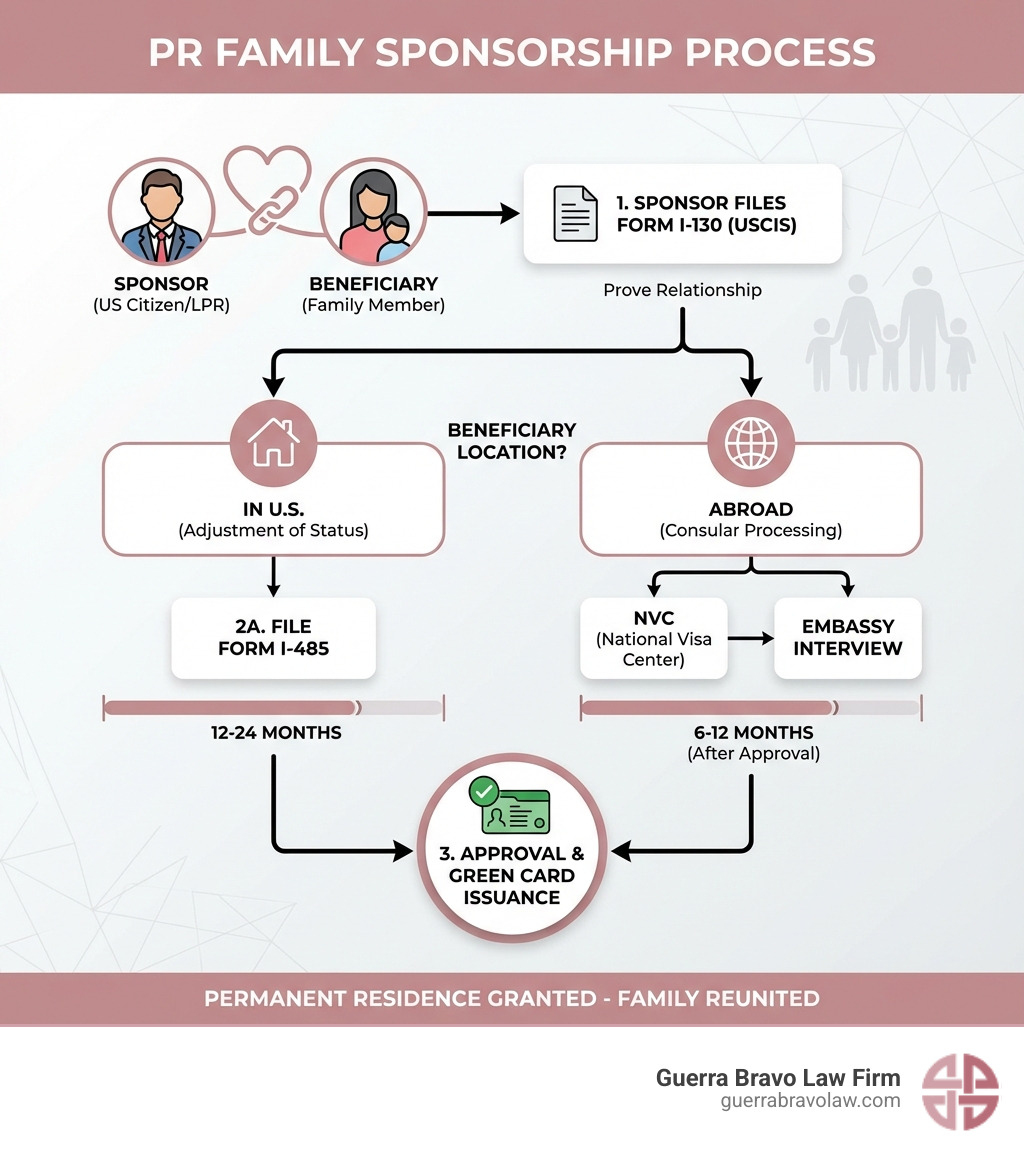
The Complete PR Family Sponsorship Application Process
Navigating the PR family sponsorship process requires careful attention to detail and adherence to specific steps. From the initial petition to the final interview, each stage plays a critical role in reuniting families. Our firm is dedicated to helping families in McAllen, Edinburg, Pharr, and throughout the Rio Grande Valley understand and successfully complete this journey, ensuring compliance with all US Immigration Law insights.
Step 1: Filing the Initial Petition
The very first step in almost all family-based immigration cases is for the U.S. citizen or Lawful Permanent Resident (LPR) sponsor to file Form I-130, Petition for Alien Relative, with U.S. Citizenship and Immigration Services (USCIS). This form establishes the qualifying relationship between the petitioner and the beneficiary.
Key aspects of filing Form I-130:
-
Purpose: The I-130 form is used to prove that a legitimate family relationship exists that qualifies for immigration under U.S. law.
-
Proof of Relationship: You must provide compelling evidence of your relationship, such as birth certificates, marriage certificates, adoption decrees, and other supporting documentation. For spouses, evidence of a bona fide marriage (joint bank accounts, photos, affidavits) is crucial.
-
One Petition Per Person: Each person you sponsor needs a separate Form I-130.
-
Submission: You can Submit a United States Citizenship and Immigration Services (USCIS) Form I-130 either online or by mail. We often advise our clients on the best submission method for their specific circumstances.
-
Case Status Tracking: After filing, you can track the progress of your petition on the USCIS website using your receipt number.
An approved I-130 petition does not grant any immediate benefits but establishes a place in line for visa processing. Once the I-130 is approved, the process diverges based on whether the family member (beneficiary) is already in the U.S. or is currently living abroad.
Step 2A: Adjustment of Status (For Applicants in the U.S.)
If your family member is already in the United States, and they meet specific eligibility criteria, they may be able to apply for Adjustment of Status. This process allows them to obtain a Green Card without having to leave the country. This is a common pathway for individuals in the Rio Grande Valley who may have entered legally and are now eligible for sponsorship.
Eligibility and Process for Adjustment of Status:
-
Form I-485: The core application for Adjustment of Status is Form I-485, Application to Register Permanent Residence or Adjust Status.
-
Concurrent Filing: In many cases, especially for Immediate Relatives, you can file Form I-485 concurrently with Form I-130, or while the I-130 is pending or approved.
-
Lawful Entry: A fundamental requirement is that the applicant must have been “inspected and admitted” or “inspected and paroled” into the U.S. This means they must have entered the country legally with permission from an immigration officer.
-
Maintaining Status: For family preference categories, maintaining lawful status since arrival in the U.S. is generally required for the principal applicant.
-
Biometrics Appointment: After filing, applicants typically receive an appointment notice for biometrics (fingerprints and photograph) at a local Application Support Center (ASC).
-
Work Authorization (Form I-765): While the I-485 is pending, applicants can apply for an Employment Authorization Document (EAD) using Form I-765, allowing them to work legally in the U.S.
-
Advance Parole (Form I-131): If the applicant needs to travel outside the U.S. while their I-485 is pending, they must apply for an Advance Parole document using Form I-131. Leaving the U.S. without this document can lead to the abandonment of the I-485 application.
We guide our clients through the intricacies of Adjustment of Status, ensuring all conditions are met and potential bars to adjustment are addressed.
Step 2B: Consular Processing (For Applicants Abroad)
If your family member is living outside the United States, or is ineligible for Adjustment of Status, they will go through Consular Processing. This involves working with the National Visa Center (NVC) and a U.S. Embassy or Consulate in their home country.
Key stages of Consular Processing:
-
National Visa Center (NVC): Once USCIS approves the I-130 petition, it is forwarded to the NVC. The NVC collects required documents, immigrant visa application fees, and supporting affidavits. They will instruct the beneficiary to submit necessary forms and civil documents.
-
Fee Payment: Both the immigrant visa application fee and the Affidavit of Support fee must be paid.
-
Document Submission: The NVC requires various documents, including civil documents (birth certificates, marriage certificates, police certificates), financial documents (Affidavit of Support), and the immigrant visa application (DS-260).
-
Embassy or Consulate Interview: Once all documents are processed and a visa number is available (for preference categories), the NVC schedules an interview at the appropriate U.S. Embassy or Consulate. For our clients whose family members are in Mexico or other countries, this means preparing them for interviews at consulates like the one in Ciudad Juarez.
-
Medical Examination: Before the interview, the applicant must undergo a medical examination by an authorized physician.
-
Visa Issuance: If the interview is successful and the applicant is found admissible, an immigrant visa is issued. The applicant then travels to the U.S. and is officially admitted as a Lawful Permanent Resident.
We carefully prepare our clients for Consular Processing, ensuring they understand each step and are ready for their interview.
Key Eligibility Rules and Potential Roadblocks
The path to PR family sponsorship is not just about filing forms; it also involves meeting strict eligibility criteria for both the sponsor and the sponsored individual. There are also potential roadblocks, known as grounds of inadmissibility, which can complicate or even prevent a Green Card approval. For detailed guidance on navigating these complexities, our firm offers comprehensive support, drawing on our expertise as A guide to family immigration lawyers.

Who is Eligible for PR Family Sponsorship?
The eligibility requirements apply to both the U.S. citizen or LPR (the petitioner/sponsor) and the foreign national (the beneficiary/applicant).
Sponsor Requirements:
-
Status: Must be a U.S. citizen or a Lawful Permanent Resident (Green Card holder).
-
Age: Must be at least 18 years old.
-
Domicile: Must reside in the U.S. (or intend to re-establish domicile in the U.S. by the time the sponsored relative becomes a permanent resident). This is crucial for sponsors living in areas like the Rio Grande Valley.
-
Financial Capacity: Must meet specific income requirements (discussed below) to financially support the sponsored family member.
Beneficiary Requirements:
-
Qualifying Family Relationship: Must have a legitimate family relationship with the sponsor that falls into one of the Immediate Relative or Family Preference categories.
-
Admissibility: Must be admissible to the U.S., meaning they do not fall under any of the grounds of inadmissibility.
Financial Requirements for PR Family Sponsorship
A critical component of PR family sponsorship is demonstrating that the sponsored individual will not become a “public charge” in the U.S. This is established through the Affidavit of Support.
-
Form I-864, Affidavit of Support: The sponsor must complete and sign Form I-864, a legally binding contract promising to financially support the sponsored family member.
-
Income Threshold: The sponsor’s household income must be at least 125% of the Federal Poverty Guidelines for their household size. For active duty U.S. military personnel sponsoring a spouse or child, the threshold is 100% of the Federal Poverty Guidelines.
-
Sponsor’s Income: USCIS will review the sponsor’s most recent federal income tax returns and other financial documents to determine if they meet this requirement.
-
Joint Sponsors: If the primary sponsor’s income is insufficient, a joint sponsor can be used. A joint sponsor must also be a U.S. citizen or LPR, be at least 18 years old, be domiciled in the U.S., and independently meet the 125% income threshold.
-
Length of Obligation: The sponsor’s financial obligation typically lasts until the sponsored individual becomes a U.S. citizen, has worked 40 quarters of covered employment (approximately 10 years), or dies (or the sponsor dies). This undertaking is significant and legally enforceable.
Common Grounds of Inadmissibility
Even with a qualifying relationship and sufficient financial support, a family member can be denied a Green Card if they are found “inadmissible” to the U.S. The Immigration and Nationality Act (INA) lists various reasons why someone might be inadmissible.
Typical grounds of inadmissibility include:
-
Criminal Convictions: Certain criminal offenses, especially those involving moral turpitude or aggravated felonies, can lead to inadmissibility. Even minor offenses can cause issues.
-
Health-Related Grounds: Communicable diseases of public health significance, specific physical or mental disorders with associated harmful behavior, or drug abuse/addiction can make an applicant inadmissible.
-
Immigration Violations: Prior immigration violations such as overstaying a visa, entering the U.S. without inspection, misrepresentation to gain immigration benefits, or previous deportations can trigger inadmissibility.
-
Public Charge Concerns: If the applicant is deemed likely to become primarily dependent on the government for subsistence, they may be found inadmissible. The Affidavit of Support aims to mitigate this.
-
Security-Related Grounds: Involvement in terrorism, espionage, or other activities deemed a threat to U.S. national security.
These grounds are outlined in INA 212(a). In some cases, waivers of inadmissibility may be available, allowing an otherwise inadmissible individual to receive a Green Card. However, obtaining a waiver is complex and requires strong legal arguments and evidence.
Assembling Your Application: A Document Checklist
A carefully prepared application package is crucial for a successful PR family sponsorship. Missing documents, errors, or improper translations can lead to significant delays or even denial. This section outlines the essential documents required for both the sponsor (petitioner) and the applicant (beneficiary).
Documents for the Sponsor (Petitioner)
The U.S. citizen or Lawful Permanent Resident sponsoring their family member must provide documents proving their own status and identity.
-
Proof of U.S. Citizenship or LPR Status:
-
U.S. Citizen: Birth certificate, passport, naturalization certificate, or Certificate of Citizenship.
-
Lawful Permanent Resident: Copy of Green Card (Form I-551).
-
-
Proof of Domicile: Documents showing residence in the U.S., such as a driver’s license, utility bills, or tax returns from a U.S. address.
-
Proof of Financial Ability:
-
Most recent federal income tax returns (Form 1040 and all supporting schedules).
-
W-2s, 1099s, or other proof of income.
-
Employment verification letter.
-
Bank statements or other asset statements (if relying on assets to meet the income threshold).
-
-
Proof of Name Change (if applicable): Marriage certificate, divorce decree, or court order showing legal name change.
Documents for the Applicant (Beneficiary)
The foreign national seeking a Green Card must provide extensive documentation to establish their identity, relationship to the sponsor, and admissibility.
-
Identity and Personal Records:
-
Passport-style Photos: Specific requirements for size and background must be met.
-
Birth Certificate: Long-form birth certificate showing parentage.
-
Passport: Copy of all pages, especially biographical data page and pages with U.S. visas or admission stamps.
-
Form I-94 Arrival/Departure Record: If the applicant entered the U.S. legally, a copy of their I-94 record, which can be obtained from the CBP website.
-
Marriage Certificates (if applicable): For spouses or if the sponsor’s marriage is key to the relationship.
-
Divorce Decrees or Death Certificates (if applicable): For any prior marriages of the applicant or sponsor, proving termination.
-
-
Relationship Evidence: Documents proving the relationship to the sponsor (e.g., birth certificates listing both parent and child, marriage certificates).
-
Admissibility Documentation:
-
Police and Court Records: Certified copies of any criminal records, arrest reports, court dispositions, or evidence of rehabilitation from any country where the applicant has lived.
-
Medical Examination Report: Form I-693, Report of Medical Examination and Vaccination Record, completed by a USCIS-approved civil surgeon (for Adjustment of Status) or by an authorized panel physician (for Consular Processing).
-
-
Application-Specific Forms (depending on the path):
-
Form I-485, Application to Register Permanent Residence or Adjust Status: If applying for Adjustment of Status within the U.S.
-
Form I-765, Application for Employment Authorization: If seeking work authorization while I-485 is pending.
-
Form I-131, Application for Travel Document: If seeking Advance Parole for travel while I-485 is pending.
-
Form DS-260, Immigrant Visa Application (online): For Consular Processing applicants.
-
Important Note on Translations and Certifications: All documents not in English must be accompanied by a complete and accurate English translation. The translator must certify that they are competent to translate and that the translation is accurate. Additionally, copies of documents must often be certified true copies of the original.
Frequently Asked Questions about Family Sponsorship
We understand that the PR family sponsorship process raises many questions. Here, we address some of the most common concerns our clients in the Rio Grande Valley and beyond typically have.
Can the sponsored relative work in the U.S. while the application is pending?
The ability to work in the U.S. while a PR family sponsorship application is pending depends on the processing path:
-
Adjustment of Status Applicants (in the U.S.): Yes, generally. If you have filed Form I-485, you can also file Form I-765, Application for Employment Authorization. Once approved, USCIS will issue an Employment Authorization Document (EAD), which allows you to work legally in the U.S. while your Green Card application is processed. Many applicants file Form I-765 concurrently with their I-485.
-
Consular Processing Applicants (abroad): No. Individuals undergoing Consular Processing cannot work in the U.S. until their immigrant visa is approved, they enter the U.S. with the visa, and become a Lawful Permanent Resident. They do not receive an EAD during this process.
What happens if a sponsor has a criminal conviction?
A sponsor’s criminal conviction can significantly impact their ability to sponsor a family member. The nature and severity of the crime are key factors:
-
Crimes Against Beneficiaries: If a sponsor has been convicted of a “specified offense against a minor” or certain violent crimes against a spouse, child, or other family members, they may be permanently barred from filing an immigrant petition.
-
Other Criminal Offenses: While other convictions might not automatically bar sponsorship, they can raise concerns about the sponsor’s character and ability to fulfill financial obligations. This could lead to increased scrutiny from USCIS.
-
Inadmissibility for Beneficiary: It’s also important to remember that certain criminal convictions of the beneficiary can make them inadmissible to the U.S.
Navigating these issues requires a deep understanding of immigration law. Our Experienced Immigration Lawyer guidance can help assess the implications of any criminal history and explore potential waivers or solutions.
How long does the family sponsorship process take?
The processing time for PR family sponsorship varies significantly depending on several factors:
-
Visa Category: Immediate Relative petitions (spouses, unmarried children under 21, and parents of U.S. citizens) generally have faster processing times because there are no annual visa limits. Family Preference categories, however, are subject to annual quotas, leading to often lengthy waiting periods based on the visa bulletin’s priority dates.
-
USCIS Workload: The volume of applications and the resources of USCIS and the National Visa Center (NVC) can affect processing times.
-
Completeness of Application: Incomplete applications or requests for additional evidence (RFEs) will inevitably cause delays.
-
Country of Origin: For Consular Processing, the specific U.S. Embassy or Consulate handling the case can also influence timelines based on their individual workload.
General Timelines (can vary):
-
Form I-130 Approval: Typically 6 to 12 months.
-
Immediate Relatives (overall): Often 12 to 24 months from I-130 filing to Green Card approval/visa issuance.
-
Adjustment of Status (in U.S.): Usually 12 to 24 months after the I-130 is filed (or approved) and I-485 is submitted.
-
NVC Processing (for Consular Processing): An additional 3 to 6 months after I-130 approval.
-
Consular Processing (abroad): 6 to 12 months after I-130 approval and NVC processing, depending on the embassy/consulate.
We encourage our clients to regularly Check Processing Times on the USCIS website and to consult the Visa Bulletin for family preference categories.
Conclusion
Navigating the complexities of PR family sponsorship can be a daunting task. From understanding the nuances of Immediate Relative versus Family Preference visas to carefully preparing documentation and adhering to strict deadlines, the journey is filled with potential pitfalls. The process demands precision, patience, and a thorough understanding of U.S. immigration law.
At Guerra Bravo Law Firm, we understand the profound importance of family reunification. Our team, led by attorney Iris Guerra Bravo, brings over 14 years of insider experience with ICE and DHS. This unique perspective allows us to offer battle-tested, individualized legal strategies for even the most complex cases, helping families in McAllen, Brownsville, Edinburg, and across the Rio Grande Valley achieve their dreams of permanent residency.
Don’t leave your family’s future to chance. Let us guide you through every step of the PR family sponsorship process, ensuring your application is strong, complete, and resilient. Our commitment is to provide you with the expert legal support needed to bring your loved ones home.
Ready to take the first step towards reuniting your family? Get expert help with your Family Petitions today.
[