
Don't Overstay The Essential Role of a Visa Extension Lawyer
Why Hiring a Visa Extension Lawyer Could Be the Most Important Decision You Make
A visa extension lawyer can be the difference between staying legally in the U.S. and facing deportation, a multi-year re-entry ban, or the loss of everything you've worked for here.
If you need a quick answer on what a visa extension lawyer does and when to hire one:
When to hire a visa extension lawyer:
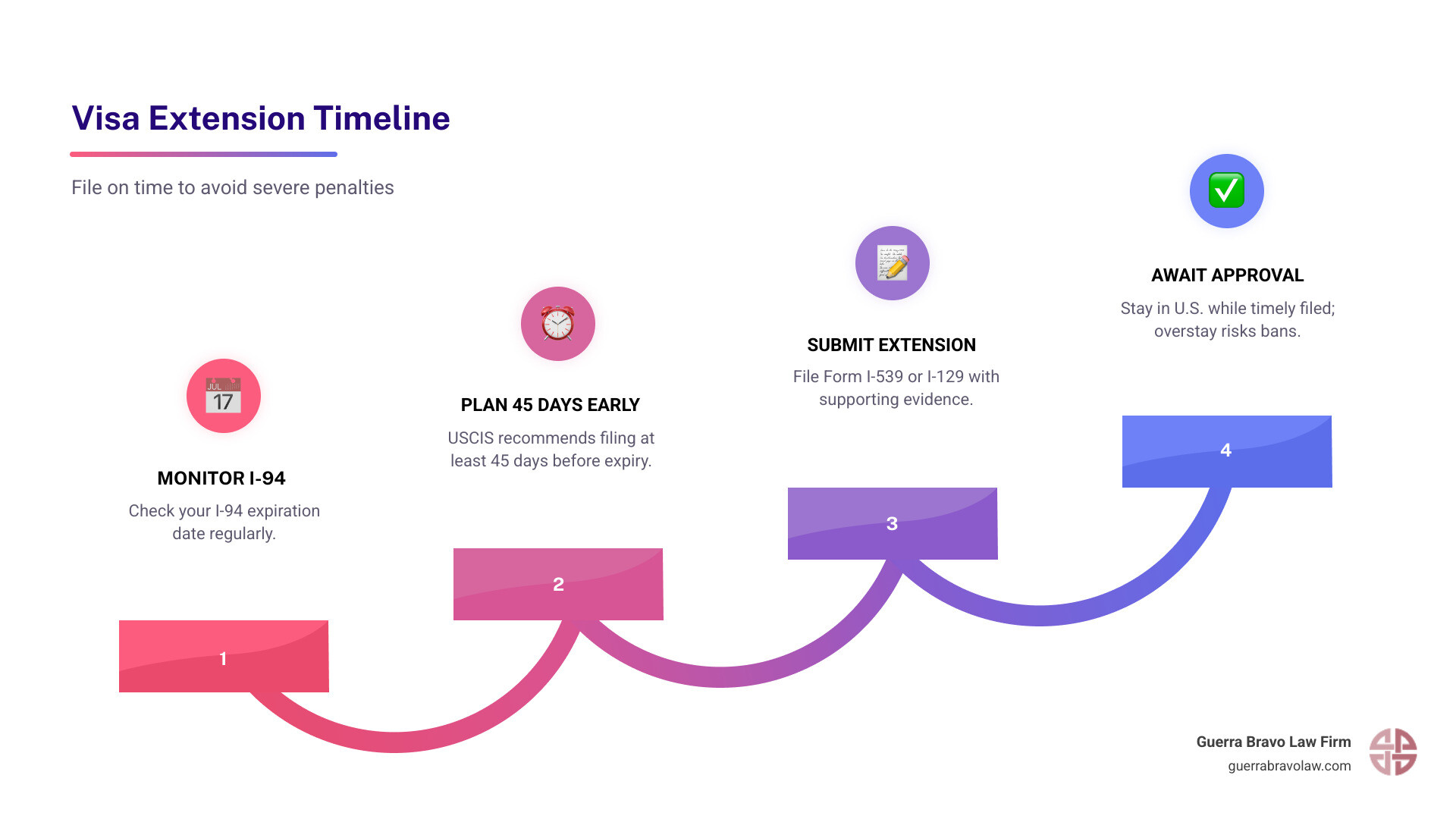
Your I-94 expiration date is approaching (act at least 45 days before it expires)
Your visa extension was denied or you received a Request for Evidence (RFE)
Your job duties, employer, or location have changed while on a work visa
You are unsure whether your visa type is even eligible for an extension
You want to change your visa status at the same time as extending your stay
What a visa extension lawyer does for you:
Reviews your eligibility and recommends the right filing strategy
Prepares and submits Form I-539 (visitors, students) or Form I-129 (work visas)
Gathers and organizes supporting documents to strengthen your case
Files Form G-28 to officially represent you before USCIS
Advises you on travel restrictions and what to do if your extension is denied
The U.S. immigration system is unforgiving when it comes to deadlines. Overstaying your authorized period of stay — even by a single day — can trigger serious consequences. More than 180 days of unlawful presence results in a 3-year bar from re-entry. More than one year means a 10-year bar.
And yet, many people don't realize their status is expiring until it's almost too late.
The stakes are high. Whether you're a professional on an H-1B, a visitor on a B-2, or a student on an F-1 visa, the process of extending your stay involves strict requirements, specific forms, tight deadlines, and documentation that must be exactly right.
This guide walks you through everything you need to know — and explains exactly how an experienced visa extension lawyer protects you at every step.
═══
Understanding U.S. Visa Extensions and Eligibility
When we talk about a "visa extension," we are technically talking about an "extension of stay." While your visa stamp in your passport allows you to travel to a U.S. port of entry, it is your I-94 record (Arrival/Departure Record) that dictates how long you are actually allowed to remain in the country. If you wish to stay past that date, you must petition U.S. Citizenship and Immigration Services (USCIS).
Depending on your visa type, this usually involves filing either Form I-539 (for visitors, students, and dependents) or Form I-129 (for workers). Navigating these forms can be tricky, which is why consulting a Visitor Visa Lawyer is often the safest route to ensure your paperwork reflects lawful admission and a clear intent to follow U.S. laws.
Eligibility Requirements for a Stay Extension
To be eligible for an extension, we must demonstrate to USCIS that you meet several specific criteria. If even one of these is missing, your application could be rejected or denied.
Lawful Admission: You must have been legally admitted to the U.S. with a nonimmigrant visa. If you entered without inspection, you are generally not eligible for an extension of stay.
Current Status: Your nonimmigrant visa status must remain valid at the time of filing. You cannot "extend" a status that has already expired; in those cases, you are technically out of status.
Clean Record: You must not have committed any crimes or engaged in activities that make you ineligible for immigration benefits (such as crimes of moral turpitude or drug offenses).
Passport Validity: Your passport must be valid for the entire duration of the requested extension. USCIS typically requires your passport to be valid for at least six months beyond your stay.
Compliance: You must not have violated the conditions of your original admission. For example, if you are on a B-2 tourist visa, you must not have engaged in unauthorized employment.
Common Visas Eligible for Extension
Not all visas are created equal when it comes to staying longer. Most "nonimmigrant" visas—those intended for temporary stays—allow for some form of extension if you have a valid reason, such as finishing a business project, completing a degree, or continuing medical treatment.
Extending Employment Status with a Visa Extension Lawyer
For professionals working in the Rio Grande Valley or anywhere in the U.S., maintaining work authorization is vital. Employment-based extensions are primarily the responsibility of the employer, but the employee must remain compliant with all visa terms.
H-1B Professionals: These visas are typically granted for an initial 3-year stay. They can be extended to a maximum of 6 years. However, if you have a pending green card application (I-140) that has been approved or pending for over 365 days, a visa extension lawyer can help you secure extensions beyond the 6-year limit.
L-1 Intra-company Transferees: Executives (L-1A) and specialized knowledge staff (L-1B) can seek extensions to continue their work for a U.S. branch of a foreign company. Our L-1 Visa Attorney services focus on proving that the business need for the employee remains valid.
Employer Responsibility: The employer must file Form I-129. This form requires detailed information about the company's financial health and the specific duties of the employee.
Job Changes: If you get a promotion or your job location moves from McAllen to Edinburg, you may need an amended petition. Failing to report these changes can jeopardize your status. For those with extraordinary abilities, our O1 Visa Lawyer Complete Guide details how to handle these transitions.
Student and Visitor Visa Extensions
B-1/B-2 Visitors: If you are here for tourism or medical care, you can often request an extension of up to 6 additional months. You must provide a written statement explaining why you need to stay and proving you have the financial means to support yourself without working.
F-1 Students: Your stay is usually "Duration of Status" (D/S), but if you need more time to finish your program due to a change in major or medical issues, you must work with your Designated School Official (DSO) to update your I-20. Maintaining Student Visa Compliance is essential to avoid being forced to leave before graduation.
Supporting Evidence: USCIS is often skeptical of long-term "visitors." We help you gather evidence of "strong ties" to your home country—such as property deeds, job offers, or family commitments—to prove you don't intend to abandon your foreign residence.
═══
The Critical Timeline and Risks of Overstaying
Timing is everything in immigration law. USCIS is currently facing significant backlogs, meaning a process that used to take weeks might now take months.
The Consequences of a Status Violation
The 45-Day Rule: While you can technically file up until the day your I-94 expires, USCIS strongly recommends filing at least 45 days in advance. This provides a "buffer" in case your application is returned for a missing signature or incorrect fee.
Automatic Revocation: Under Section 222(g) of the Immigration and Nationality Act, if you overstay your authorized period of stay by even one day, the visa stamp in your passport is automatically voided. You would then be required to apply for a new visa in your home country for any future travel.
Unlawful Presence: This is the most dangerous consequence.
3-Year Ban: If you depart the U.S. after accruing more than 180 days but less than one year of unlawful presence.
10-Year Ban: If you depart after accruing one year or more of unlawful presence.
The 240-Day Rule: If you are on an employment-based visa (like an H-1B or L-1) and your employer files a timely extension, you are authorized to continue working for the same employer for up to 240 days while the application is pending.
If you find yourself approaching your expiration date, finding an attorney immediately is the best way to stop the clock on potential penalties.
═══
Why You Need a Visa Extension Lawyer for Your Application
You might be tempted to "DIY" your visa extension to save money. However, a single mistake—like using an outdated form version or sending the wrong filing fee—can lead to a rejection. By the time the rejected package arrives back in your mail, your I-94 may have already expired, leaving you with no legal way to refile from within the U.S.
A visa extension lawyer acts as your shield against these procedural traps. We ensure that every box is checked and every piece of evidence is "battle-ready" for USCIS scrutiny.
Verifying Your Legal Representative
Not everyone who offers "immigration help" is qualified to do so. In places like McAllen and Brownsville, you may encounter "notarios." It is vital to understand the difference:
Bar Membership: A licensed attorney must be a member in good standing of a state bar. You can verify this through state bar websites.
DOJ Accreditation: If a representative is not a lawyer, they must work for a recognized non-profit and be on the List of Recognized Organizations and Accredited Representatives.
Avoid "Notarios": In many Latin American countries, a notario público is a high-level lawyer. In the U.S., a notary public is simply someone authorized to witness signatures. They are not lawyers and cannot give legal advice. Using one can lead to "notario fraud," which can permanently ruin your immigration record.
Form G-28: When you hire us, we file Form G-28. This tells USCIS that we are your official representatives. It allows us to speak with officers on your behalf and ensures that all official notices are sent to our office so we can keep your case on track. This is especially helpful when hiring an Immigration Lawyer for Work Visas to manage complex corporate filings.
How a Visa Extension Lawyer Handles Denials and Appeals
If your extension is denied, the clock starts ticking immediately. Usually, USCIS gives you 30 days to depart the country.
Denial Grounds: Denials often happen because the applicant failed to show they have enough money to stay without working, or they didn't sufficiently prove they intend to go home.
Motion to Reopen or Reconsider: If the officer made a legal error or if you have new, life-changing evidence, we can file a motion to have the case looked at again.
Visa Denial Appeal: If a motion isn't enough, we can navigate a Visa Denial Appeal through the Administrative Appeals Office (AAO).
Departure Grace Period: If an appeal isn't viable, we advise you on how to depart gracefully to avoid a formal deportation order, which carries much harsher penalties.
═══
Frequently Asked Questions about Visa Extensions
Can I travel outside the U.S. while my extension is pending?
Generally, no. If you file Form I-539 to extend your stay and then leave the U.S. before a decision is made, USCIS will consider your application "abandoned." You may then find yourself stuck outside the U.S. without a valid visa to get back in. If you absolutely must travel, consult with us first to see if "Premium Processing" or other strategies can speed up your decision.
Which visas are ineligible for an extension?
Some visas are designed for very specific, short-term purposes and cannot be extended under any circumstances:
Visa Waiver Program (VWP): If you entered via ESTA, you are limited to 90 days. There are almost no exceptions, except for extreme medical emergencies (known as "Satisfactory Departure").
K-1 Fiancé Visas: You have 90 days to get married. If you don't marry within that window, you cannot extend the K-1; you must leave. If you do marry, you don't extend the visa—you apply for a Green Card.
C and D Visas: These are for people transiting through the U.S. or crewmembers on ships/planes. They are strictly temporary.
What are the filing fees for a visa extension?
Filing fees change frequently. Currently:
Form I-539: Usually costs several hundred dollars, and you may also have to pay a biometrics (fingerprinting) fee.
Form I-129: These fees are higher and are typically paid by the employer. Depending on the company's size, there may be additional "Fraud Prevention" or "Worker Training" fees.
Always check the latest USCIS fee schedule or ask your visa extension lawyer for the current total before writing your check.
═══
Conclusion
The U.S. immigration journey is rarely a straight line. Sometimes life happens—a project takes longer than expected, a family member falls ill, or a new job opportunity arises. In these moments, knowing you have a plan to stay legal is the only way to have peace of mind.
Secure Your Stay with Guerra Bravo Law Firm
Navigating the U.S. immigration system requires more than just filling out forms; it requires a strategic approach to protect your future. Guerra Bravo Law Firm in McAllen, TX, provides battle-tested representation for those seeking to extend their stay.
Attorney Iris Guerra Bravo brings over 14 years of insider experience from her time with ICE and DHS. This "insider" knowledge is invaluable; she understands exactly how the government evaluates extension petitions and knows where the common pitfalls lie. Whether you are a professional on an H-1B in Edinburg or a visitor in Mission needing more time with your grandchildren, our firm provides the individualized legal strategies necessary to avoid the pitfalls of overstaying.
Don't leave your legal status to chance. Contact us today to explore our full range of Immigration Services and ensure your American dream stays on track.
═══