

From No to Go: Appealing Your Visa Denial
Understanding Your Visa Denial and What Comes Next
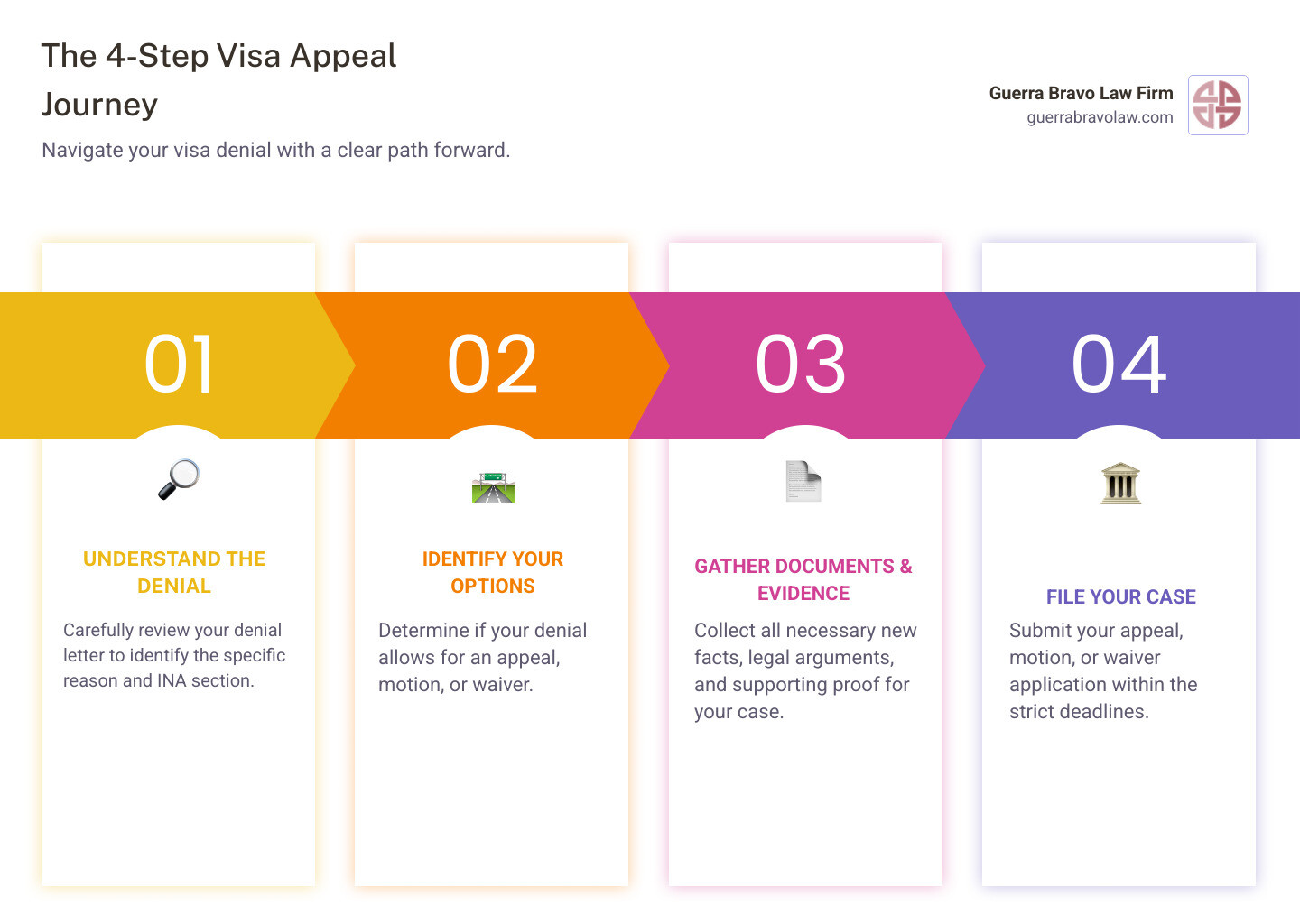
A visa denial appeal is a formal process to challenge a rejected visa application. This can involve requesting a review, filing a motion to reopen or reconsider, or applying for a waiver of ineligibility. The options available depend on the visa type and the reason for denial.
Your visa denial appeal options depend on who denied your visa:
USCIS Denials: File Form I-290B (Motion to Reopen or Reconsider) within 30 days.
Consular Denials (214(b)): No formal appeal; you must reapply with stronger evidence.
Other Consular Denials: Contact the consulate for administrative review options.
Waiver-Eligible Denials: Apply for a waiver of ineligibility (e.g., Form I-601).
Receiving a visa denial is devastating, but a denial is not always the end of your journey. The U.S. immigration system provides pathways to challenge or overcome a negative decision.
The key is understanding why your visa was denied and which options apply. While consular officers and USCIS adjudicators have broad authority, they must follow the law. If they make an error or your circumstances change, you have the right to seek review.
Time is critical. Most appeals and motions must be filed within 30 days of your denial. Missing this deadline can eliminate your options entirely.
First Steps: Decoding the Denial Notice
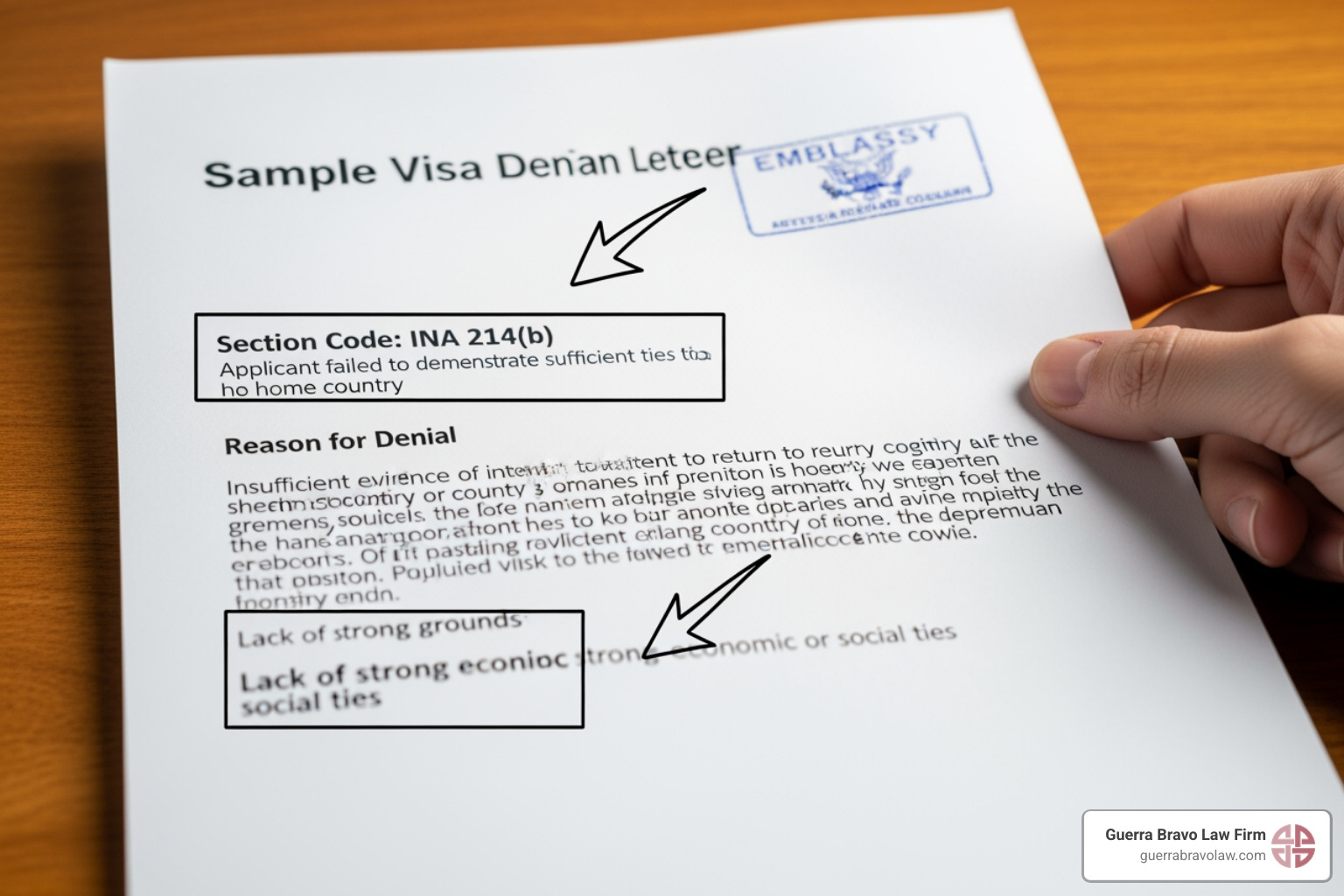
Your denial letter is the most important document in this process. It's a legal explanation that tells you why your application was denied and what you can do about it.
Every denial letter cites a specific section of the Immigration and Nationality Act (INA). This code is your starting point for understanding whether you can file a visa denial appeal, reapply, or pursue a waiver. Consular officers at U.S. Embassies have the final say on visa applications, and their decisions are binding for that specific application. However, understanding the legal basis of their decision is the first step to responding strategically.
Visa application fees are non-refundable. For official guidance, you can learn more from the Department of State about visa denials. Our resources on US Immigration Law can also help you understand the bigger picture.
Common Grounds for Ineligibility (INA Sections)
Visa denials are based on specific legal grounds in the INA. Knowing which section applies to you is essential for building a strategy.
Section 221(g) - Incomplete Application: This is a temporary refusal, not a final denial. It means the consular officer needs more information or your application requires additional administrative processing. You typically have up to one year to submit the missing information. This is a pause, not a rejection.
Section 214(b) - Failure to Prove Non-Immigrant Intent: This is the most common reason for non-immigrant visa denials (e.g., tourist, student). U.S. law presumes you intend to stay permanently unless you prove otherwise. A 214(b) denial means the officer wasn't convinced you have "strong ties" (job, family, property) to your home country. There is no formal visa denial appeal for a 214(b) refusal; you must reapply with new, compelling evidence of your intent to return home.
Section 212(a)(4) - Public Charge: This means the officer believes you are likely to become dependent on government benefits. This is often related to insufficient financial resources. It can be overcome by demonstrating stronger financial support, such as through an Affidavit of Support from a qualifying U.S. sponsor.
Section 212(a)(6)(C)(i) - Fraud or Misrepresentation: This is a serious finding that you willfully misrepresented a material fact to obtain a visa. It typically results in permanent ineligibility. In certain limited circumstances, a waiver may be available, but it is difficult to obtain.
Section 212(a)(9)(B)(i) - Unlawful Presence: This applies if you have overstayed a previous visa. Unlawful presence of more than 180 days but less than one year triggers a 3-year bar from re-entry. Unlawful presence of one year or more triggers a 10-year bar. A waiver may be available if you can demonstrate "extreme hardship" to a qualifying U.S. citizen or lawful permanent resident relative.
The U.S. Visa Denial Appeal Process Explained
Not all visa denials are treated the same, and the term "appeal" can mean different things depending on who denied your visa.
When a visa denial comes from a U.S. Embassy or Consulate—especially under INA Section 214(b)—there is no formal visa denial appeal process. The consular officer's decision is final for that application. Your path forward is to reapply with new, stronger evidence showing your circumstances have changed.
The situation is different if your denial came from U.S. Citizenship and Immigration Services (USCIS), which handles applications filed within the U.S. For USCIS denials, you have access to a formal appeal or motion process. This distinction is critical and shapes your entire strategy.
Consular denials typically require a fresh application, while USCIS denials allow you to challenge the decision through legal motions. Our Immigration Education section offers more resources to help you understand these options.

Filing a Motion: Reopen vs. Reconsider
When USCIS denies your application, you can challenge the decision with a Motion to Reopen or a Motion to Reconsider. Choosing the right one is crucial.
A Motion to Reopen is used when you have new facts or evidence that were not available during your original application. You are asking USCIS to look at your case again with this new information (e.g., affidavits, new documents) that proves you were eligible when you first filed.
A Motion to Reconsider argues that USCIS made a legal mistake. You are not introducing new facts but claiming the decision was based on an incorrect application of law or policy. This requires citing specific statutes, regulations, or case law to support your argument.
Both motions are filed using Form I-290B, Notice of Appeal or Motion, and have strict deadlines. You generally have 30 calendar days from the decision date to file (33 days if the decision was mailed). For certain revocations, the deadline is only 15 days (18 if mailed). There is a filing fee, though a waiver may be requested. For more details, the Board of Immigration Appeals provides more info on motions from the BIA.
Required Documents for Your Visa Denial Appeal
The quality and completeness of your documentation can make or break your case. A successful visa denial appeal or motion tells a compelling story backed by solid evidence.
Key documents include:
Form I-290B, Notice of Appeal or Motion: Completed accurately.
Original Denial Notice: This explains the reason for denial, which your response must address.
Detailed Legal Brief: This is your written argument. For a Motion to Reconsider, it cites legal error. For a Motion to Reopen, it explains the new facts.
Supporting Evidence: This varies by case. It could include financial records, proof of ties to your home country, affidavits, or medical records. Every document must directly address the reason for denial.
Proof of Fee Payment or Fee Waiver Request: Include the filing fee or a completed Form I-912.
Navigating Waivers of Ineligibility
Sometimes, you must acknowledge an issue that makes you inadmissible and ask the government to overlook it. This is done through a waiver of ineligibility.
A waiver is a request for official permission to enter the U.S. despite a disqualifying issue. Approval is discretionary. For most immigrant visa applicants, Form I-601, Application for Waiver of Grounds of Inadmissibility, is used. This covers issues like certain criminal offenses, health problems, and unlawful presence.
Many waivers require proving "extreme hardship" to a qualifying U.S. citizen or lawful permanent resident spouse or parent. This is a high legal standard requiring evidence of suffering far beyond the normal strain of family separation. The consular officer or USCIS will inform you if you might be eligible for a waiver. You can also find out if you are eligible for a waiver on the grounds of inadmissibility via the USCIS website.
After You File: Timelines and Next Steps
After filing your visa denial appeal or motion, the waiting period begins. Understanding the general timelines and procedures can help manage expectations. Immigration cases take time, and different administrative bodies handle different types of reviews. If you're dealing with an employment-based petition, an Immigration Lawyer for Work Visas can provide specific guidance during this period.
The Role of the AAO and BIA
Two key organizations handle appeals of USCIS denials.
The Administrative Appeals Office (AAO) is USCIS's internal appeals body. It reviews appeals for most USCIS decisions, including many employment-based petitions (I-140) and waiver applications (I-601). When you file an appeal (Form I-290B), the original office reviews it first. If they don't overturn their decision, they forward the case to the AAO. The AAO aims to complete its review within 180 days of receiving a complete file, though complex cases can take longer.
The Board of Immigration Appeals (BIA) is part of the Department of Justice, not USCIS. The BIA primarily reviews appeals from immigration judges and certain DHS decisions, particularly regarding family-based immigrant petitions (Form I-130). The BIA has jurisdiction over family-based petition appeals but not employment-based ones.
What to Expect During Processing
Patience is key after filing. Here's a general overview of what happens next.
A motion to reopen or reconsider is first reviewed by the USCIS office that issued the denial. They typically try to adjudicate these motions within 90 days.
If your motion is denied or you filed an appeal, the case moves to the appropriate appellate body (AAO or BIA). The AAO's goal is to issue a decision within 180 days. However, these timelines are estimates, not guarantees. Complex cases will take longer.
You might receive a Request for Evidence (RFE) if the officer needs more information. An RFE is an opportunity to strengthen your case, not a denial. You must respond completely and before the stated deadline to avoid having your case denied.
Eventually, you will receive a final decision notification in writing. The decision will either grant your appeal, deny it, or remand the case (send it back to the original office for further action). A remand often means the appellate body found an issue that needs to be corrected.
You can check your case status online through the USCIS website using your receipt number.
Frequently Asked Questions about Visa Denials
A visa denial raises many questions. Here are answers to common concerns we hear from our clients in the Rio Grande Valley. For personalized guidance on your unique situation, please Contact Us.
Can a friend or relative inquire about my denied visa application?
No. Due to strict confidentiality rules under INA Section 222(f), the U.S. government can only provide information about a denied visa application directly to the applicant. The only exceptions are for your legal representatives, U.S. sponsors, or members of Congress who are acting with your explicit, written permission. This protects your privacy and sensitive immigration information.
How do I find specific appeal procedures for my visa type?
Procedures vary significantly by visa type and the denying agency. Here's how to find the right path forward:
Review your denial notice carefully. It should state the reason for denial and may provide information about appeal rights.
Check the specific U.S. Embassy or Consulate website. If your denial was from a consulate, its website will have instructions for reapplication or review. You can Find a U.S. Embassy or Consulate online.
Consult an experienced immigration attorney. This is the most effective way to identify the correct procedures, forms, and strategies for your specific case and avoid costly mistakes.
What is the timeframe for submitting a visa denial appeal?
Timing is absolutely critical. The deadlines for filing a visa denial appeal or motion with USCIS are strict and cannot be missed.
For most appeals and motions, you have 30 calendar days from the date the decision was served. If the decision was mailed, you get an additional three days, for a total of 33 calendar days.
For certain petition revocations, the deadline is shorter: 15 calendar days, or 18 if the decision was mailed.
It is crucial to calculate this deadline from the date on your denial notice. Extensions are almost never granted, and if you miss the deadline, your appeal or motion will be rejected. The clock starts ticking the moment the denial is issued.
Conclusion: Get Expert Guidance for Your Appeal
Receiving a visa denial is frustrating, but as we've seen time and again in our McAllen office, a denial is not the end of your story.
As this guide has shown, you have options to challenge a denial, including a visa denial appeal, a motion to reopen or reconsider, or a waiver of inadmissibility. The right path forward depends entirely on the specific circumstances of your case.
However, the U.S. immigration system is complex. Choosing the wrong motion, missing the strict 30-day deadline, or submitting incorrect evidence can doom your case. This is why professional legal strategy isn't just helpful—it's critical to protecting your future.
At Guerra Bravo Law Firm, we bring over 14 years of insider experience with ICE and DHS to your case. Attorney Iris Guerra Bravo has seen the immigration system from the inside and understands how government adjudicators think. This battle-tested perspective allows us to craft individualized legal strategies that address the real issues in your case.
We serve families and individuals across the Rio Grande Valley—from McAllen and Brownsville to Edinburg and Harlingen. We've helped countless clients overcome denials by filing carefully documented motions, compelling legal briefs, and persuasive waiver applications. Each case was different, but they all started with a refusal to give up on the American dream.
Your next steps define your future. Let us review your denial notice, explain your realistic options, and build a strategy for your specific situation. Protect your future by exploring your removal defense options and see how our experience can work for you. Contact Us today to get back on track.