Study Smart, Stay Compliant: A Student's Guide to Visa Rules
Why Student Visa Compliance Matters for Your Academic Future
Student visa compliance is the foundation of your ability to study, work, and remain legally in your host country. Whether you are in Canada or the United States, following your visa conditions protects your academic dreams and future opportunities.
Core Requirements for Student Visa Compliance
To maintain your status, you must:
Stay enrolled at a government-approved institution (DLI in Canada, SEVP-certified school in the U.S.)
Make academic progress toward completing your program
Follow all conditions listed on your study permit or Form I-20
Work only when authorized and within permitted hour limits
Keep documents current and report changes promptly
Leave or change status before your authorization expires
The stakes are high. Immigration, Refugees and Citizenship Canada (IRCC) and the U.S. Student and Exchange Visitor Information System (SEVIS) track compliance in real-time. Failure to comply can lead to immediate loss of status, deportation, and bars to future entry.
Compliance is straightforward when you understand the rules. This guide breaks down everything you need to know, from the documents required at entry to employment restrictions and the consequences of non-compliance.
═══
Navigating Student Visa Compliance in Canada
Canadian student visa compliance primarily revolves around your study permit and enrollment at a Designated Learning Institution (DLI). DLIs periodically report on each international student’s enrollment status to Immigration, Refugees and Citizenship Canada (IRCC) to ensure students are actively pursuing their studies.
Essential Documents and Entry Requirements
Preparation is key to a smooth entry. Ensure you have the following:
Study Permit or Letter of Introduction: This letter of introduction from IRCC confirms your approval.
Valid Travel Document: A passport valid for at least six months beyond your stay.
Letter of Acceptance: Must be from a designated learning institution (DLI).
Provincial or Territorial Attestation Letter (PAL/TAL): Required for most students; check for exceptions.
Proof of Financial Support: Evidence of funds for tuition and living expenses as required by IRCC.
eTA or Visa: Depending on nationality, you may need an Electronic Travel Authorization.
Maintaining Status and Actively Pursuing Studies
Once in Canada, your primary responsibility is to remain a student in good standing:
Always be enrolled at a DLI: You must maintain enrollment at a designated learning institution.
Make Academic Progress: You must show you are working toward finishing your program.
Respect Permit Conditions: Follow all rules regarding work limits and expiry dates.
Scheduled Breaks: A regular break (like summer) can only be taken once per year. You must have been enrolled full-time before and after the break.
If you have questions, the IRCC Help Centre is a valuable resource.
═══
Understanding U.S. F-1 and M-1 Student Status
Guerra Bravo Law proudly serves students in the Rio Grande Valley and across Texas. In the U.S., student visa compliance is managed through F-1 and M-1 statuses, tracked by the Student and Exchange Visitor Information System (SEVIS). The U.S. Department of State issues student visas, while USCIS authorizes changes of status and certain employment benefits.
Key Differences in F-1 and M-1 Compliance
F-1 Students: For academic and language programs. They must maintain a full course of study and make normal academic progress.
M-1 Students: For vocational studies. M-1 students are generally not eligible for employment during their program.
Maintaining Legal Status
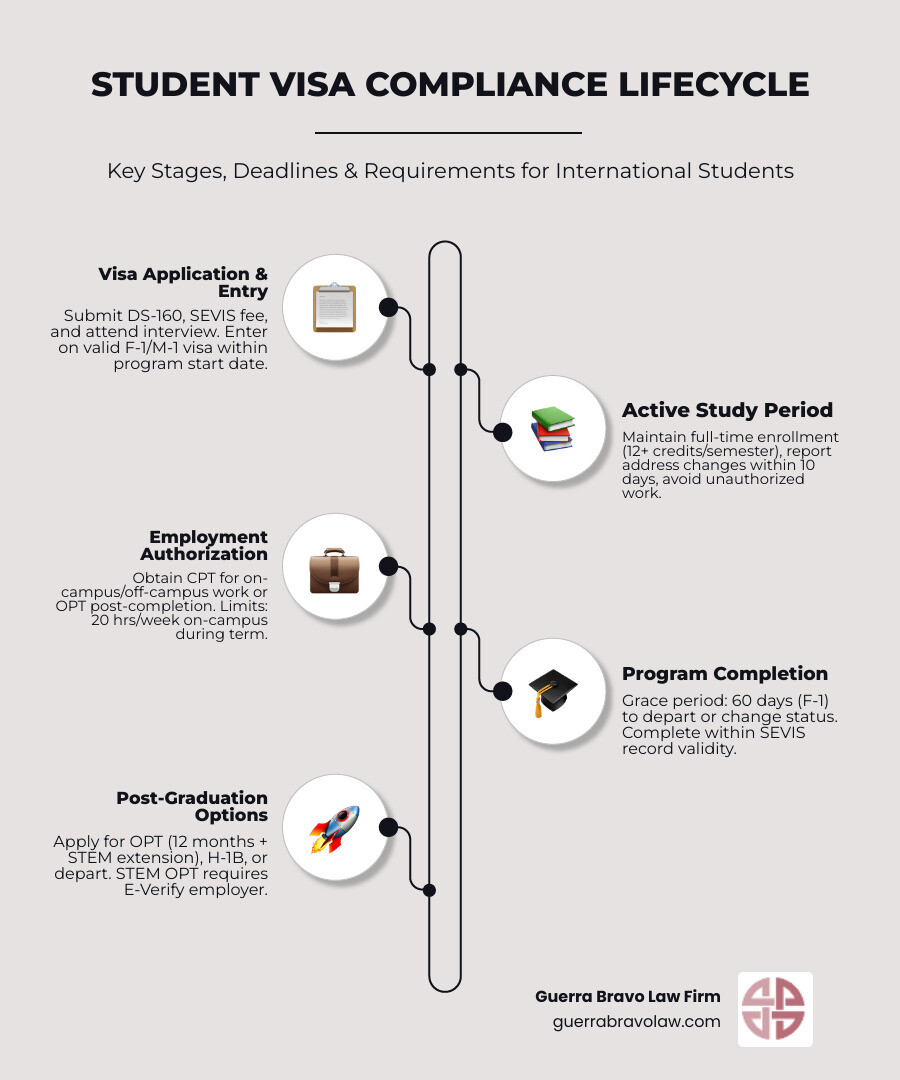
To avoid a SEVIS violation (and the risk of termination), keep these core rules in mind:
Enter the U.S. no more than 30 days before your program start date.
Check in with your school promptly after arrival so your record can be properly activated and kept accurate.
Attend all classes and maintain a full course of study each term.
Request approval before you change anything important, including:
Dropping below full-time
Changing your major or education level
Transferring schools
Taking a leave of absence
Keep your documents valid and consistent, including:
An up-to-date Form I-20
A passport that remains valid while you are in the U.S.
Work only with proper authorization (from your DSO and/or USCIS, depending on the type of work).
Depart the U.S. within the grace period after program completion (generally 60 days for F-1, 30 days for M-1).
The Role of the Designated School Official (DSO)
Your DSO is your immigration guide on campus and the person responsible for many SEVIS updates. A strong student-DSO relationship is one of the easiest ways to stay compliant.
Key DSO-related compliance points include:
SEVIS record updates when there are changes to:
Major or program level
Enrollment status (including reduced course loads)
Program end dates and extensions
Authorized practical training
Reissuing Forms I-20 for:
Lost documents
Program extensions
Travel signatures
Transfers between SEVP-certified schools
Employment processing by:
Authorizing CPT (where eligible)
Recommending OPT (where eligible) and helping you understand timing
You must also inform your DSO of any legal name or address changes within 10 days, as required by 8 CFR 265.1.
Practical tip: before you travel internationally, confirm your I-20 travel signature is current and that your passport and visa (if applicable) are in order. A small documentation issue at the wrong time can create big compliance problems later.
Employment Authorization and Restrictions
Unauthorized employment is a serious violation of student visa compliance. Even well-meaning mistakes (like working a few extra hours, accepting the wrong type of internship, or starting a job before approval is issued) can cause loss of status.
Before you accept any job, internship, assistantship, or paid training, confirm:
Where the work will take place (on-campus vs. off-campus)
Whether your immigration category allows that type of work
Who must authorize it (your DSO, USCIS, IRCC, or a combination)
When you can start (some approvals are not valid until a specific date)
How many hours you are permitted to work
U.S. F-1 Employment Opportunities
On-Campus: Up to 20 hours per week during sessions and full-time during breaks.
Curricular Practical Training (CPT): Employment that is an integral part of the curriculum, authorized by the DSO on Form I-20.
Optional Practical Training (OPT): Work experience related to your major. Requires an EAD from USCIS.
STEM OPT Extension: A 24-month extension for students with eligible STEM degrees.
Compliance reminders for F-1 employment:
Do not begin CPT until your updated I-20 shows CPT authorization (including dates and employer information).
Do not begin OPT until you have your EAD and the start date is valid.
Keep documentation (offer letters, I-20s, EAD copies, pay statements) in case you need to prove you remained compliant.
STEM OPT and the Cap-Gap Provision
STEM OPT has additional requirements that students and employers must follow closely.
Employers must be enrolled in E-Verify and complete a Form I-983 training plan.
Students must follow reporting rules and maintain eligible employment as required during the STEM OPT period.
The 'cap-gap' provision can automatically extend status for certain F-1 students with a timely filed H-1B petition.
If you are unsure whether a specific job offer qualifies (or whether a gap in employment could create a problem), it is much safer to confirm before accepting the position.
Canada: SIN and Post-Graduation Work Permits
Social Insurance Number (SIN): Required to work in Canada. Apply online or in person at a Service Canada Centre with required documents.
Working while studying: Your study permit and IRCC rules control whether you can work on-campus or off-campus and how many hours you can work. Always confirm your specific permit conditions before starting any job.
Post-Graduation Work Permit (PGWP): Allows graduates from a DLI to gain Canadian work experience. Check DLI eligibility before enrolling. Information on spousal work permits is also available.
Consequences of Non-Compliance and Restoration
Ignoring student visa compliance can lead to severe repercussions, including loss of status, removal proceedings, or difficulty obtaining future visas or benefits. Because both Canada and the U.S. track student status closely, small issues can escalate quickly if they are not addressed early.
Common Compliance Issues That Trigger Problems
The situations below frequently lead to enforcement action or the loss of student status:
Letting a permit/document expire before applying to extend
Dropping below the required course load without prior authorization
Taking a leave of absence without following the required process
Transferring schools or changing programs without updating the proper records
Working without authorization or exceeding permitted hours
Failing to update your address or other required information on time
Restoration of Status
Canada: If your permit expires without an extension application, you are out-of-status and must stop studying and working immediately. You generally have 90 days to apply for restoration of status after your permit expires. You cannot study or work during this period.
United States: Working without authorization can result in SEVIS termination, loss of status, and potential bars on re-entering the U.S. If your SEVIS record is terminated or you otherwise fall out of status, your options depend on the reason for the violation and your timing.
If you believe you are out of status (or close to falling out of status), the most important step is to act quickly and get accurate, case-specific guidance.
Renewing or Extending Your Stay
Canada: Apply for an extension at least three months before your permit expires. Check processing times on the IRCC website.
United States: Extensions and status changes are governed by 8 CFR 214.1. F-1 students must retain their initial Form I-20 or successor forms as detailed in 214.3(l)(1).
How Guerra Bravo Law Firm Can Help Students Stay Compliant
International students often do everything right academically but still face immigration trouble because a deadline was missed, a DSO update was delayed, or a work authorization detail was misunderstood.
Guerra Bravo Law Firm helps students in McAllen and across the Rio Grande Valley understand their options and respond strategically, including:
Reviewing your immigration history and documents for risk points
Advising on travel timing, program changes, and document validity
Helping you understand the immigration consequences of employment decisions
Building a plan to address potential status violations proactively
Frequently Asked Questions about Student Visa Compliance
What happens if my study permit expires while I am still studying?
In Canada, you are out-of-status and must stop all activities. You have 90 days to apply for restoration. In the U.S., an expired Form I-20 may lead to SEVIS termination. Consult your DSO or an immigration attorney immediately. You can check application status via IRCC.
Can F-1 students work off-campus during their first year?
Generally, F-1 students must complete one full academic year before becoming eligible for off-campus work. Exceptions include severe economic hardship under 8 CFR 106.2, which requires DSO recommendation and USCIS authorization.
How do semester breaks affect my ability to work?
In the U.S., F-1 students can generally work full-time during official breaks if they intend to register for the next term. See SEVP Policy Guidance 1408-01. In Canada, a scheduled break is allowed once per year if you maintain full-time enrollment before and after the break.
═══
Conclusion
Navigating student visa compliance is one of the most important steps to safeguarding your academic journey. From ensuring your documents are current to understanding employment limits and reporting requirements, the details matter.
If you are studying in Texas or planning to attend school in the U.S. — especially in the Rio Grande Valley — Guerra Bravo Law Firm can help you stay proactive and prepared. Attorney Iris Guerra Bravo brings 14+ years of insider experience with ICE and DHS and applies battle-tested, individualized legal strategies to complex immigration matters.
Do not let uncertainty jeopardize your future. If you have questions about your F-1 or M-1 status, need guidance on work authorization, or are worried you may be out of status, contact Guerra Bravo Law Firm to discuss your next steps.
Locations served include McAllen, Brownsville, Edinburg, Harlingen, Mission, Pharr, Weslaco, Mercedes, Alamo, San Juan, Donna, Hidalgo, Palmview, La Joya, and Penitas.