

February 4, 2026
The L-1 Visa Lowdown: What an Attorney Can Do for You
The L-1 Visa Lowdown: What an Attorney Can Do for You
Why an L-1 Visa Attorney is Your Best Investment for Global Business Transfers
An L-1 visa attorney specializes in helping multinational companies transfer executives, managers, and specialized knowledge employees from their foreign offices to the United States. They steer complex USCIS requirements, prepare comprehensive petitions, respond to requests for evidence, and develop legal strategies to overcome the increasingly strict scrutiny that L-1 applications now face.
What an L-1 Visa Attorney Does for You:
-
Assesses Eligibility - Evaluates whether your company and employee meet qualifying relationship and employment duration requirements
-
Develops Case Strategy - Creates a custom approach based on whether you’re transferring an executive (L-1A) or specialized knowledge employee (L-1B)
-
Prepares Documentation - Compiles evidence of corporate relationships, job duties, and business operations
-
Handles USCIS Communications - Files petitions (Form I-129), responds to Requests for Evidence, and manages appeals
-
Guides Consular Processing - Prepares employees for visa interviews at U.S. consulates abroad
-
Manages Extensions - Ensures compliance and continued eligibility for visa renewals up to the maximum stay period
-
Plans Green Card Pathways - Advises on permanent residency options, especially the EB-1C route for L-1A holders
The L-1 visa has become significantly more complicated in recent years. USCIS has increased scrutiny of these applications due to widespread abuse, leading to higher denial rates and more requests for additional evidence. What used to be a straightforward intracompany transfer process now requires precise legal definitions, compelling documentation, and strategic positioning.
Whether you’re establishing a new U.S. office, transferring key personnel to an existing operation, or seeking a blanket petition for your large multinational organization, an experienced L-1 visa attorney helps you avoid costly mistakes and delays that could derail your global business expansion plans.
Decoding the L-1 Visa: Categories and Core Requirements

The L-1 visa is a powerful tool for global businesses, designed to facilitate the temporary transfer of essential personnel from a qualifying foreign entity to a U.S. office. It’s ideal for multinational corporations looking to leverage their talent across borders, including those with operations in or expanding to the Rio Grande Valley.
What is an L-1 Visa and Who is it For?
The L-1 visa is a nonimmigrant work visa that allows multinational companies to transfer certain employees to a U.S. office. It’s specifically intended for executives, managers, and employees with specialized knowledge who have been working for a foreign branch, subsidiary, affiliate, or parent company and are being transferred to a U.S. entity with a qualifying relationship.
This visa classification is ideal for:
-
Executives who will direct the management of an organization or a major component.
-
Managers who will supervise other managers or professionals, or manage an essential function.
-
Specialized Knowledge Professionals who possess unique expertise critical to the company’s U.S. operations.
This visa helps companies in sectors from tech in Edinburg to agriculture in Weslaco move key personnel efficiently. For more insights into how such transfers fit within broader corporate immigration strategies, explore our resources on corporate immigration law services.
L-1A vs. L-1B: A Detailed Comparison
The L-1 visa category is divided into two main types, each custom to different roles within a company. Understanding the distinctions is crucial for determining eligibility and the potential duration of stay.
L-1A Visa: Executives and Managers
-
Purpose: This visa is for transferring professionals employed in an executive or managerial capacity for the foreign company who will be assuming the same role and capacity in the qualified U.S. company.
-
Definitions:
-
Executive Capacity: The employee’s ability to make broad decisions with little oversight, directing the organization or a major component.
-
Managerial Capacity: The ability to supervise professional employees and manage the organization, a department, or an essential function, possibly without directly supervising others.
-
-
Maximum Stay: Initially valid for three years for established U.S. companies (one year for new offices), it can be extended in two-year increments up to a maximum of seven years.
-
Green Card Pathway: L-1A visa holders have a direct route to a Green Card through the EB-1C immigrant visa category, which is specifically designed for multinational executives and managers and does not require labor certification.
L-1B Visa: Specialized Knowledge
-
Purpose: This visa is for transferring professionals employed in a specialized knowledge position. See the official USCIS page for L-1B Intracompany Transferee Specialized Knowledge.
-
Definition: “Specialized knowledge” is defined as special knowledge of the company’s products, services, techniques, or management and its international application, OR an advanced knowledge of the company’s processes and procedures. This knowledge must be uncommon within the industry or highly developed.
-
Maximum Stay: Initially valid for three years (one year for new offices), it can be extended in two-year increments up to a maximum of five years.
-
Green Card Pathway: While not as direct as L-1A, L-1B holders can still pursue Green Card options like EB-2 or EB-3, though these typically involve labor certification.
For a deeper dive into the L-1A, you can visit the L-1A Intracompany Transferee Executive or Manager page on the USCIS website.
Fundamental Eligibility for Employers and Employees
To qualify for an L-1 visa, both the U.S. employer and the transferring employee must meet specific criteria.
For the Employer (U.S. Company):
-
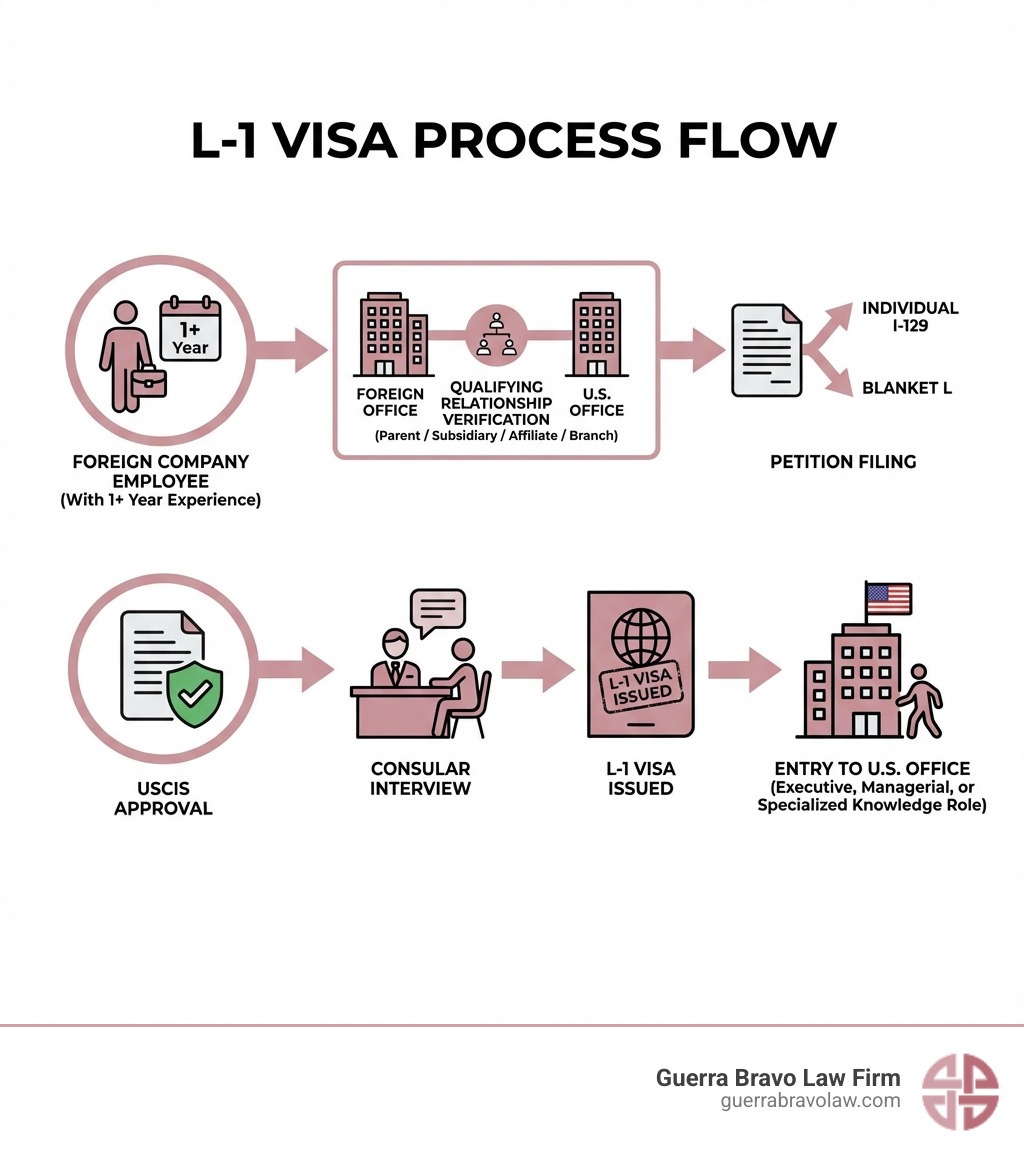
Qualifying Relationship: The U.S. company must have a “qualifying relationship” with the foreign company. This means it must be a parent company, branch, subsidiary, or affiliate of the foreign entity.
-
“Doing Business” Requirement: The related companies must be “doing business” in the U.S. and in at least one other country for the duration of the beneficiary’s stay in the U.S. “Doing business” means the regular, systematic, and continuous provision of goods and/or services by a qualifying organization, not merely the presence of an agent or an office.
-
Active and Operational: The U.S. company must be an active and operational business or, if newly established, have a clear expansion plan.
For the Employee (Beneficiary):
-
Minimum Employment Duration Abroad: The beneficiary must have worked full-time for the foreign company for at least one continuous year within the past three years before applying for an L-1 visa. This employment must have been in an executive, managerial, or specialized knowledge capacity.
-
Comparable U.S. Role: The role in the U.S. must be comparable in function and responsibility to the position held at the foreign company, aligning with either executive, managerial, or specialized knowledge requirements.
These fundamental requirements form the bedrock of any L-1 visa petition. Without meeting them, the application cannot proceed.
Navigating the L-1 Application: Key Concepts and Processes

The L-1 visa process involves several key concepts and procedural steps. Navigating these complexities effectively often requires the guidance of an experienced L-1 visa attorney.
Establishing a ‘Qualifying Relationship’ and ‘Doing Business’
A critical part of any L-1 petition is proving the legal connection between the foreign and U.S. companies and showing that both are actively operating.
Qualifying Relationship:
-
The U.S. company must be a branch, subsidiary, parent, or affiliate of the foreign company.
-
Proof of corporate structure typically involves submitting organizational charts, articles of incorporation, stock certificates, and other legal documents that clearly show ownership and control relationships.
“Doing Business” Requirement:
-
Both the U.S. company and the foreign company must be actively engaged in the “regular, systematic, and continuous provision of goods and/or services.”
-
This means the companies must be actively operating and generating revenue, not merely existing on paper. Evidence includes financial statements, tax returns, contracts, invoices, and employee payroll records.
-
This requirement must be met for the entire duration of the beneficiary’s stay in the U.S.
-
For detailed insights on maintaining compliance, especially concerning these operational requirements, you can refer to our resources on immigration compliance.
The ‘New Office’ L-1 Petition
The L-1 visa offers a unique pathway for foreign employers to send an executive or manager to establish a new U.S. office. This is highly relevant for businesses expanding into South Texas markets like Harlingen or Mission.
Specific Requirements for New Offices:
-
Securing Physical Premises: The employer must show that they have secured sufficient physical premises to house the new office. This means providing a lease agreement, proof of ownership, or other documentation demonstrating a dedicated workspace.
-
Comprehensive Business Plan: A detailed business plan is essential. This plan must demonstrate the viability of the new U.S. operation and show that it will be able to support an executive or managerial position within one year of the petition’s approval. This includes financial projections, organizational structure, staffing plans, and market analysis.
-
Employee’s Prior Role: The employee must have been employed as an executive or manager for one continuous year in the three years preceding the filing of the petition.
-
Initial Validity: Qualified employees entering the U.S. to establish a new office will be allowed a maximum initial stay of one year. Subsequent extensions require demonstrating that the office is actively doing business and can support the executive or managerial role.
The L-1 Application Journey: Individual vs. Blanket Petitions
The path to obtaining an L-1 visa can take different forms, depending on the size and structure of the petitioning organization.
Individual Petition (Form I-129):
-
This is the standard route for most companies, where a separate Form I-129, Petition for a Nonimmigrant Worker, is filed with USCIS for each individual employee seeking an L-1 visa.
-
Each petition requires extensive documentation proving the qualifying relationship, the employee’s eligibility, and the nature of the U.S. position.
Blanket L Petition:
-
For large multinational companies, the L-1 blanket petition simplifies the transfer process by allowing multiple employees to apply under a single petition rather than filing separate applications for each individual.
-
Eligibility for blanket L certification requires the petitioner and its related entities to be engaged in commercial trade, have a U.S. office doing business for at least one year, and have at least three domestic and foreign branches, subsidiaries, or affiliates. Additionally, the company must meet one of the following:
-
Obtained at least 10 L-1 approvals in the prior year.
-
Have U.S. entities with combined annual sales of at least $25 million.
-
Employ a U.S. workforce of at least 1,000 people.
-
-
Streamlined Processing: Once a blanket petition is approved, individual employees can apply for their L-1 visa directly at a U.S. consulate abroad (or at a port-of-entry for Canadian citizens) by presenting Form I-129S, Nonimmigrant Petition Based on Blanket L Petition, along with other supporting documents. This can significantly expedite the process for eligible employees.
-
USCIS vs. Consular Filing: While individual petitions are always filed with USCIS, under an approved blanket petition, the L-1 visa application typically proceeds through consular processing. For Canadian citizens, they can present Form I-129S and supporting documentation to a CBP Officer at certain ports-of-entry or pre-clearance stations to apply for L-1 status.
The Strategic Advantage of an L-1 Visa Attorney
Navigating the L-1 visa process is complex. The strict requirements and potential pitfalls make an experienced L-1 visa attorney an invaluable asset. At Guerra Bravo Law Firm, we understand the stakes involved for businesses in McAllen, Edinburg, and across the Rio Grande Valley.
Why You Need an L-1 Visa Attorney for Your Petition
The L-1 visa, while a fantastic opportunity, is not without its challenges. USCIS scrutiny has increased, leading to higher denial rates and more Requests for Evidence (RFEs). This is where our expertise becomes your strategic advantage.
-
Complex Legal Definitions: The definitions of “executive,” “managerial,” and “specialized knowledge” are nuanced and subject to interpretation by USCIS. An attorney can help you present your employee’s role in a way that aligns perfectly with these definitions.
-
High Denial Rates: Due to widespread abuse, USCIS has become stricter and more critical of L-1 visa petitions. What was once considered straightforward now requires meticulous preparation.
-
Case Strategy Development: We don’t just fill out forms; we develop a comprehensive legal strategy custom to your specific situation. This includes assessing eligibility, identifying potential weaknesses, and building a strong, evidence-based case.
-
Eligibility Assessment: We carefully evaluate whether your company and employee meet all qualifying relationship and employment duration requirements, helping you avoid common pitfalls.
-
Insider Knowledge of Agency Procedures: Our firm’s unique strength lies in attorney Iris Guerra Bravo’s 14+ years of insider experience with ICE and DHS. This battle-tested knowledge provides us with a profound understanding of how government agencies review petitions, enabling us to anticipate issues and craft individualized legal strategies that give your petition the best chance of success. This is particularly beneficial in the Rio Grande Valley, where familiarity with local immigration procedures can make a significant difference.
Choosing an experienced immigration lawyer is not just about filling out paperwork; it’s about securing your company’s future and ensuring your key personnel can contribute to your U.S. operations.
From Paperwork to Approval: How Legal Counsel Helps
Preparing an L-1 petition involves extensive paperwork and precise legal arguments. Our team guides you through every step:
Documentation Typically Required for an L-1 Visa Petition:
-
Proof of Qualifying Relationship: Corporate documents showing ownership and control between the U.S. and foreign entities (e.g., articles of incorporation, stock certificates).
-
Evidence of “Doing Business”: Financial and operational records for both companies (e.g., tax returns, contracts, payroll records).
-
Employee’s Foreign Employment Records: Proof of one year of continuous, qualifying employment abroad (e.g., verification letters, pay stubs, job descriptions).
-
U.S. Job Description: A detailed description of the proposed U.S. role, proving it meets L-1A or L-1B criteria.
-
For New Offices: A comprehensive business plan, proof of physical U.S. premises (e.g., a lease), and financial records showing the ability to pay the employee and sustain operations.
Our Role in the Process:
-
Compiling Compelling Evidence: We carefully gather and organize all necessary documentation, ensuring it clearly supports your petition’s claims.
-
Drafting Support Letters: We draft detailed and persuasive support letters that articulate the qualifying relationship, the employee’s role, and the necessity of the transfer, using precise legal language.
-
Responding to Requests for Evidence (RFEs): If USCIS issues an RFE, we analyze the request, pinpoint the specific concerns, and prepare a robust, well-documented response to address all questions thoroughly.
-
Overcoming Denials: Should a petition be denied, we assess the reasons and advise on potential options, including appeals or refiling, leveraging our deep understanding of immigration law and agency procedures.
Our goal is to streamline your employment petitions and maximize your chances of approval.
Navigating Renewals and Status Changes with an L-1 Visa Attorney
Obtaining the initial L-1 visa is often just the first step. Many companies and employees will need to consider renewals or changes in status, which come with their own set of requirements and complexities.
-
Visa Extensions: L-1 visas are not indefinite. Initial validity periods are typically three years for established U.S. companies (or one year for new offices). Extensions are granted in two-year increments.
-
L-1A Maximum Stay: The total maximum stay for L-1A visa holders (executives/managers) is seven years.
-
L-1B Maximum Stay: The total maximum stay for L-1B visa holders (specialized knowledge) is five years.
-
-
Maintaining Compliance: For extensions, we help you demonstrate continued eligibility, proving that the U.S. operation remains viable, the qualifying relationship persists, and the employee continues to fulfill the L-1 duties. This includes submitting updated financial records, organizational charts, and evidence of ongoing business activities.
-
Change of Status: We also assist with changes in status, for example, if an employee’s role changes from specialized knowledge to managerial, or if there’s a need to adjust from another visa category to L-1.
-
Proving Continued Eligibility: USCIS scrutinizes extension petitions just as closely as initial applications. We ensure all necessary documentation is updated and presented clearly to avoid any disruptions to your employee’s status.
Our expertise in U.S. immigration law ensures that your company and employees remain compliant and successfully steer these ongoing requirements.
L-1 Visa Benefits and Long-Term Pathways
The L-1 visa offers significant advantages for multinational companies and their employees, especially when compared to other U.S. work visa options. Beyond its initial benefits, it also provides a clear pathway for individuals seeking permanent residency in the United States, including for those settling in communities like McAllen, Donna, or San Juan.
Key Benefits Over Other Work Visas
The L-1 visa stands out for several reasons, making it a highly attractive option for global talent mobility:
-
No Annual Cap: Unlike the H-1B visa, which is subject to strict numerical limits and a lottery system, the L-1 visa has no annual cap. This means qualified applicants can apply at any time of the year without worrying about lottery selections or quota restrictions.
-
No Lottery System: The absence of a lottery system provides greater predictability and certainty for companies planning international transfers.
-
Dual Intent Recognized: The L-1 visa is considered a “dual intent” visa. This is a crucial benefit, as it means L-1 visa holders can pursue permanent residency (Green Card) without affecting their nonimmigrant visa status for the duration of their stay. This allows for long-term planning and stability for the employee and their family.
Bringing Your Family: The L-2 Dependent Visa
The L-1 visa program allows key employees to bring their immediate family members with them to the U.S.
-
L-2 Visa for Spouse and Children: L-1 visa holders can bring their spouses and unmarried children under 21 years of age to the U.S. under the L-2 visa classification.
-
L-2S Spousal Work Authorization: Spouses in L-2S status are authorized to work incident to their status. This means they can work without a separate Employment Authorization Document (EAD), though obtaining one is still an option for convenience.
-
Employment Authorized Incident to Status: For L-2 spouses, acceptable evidence of employment authorization incident to status includes an unexpired Form I-94 with an L-2S notation. They may also file Form I-765 to obtain an Employment Authorization Document (EAD), although it’s not strictly required for their employment authorization.
The Pathway to a Green Card for L-1 Holders
The L-1 visa is a powerful stepping stone to permanent residency, especially for L-1A visa holders.
-
L-1A to EB-1C Green Card: For executives and managers holding an L-1A visa, there is a direct and often expedited pathway to a Green Card through the EB-1C immigrant visa category, known as “Multinational Manager or Executive.”
-
This category is designed for multinational executives and managers and does not require labor certification, a lengthy process required for many other employment-based Green Cards.
-
The EB-1C category is highly advantageous, often having favorable priority date availability, making it a faster route to permanent residency.
-
-
Green Card Options for L-1B Holders: While L-1B (specialized knowledge) holders do not have the same direct EB-1C pathway, they can still pursue other employment-based Green Card options, such as EB-2 (for professionals with advanced degrees or exceptional ability) or EB-3 (for skilled workers, professionals, or other workers). These pathways typically involve the PERM labor certification process, which requires demonstrating that there are no qualified U.S. workers for the position.
The “dual intent” nature of the L-1 visa ensures that individuals can plan for both their temporary work in the U.S. and their long-term goal of permanent residency without legal conflict.
Frequently Asked Questions about the L-1 Visa
We understand that the L-1 visa process can raise many questions. Here, we address some of the most common inquiries we receive from clients in the Rio Grande Valley and beyond.
How long must I have worked abroad to qualify for an L-1 visa?
To qualify for an L-1 visa, the employee must have worked full-time for the foreign company for at least one continuous year within the three years immediately preceding the filing of the petition or their admission to the U.S. This employment must have been in an executive, managerial, or specialized knowledge capacity.
What is the maximum duration of an L-1 visa?
The maximum duration of an L-1 visa depends on the category:
-
L-1A (Executives and Managers): The maximum period of stay is seven years.
-
L-1B (Specialized Knowledge): The maximum period of stay is five years.
The initial period of stay is typically three years for established U.S. operations. However, for qualified employees entering the U.S. to establish a “new office,” the maximum initial stay is one year. Extensions are generally granted in two-year increments until the maximum limit is reached.
Can I apply for an L-1 visa to open a brand new company in the U.S.?
Yes, you can apply for an L-1 visa to open a brand new company in the U.S. This is known as a “new office” L-1 petition. However, it comes with specific requirements:
-
A qualifying relationship must exist between the new U.S. office and the foreign company.
-
The employer must have secured physical premises for the new office.
-
A comprehensive business plan is required, showing the new operation is viable and will support a manager/executive within one year.
-
Initial approval is for one year. Extensions require proving the office is actively doing business and can support the role.
Conclusion: Secure Your Company’s Global Mobility Strategy
The L-1 visa offers an invaluable pathway for multinational companies to transfer essential talent to the United States, fostering growth and expanding global reach. However, the intricacies of its requirements, the strict scrutiny from USCIS, and the potential for costly delays underscore the critical importance of expert legal guidance. From proving qualifying relationships and navigating “new office” petitions to understanding the nuances of L-1A versus L-1B and planning for Green Card pathways, the process is complex.
At Guerra Bravo Law Firm, we are deeply committed to supporting businesses and individuals in the Rio Grande Valley, including McAllen, Brownsville, Edinburg, and beyond, in achieving their immigration goals. Our unique advantage comes from attorney Iris Guerra Bravo’s 14+ years of insider experience with ICE and DHS. This background equips us with battle-tested strategies and an unparalleled understanding of agency procedures, allowing us to anticipate challenges and craft individualized legal solutions for even the most complex L-1 cases.
Don’t let the complexities of the L-1 visa process deter your global ambitions. Partner with an L-1 visa attorney who can provide clarity, confidence, and a strategic approach. We are here to ensure your company’s global mobility strategy is seamless and successful.
Ready to take the next step in your global expansion or secure the transfer of your key personnel? Take the next step in your employment petition with Guerra Bravo Law Firm. We’re here to guide you.
[