

February 1, 2026
ICE, Audits, and Beyond: Understanding Immigration Enforcement
ICE, Audits, and Beyond: Understanding Immigration Enforcement
Why Immigration Compliance and Enforcement Matters Now More Than Ever
Immigration compliance and enforcement affects millions of people and thousands of businesses across the United States every single day. Whether you’re an individual facing questions about your status or an employer trying to verify your workforce correctly, understanding how enforcement works is critical to protecting your rights and your future.
Quick Answer: What Is Immigration Compliance and Enforcement?
Immigration compliance and enforcement refers to two interconnected systems:
For Individuals:
-
How agencies like ICE, CBP, and USCIS identify, apprehend, detain, and remove people who violate immigration laws
-
Your rights during encounters with immigration officers
-
The legal process for challenging deportation or removal
For Employers:
-
Legal requirements to verify employee work authorization (Form I-9, E-Verify)
-
Government audits and worksite inspections
-
Penalties for hiring unauthorized workers (up to $250,000 in fines per violation, criminal charges, business closure)
The stakes are incredibly high. In the United States alone, there are an estimated 11 million undocumented or removable noncitizens. The Department of Homeland Security (DHS) engages in enforcement actions to prevent unlawful entry and apprehend those who have violated immigration laws.
For businesses, the risk landscape has grown dramatically. Employers now face I-9 audits, unexpected raids, criminal prosecutions, and even debarment from government contracts if they fail to comply with verification requirements.
The truth is simple: ignorance is not protection. Whether you’re worried about a knock on your door or an audit letter in your mailbox, understanding how the system works gives you power to respond effectively.
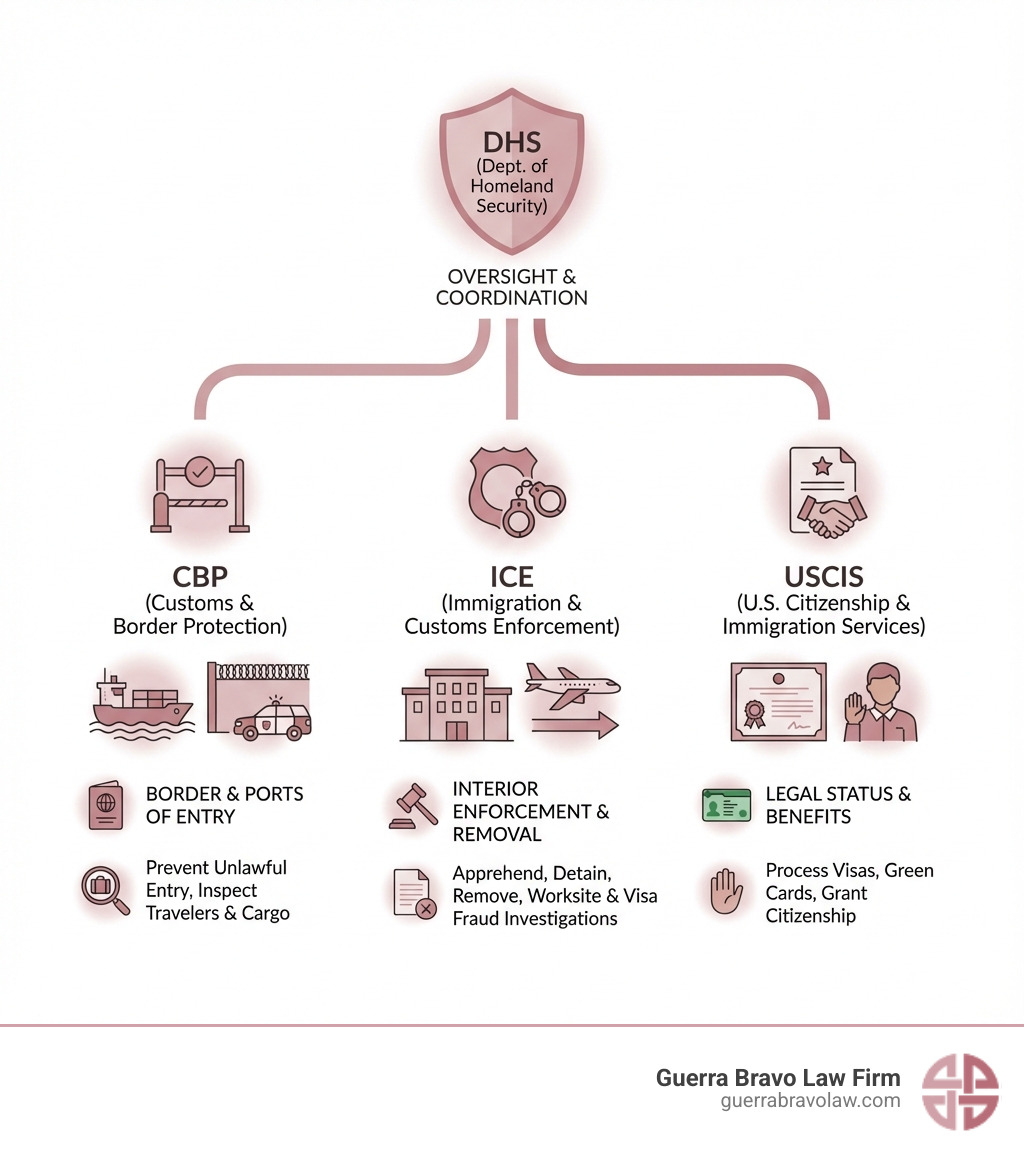
The U.S. Framework: How Federal Agencies Handle Immigration Enforcement
This section details the operational guidelines and priorities for U.S. immigration agencies, outlining the procedures for encounters with individuals and the legal framework governing their actions. Our firm, with its roots deep in the Rio Grande Valley—including McAllen, Brownsville, Edinburg, and Harlingen—understands the unique challenges individuals and families face in these border communities.
Understanding the Priorities of U.S. Immigration Compliance and Enforcement
The Department of Homeland Security (DHS) plays a central role in U.S. immigration compliance and enforcement. Its primary mandate is to prevent unlawful entry and to apprehend individuals who have violated U.S. immigration laws. While there are an estimated 11 million undocumented or otherwise removable noncitizens in the United States, enforcement resources are strategically prioritized.
The foundational principle guiding civil immigration enforcement is prosecutorial discretion. This means federal officials have significant latitude in deciding who to arrest, detain, and remove. This discretion is a deep-rooted tradition in immigration law, affirmed by the U.S. Supreme Court.
Our firm focuses on three core enforcement priorities, as outlined in the Guidelines for the Enforcement of Civil Immigration Law:
Enforcement Priorities:
-
Threats to National Security: This includes individuals suspected of terrorism or espionage.
-
Threats to Public Safety: This covers noncitizens who pose a current threat due to serious criminal conduct. Officers assess this by weighing aggravating factors (e.g., gravity of the offense, use of weapons, prior criminal record) against mitigating factors (e.g., advanced age, lengthy U.S. presence, impact on U.S. citizen family, evidence of rehabilitation).
-
Threats to Border Security: This priority targets noncitizens apprehended attempting to unlawfully enter the U.S. at a border or port of entry, or those apprehended within the U.S. after unlawfully entering on or after November 1, 2020.
A noncitizen’s race, religion, gender, sexual orientation, national origin, or political associations should never be factors in enforcement decisions. Furthermore, enforcement authority must not be used to retaliate against individuals asserting their legal rights, such as workplace rights; exercising such rights should be considered a mitigating factor.
On the Ground: Apprehension, Detention, and Use of Force
When immigration officers are on the ground, their actions are governed by strict protocols concerning apprehension, detention, and the use of force. These standards are designed to ensure safety, uphold legal procedures, and protect civil liberties.

Apprehension and Arrest Procedures:
-
Only designated officers can make an arrest, typically with a warrant, if they have reason to believe an immigration violation has occurred. An arrest without a warrant is possible if the person is likely to escape.
-
Officers must identify themselves, state the reason for the arrest, and advise individuals of their rights in a language they understand.
Detention System and Standards:
The U.S. immigration detention system is outlined in regulations like 8 CFR Part 236 — Apprehension and Detention of Inadmissible and Deportable Aliens; Removal of Aliens Ordered Removed. Our clients in the Rio Grande Valley often encounter these realities directly. We have extensive experience navigating ICE Detention and Release and understanding the complexities of ICE ERO Detention facilities. Protecting civil rights during these actions is paramount.
Use of Force Standards:
Immigration officers are strictly regulated in their use of force:
-
Non-Deadly Force: May be used only when an officer has reasonable grounds to believe it is necessary, using the minimum force required.
-
Deadly Force: This is an extreme measure, reserved for situations where an officer reasonably believes it is necessary to protect themselves or others from imminent danger of death or serious physical injury.
These standards aim to maintain accountability and minimize harm during encounters.
Facing Removal: The Deportation Process and Defenses
For individuals, the ultimate consequence of violating immigration laws is removal from the United States (deportation). Our firm specializes in Deportation Defense Lawyer services, particularly in the Texas Immigration Courts serving the Rio Grande Valley.
Common Grounds for Deportation or Removal:
Any non-citizen can become subject to removal. Common grounds include:
-
Criminal Offenses: Certain convictions, especially “aggravated felonies” or crimes involving moral turpitude. We help clients understand What Crimes Are Eligible for Deportation for an Immigrant.
-
Misrepresentation or Fraud: Including false claims to U.S. citizenship or marriage fraud.
-
Overstaying a Visa or Entry Without Inspection.
Understanding Removal Proceedings and Available Defenses:
When an individual is placed in removal proceedings, they face an immigration judge. Various forms of relief and waivers are available. Our expertise in Understanding Removal Defense in Texas Immigration Courts is critical here.
Key Relief Options and Waivers:
-
Cancellation of Removal: Available for some long-term residents who can prove their removal would cause “extreme and unusual hardship” to qualifying relatives.
-
Asylum: For those with a well-founded fear of persecution in their home country based on protected grounds.
-
Withholding of Removal: A similar but harder-to-obtain protection for those who don’t qualify for asylum, preventing removal to a country where they would be threatened.
-
Adjustment of Status: Allows eligible individuals in the U.S. to apply for a green card, often through a family relationship.
-
Waivers of Inadmissibility or Removability: Can forgive certain grounds of removal, like some criminal convictions or immigration violations, often by proving hardship.
-
Cancel Deportation Order: A specialized service to challenge a prior removal order.
Navigating these options requires strategic guidance from an experienced attorney.
Employer Obligations: Navigating U.S. Immigration Compliance and Enforcement
For businesses in the Rio Grande Valley and across the U.S., compliance with immigration laws is a legal imperative with significant consequences. Our firm understands this challenging environment, where employers face greater risk from I-9 audits to criminal prosecutions.
The Cornerstone of Compliance: Form I-9 and E-Verify
At the heart of U.S. employer immigration compliance and enforcement lies the Form I-9, Employment Eligibility Verification. Immigration law requires all employers to verify that all newly hired employees are authorized to work in the United States.

Employer Requirements for Form I-9:
-
Verification: Complete Form I-9 for every new hire to verify identity and work authorization by examining specific documents.
-
Timeliness: The form must be completed within three business days of the employee’s start date.
-
Record-Keeping: Retain I-9s for three years after the hire date or one year after termination, whichever is later, and have them ready for inspection.
-
Reverification: Track and reverify expiring work authorization for employees with temporary status.
We guide businesses on Maintaining I-9 Compliance and implementing Employer Immigration Compliance Best Practices.
The E-Verify System:
E-Verify is an internet-based system that allows businesses to confirm employee work eligibility. While voluntary for most, it is mandatory for some federal contractors and in certain states. Employers using E-Verify must not pre-screen applicants and must follow specific procedures if a Tentative Non-Confirmation (TNC) is received, allowing the employee to resolve the issue.
Regulations like 8 CFR Part 1274a outline employer requirements and penalties. Our firm ensures clients understand their obligations regarding Immigration Compliance to mitigate risks.
When ICE Knocks: Worksite Enforcement and I-9 Audits
The landscape of worksite immigration compliance and enforcement has become increasingly aggressive. Employers must be prepared for government actions, including I-9 audits and worksite visits.
I-9 Audits and Worksite Enforcement Actions:
-
I-9 Audits (Notices of Inspection - NOIs): ICE can conduct I-9 audits to ensure proper verification, typically starting with a Notice of Inspection demanding I-9 forms.
-
Worksite Visits: These can be unannounced raids by ICE or planned visits by USCIS Fraud Detection and National Security (FDNS) officers, often related to work visa petitions (e.g., H-1B, L-1).
-
Other Enforcement Actions: This can include Department of Justice anti-discrimination reviews, Labor Department investigations, and E-Verify compliance reviews.
Responding to Government Actions:
Knowing how to respond is crucial. Our firm provides top-tier compliance and enforcement services, helping businesses steer unexpected raids or other ICE actions.
-
During a Raid or Visit: Know your rights. Agents cannot enter non-public areas of your business without a warrant or consent.
-
After an Audit or Inspection: If issues are found, employers may receive a Notice of Intent to Fine (NIF), which they have the right to contest before an Administrative Law Judge.
We offer expertise in Corporate Immigration Law and work with businesses hiring temporary foreign workers, providing guidance from a seasoned Immigration Lawyer for Work Visas. Our firm’s strength comes from attorney Iris Guerra Bravo’s 14+ years of insider experience with ICE and DHS, offering battle-tested legal strategies.
The High Cost of Non-Compliance: Penalties in Immigration Compliance and Enforcement
The consequences for non-compliance are severe and can threaten a business’s existence.
Potential Consequences for Employers:
-
Monetary Penalties: Fines range from hundreds of dollars for paperwork errors to tens of thousands per unauthorized worker for knowingly hiring violations.
-
Criminal Prosecutions: Egregious violations can lead to criminal charges, significant fines, and imprisonment.
-
Government Contract Debarment: Non-compliant businesses can be barred from receiving federal contracts.
-
Business Closure Risk: A pattern of non-compliance can threaten a business’s existence.
-
Reputational Damage: Public knowledge of violations can harm a company’s brand, customer trust, and employee morale.
We work with clients to understand Federal Employment Law as it intersects with immigration, helping them avoid these costly pitfalls.
A Comparative Look: Canada’s Approach to Enforcement and Compliance
While our firm focuses on U.S. immigration law for clients in the Rio Grande Valley, a brief look at Canada’s approach provides valuable context on different global strategies for immigration compliance and enforcement.
Canada’s Enforcement and Employer Compliance Framework
In Canada, the Canada Border Services Agency (CBSA) handles enforcement. Its responsibilities include arresting, detaining, and removing individuals who are inadmissible for reasons like criminality, security risks, or misrepresentation. Canada also uses Alternatives to Detention (ATD), such as community supervision, to monitor individuals. For more details, see Canada’s page on Immigration and citizenship inadmissibility, enforcement and violations.
For employers, particularly those hiring through the Temporary Foreign Worker Program (TFWP), compliance is strict. Key points include:
-
Employer Obligations: Employers must adhere to the conditions of a Labour Market Impact Assessment (LMIA) regarding wages and working conditions. They must also maintain records for six years, as detailed in the Immigration and Refugee Protection Regulations.
-
Inspections and Penalties: Authorities can conduct unannounced inspections. Non-compliance can lead to severe penalties, including fines up to $100,000 per violation, a ban from hiring foreign workers, and public disclosure of the violation. Provincial laws, like the Ontario Immigration Act, 2015, add another layer of regulation.
This system highlights a global trend toward robust enforcement and strict employer accountability, similar in principle to the U.S. framework but with its own distinct procedures.
Frequently Asked Questions about Immigration Enforcement
We understand that immigration law can be complex and overwhelming. Here are some common questions we hear, particularly from our community in the Rio Grande Valley:
What are my rights if ICE agents come to my home or workplace?
If ICE agents come to your home or workplace, remember these key rights:
-
Remain Silent: You do not have to answer questions about your immigration status or origin.
-
Do Not Open Your Door: You are not required to open your door unless agents show you a warrant signed by a judge. Ask them to slide it under the door. An arrest warrant does not give them permission to enter your home.
-
Request an Attorney: State clearly that you wish to speak with an attorney. Do not sign anything without legal advice.
-
Do Not Lie: Never provide false information to an officer.
-
Have a Plan: Memorize the phone number of an attorney or family member. Contact us immediately if you encounter immigration enforcement.
What is the most common mistake employers make with Form I-9?
The most common Form I-9 mistakes stem from a lack of attention to detail:
-
Incomplete or Incorrect Sections: Leaving fields blank, using wrong dates, or missing signatures are frequent errors that lead to fines.
-
Failure to Reverify: Forgetting to track and reverify expiring work authorization documents is a critical compliance gap.
-
Accepting Invalid Documents: Employers must reject documents that do not reasonably appear genuine.
-
Poor Record-Keeping: Failing to retain I-9s for the required period or not having them ready for inspection.
-
Discriminatory Practices: Asking for more or different documents than required can lead to discrimination claims.
Regular training and internal audits are the best way to avoid these common pitfalls.
Can a minor criminal offense lead to deportation?
Yes, even a minor criminal offense can lead to deportation. The impact of a conviction is complex and depends on several factors:
-
Type of Offense: Certain crimes are especially risky for non-citizens. These include:
-
Crimes Involving Moral Turpitude (CIMT): Offenses like theft, fraud, or assault that are considered morally wrong can trigger removal.
-
Aggravated Felonies: This is a broad immigration law category that includes many state-level misdemeanors. A conviction almost guarantees deportation.
-
Controlled Substance Violations: Nearly any drug offense, including minor possession, can be a deportable offense.
-
-
Sentence and Number of Convictions: The length of the sentence (even if suspended) and having multiple convictions can also trigger removal proceedings.
Because the specific statute, timing, and facts of the case are critical, consulting an attorney who understands both criminal and immigration law is essential. A seemingly minor conviction can have permanent immigration consequences.
Conclusion: Proactive Strategies for a Complex Landscape
The world of immigration compliance and enforcement is intricate, with high stakes for both individuals and businesses. Understanding your rights and obligations is the first step, but proactive preparation is key. Whether you are facing a removal proceeding or an I-9 audit, navigating these challenges requires expert guidance. With deep insider experience at agencies like ICE and DHS, the team at Guerra Bravo Law Firm provides battle-tested strategies to protect your future. For robust defense and compliance assistance, explore our services on Worksite Enforcement.
[