
Deportation Defense: Finding the Lawyer Who Fights for You
Why Finding the Right Deportation Defense Lawyer Can Change Everything
A deportation defense lawyer represents individuals in removal proceedings, protecting their right to remain in the United States. Using legal strategies like asylum, cancellation of removal, and adjustment of status, they steer the complex immigration system, gather evidence, and advocate before immigration judges to fight deportation orders.
Quick Answer: What to Look for in a Deportation Defense Lawyer
Experience in Immigration Court - Proven track record with EOIR (Executive Office for Immigration Review) proceedings
Specific Expertise - Knowledge of relief options like asylum, cancellation of removal, waivers, and bond hearings
Immediate Availability - Deportation cases have strict deadlines; delays can cost you your case
Clear Communication - Transparent about the process, costs, and realistic outcomes
Representation Scope - Ability to handle detention cases, appeals to BIA, and Federal Court if needed
Receiving a Notice to Appear (NTA) for removal proceedings is a nightmare for thousands of people every year. The stakes are incredibly high, but here's the critical truth: legal representation is the single most important factor in determining the outcome of a deportation case.
The deportation process is confusing. It starts with an NTA and moves to a complex legal system where the government argues for your removal. However, being charged does not automatically mean you will be deported. Many legal defenses exist, and the difference between staying with your family and forced removal often comes down to having a skilled lawyer.
Time is not on your side. Removal orders have strict appeal deadlines, sometimes as short as 30 days. Acting quickly is imperative.
This guide explains what deportation defense lawyers do, how they can help, and how to find the right attorney to fight for your right to remain in the United States.
What is Deportation Defense and Why is it So Important?
Receiving a Notice to Appear means you are facing removal proceedings and potential separation from your life in the United States. Deportation defense (also called removal defense) is the legal fight to keep you here. It's a specialized area of immigration law where an attorney stands between you and forced removal.
At Guerra Bravo Law Firm, with deep roots in McAllen and the Rio Grande Valley, we understand what's at stake because we are part of this community. Deportation is happening to families across America every day, and immigration courts are processing a record number of cases. Most people facing a judge do so without a lawyer.
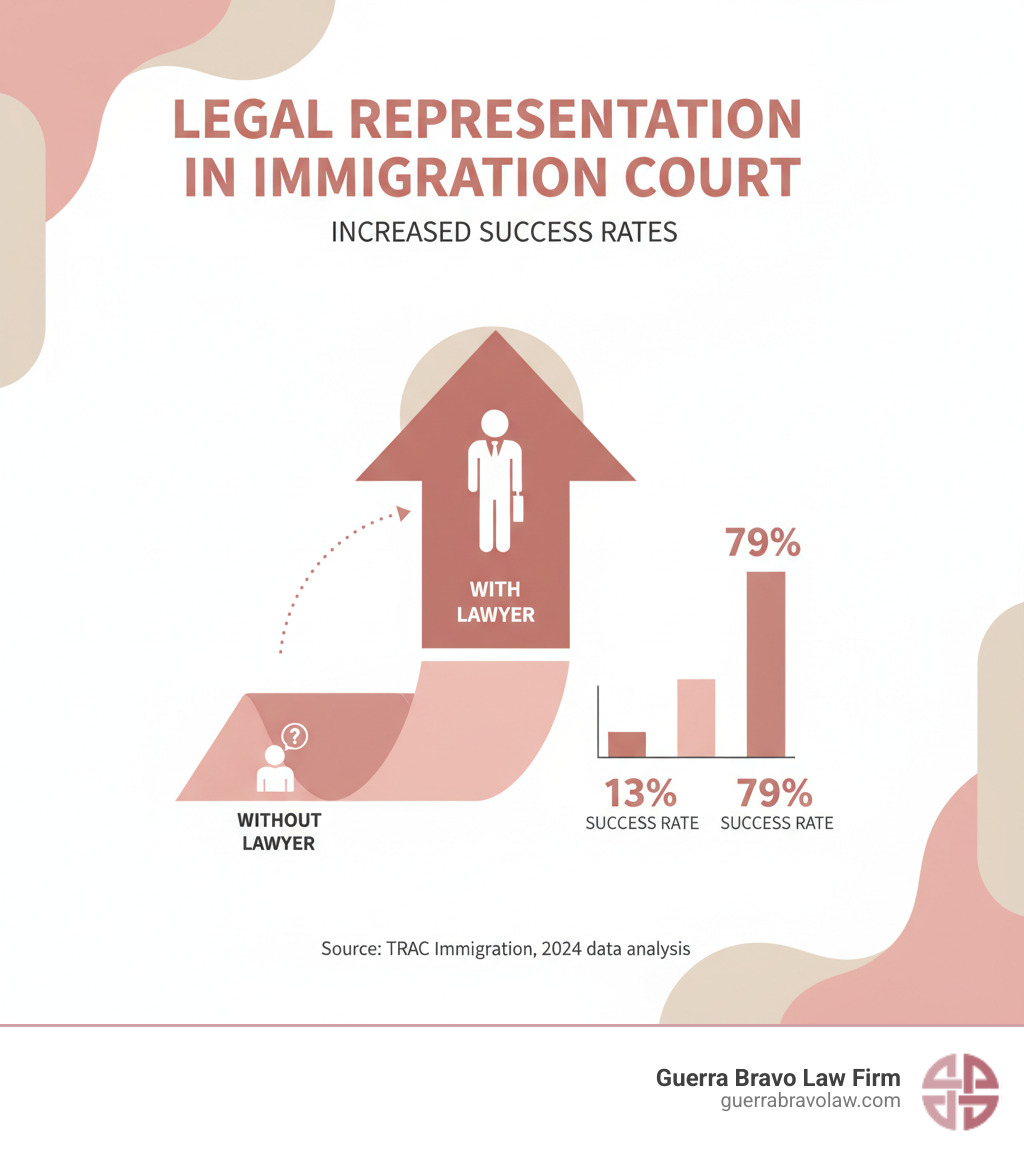
Here's the truth: having a skilled deportation defense lawyer is the single most important factor in whether you win or lose your case. Studies consistently show that people with legal representation are significantly more likely to succeed than those who face the court alone.
The immigration court system is incredibly complex, with constantly changing rules and strict deadlines. Without proper legal representation, you're navigating a maze blindfolded while an experienced government attorney argues for your removal.
Attorney Iris Guerra Bravo of Guerra Bravo Law Firm brings a unique advantage to your defense: 14+ years of insider experience working with ICE and DHS. She knows how the government builds its cases and, more importantly, how to counter their arguments. This insider knowledge, combined with battle-tested legal strategies, gives our clients a fighting chance.
Our goal is fierce and simple: to provide the aggressive, individualized representation you need to protect your right to stay in the United States. Every case is different, and we're here to fight for yours.
Common Reasons for Deportation or Removal from the U.S.
Understanding why deportation happens is the first step in building a strong defense. Removal proceedings are triggered by specific legal reasons, often stemming from violations of immigration law or criminal convictions. After more than 14 years working inside ICE and DHS, I've seen how these cases unfold. Let's break down the most common triggers.
Immigration Violations
Many deportation cases begin with a violation of U.S. immigration laws. These include:
Entering without permission: Crossing the border without lawful authorization or using improper documents makes an individual subject to removal.
Overstaying a visa: Remaining in the U.S. beyond the authorized period on a visa (e.g., tourist or student visa) is a common reason for deportability. The expiration date is a hard legal deadline.
Falsifying documents or misrepresentation: Providing false information on immigration applications or to immigration officials can result in deportation and permanent bars to future benefits.
Violating the terms of your entry: This can include working without authorization on a tourist visa or failing to maintain student status on an F-1 visa.
A skilled deportation defense lawyer can often find legal pathways to fight removal, even when violations have occurred.
Criminal Convictions and Their Impact
Criminal convictions are a major cause of deportation, affecting not just undocumented immigrants but also lawful permanent residents (Green Card holders). Certain crimes can trigger removal regardless of how long you've lived here legally. For a detailed look, read our article: What Crimes Are Eligible for Deportation for an Immigrant.
Key categories include:
Crimes Involving Moral Turpitude (CIMT): These are offenses showing a corrupt mind, such as fraud, theft, and certain assault or domestic violence offenses. Even one CIMT can make you deportable.
Aggravated Felonies: This is a broad immigration law category that includes serious crimes like murder but also some theft, fraud, and drug trafficking offenses that may not be felonies under state law. An aggravated felony conviction carries severe consequences, including mandatory detention and bars to nearly all forms of relief.
Controlled Substance Offenses: Convictions related to illegal drugs, including simple possession, can lead directly to deportation.
Firearms Offenses: Any violation involving firearms, from illegal possession to trafficking, is a serious ground for removal.
Crucial Warning: A plea bargain that seems favorable in criminal court can have devastating immigration consequences. It is vital to consult with an attorney who understands both criminal and immigration law before accepting any deal. At Guerra Bravo Law Firm, we bring that dual perspective, understanding not just the law but how immigration enforcement operates from the inside.
Understanding Removal Orders and the Deportation Process
If you've received a notice from immigration authorities, you're likely feeling overwhelmed. Understanding the process is the first step toward protecting yourself. Legally, "removal" is the official term for being forced to leave the United States, replacing the older terms "deportation" and "exclusion."
The Notice to Appear (NTA)
Removal proceedings typically begin with a Notice to Appear (NTA). This is a charging document from the Department of Homeland Security (DHS) that officially starts the legal process to remove you from the U.S.
The NTA outlines the government's case against you, including the alleged facts and the legal reasons why they believe you are removable. Most importantly, it tells you when and where to appear for your first hearing before an immigration judge. Receiving an NTA is serious, and the clock starts ticking immediately. This is the moment a skilled deportation defense lawyer becomes critical.
Types of Removal Orders
A Final Order of Removal is the legal document requiring you to leave the U.S. It is issued by an immigration judge only after you've had the opportunity to present your case in court. Receiving an NTA does not automatically lead to a removal order. With the right legal representation, you may be able to fight removal and stay. For a deeper look at our strategies, visit our Removal Defense page or read about what a Removal Defense Lawyer does.
The Role of an Immigration Judge and the Executive Office for Immigration Review (EOIR)
Once an NTA is issued, your case moves to an immigration judge. These judges work for the Executive Office for Immigration Review (EOIR), part of the U.S. Department of Justice, and they will decide your case.
Immigration court is an adversarial process where an ICE attorney argues for your removal, while you and your deportation defense lawyer fight to prove you have the right to stay. The judge presides over hearings, reviews all evidence, and determines if you are removable and if you qualify for any relief that would allow you to stay.
An immigration judge can terminate proceedings (you win), grant relief from removal (you get to stay), or issue a Final Order of Removal. Our firm knows the Texas immigration courts, and Attorney Iris Guerra Bravo's insider experience gives us unique insight into building a winning case. Learn more about Removal Defense in Texas Immigration Courts.
Potential Defenses and Legal Strategies Against Deportation
Receiving a Notice to Appear is not the end of your case; it's the beginning of a fight you can win with the right strategy and a skilled deportation defense lawyer. Immigration law offers numerous paths to staying in the U.S., even after removal proceedings begin. At our firm, Attorney Iris Guerra Bravo's 14+ years of insider experience with ICE and DHS helps us find opportunities others might miss. We craft individualized strategies based on your unique circumstances.
Here are the most common forms of relief from removal:
Common Forms of Relief from Removal
Asylum, Withholding of Removal, and CAT Protection: If you fear persecution, torture, or threats to your life or freedom in your home country based on race, religion, nationality, political opinion, or social group, you may qualify for these protections.
Cancellation of Removal: This relief is for those with deep roots in the U.S. The requirements are strict:
For Lawful Permanent Residents (Form EOIR-42A): Must have been a Green Card holder for 5+ years, lived in the U.S. continuously for 7+ years after admission, and not have certain criminal convictions. Learn more about Green Card Deportation.
For Non-Permanent Residents (Form EOIR-42B): Must have been in the U.S. for 10+ years, show good moral character, and prove that removal would cause "exceptional and extremely unusual hardship" to a qualifying U.S. citizen or permanent resident relative.
Adjustment of Status: If you are eligible for a Green Card through a family or employment petition, you may be able to adjust your status in immigration court without leaving the country.
Waivers of Inadmissibility: These complex waivers can forgive certain grounds of removability. They include the I-601A for unlawful presence, the I-601 for various grounds (often requiring proof of extreme hardship), the Section 212(h) waiver for certain criminal grounds, and the Section 237(a)(1)(H) waiver for misrepresentation.
Voluntary Departure: If you concede removability, a judge may allow you to leave the U.S. at your own expense. This avoids a formal removal order and the harsh re-entry bars that come with it.
Prosecutorial Discretion: DHS attorneys have the power to close or terminate cases that are not an enforcement priority. We know how to present cases to encourage this outcome.
Deferred Action: This provides temporary relief from deportation and allows for work authorization. DACA is the most well-known example.
Protections for Victims (U Visa, T Visa, VAWA): Special visas and petitions are available for victims of certain crimes (U visa), human trafficking (T visa), and domestic violence by a U.S. citizen or LPR relative (VAWA).
Options for Individuals in Detention Facing Deportation
Being held in immigration detention is frightening and isolating, but it doesn't mean you're out of options. In South Texas, we see many individuals detained by ICE while their cases proceed. There are legal pathways to release, and the right deportation defense lawyer can make all the difference.
Bond Hearings
A bond hearing is an opportunity to ask an immigration judge for your release while your case continues. Your attorney will argue that you are not a flight risk and do not pose a danger to the community. The judge considers factors like:
Ties to the community (family, job, property)
Criminal history (or lack thereof)
Time in the United States
Eligibility for relief from removal
Our job is to present the strongest possible case for your release on a reasonable bond. For more details, visit our page on ICE Detention Release.
Parole Requests
If you are not eligible for a bond hearing, we can submit a parole request directly to ICE. Parole is a discretionary release granted for urgent humanitarian reasons or significant public benefit. Compelling circumstances may include a serious medical condition, being the sole caregiver for a child or parent, or being a key witness in a case.
Preparing a parole request requires persuasive legal arguments and careful documentation. Attorney Iris Guerra Bravo's 14+ years of insider experience with ICE and DHS gives our firm unique insight into how these agencies make decisions, improving your chances of a favorable outcome.
Detention makes preparing your defense much harder. We move quickly to explore every avenue for your release so you can fight your case from a position of strength.
Appealing Deportation Decisions
An unfavorable decision from an immigration judge is not the final word. You have the right to appeal, and this process can turn a case around. Having an experienced deportation defense lawyer is critical during an appeal, as the process exists to correct legal errors made by the judge.
Appeals to the Board of Immigration Appeals (BIA)
The Board of Immigration Appeals (BIA) is the highest administrative body for interpreting immigration laws. If you disagree with a judge's decision, your attorney can file an appeal with the BIA.
This is extremely time-sensitive: You have only 30 days from the judge's decision to file your appeal. Missing this strict deadline means the removal order becomes final. Your lawyer will submit a legal brief arguing the judge made a legal error, and the BIA will review the case.
Appeals to Federal Court
If the BIA upholds the negative decision, it may be possible to take your case to a U.S. Federal Court of Appeals. These appeals are highly technical and typically focus on questions of law, such as whether the BIA or judge misinterpreted a statute. Our firm has the expertise to handle these higher-level appeals, ensuring every avenue is explored.
Motions to Reopen or Reconsider
Even after a final order of removal, there may still be options. Motions to reopen or reconsider can give you another chance.
A motion to reopen asks the judge or BIA to look at your case again due to new evidence or changed circumstances (e.g., worsening conditions in your home country).
A motion to reconsider argues that the original decision was based on a legal or factual error in the existing record.
Both motions have strict time limits and high standards, underscoring the need for skilled legal representation. Never assume your case is over. With the right legal strategy, there is often still hope.
Consequences of Deportation
The consequences of a removal order are severe and can last a lifetime, extending far beyond simply leaving the country. Understanding these stakes highlights why fighting your case with an experienced deportation defense lawyer is so critical.
Bars on Re-entry
One of the harshest consequences is being legally barred from returning to the United States. The length of the bar depends on your immigration history and the circumstances of your removal.
5-Year Bar: Typically applies to those removed through expedited removal (a fast-track process at the border).
10-Year Bar: Applies to individuals who receive a final order of removal after formal proceedings in immigration court.
Permanent Bar: This is the most severe consequence and can apply if you have been removed multiple times, were removed for certain serious criminal convictions, or re-entered unlawfully after a prior removal.
While waivers for these bars exist in limited circumstances, they are notoriously difficult to obtain and require proving extreme hardship to a qualifying U.S. relative. The process is complex, and success is never guaranteed. This is why preventing a deportation order in the first place is the best strategy.
Once you are removed with a bar in place, your options for legally returning are extremely limited. Attorney Iris Guerra Bravo's 14+ years of insider experience with ICE and DHS means she understands exactly what's at stake and how to build the strongest possible defense to prevent these life-altering consequences.
Services Offered by Deportation Defense Lawyers
When your future is on the line, you need a comprehensive strategy from a lawyer who will fight for you. A skilled deportation defense lawyer provides a full range of services to protect your rights. At Guerra Bravo Law Firm, we leverage 14+ years of insider ICE and DHS experience to craft individualized strategies for even the most complex cases.
Our services include:
Initial Consultation and Case Evaluation: We conduct a thorough review of your immigration history to identify all potential grounds for relief and build a strong defense strategy.
Immigration Court Representation: We represent you at all hearings, including master calendar hearings, individual merits hearings, and bond hearings.
Bond Hearings and Detention Release: We aggressively argue for your release from custody at bond hearings and prepare parole requests for ICE. Learn more about ICE Detention Release.
Asylum and Refugee Protection: We prepare and present strong asylum applications, gathering the evidence needed to prove a well-founded fear of persecution.
Cancellation of Removal: We build compelling cases for both lawful permanent residents and non-permanent residents, focusing on good moral character and extreme hardship to your family. See our guide on Green Card Deportation.
Adjustment of Status in Court: We guide you through the process of obtaining a Green Card in removal proceedings if you are eligible through a family or employer petition.
Waivers of Inadmissibility: We identify and apply for all eligible waivers to overcome legal barriers, such as those for unlawful presence or criminal grounds.
Appeals and Motions: We file and litigate appeals to the Board of Immigration Appeals (BIA), pursue federal court appeals, and file motions to reopen or reconsider when appropriate.
Crimmigration Defense: We consult on the immigration consequences of criminal convictions and work with criminal defense attorneys to avoid outcomes that trigger deportation. See our article on What Crimes Are Eligible for Deportation for an Immigrant.
Victim-Based Petitions: We assist victims of crime and abuse with U visas, T visas, and VAWA petitions.
For a broader overview, explore our pages on US Immigration Law and, for Spanish speakers, Abogados de Migración.
How Legal Representation Significantly Impacts the Outcome
When facing deportation, having a deportation defense lawyer is not just helpful—it is often the deciding factor. The data is clear: legal representation is the single most important factor in determining whether someone wins their deportation case.
Navigating Complexity
Immigration law is a maze of complex, constantly changing rules and strict deadlines. Without a lawyer, navigating your rights, identifying defenses, and properly presenting your case is nearly impossible. Our role is to guide you through every step, translating legal jargon and ensuring you are never alone in this fight.
Building a Strong Defense
An experienced attorney knows what evidence is needed, how to gather it, and how to present it effectively. We review every detail of your case to build the strongest possible defense custom to your unique situation. This involves gathering documents, preparing legal arguments, and preparing witnesses to testify in court.
Advocacy and Voice
In the adversarial system of immigration court, your attorney is your voice. They represent your interests, challenge the government's case, and protect your rights. Our firm's unique advantage comes from Attorney Iris Guerra Bravo's 14+ years of insider experience with ICE and DHS. This battle-tested insight allows us to anticipate government strategies and develop more effective defenses.
We know how the government thinks and where their weaknesses lie. That insider knowledge becomes your advantage. We don't just provide legal representation; we protect your family.
Finding and Choosing a Qualified Deportation Defense Lawyer
Choosing the right deportation defense lawyer can be the difference between staying with your family and being forced to leave. This decision requires careful thought, especially for families in the Rio Grande Valley.
What to Look For in a Lawyer
Specialized Experience: You need an attorney who lives and breathes immigration law, specifically deportation defense. They should regularly appear before immigration judges (EOIR) and know the local Texas courts. Our firm offers a unique advantage: Attorney Iris Guerra Bravo's 14+ years of experience inside ICE and DHS. She knows how the government builds cases and how to counter their strategies, giving our clients a powerful edge.
Clear Communication: Your lawyer must explain complex legal issues in plain language (we are fully bilingual in English and Spanish). They should be responsive, transparent about costs and realistic outcomes, and keep you informed. In a fast-moving deportation case, silence from your attorney is dangerous.
Local Presence: While immigration law is federal, a local lawyer understands the procedures of the McAllen and Rio Grande Valley courts. They know the community and the unique challenges families face here, which translates into more effective representation.
Your Initial Consultation
Use the initial consultation to evaluate the attorney. Ask yourself:
Do they listen carefully to your story?
Do they ask thoughtful questions about your history and family ties?
Can they explain potential defense strategies clearly?
Are they transparent about their experience with cases like yours?
A confident, experienced attorney will gladly discuss their background. Also, look for credentials like membership in the American Immigration Lawyers Association (AILA), which shows a commitment to the field.
The Clock is Already Ticking
Deportation orders come with strict deadlines, sometimes only 30 days to appeal. Every day without legal representation is a lost opportunity. If you've received a Notice to Appear or are worried about your status, don't wait. The sooner you contact a qualified deportation defense lawyer, the more options you have. Contact us today for a consultation.
Take Action Today
The clock is ticking. If you or a loved one is facing removal proceedings, every day matters. Deportation cases move quickly, with strict deadlines and opportunities that can be lost if you wait.
You are not alone in this fight.
At Guerra Bravo Law Firm, we are dedicated to defending families in the Rio Grande Valley. We understand that behind every case is a real person with a family, a life, and a future they've worked hard to build. Your story matters to us, and we're ready to fight for your right to stay.
What makes our firm different? Attorney Iris Guerra Bravo brings more than 14 years of insider experience with ICE and DHS to your defense. This is battle-tested insight into how the government thinks and how to effectively counter their strategies. We know their playbook, and we use that knowledge to protect you.
The sooner you reach out, the more options we can explore. Waiting can mean missing critical deadlines and losing eligibility for relief. Whether you're in detention, facing a court date, or need to appeal a decision, we are here to provide the aggressive, compassionate representation you deserve.
This is about keeping families together. Don't let fear or uncertainty stop you. Contact us today to schedule your consultation and let us put our experience to work for you. Your family's future is worth fighting for.
Learn more about how we can help with your removal defense case: Removal Defense