
Don't Get Audited: Maintaining Perfect I-9 Immigration Compliance
Why Perfect I-9 Compliance Matters More Than Ever
Maintaining I-9 compliance is the non-negotiable legal duty for U.S. employers to verify every employee's authorization to work in the United States. The consequences of non-compliance are severe, making it a critical business function.
Quick Answer: The Five Pillars of I-9 Compliance
Complete Form I-9 on time: Section 1 by the employee's first day; Section 2 within three business days.
Verify original documents: Examine physical, unexpired documents from the official Lists of Acceptable Documents.
Store forms securely: Keep I-9s separate from personnel files for privacy and easy inspection.
Retain for the required period: Three years from hire date or one year from termination, whichever is later.
Conduct regular internal audits: Proactively find and fix errors before government agencies do.
The stakes are incredibly high. Penalties for paperwork violations alone range from $281 to $2,789 per form, with an average fine of $1,862 for a single error. Knowingly hiring unauthorized workers can lead to fines of up to $27,894 per violation. With ICE audits increasing five-fold in recent years and 76% of paper I-9s containing at least one error, the risk is undeniable.
Since the Immigration Reform and Control Act of 1986, every employer must use Form I-9 for this verification. However, with complex rules, strict timelines, and aggressive enforcement from DHS, DOJ, and DOL, maintaining I-9 compliance requires constant vigilance and expert knowledge.
The I-9 Lifecycle: Key Timelines from Hire to Termination
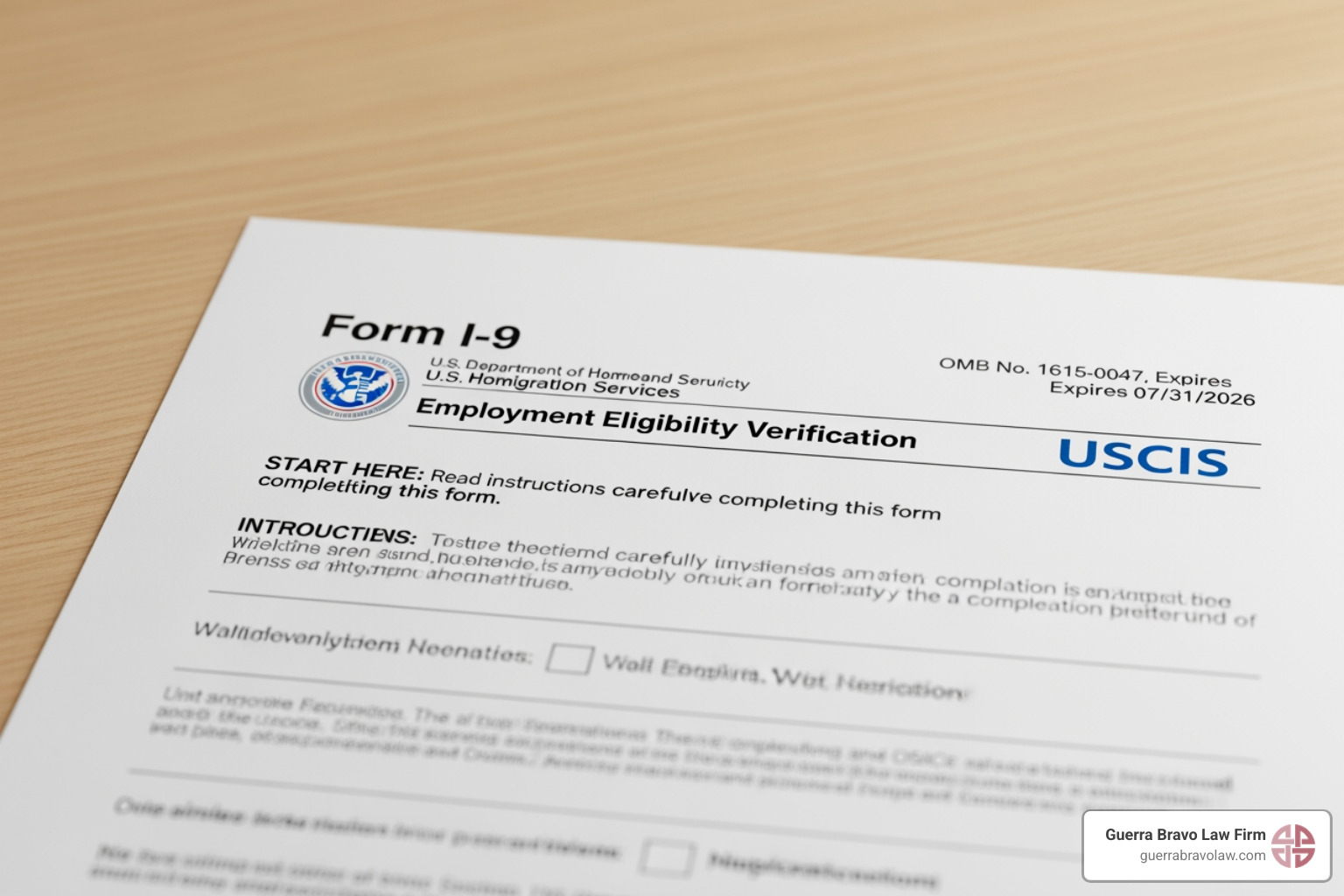
Maintaining I-9 compliance hinges on a precise timeline that begins with a job offer and extends beyond an employee's departure. Missing a deadline by even one day can result in penalties. The 08/01/23 edition of Form I-9, mandatory since November 1, 2023, streamlined the form but kept the core timelines intact.
Section 1: Employee Information and Attestation
Your new hire must complete and sign Section 1 on or before their first day of employment for pay. In this section, the employee attests under penalty of perjury to their work authorization status by checking one of four boxes: U.S. Citizen, Noncitizen National, Lawful Permanent Resident, or Alien Authorized to Work. While the Social Security number is optional for most employers, it becomes mandatory if you participate in E-Verify. If an employee needs assistance, a helper can complete the Preparer/Translator Certification, which is now a standalone supplement.
Section 2: Employer Review and Verification
After the employee completes Section 1, you have a strict deadline: three business days from the employee's first day of work. Your core duty is to physically examine original, unexpired documents that reasonably appear to be genuine. Photocopies are not acceptable (with specific exceptions for remote verification).
The employee chooses which documents to present from the Lists of Acceptable Documents: either one document from List A (proving both identity and work authorization) or a combination of one document from List B (identity) and one from List C (work authorization). You cannot demand specific documents, as this can lead to discrimination claims.
For remote employees, you can designate an authorized representative to examine documents in person. You are liable for any mistakes your representative makes.
Supplement B: Reverification and Rehire
Supplement B is used for updates after the initial form is completed.
Reverification: If an employee's work authorization has an expiration date, you must reverify their eligibility by completing Supplement B before that date.
Rehire: If you rehire an employee within three years of their original I-9 date, you can complete Supplement B instead of a new form.
Name Changes: Legal name changes are also noted on Supplement B.
Crucially, you must know when not to reverify to avoid discrimination. Never reverify U.S. citizens, noncitizen nationals, an expired Permanent Resident Card, or any List B document.
Mastering I-9 Record-Keeping: Retention, Storage, and Destruction

Completing the Form I-9 is only the first step. Maintaining I-9 compliance depends heavily on how you retain, store, and ultimately destroy these sensitive records. Getting this long game wrong can invalidate your otherwise perfect forms during an audit. This process is a fundamental part of What is Immigration Compliance.
Calculating the Retention Period
The rule for how long to keep a Form I-9 is known as the "3-year/1-year" rule. For terminated employees, you must keep their form until one year after their termination date OR three years after their hire date, whichever is later. For current employees, you must retain their Form I-9 for their entire period of employment.
For example, if an employee hired on Jan 1, 2023, leaves on Jan 1, 2024, you must keep the form until Jan 1, 2026 (three years from hire). If a long-term employee hired on Jan 1, 2020, leaves on Jan 1, 2025, you must keep the form until Jan 1, 2026 (one year from termination). Accurate hire and termination dates are essential for this calculation.
Storage Methods and Requirements
How and where you store I-9s is critical. Per USCIS guidance at their Retention and Storage - USCIS page, you must be able to present forms for inspection within three business days.
Paper Storage: Keep paper forms in a locked cabinet or secure room. Crucially, store I-9s completely separate from personnel files to protect sensitive data and streamline audits.
Electronic Storage: This is a popular option, but your system must meet specific DHS standards. It must ensure data integrity and accuracy, have robust security measures (like access controls and encryption), use a clear indexing system for quick retrieval, and create detailed audit trails for every action taken on a form.
Handling Supporting Documents and Destruction
While not required for all employers, if you choose to copy the documents an employee presents, you must do so for every employee to avoid discrimination claims. These copies must be stored with the corresponding Form I-9.
Once the retention period expires, you are obligated to destroy the Form I-9 and any related copies. Use a secure destruction method like shredding or permanent electronic deletion. Simply tossing them in the recycling is not sufficient. Consider keeping a log of destroyed I-9s to demonstrate your compliant process.
Proactive Strategies for Maintaining I-9 Compliance
With studies showing that 76% of paper Form I-9s contain at least one error, a proactive approach is essential for maintaining I-9 compliance. This means avoiding common pitfalls, correcting mistakes properly, and conducting regular self-audits. These practices are a core part of Corporate Immigration Law.
Avoiding Common (and Costly) I-9 Errors
Many costly errors are simple to avoid. Watch out for these frequent missteps:
Missing Signatures or Dates: Both the employee (Section 1) and employer (Section 2) must sign and date the form.
Incorrect Dates: Ensure the employee's start date and the form completion dates are accurate. Never backdate.
Blank Fields: All required fields must be completed.
Over-Documentation: Requesting more documents than required can be considered discriminatory "document abuse."
Accepting Expired Documents: Documents must be unexpired at the time of verification.
Failure to Complete Section 2 on Time: The three-business-day deadline is strict and frequently violated.
The Internal Audit: Your Best Defense for Maintaining I-9 Compliance
An internal audit is your opportunity to find and fix errors before the government does. It is your single best defense.
Best Practices: Conduct an audit at least annually, reviewing all active I-9s and a sample of terminated employee forms still in retention. Use a detailed checklist, like those found in resources such as How to Conduct an I-9 Audit.
Correcting Errors: For minor errors, draw a single line through the mistake, write the correct information, then initial and date the change. Never use white-out or backdate corrections. For significant errors, complete a new Form I-9 and attach it to the original, including a signed explanation.
Compliance Policy: Establish a written I-9 compliance policy to ensure consistency. It should define responsibilities, procedures for verification and audits, and your response plan for a government inspection.
Navigating Modern Challenges: Remote Work, E-Verify, and New Rules
The modern workplace requires adapting I-9 compliance to new realities like remote work. The 2023 Form I-9 update and evolving E-Verify rules introduce new options and complexities that intersect with Federal Employment Law.
Adapting to the New Form I-9 and Remote Verification
The mandatory August 1, 2023 edition of Form I-9 is a streamlined, single-sided, and mobile-friendly document, making it easier to complete on tablets and smartphones.
The most significant change is the DHS-authorized alternative procedure for remote document verification, available only to employers enrolled in E-Verify and in good standing. The process is:
The employee transmits copies of their identity and work authorization documents to the employer.
The employer conducts a live video interaction with the employee, who holds up the same documents for verification.
The employer checks a box on Form I-9 to indicate the alternative procedure was used.
The employer must retain clear copies of the documents presented.
If you are not an E-Verify employer, you must continue using an authorized representative to physically inspect documents for remote hires. The temporary COVID-19 flexibilities for remote inspection ended on July 31, 2023, and the grace period for in-person follow-ups has passed. For detailed guidance, consult the Handbook for Employers (M-274).
E-Verify and Its Impact on Maintaining I-9 Compliance
E-Verify is a web-based system that confirms employment eligibility against government databases. While often voluntary, it is required by some states and federal contracts.
Key E-Verify rules include:
Consistent Use: You must use E-Verify for all new hires, not just select individuals, to avoid discrimination.
Tentative Nonconfirmation (TNC): If a TNC is issued, you must notify the employee privately. The employee has the right to contest the TNC, and you cannot take any adverse action (like termination or suspension) against them during this period.
Document Retention: E-Verify users must retain copies of the documents presented for Form I-9.
Anti-Discrimination: Strict provisions prohibit discriminating against employees based on national origin or citizenship status. USCIS offers free training webinars at their Take a Free Webinar page.
While third-party compliance software can be helpful, software is not a safe harbor. You, the employer, remain fully responsible for compliance, and human oversight is always essential.
The High Cost of Non-Compliance: Penalties and Enforcement
Understanding the financial consequences of I-9 errors is critical. Government agencies are actively enforcing these requirements, and the penalties can be devastating for a business. This is why a firm grasp of Worksite Enforcement is essential.
With 76% of paper I-9s containing at least one mistake, the risk of fines is substantial.
Understanding the Penalties
Penalties are structured to address different types of violations:
Paperwork Violations: These are the most common, resulting from errors like missing signatures, incorrect dates, or failing to produce a form. Fines for first offenses range from $281 to $2,789 per Form I-9.
Knowingly Hiring Unauthorized Workers: This is a far more serious offense. Fines start at $698 to $5,579 per worker for a first offense and can escalate to $8,369 to $27,894 per worker for subsequent offenses.
Document Abuse & Discrimination: Requesting specific documents or treating individuals differently based on their citizenship or national origin can lead to fines ranging from $230 to over $4,610 per violation.
Enforcement statistics are sobering. ICE audits increased by 375% in one recent year, with overall enforcement climbing five-fold. In 2019 alone, the government issued $14 million in fines for I-9 violations.
Who Can Inspect Your Forms?
Several federal agencies have the authority to inspect your I-9 records:
Department of Homeland Security (DHS): Primarily through Immigration and Customs Enforcement (ICE), which conducts most worksite audits.
Department of Justice (DOJ): The Immigrant and Employee Rights Section (IER) investigates discrimination claims.
Department of Labor (DOL): Can inspect I-9s during wage and hour investigations.
Upon receiving a Notice of Inspection (NOI), you typically have only three business days to produce your I-9 forms. This tight deadline underscores the need for constant, audit-ready compliance.
Frequently Asked Questions about I-9 Compliance
Maintaining I-9 compliance raises many common questions. Here are clear, concise answers to some of the most frequent concerns.
How long must I keep a Form I-9 for a terminated employee?
You must retain a terminated employee's Form I-9 according to the "3-year/1-year" rule. Keep the form until one year after their termination date OR three years after their hire date, whichever date is later.
For example, for an employee who worked for six months, the three-year-from-hire-date rule will likely apply. For a ten-year employee, the one-year-from-termination-date rule will apply. This requires diligent tracking of both hire and termination dates.
What are the most common (and costly) I-9 errors?
Given that 76% of paper Form I-9s contain at least one error, employers often make the same costly mistakes. The most common include:
Missing Signatures or Dates: Forgetting to have the employee sign Section 1 or the employer sign Section 2.
Late Completion: Failing to complete Section 2 within the mandatory three business days of the employee's start date.
Incorrect Document Information: Listing document details in the wrong section or omitting expiration dates.
Blank Fields: Leaving required fields in Section 1 or 2 empty.
Each of these errors can result in a separate penalty during an audit.
Can I store all my I-9s electronically?
Yes, you can store Forms I-9 electronically, which can be more efficient and secure than paper. However, your electronic system must meet strict Department of Homeland Security (DHS) requirements. The system must:
Ensure the integrity of the form, preventing unauthorized alterations.
Have robust security measures, including access controls and encryption.
Be indexed for easy accessibility and retrieval.
Maintain a detailed audit trail of all actions performed on each form.
You must be able to provide legible paper copies of any requested forms to government officials during an inspection. This makes choosing a compliant system crucial for maintaining I-9 compliance.
Conclusion: Partnering with Experts for Bulletproof Compliance
Maintaining I-9 compliance is an ongoing process, not a one-time task. The rules are complex, the deadlines are strict, and the penalties for errors are severe. With 76% of paper I-9s containing mistakes and the average penalty per form at $1,862, proactive management is not just wise—it's essential.
Knowing the rules is one thing; applying them flawlessly is another. That's where expert guidance becomes your greatest asset.
At Guerra Bravo Law Firm in McAllen, TX, we offer more than just textbook legal advice. Attorney Iris Guerra Bravo brings over 14 years of insider experience with ICE and DHS. She knows what auditors look for and how to build a robust compliance strategy that protects your business from costly fines.
We help businesses implement proactive measures, conduct internal audits, train HR staff, and steer the complexities of E-Verify. Don't wait for a Notice of Inspection to find your vulnerabilities. Let us apply our battle-tested strategies to turn your potential liabilities into bulletproof compliance.