
Beyond Borders: Navigating Immigration Compliance for Multinational Employers
Why Employer Immigration Compliance Matters More Than Ever
Employer immigration compliance refers to the legal obligations businesses have when hiring and retaining foreign nationals or any employee whose work status requires verification. With immigration enforcement actions on the rise, understanding these requirements is no longer optional.
Core employer immigration compliance requirements include:
Form I-9 Completion: Verify identity and work authorization for all new hires within three business days.
Document Examination: Review original, unexpired documents that appear genuine.
Record Retention: Keep I-9 forms for three years after hire or one year after termination, whichever is later.
E-Verify Participation: Required for federal contractors and in some states; it is binding once a company enrolls.
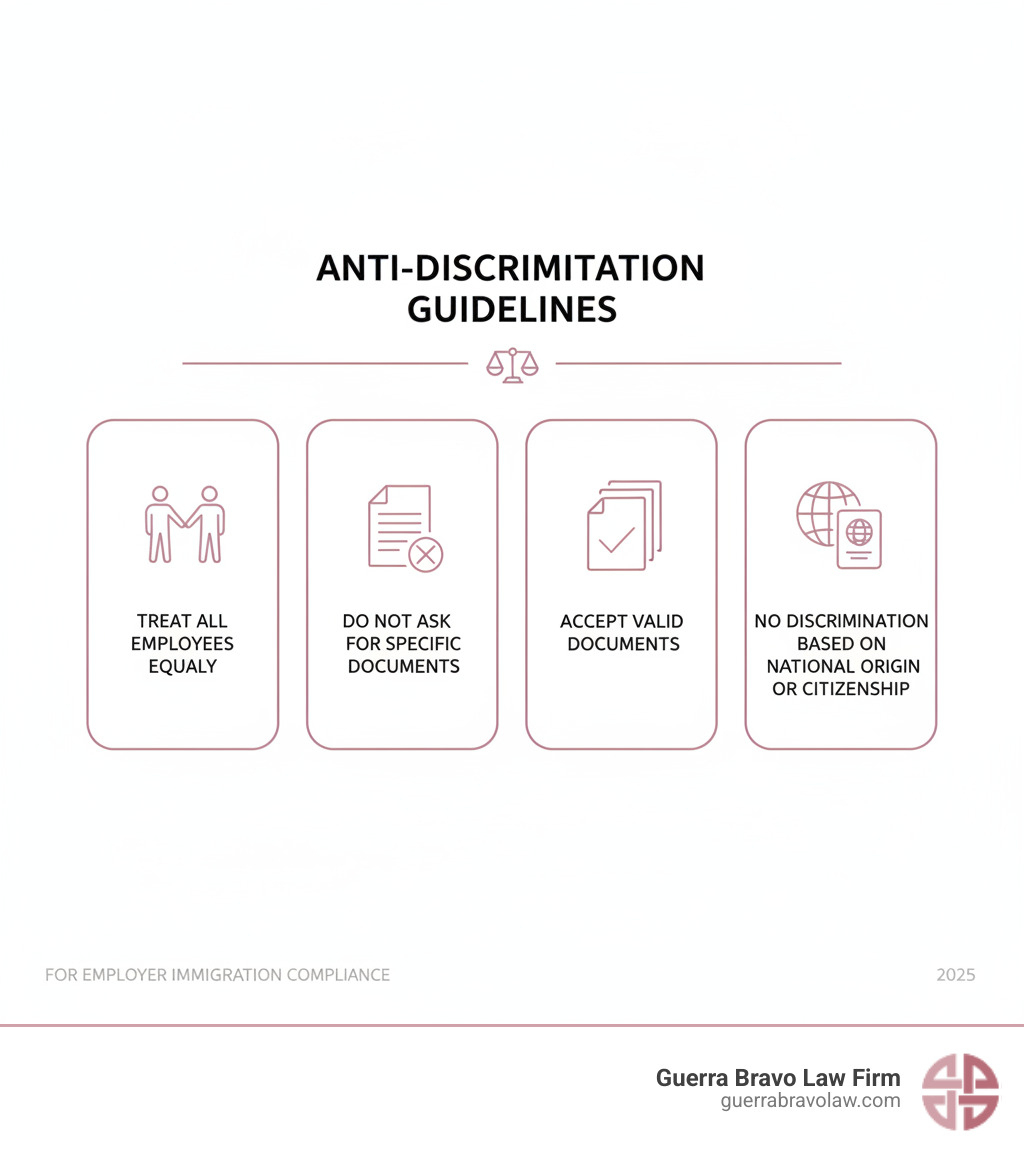
Avoiding Discrimination: Do not request specific documents or treat employees differently based on citizenship or national origin.
Audit Preparation: Be ready to produce I-9s and related documentation within three business days of a Notice of Inspection.
The stakes are high. Civil penalties for I-9 violations range from $288 to $2,861 per form, while knowingly hiring unauthorized workers carries fines from $716 to $28,619 per violation. The largest criminal fine against an employer in a worksite case totaled $95 million.
Crucially, switching to electronic I-9s or enrolling in E-Verify does not automatically guarantee compliance. As one immigration law firm notes, "It is a common misconception that switching to E-Verify automatically makes employers compliant. Business immigration laws require much more from employers."
This guide walks you through the essential compliance requirements, from basic I-9 procedures to preparing for enforcement actions, so you can build a workforce that's both global and compliant.
1. Primary Legal Obligations for Employers in the U.S.
Your primary legal obligations for employer immigration compliance stem from the Immigration Reform and Control Act (IRCA) of 1986. This law made it illegal to knowingly hire unauthorized workers and created the employment verification system we use today. These rules apply to every employer in the United States, regardless of size or industry.
Your core responsibilities include:
Verifying Identity and Work Authorization: For every new hire, you must complete Form I-9 to verify their identity and legal authorization to work in the U.S.
Avoiding Unauthorized Employment: You cannot knowingly hire or continue to employ unauthorized workers. This includes having "constructive knowledge," where you ignore obvious red flags, such as suspicious documents or questionable statements from an employee about their status. Ignoring these signs is not a defense.
Proper Record Retention: Completed I-9 forms must be retained for a specific period and be available for government inspection upon request.
Preventing Discrimination: While verifying eligibility, you must not discriminate based on national origin or citizenship status. This means you cannot demand specific documents or treat protected individuals differently. This critical balancing act is detailed in federal regulations, primarily in 8 CFR Part 274a.
Understanding these foundational duties is the first step toward building a legally sound hiring process that protects your business.
2. What is Form I-9 and Why is it Crucial?
Form I-9, the Employment Eligibility Verification Form, is the cornerstone of your employer immigration compliance program. It is the official document proving you have verified the identity and work authorization of every person hired after November 6, 1986. When completed correctly, it is your best defense in an audit; when handled carelessly, it is a primary source of penalties.
The I-9 Process
The form has three parts with strict deadlines:
Section 1 (Employee): The new hire must complete this section on or before their first day of employment. They provide personal information and attest to their work authorization status under penalty of perjury.
Section 2 (Employer): You have three business days from the employee's start date to complete this section. You must physically examine original, unexpired documents from the Lists of Acceptable Documents. The employee may present either one document from List A (proving identity and work authorization) or a combination of one document from List B (identity) and one from List C (work authorization). You must accept any document that appears genuine.
Section 3 (Reverification): This section is used to update expiring work authorization for certain employees or to record the rehire of a former employee within three years of their original I-9 completion date.
Retention and Accuracy
You must retain a completed Form I-9 for three years after the date of hire or one year after employment ends, whichever is later. These forms must be stored securely but be accessible, as you typically have only three business days to produce them during an ICE inspection.
Even minor errors—like a missing date or an empty field—can result in substantial fines, ranging from $288 to $2,861 per violation. As a firm with over 14 years of experience inside ICE and DHS, we've seen how preventable mistakes lead to costly penalties. Treating I-9s as an ongoing priority, not a one-time task, is the key to avoiding these issues.
3. Consequences of Non-Compliance
Understanding the consequences of non-compliance is critical for any business. After 14+ years working with ICE and DHS, I've seen how quickly government scrutiny can escalate. With worksite investigations and I-9 audits increasing dramatically, no employer can afford to be complacent.
Civil and Criminal Penalties
The financial and legal risks are significant:
I-9 Paperwork Violations: Simple errors in completing or retaining forms can lead to fines of $288 to $2,861 per form.
Knowingly Hiring Unauthorized Workers: These penalties are much steeper, starting at $716 to $5,724 per employee for a first offense and rising to $8,586 to $28,619 per employee for repeat offenders.
Document Abuse: Requesting more or specific documents than required, or rejecting valid documents, can result in fines from $288 to $2,861 per individual.
Criminal Charges: A "pattern or practice" of knowingly hiring unauthorized workers can lead to criminal prosecution, including imprisonment and massive fines. The largest criminal fine in a worksite case was $95 million.
Other Serious Consequences
Beyond fines, non-compliance can lead to:
Debarment from Federal Contracts: Losing the ability to work with the government can be a death sentence for many businesses.
Worksite Raids: Federal agents arriving at your business disrupts operations, damages morale, and can lead to arrests of both employees and management.
Reputational Damage: News of an immigration raid travels fast, especially in close-knit communities like the Rio Grande Valley. This can harm your brand and make it difficult to recruit talent.
Business Disruption and Closure: The combined cost of fines, legal fees, and lost productivity can be too much for a business to survive.
Effective employer immigration compliance is not just about avoiding fines; it's about protecting the future of your business.
4. How Can Employers Ensure Proper Verification?
Proper verification is the practical application of employer immigration compliance. It requires a consistent, thorough process that protects both your business and your employees from legal risk.
Form I-9 Best Practices
Be Consistent: Apply the exact same verification process to every new hire, regardless of their citizenship or national origin. This is your best defense against discrimination claims.
Mind the Deadlines: The employee must complete Section 1 by their first day of work. You must complete Section 2 within three business days. There is no flexibility on these deadlines.
Examine Documents Properly: You must review original, unexpired documents that reasonably appear to be genuine. You are not a forensic expert, but you cannot ignore obvious signs of fraud.
Let the Employee Choose: You must not request specific documents. The employee chooses which valid documents to present from the Lists of Acceptable Documents. Demanding a specific document, like a Green Card, is a violation known as "document abuse."
Store and Reverity: Keep I-9s in a secure, accessible location. Track work authorization expiration dates and complete Section 3 for reverification before the current authorization expires.
Using an Authorized Representative
Many employers use a designated agent, like an HR staff member or notary, to complete Section 2. While this is permissible, you, the employer, remain 100% liable for any mistakes they make. Ensure anyone completing I-9s on your behalf is properly trained.
Building these habits into your hiring process makes compliance second nature. For businesses in the Rio Grande Valley, from Harlingen to McAllen, a consistent process is the key to avoiding costly errors.
5. Hiring Permanent Residents Versus Non-Permanent Residents
For employer immigration compliance, it's crucial to understand the difference between permanent and non-permanent residents, as their verification and reverification rules differ significantly.
Permanent Residents (Green Card Holders)
These individuals hold a Form I-551, Permanent Resident Card (Green Card), and are authorized to live and work in the U.S. indefinitely. For Form I-9, they can present their Green Card as a List A document.
A critical point for employers: You must not reverify an expired Green Card. The card is proof of status, but the status itself does not expire. Requesting a new card upon expiration is considered document abuse. The only exception is if an employee initially presents a temporary I-551 stamp in their passport; that stamp's expiration date must be tracked for reverification.
Non-Permanent Residents (Aliens)
This broad category includes anyone with temporary work authorization. Their eligibility is often tied to a specific employer, role, or time period, making compliance more complex.
Temporary Visa Holders: Individuals on visas like H-1B, L-1, or TN have work authorization that is employer-specific. Hiring them often requires you to file a petition with U.S. Citizenship and Immigration Services (USCIS).
Asylees and Refugees: These individuals are authorized to work indefinitely. Even if their Employment Authorization Document (EAD) has an expiration date, their work authorization is continuous, and you should not reverify it.
Students and Exchange Visitors: F-1 and J-1 visa holders may have work authorization (like OPT or CPT) tied to their program. Their EADs have firm expiration dates that you must track for reverification.
Automatic EAD Extensions: A recent rule allows for automatic extensions of certain EADs for up to 540 days if a renewal is filed on time. This means an employee may be authorized to work past the date on their card. Staying current on this USCIS guidance is essential for compliance.
6. Implications of Using Electronic I-9 Systems
Switching to an electronic I-9 system can streamline your employer immigration compliance, offering faster completion and easier storage. However, a digital system is not a magic bullet for compliance. An incorrect electronic I-9 is just as problematic as a flawed paper one.
Benefits and Risks
While electronic systems help prevent common errors and make audit responses faster, they come with their own set of rules. Simply scanning paper forms into a PDF does not create a compliant electronic system. Federal regulations at 8 CFR Part 274a have strict technical requirements.
Key Government Requirements
Audit Trails: Your system must create a secure, unalterable audit trail that records every time a form is created, accessed, or changed. During an inspection, agents will scrutinize these trails. A missing or incomplete trail is a violation.
Integrity and Security: The system must ensure the accuracy and reliability of the I-9 data and prevent unauthorized access or alterations.
Accessibility: You must be able to produce legible paper copies of any electronic I-9 upon request.
The Remote Examination Option
A major development occurred on August 1, 2023. Employers enrolled in E-Verify may now use an alternative procedure for remote document examination. This allows you to inspect documents via live video call instead of in person. However, you must follow the procedure exactly:
Conduct a live video interaction with the employee.
Indicate on the Form I-9 that you used the alternative procedure.
Retain clear copies of the front and back of all documents presented.
Missing any of these steps invalidates the remote verification. Technology is a powerful tool, but only when it is legally compliant and managed with attention to detail.
7. How Does E-Verify Work, and What Are Its Benefits and Limitations?
E-Verify is a web-based system from the Department of Homeland Security (DHS) that allows employers to confirm the employment eligibility of new hires. It's a powerful tool, but it's crucial to understand that E-Verify supplements Form I-9; it does not replace it.
The E-Verify Process
After completing Form I-9, you enter the employee's information into the E-Verify system. The system checks this data against DHS and Social Security Administration (SSA) records.
Employment Authorized: Most cases receive this result in seconds, confirming the employee is eligible to work.
Tentative Nonconfirmation (TNC): This means there is a data mismatch. It is not grounds for termination. You must notify the employee, who has the right to contest the TNC and resolve the issue with the relevant agency. They must be allowed to continue working during this period.
Final Nonconfirmation (FNC): If the employee cannot resolve the TNC, the system issues an FNC. At this point, you may terminate employment.
Benefits and Limitations
E-Verify provides greater assurance that your workforce is legal and can deter applicants with fraudulent documents. It is mandatory for federal contractors and some employers under state law. However, it comes with significant compliance risks:
It's Not a Substitute for Form I-9: You must still complete and retain a compliant Form I-9 for every employee.
No Pre-Screening: You can only create an E-Verify case after an employee has accepted a job offer and completed Form I-9.
Consistent Use is Required: Once enrolled, you must use E-Verify for all new hires. You cannot use it selectively, as this is a form of discrimination.
Discrimination Risks: Firing an employee over a TNC or telling them which documents to present are serious violations. The only document rule change for E-Verify employers is that if an employee presents a List B document, it must contain a photograph.
Used correctly, E-Verify strengthens your employer immigration compliance. Used carelessly, it creates new legal headaches.
8. Foreign National Employees: Tax and Social Security Implications
Effective employer immigration compliance goes beyond Form I-9 and includes navigating tax and Social Security rules for foreign national employees. The key is to determine their tax residency status, which is different from their immigration status.
Tax Residency Status
Resident Aliens for Tax Purposes: This includes Green Card holders and those who meet the IRS's "Substantial Presence Test." For payroll, you treat them exactly like U.S. citizens, withholding federal income tax, Social Security, and Medicare (FICA) taxes. The IRS page on Taxation of Resident Aliens has more details.
Nonresident Aliens for Tax Purposes: These are foreign nationals who do not meet the residency tests. They are taxed differently, and some are exempt from FICA taxes. This is a crucial distinction for employers.
FICA Tax Exemptions
Many nonresident aliens on specific visas—notably students on F-1 visas and exchange visitors on J-1 visas—are exempt from Social Security and Medicare taxes for a limited period (typically the first five years for students and two for researchers). Failing to apply this exemption means you over-withhold taxes, while failing to stop it when the exemption period ends means you under-withhold.
Most foreign workers need a Social Security Number (SSN) to work, which you will use for reporting. For more information, you can consult the IRS page on Taxation of Nonresident Aliens and the Social Security Administration website.
Given the complexity, consulting with a tax professional specializing in international taxation is a wise investment to ensure you handle payroll correctly and avoid penalties.
9. Preparing for and Responding to Enforcement Actions
In today's climate, preparing for an immigration enforcement action is a critical part of risk management. With worksite investigations on the rise, especially in industries like agriculture and construction common in South Texas, being proactive is your best defense.
Build Your Defense Before You Need It
Conduct Internal I-9 Audits: Regularly review your Forms I-9 for errors. When you find mistakes, consult with legal counsel on the proper correction procedures. Improperly altering forms can create more problems.
Create a Response Plan: Have a written plan that designates a point person to interact with agents, details where records are stored, and includes contact information for your attorney. When ICE serves a Notice of Inspection (NOI), you only have three business days to respond.
Train Your Employees: Your staff should understand their rights, including the right to remain silent and speak with an attorney. Critically, they should be instructed never to run from agents, as this can create legal justification for an arrest.
Maintain Organized Records: Whether paper or electronic, your I-9s, payroll lists, and audit trails must be organized and ready for production within the three-day window.
Understand Enforcement Triggers
Actions are often triggered by tips from disgruntled employees, data mining from systems like E-Verify, or industry-wide sweeps. The government is increasingly focused on prosecuting employers who knowingly violate the law. With Attorney Iris Guerra Bravo's 14+ years of insider experience at ICE and DHS, our firm knows how to build a defense strategy that anticipates the government's moves.

10. Rights and Responsibilities During Enforcement Actions
When immigration agents arrive, a calm, informed response is your most powerful tool. Panic leads to mistakes, but knowing your rights and responsibilities protects your business and your employees.
If You Receive a Notice of Inspection (I-9 Audit)
An I-9 audit typically begins with a Notice of Inspection (NOI), giving you at least three business days to produce your forms.
First Step: Call Your Attorney. Do not attempt to handle an audit alone. With over 14 years of insider experience at ICE and DHS, our firm knows exactly what agents look for.
Designate a Point Person. Have one manager interact with the agents to ensure clear, consistent communication.
Provide Only What Is Requested. Do not volunteer extra documents or information.
If Agents Arrive Unannounced (Worksite Raid)
A raid is more disruptive and requires an immediate, measured response.
Stay Calm and Call Your Attorney. Do not answer questions or consent to anything until you have spoken with legal counsel.
Ask for a Warrant. Ask the lead agent, "Do you have a warrant?" A judicial search warrant signed by a judge is required to search non-public areas of your business. An administrative warrant is not sufficient.
Do Not Consent to a Search. If agents do not have a judicial search warrant, you have the right to refuse entry to non-public areas. Politely state, "I do not consent to a search without a judicial warrant."
Protect Your Employees. Employees have the right to remain silent and speak to an attorney. They should not run or obstruct the agents.
Document Everything. Discreetly take notes on the agents' actions: who they questioned, what areas they searched, and what they seized. This information is vital for your legal defense.
After agents leave, debrief immediately with your attorney to assess liability and plan your next steps. Having experienced counsel who knows the enforcement playbook is the key to navigating these high-stakes situations.
11. How Can Employers Avoid Discrimination?
Employer immigration compliance has two equal parts: verifying work authorization and avoiding discrimination. The Immigration and Nationality Act (INA) has strong anti-discrimination rules, and violations can lead to serious penalties, even if your I-9s are technically perfect.
What the Law Prohibits
The law protects against:
Citizenship Status Discrimination: Treating protected individuals (U.S. citizens, permanent residents, asylees, refugees) differently.
National Origin Discrimination: Treating any work-authorized individual differently based on their accent, appearance, or ethnicity.
Document Abuse: This is the most common pitfall. It occurs when you request more or different documents than required, reject valid documents, or demand specific documents (e.g., "Show me your Green Card").
How to Stay Compliant
Consistency is Key: Apply the exact same hiring and verification process to every single applicant and new hire. This is your best defense.
Let the Employee Choose: Always allow the employee to choose which acceptable documents they wish to present from the Lists of Acceptable Documents. Your role is to determine if the documents appear genuine, not to dictate their choice.
Train Your Team: Anyone involved in hiring must understand that treating people differently based on how they look or sound is illegal.
Use E-Verify Carefully: Do not use E-Verify to pre-screen applicants or selectively verify certain employees. Both are discriminatory practices.
Verifying work authorization and treating all employees with fairness and consistency are not mutually exclusive—they are both required by law.
12. Resources for Employers Seeking Assistance
Navigating the complexities of employer immigration compliance can be daunting, but you don't have to do it alone. Numerous government and professional resources are available to help businesses in the Rio Grande Valley and beyond.
Government Resources
U.S. Citizenship and Immigration Services (USCIS): Offers the Handbook for Employers (M-274) and the I-9 Central website for forms and guidance.
E-Verify: The official site, E-Verify.gov, provides user manuals and enrollment information.
U.S. Immigration and Customs Enforcement (ICE): The Worksite Enforcement page explains ICE's strategy and the IMAGE partnership program.
Department of Justice (DOJ): The Immigrant and Employee Rights Section (IER) enforces anti-discrimination laws and offers an employer hotline.
IRS and SSA: Provide guidance on Taxation of Resident Aliens, Taxation of Nonresident Aliens, and Social Security numbers for foreign workers.
Our Firm: Your Trusted Partner in Compliance
At Guerra Bravo Law Firm, we specialize in comprehensive Corporate Immigration Law and employer immigration compliance. Our founder, Iris Guerra Bravo, brings over 14 years of insider experience with ICE and DHS, offering battle-tested legal strategies for complex cases. We are dedicated to helping businesses in South Texas steer the intricate landscape of immigration law.
Whether you need help with Worksite Enforcement response plans, internal I-9 audits, or Employment Petitions, our team provides the guidance you need. Proactive compliance is your best defense.
Take Action Today
If your business in McAllen, Brownsville, or the greater Rio Grande Valley needs to strengthen its employer immigration compliance strategies, we invite you to reach out. Our team is ready to help you build a compliant and thriving workforce.