
January 4, 2026
The Family Reunion: How to Sponsor Your Parents for Permanent Residency
The Family Reunion: How to Sponsor Your Parents for Permanent Residency
Why Reuniting with Your Parents Matters
For families in the Rio Grande Valley—including McAllen, Brownsville, Edinburg, Harlingen, Mission, Pharr, Weslaco, Mercedes, Alamo, San Juan, Donna, Hidalgo, Palmview, La Joya, and Penitas—with ties across North America, understanding all avenues for family reunification is key. While Guerra Bravo Law Firm focuses on U.S. immigration matters, many local families ask about Canadian options when planning cross-border family strategies. One of Canada’s most significant immigration pathways is its Parent PR sponsorship program, which allows Canadian citizens and permanent residents to bring their parents or grandparents to Canada as permanent residents. This gives them the right to live, work, and access healthcare in their new home. The process, known as the Parents and Grandparents Program (PGP), uses a competitive lottery system and has strict financial requirements for sponsors.
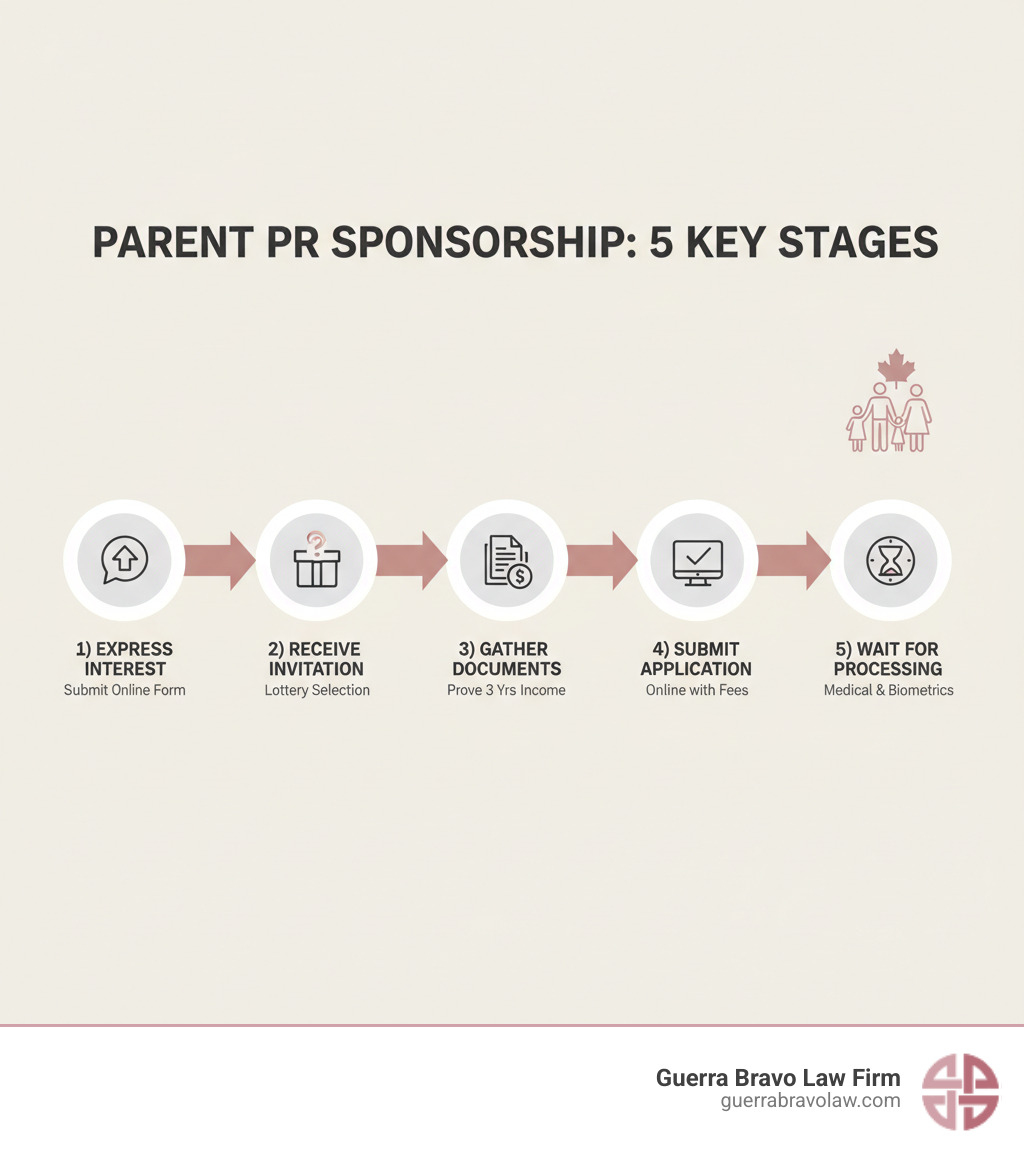
Quick Overview: How to Sponsor Your Parents for PR in Canada
-
Submit an Interest to Sponsor form when the portal opens.
-
Receive an Invitation to Apply (ITA) if selected in the random lottery.
-
Meet income requirements for the past three tax years.
-
Submit a complete application within the 60-day deadline.
-
Sign a 20-year undertaking to financially support your parents (10 years in Quebec).
-
Wait for processing, which can take 24-36 months.
Competition is intense; for 2024, 35,700 invitations were sent for only 20,500 spots. For those not invited or seeking a faster option, the Super Visa allows parents to visit Canada for up to 5 years at a time on a 10-year visa. While it doesn’t lead to permanent residency, it’s a much quicker alternative.
Understanding this process is the first step for any family considering this path. Knowing the requirements can help avoid costly mistakes and increase the chances of a successful family reunion.
What is the Parent and Grandparent Program (PGP)?
The Parents and Grandparents Program (PGP) is Canada’s primary pathway for its citizens and permanent residents to sponsor their parents and grandparents for permanent residency. This status allows them to live, work, and study anywhere in Canada, access universal healthcare, and eventually apply for Canadian citizenship. Due to its popularity, the PGP is highly competitive and operates on a lottery system. Immigration, Refugees and Citizenship Canada (IRCC) periodically opens a portal for potential sponsors to submit an “Interest to Sponsor” form. From this pool, IRCC randomly invites a limited number to apply. For example, the 2024 intake sent 35,700 invitations for 20,500 available spots, highlighting the high demand.
PGP vs. The Super Visa: Key Differences
While both programs unite families in Canada, they serve different purposes. Understanding the distinctions is crucial for choosing the right path.
Parents and Grandparents Program (PGP)
-
Goal: Permanent Residency (PR).
-
Outcome: Sponsored individuals become permanent residents with a path to Canadian citizenship.
-
Process: Invitation-only, based on a random lottery from a pool of interested sponsors.
-
Benefits: Full access to Canadian healthcare, social services, and the right to work without restriction.
-
Sponsor’s Commitment: A legally binding financial undertaking for 20 years (10 years in Quebec).
The Super Visa
-
Goal: Long-term temporary visits.
-
Outcome: A multi-entry visitor visa valid for up to 10 years, allowing stays of up to 5 years at a time per entry.
-
Process: Direct application at any time, with no lottery system involved.
-
Benefits: Flexibility for extended family visits without the long-term commitment of PR.
-
Sponsor’s Commitment: A letter of invitation and proof of meeting a lower income threshold. The parent or grandparent must also have private Canadian health insurance for at least one year.
In short, the PGP is for permanent immigration, while the Super Visa is a flexible, temporary solution for long visits. Many families use the Super Visa to have their loved ones in Canada while waiting for a PGP invitation or for an application to be processed.
Eligibility: Who Can Sponsor and Be Sponsored?
Eligibility for Canada’s parent PR sponsorship program involves strict criteria for both the sponsor in Canada and the parents or grandparents being sponsored.
Sponsor Eligibility Requirements
To sponsor your parents or grandparents, you must:
-
Be a permanent resident of Canada, a Canadian citizen, or a person registered in Canada as an Indian under the Canadian Indian Act.
-
Be 18 years of age or older.
-
Reside in Canada.
-
Meet the Minimum Necessary Income (MNI) for the last three consecutive tax years.
-
Sign a legal sponsorship undertaking, promising to financially support your sponsored relatives.
IRCC also requires that sponsors are not in prison, bankrupt, in default of a previous sponsorship, or have been convicted of certain serious offenses.
Income Requirements for Sponsors
This is often the most challenging requirement. The sponsor (and their co-signing spouse or common-law partner, if applicable) must prove they meet or exceed the Minimum Necessary Income (MNI) plus 30% for the three tax years immediately preceding the application. This income is verified using Notices of Assessment (NOA) from the Canada Revenue Agency (CRA).
-
Family Size: The required income level depends on the total number of people you will be financially responsible for, including yourself, your dependents, your spouse, anyone you are currently sponsoring, and the parents or grandparents you intend to sponsor.
-
Co-signer: Your spouse or common-law partner can co-sign the application. Their income is combined with yours to meet the MNI. They must meet the same eligibility requirements and sign the same financial undertaking.
-
Proof of Income: Only income reported on line 15000 of your CRA Notices of Assessment is generally considered. Certain income sources, like most provincial social assistance payments, are not included.
Eligibility for Sponsored Parents and Grandparents
Your parents or grandparents must also meet certain criteria:
-
Relationship: They must be your parent or grandparent by blood or adoption. You will need to provide documents like birth certificates to prove the relationship.
-
Admissibility: They and any of their dependents must be admissible to Canada. This involves passing:
-
Medical Exams: To ensure they do not pose a risk to public health or create excessive demand on health services.
-
Criminal and Security Checks: To ensure they do not have a criminal record or pose a security risk that would make them inadmissible.
-
Sponsoring in Quebec
If you reside in Quebec, you must meet additional provincial requirements. After receiving a federal Invitation to Apply and being approved by IRCC, you must also apply to Quebec’s Ministère de l’Immigration, de la Francisation et de l’Intégration (MIFI). Quebec has its own income scale and a shorter financial undertaking period of 10 years. For more details, you can Find out how to sponsor your parents and grandparents in Quebec.
The PGP Application: A Step-by-Step Guide to parent pr sponsorship
The parent PR sponsorship application is a multi-step process that begins long before the application itself. Once you receive an invitation, you must act quickly, as deadlines are strict.
Step 1: Receive an Invitation to Apply (ITA)
The PGP process starts by submitting an “Interest to Sponsor” form when IRCC opens the portal. IRCC then conducts a random lottery from this pool and sends Invitations to Apply (ITAs) to those selected. Simply expressing interest does not guarantee an invitation. For recent intakes, IRCC has been drawing from the pool of forms submitted in 2020. It is vital to monitor the email address you provided to IRCC, including spam folders, for an ITA.
Step 2: Prepare Key Documents for Your parent pr sponsorship Application
Upon receiving an ITA, you typically have only 60 days to submit a complete application. Early preparation is essential.
-
For the Sponsor:
-
Proof of status in Canada (e.g., passport, PR card).
-
Notices of Assessment (NOA) from the CRA for the last 3 tax years to prove income.
-
Completed sponsorship agreement forms.
-
Proof of residency in Canada.
-
-
For the Sponsored Parents/Grandparents:
-
Valid passports and other identity documents.
-
Birth certificates or other documents to prove the family relationship.
-
Police certificates from every country they have lived in for 6+ months since age 18.
-
Passport-style photos meeting IRCC specifications.
-
Completed permanent residence application forms.
-
The official Instruction Guide [IMM 5772] provides a complete checklist and detailed instructions.
Step 3: Pay Fees and Submit Online
All applications must be submitted electronically through IRCC’s online portal, along with the required fees.

Fees include application processing fees, the Right of Permanent Residence Fee (RPRF), and biometrics fees, starting from $1,205 CAD per sponsored person. All parent PR sponsorship applications are submitted via the Permanent Residence (PR) Portal. The principal applicant (your parent or grandparent) submits both the sponsorship and PR applications together.
Deadlines are absolute. An incomplete application will result in a request for missing documents with a 30-day response time. Failure to comply will lead to the application being returned unprocessed, and you would have to start over if you receive a new invitation in the future.
After You Apply: Sponsor Responsibilities and Processing
Submitting your parent PR sponsorship application marks the beginning of a new phase that requires patience and an understanding of your ongoing responsibilities.
The Sponsorship Undertaking
By sponsoring a relative, you sign a legally binding contract with the Government of Canada called an undertaking. This is your promise to financially support your sponsored parents or grandparents and repay any provincial social assistance they may receive.
-
Duration: The undertaking lasts for 20 years from the day they become permanent residents (10 years for sponsors in Quebec).
-
Responsibility: You are responsible for covering their basic needs, such as food, clothing, and shelter.
-
Legal Consequences: Failure to meet these obligations puts you in default, which can prevent you from sponsoring anyone else in the future.
Processing Times and Next Steps
After submission, the waiting period begins. Processing times for parent PR sponsorship applications typically range from 24 to 36 months. During this time, IRCC will contact the principal applicant to request further steps.
-
Medical Exams: Your parents or grandparents will be required to complete a medical exam with an IRCC-approved panel physician.
-
Biometrics: Applicants between 14 and 79 years old will receive a Biometric Instruction Letter (BIL) and will have 30 days to provide their fingerprints and a photo at a designated collection site. Delays can slow down the application.
You can check estimated processing times on the official IRCC’s website. It is crucial to keep all contact information updated with IRCC throughout the process.
Common Reasons for a parent pr sponsorship Refusal
Understanding common pitfalls can help you prepare a stronger application. Key reasons for refusal include:
-
Failure to Meet Income Requirements: Not meeting the Minimum Necessary Income for all three required tax years is the most common reason for refusal.
-
Incomplete or Late Application: IRCC is strict about deadlines and completeness. Missing documents, signatures, or a late submission will result in your application being returned.
-
Inadmissibility: The sponsored person may be found inadmissible for medical reasons (e.g., a condition that would cause excessive demand on health services) or due to a criminal record.
-
Insufficient Proof of Relationship: Failure to provide clear documentation (like birth certificates) proving the parent-child or grandparent-grandchild relationship.
-
Misrepresentation: Providing false information can lead to refusal and a multi-year ban on applying for Canadian immigration.
-
Default on a Previous Sponsorship: If you have failed to meet the obligations of a past sponsorship, you will be ineligible to sponsor again.
Frequently Asked Questions about the PGP
Here are answers to some of the most common questions about parent PR sponsorship in Canada.
Can my sponsored parents work in Canada?
Yes. Once they become permanent residents, sponsored parents and grandparents have the right to live, work, and study anywhere in Canada. They do not need a separate work permit and will have access to Canada’s healthcare system and other social benefits.
What happens if I don’t get an invitation to apply?
If you are not invited, you cannot apply for the PGP in that intake, as the program is strictly invitation-only. You must wait for a future opportunity to express interest. In the meantime, your parents or grandparents may be eligible for the Super Visa. This allows them to visit Canada for up to 5 years at a time on a 10-year multi-entry visa, providing a great alternative for long-term family visits.
Can my spouse or common-law partner be a co-signer?
Yes, your spouse or common-law partner can be a co-signer. This is a common strategy to meet the Minimum Necessary Income (MNI) requirements. To be a co-signer, your partner must:
-
Meet the same eligibility requirements as the sponsor.
-
Agree to be jointly responsible for the 20-year (or 10-year in Quebec) financial undertaking.
Their income will be combined with yours to meet the MNI threshold for the past three tax years, which can significantly strengthen your application.
Conclusion: Your Family’s Future in Canada
Reuniting with parents and grandparents is a cherished goal for many families. While Canada’s parent PR sponsorship program offers one such path, it is a complex, competitive process requiring significant commitment. Understanding its lottery-based system, strict income rules, and lengthy processing is key for anyone considering this option.
While this guide explores Canadian immigration, we know many families in our community are navigating the U.S. system. If you are a U.S. citizen or lawful permanent resident in the Rio Grande Valley—including McAllen, Brownsville, Edinburg, Harlingen, Mission, Pharr, Weslaco, Mercedes, Alamo, San Juan, Donna, Hidalgo, Palmview, La Joya, or Penitas—you are likely focused on the U.S. family petition process.
At Guerra Bravo Law Firm, we specialize in U.S. immigration law. Attorney Iris Guerra Bravo’s 14+ years of insider experience with ICE and DHS provide our clients with battle-tested strategies and individualized attention. We know the intricacies of U.S. law and use that knowledge to fight for families who deserve to be together.
If you’re exploring US-based Family Petitions to bring your relatives to the United States, we are here to guide you. Our team is committed to helping families steer every step of the process to achieve their American dream.
Contact Us today to discuss your family’s U.S. immigration needs. Let’s work together to build the future your family deserves.

[