

Your Family's Future: Choosing the Right Immigration Attorney
Why Your Family's Future Depends on the Right Immigration Attorney
A Family immigration lawyer specializes in helping U.S. citizens and lawful permanent residents steer the complex legal process of bringing family members to the United States—whether it's a spouse, child, parent, or sibling. These attorneys handle everything from visa applications and petitions to waivers and representation before immigration courts.
Quick Answer: What Does a Family Immigration Lawyer Do?
File Family Petitions - Prepares and submits Form I-130 and supporting documents to USCIS
Steer Visa Categories - Determines the right pathway (Immediate Relative, Family Preference, K-1 Fiancé visa)
Handle Complex Cases - Addresses inadmissibility issues, criminal history, prior violations, and waivers
Prevent Costly Mistakes - Ensures applications are complete, accurate, and meet strict deadlines
Represent Clients - Advocates at interviews, appeals, and deportation proceedings
Advise on Strategy - Chooses between Adjustment of Status vs. Consular Processing based on your situation
Immigrating to the U.S. as a family should be a time of hope, but the reality is that the immigration system is intricate, ever-changing, and unforgiving of errors. Family-based immigration isn't just about filling out forms; it involves understanding different visa categories, navigating priority dates, proving relationships, and meeting strict financial requirements.
The stakes are high. A single mistake can delay your family's reunion by months or even years. That's why experienced legal guidance is essential. Whether you're sponsoring a spouse, petitioning for a child, or facing complex challenges like deportation, the right family immigration lawyer becomes your advocate and strategist, securing your family's future.
What is Family-Based Immigration? Understanding Your Options
Family-based immigration is the legal pathway for U.S. citizens and lawful permanent residents to sponsor certain relatives for a green card, allowing them to live, work, and build a life in the United States. The family-based immigration process makes family reunification possible.
However, not every family relationship qualifies, and timelines vary dramatically depending on the sponsor's status and the relative being sponsored.
Who Can Sponsor a Family Member?
U.S. Citizens have the broadest options, with the ability to petition for a spouse, children (married or unmarried, any age), parents (if the citizen is 21+), and siblings (if the citizen is 21+).
Lawful Permanent Residents (green card holders) have a narrower path, limited to sponsoring a spouse and unmarried children.
A family immigration lawyer helps you identify the correct category for your family petitions and avoid costly mistakes.
Immediate Relatives of U.S. Citizens
This is the fastest path for family immigration. Immediate relatives are not subject to annual visa limits, meaning there's no long wait for a visa number to become available. This category includes:
Spouse of a U.S. citizen
Unmarried children under 21 of a U.S. citizen
Parents of a U.S. citizen (if the citizen is at least 21)
For marriage-based cases, proving the relationship is genuine is critical. Immigration officials scrutinize evidence to prevent fraud. Our guide on top immigration marriage questions can help you prepare.
Family Preference Categories
Relatives who are not "immediate relatives" fall into family preference categories, which have annual numerical limits. This creates a waiting list based on a "priority date" (the date the petition was filed). The U.S. Department of State's monthly Visa Bulletin tracks which dates are current. Wait times can range from a few years to over a decade.
First Preference (F1): Unmarried sons and daughters (21+) of U.S. citizens.
Second Preference (F2): F2A is for spouses and children (under 21) of permanent residents. F2B is for unmarried sons and daughters (21+) of permanent residents.
Third Preference (F3): Married sons and daughters of U.S. citizens.
Fourth Preference (F4): Siblings of adult U.S. citizens (21+). This category has the longest wait times, often 15 years or more. Our article on American citizens petitioning for siblings explains this process.
For guidance on sponsoring adult children, see our guide on green cards for adult children.
Fiancé(e)s and Spousal Visas
When love crosses borders, you have two main options:
K-1 Fiancé(e) Visa: For a U.S. citizen to bring their foreign fiancé(e) to the U.S. to get married. The couple must marry within 90 days of arrival, after which the foreign spouse applies for a green card.
Spousal Visa (CR-1 or IR-1): For couples who are already legally married. The foreign spouse arrives in the U.S. as a lawful permanent resident, which can be a more direct path to a green card.
U.S. immigration law generally only recognizes legally valid marriages. A family immigration lawyer can help determine if your relationship qualifies. For more details, check our guide on how to get a green card in Texas for immediate family.
The Family Reunification Journey: Key Steps and Timelines
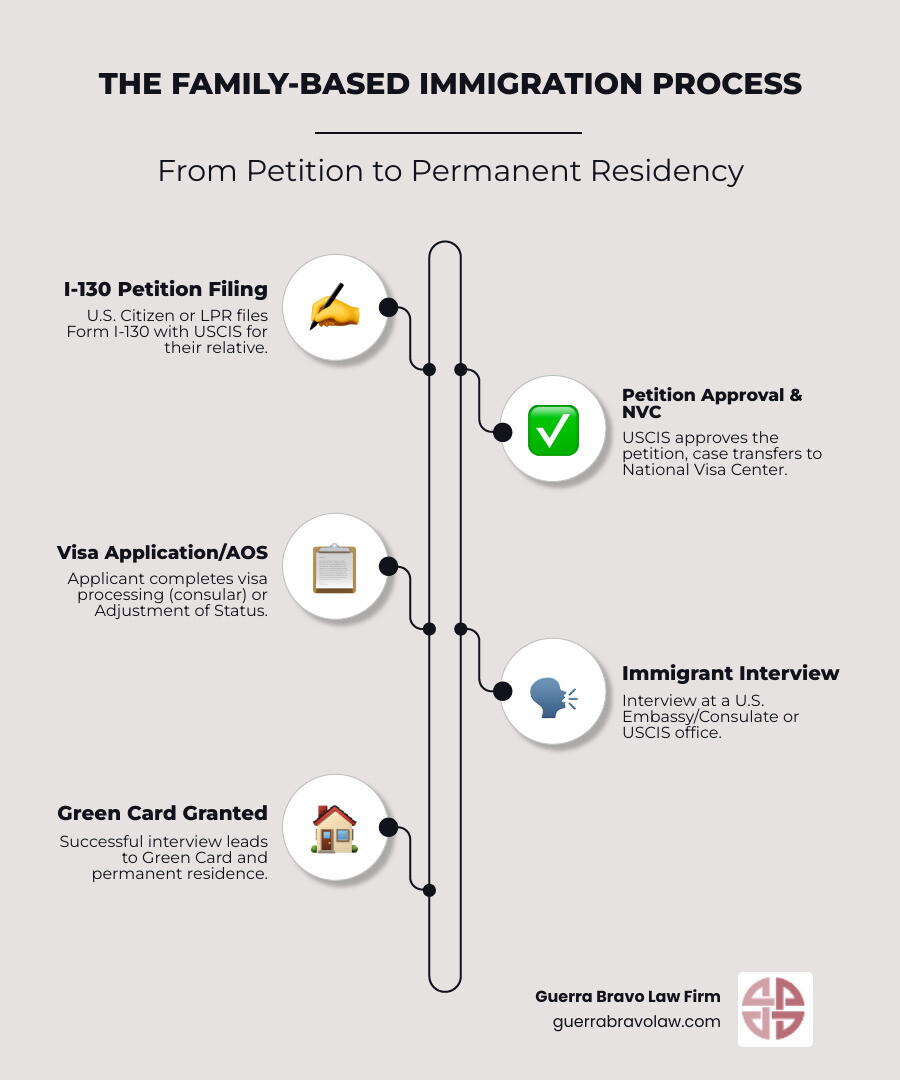
Bringing your family to the U.S. is a multi-step journey requiring precision and patience. Understanding the process helps you prepare and avoid delays.

1. File Form I-130, Petition for Alien Relative: As the sponsor, you file this form with U.S. Citizenship and Immigration Services (USCIS) to establish your qualifying family relationship. This is the foundation of your case.
2. USCIS Petition Review: USCIS reviews the petition. If information is missing, they may issue a Request for Evidence (RFE), which can delay your case by months.
3. National Visa Center (NVC) Processing: After USCIS approval, the case moves to the NVC. The NVC collects required documents, fees, and the Affidavit of Support (Form I-864), which proves you can financially support your relative.
4. Consular Processing or Adjustment of Status:
Consular Processing: If your relative is abroad, they will interview at a U.S. Embassy or Consulate in their home country.
Adjustment of Status (AOS): If your relative is already in the U.S. legally, they may be eligible to file Form I-485 to get their green card without leaving the country.
5. The Interview and Final Approval: An immigration official will interview your family member to verify eligibility and the authenticity of your relationship. After the interview and background checks, a final decision is made. If approved, your relative receives an immigrant visa or a green card.
So, how long does this all take? Processing times vary significantly.
Immediate Relatives of U.S. citizens (spouses, minor children, parents) have the fastest timelines, typically 12 to 18 months, as there are no annual visa limits.
Family Preference Categories face backlogs due to annual visa caps. Your "priority date" (when the I-130 was filed) determines your place in line. Wait times are published in the monthly Visa Bulletin and can be impacted by your relative's country of origin and agency workloads.
Application accuracy is critical. Incomplete applications or missing documents can trigger RFEs or denials, adding months or years to your wait. A family immigration lawyer ensures everything is filed correctly the first time to avoid unnecessary delays.
Why You Need an Experienced Family Immigration Lawyer
Navigating the U.S. immigration system is like trying to solve a complex puzzle where the future of your family is at stake. The process involves a web of statutes, regulations, and changing procedures. A small mistake can delay your family's reunion or even lead to a denial.
This is why an experienced family immigration lawyer is essential. At Guerra Bravo Law Firm, we understand the system from the inside out. With locations in McAllen, Brownsville, and across the Rio Grande Valley, we serve our local community. Our lead attorney, Iris Guerra Bravo, brings over 14 years of insider experience with ICE and DHS to every case. This "battle-tested" perspective means we know how to build strategies that work, even in the most challenging situations.

Navigating Complex Regulations and Documentation
Immigration law is unforgiving. A lawyer ensures every detail of your application is accurate, complete, and strategically presented. We prevent common errors that lead to Requests for Evidence (RFEs), which cause months of delays. We also manage all deadlines to prevent your application from being terminated.
The process requires a mountain of documents, from foreign birth certificates to financial records. We guide you on what's needed, help you obtain them, and ensure everything is properly certified and translated, as emphasized by experts like the American Immigration Lawyers Association.
Overcoming Common Challenges and Roadblocks
Many cases face roadblocks that require expert legal help. We specialize in overcoming these challenges:
Inadmissibility Issues: We address circumstances that could bar someone from getting a green card.
Criminal History: The intersection of criminal and immigration law ("crimmigration") is one of our specialties. We work to minimize the impact of past offenses, exploring options like waivers.
Prior Immigration Violations: Overstaying a visa or entering without inspection must be addressed with specific legal strategies. We prepare provisional unlawful presence waivers (Form I-601A) by demonstrating "extreme hardship" to a qualifying relative.
Proving a Bona Fide Marriage: We help you compile compelling evidence—joint bank accounts, leases, photos, and affidavits—to prove your marriage is genuine and not for immigration fraud.
Financial Sponsorship: If a sponsor's income is insufficient, we help identify and work with joint sponsors to meet the requirements.
Deportation Defense: If your family member is facing removal, we provide aggressive representation in immigration court.
The Strategic Advantage of a Family Immigration Lawyer
Hiring a lawyer gives you a strategic partner who anticipates problems and develops custom solutions. We help you make critical decisions, such as choosing between consular processing and adjustment of status. We also prepare you thoroughly for interviews and can represent you if issues arise.
If a case is denied, we file appeals or motions to reopen. We protect your rights throughout the process, which extends to other matters like Citizenship Application Assistance and US Citizenship Claims. For local families, our McAllen Family Immigration: Your Essential Guide provides practical information. The peace of mind from having an expert manage your case is invaluable.
Sponsor Responsibilities and Immigrant Rights
Sponsoring a family member is a promise to them and the U.S. government. This commitment comes with legal responsibilities, while your relative gains significant rights and opportunities upon arrival.
The Affidavit of Support: Your Financial Obligation
When you sponsor a relative, you sign Form I-864, the Affidavit of Support, a legally binding contract with the U.S. government. You promise to financially support your family member to ensure they do not rely on public benefits.
This obligation continues until your relative becomes a U.S. citizen, works for 40 quarters (about 10 years), permanently leaves the U.S., or passes away. To qualify, your income must be at least 125% of the federal poverty guidelines. If your income is insufficient, a joint sponsor who meets the requirements can share the financial responsibility. Understanding this serious commitment is why consulting a family immigration lawyer is so important.
Life in the U.S.: Rights and Opportunities for Sponsored Relatives
Once your family member becomes a lawful permanent resident (green card holder), a new world of opportunity opens up. They gain:
The right to live and work anywhere in the United States.
The ability to enroll in schools and universities.
The freedom to travel internationally (with some restrictions on long absences).
Eligibility for Social Security benefits after paying into the system.
Most importantly, permanent residency is the path to U.S. citizenship. After three to five years, they can apply for naturalization, gaining the right to vote and full protection under U.S. law. We can guide you through this with our US Citizenship Claims services.
Addressing Past Financial Assistance and Inadmissibility
A history of receiving certain government benefits can raise concerns under the public charge rule. An immigration official will assess if the applicant is likely to become dependent on the government. However, not all benefits count, and the rules are complex. A strong Affidavit of Support can often overcome these concerns.
In cases where someone is found inadmissible for public charge or other reasons (like criminal history or immigration violations), a waiver of inadmissibility may be possible. This usually requires proving that a U.S. citizen or permanent resident relative would suffer "extreme hardship" if the waiver is denied. We specialize in building compelling waiver applications to give your family the best chance of success.
Frequently Asked Questions about Family Immigration
We understand the family immigration process is filled with questions. Here are answers to some of the most common inquiries we receive.
How long does it take to sponsor a family member?
Processing times vary greatly. The two main factors are:
Visa Category: Immediate Relatives (spouses, minor children, and parents of U.S. citizens) have much shorter processing times, often several months to a couple of years, because there are no annual visa caps. Family Preference Categories (adult children, siblings, etc.) face long waits for a visa number to become available, based on their "priority date."
Application Quality: A complete and accurate application prevents delays from Requests for Evidence (RFEs). An error is the quickest way to extend your family's separation.
What's the difference between sponsoring a spouse and a fiancé(e)?
This is a strategic choice with different processes:
K-1 Fiancé(e) Visa: For a U.S. citizen's foreign fiancé(e). They enter the U.S., must marry within 90 days, and then apply for a green card (Adjustment of Status). This is often faster to get your partner into the U.S.
CR-1/IR-1 Spousal Visa: For couples already married. The foreign spouse completes processing abroad and enters the U.S. as a permanent resident, with a green card in hand. This can be a more direct path to permanent residency.
We help families weigh the pros and cons to make the best decision for their situation.
Can a U.S. citizen sponsor a sibling?
Yes, a U.S. citizen aged 21 or older can sponsor a sibling under the F4 preference category. However, this category has the longest wait times of any family-based petition due to high demand and low annual visa numbers. The wait can easily exceed 15 years, depending on the sibling's country of origin. Because the "priority date" is set when the petition is filed, it is critical to file as early as possible to secure a place in the long queue.
Conclusion: Secure Your Family's Tomorrow, Today
Family unity is the heart of our work. We know the path to bringing loved ones to the United States is filled with challenges, from complex forms and financial requirements to potential roadblocks like inadmissibility. A single mistake can delay your reunion for years, which is why you shouldn't steer this journey alone.
Guerra Bravo Law Firm stands apart. Attorney Iris Guerra Bravo brings over 14 years of insider experience with ICE and DHS to every case. This battle-tested perspective means we understand how immigration agencies operate and how to position your case for success, even in the toughest situations. We develop individualized legal strategies that work.
Serving families throughout the Rio Grande Valley, including McAllen, Brownsville, Edinburg, and Harlingen, we are deeply rooted in this community. Your family's future is too important to leave to chance.
The waiting is hard enough. Don't risk delays or denials. Your family's tomorrow begins with the decision you make today.
Ready to take the first step? Contact Us for a confidential consultation to create a roadmap for bringing your family together. You can also Explore Our Services to learn more.
Your loved ones are waiting. Let's bring them home.