

How the Federal Age Discrimination in Employment Act Keeps You Working
Why the Federal Age Discrimination in Employment Act Still Matters for Workers Over 40
The federal age discrimination in employment act was signed into law in 1967 — and nearly six decades later, it remains one of the most important workplace protections in the United States.
Here's what you need to know quickly:
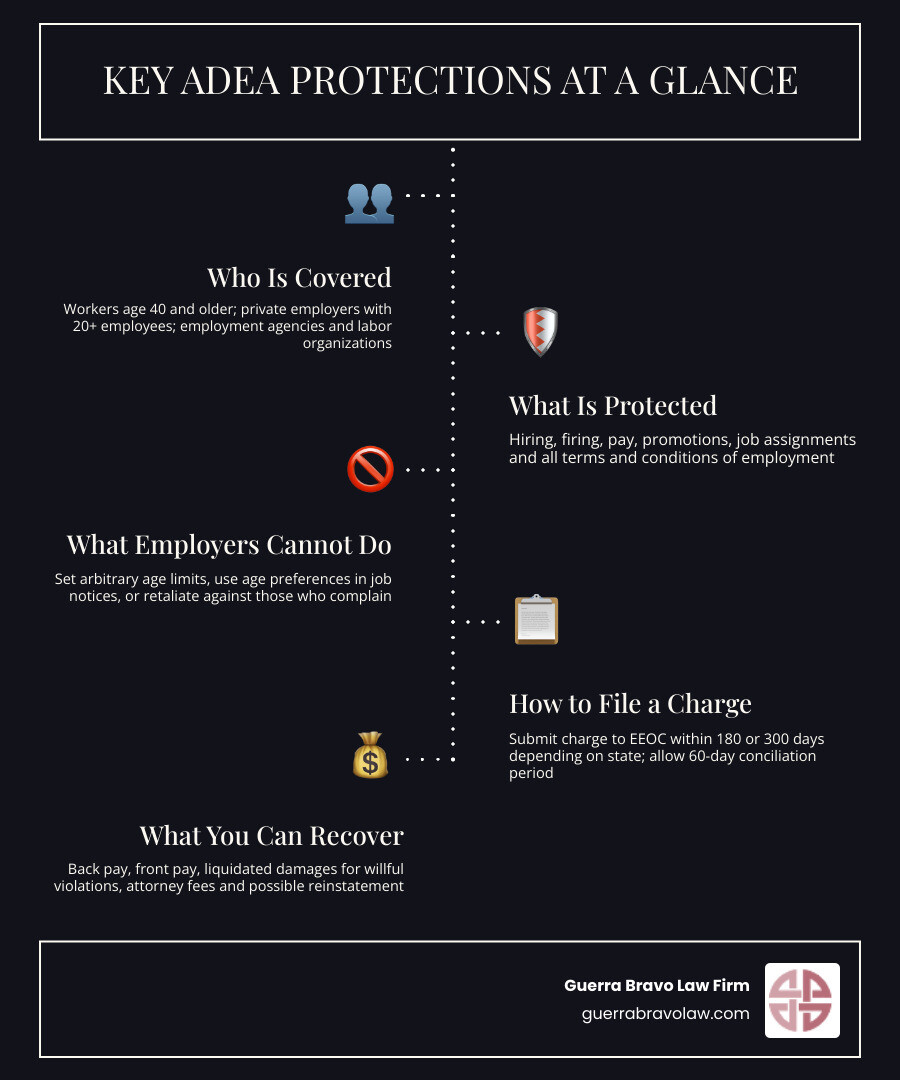
Who it protects: Workers and job applicants age 40 and older
Who must follow it: Employers with 20 or more employees, plus employment agencies and labor organizations
What it covers: Hiring, firing, pay, promotions, job assignments, and other employment terms
Who enforces it: The U.S. Equal Employment Opportunity Commission (EEOC)
Key stat: In fiscal year 2022, the EEOC recovered $94.1 million for age discrimination victims
The law exists for a straightforward reason. Congress found that older workers were being pushed out of jobs — not because of poor performance — but because of arbitrary age limits. That wasn't fair then, and it's still not fair now.
Age discrimination is more common than many people realize. In FY 2022 alone, the EEOC received over 11,000 charges under the ADEA. And despite those numbers, many workers don't know their rights or how to protect them.
This guide breaks down exactly what the ADEA covers, what employers can and can't do, and what steps you can take if you believe your age is being used against you.
Understanding the federal age discrimination in employment act
To understand your rights, we first have to look at the foundation of the law. The Age Discrimination in Employment Act of 1967 (ADEA) was enacted to promote the employment of older persons based on their ability rather than their age. It was also designed to help employers and workers find ways to meet problems arising from the impact of age on employment.
In our work at Guerra Bravo Law Firm, we often see how Federal Employment Law intersects with the lives of hardworking people in McAllen and the Rio Grande Valley. The ADEA doesn’t apply to every single mom-and-pop shop on the corner, but it covers a vast majority of the workforce.
Employer Coverage and Scope The federal age discrimination in employment act applies to:
Private Employers: Those who have 20 or more employees for each working day in each of 20 or more calendar weeks in the current or preceding calendar year.
Labor Organizations: Unions that operate a hiring hall or have 25 or more members.
Employment Agencies: This includes any person or entity regularly undertaking with or without compensation to procure employees for an employer.
Government Entities: This includes federal, state, and local governments, regardless of the number of employees.
The law specifically targets industries affecting interstate commerce. While that sounds like "big business" talk, in today's global economy, almost every business in Texas—from Pharr to Edinburg—falls under this umbrella.
Core Protections Under the federal age discrimination in employment act
The ADEA is broad. It doesn’t just stop an employer from saying "you're too old to work here." It covers the entire lifecycle of employment. Under Federal Anti-Discrimination Laws, it is unlawful for an employer to:
Hiring: Fail or refuse to hire an applicant because of their age (40 or older).
Discharge: Fire or lay off an employee specifically because of their age.
Compensation: Pay an older worker less than a younger worker for the same job duties.
Terms and Conditions: Discriminate regarding job assignments, promotions, or use of company facilities.
Privileges of Employment: This includes access to training programs, fringe benefits, and even office space.
Essentially, if a decision is made that affects your wallet, your career path, or your daily work environment, and that decision was based on you being 40 or older, the ADEA is likely standing in your corner.
Prohibited Advertising and Retaliation
One of the most common ways age discrimination starts is before a person even gets an interview. Have you ever seen a job ad asking for "digital natives" or "recent college grads"? While not always illegal, these can be red flags.
According to 29 USC 623: Prohibition of age discrimination, it is unlawful to print or publish any notice or advertisement indicating any preference, limitation, specification, or discrimination based on age.
The Protection Against Retaliation We know it’s scary to speak up. Many workers in the Rio Grande Valley worry that if they report discrimination, they’ll be targeted. The ADEA includes two very strong shields:
The Opposition Clause: You are protected if you oppose any practice made unlawful by the ADEA (like telling your boss that a policy is unfair to older workers).
The Participation Clause: You are protected if you file a charge, testify, assist, or participate in any investigation or proceeding under the Act.
If an employer tries to "get back at you" for exercising these rights, they are violating the law a second time.
Lawful Exceptions and Employer Defenses

While the federal age discrimination in employment act is powerful, it isn't absolute. There are specific situations where an employer can legally take age into account. Understanding these defenses is crucial because they are the "loopholes" an employer will try to use if you ever file a claim.
Bona Fide Occupational Qualification (BFOQ) This is a fancy legal term for "age is actually necessary for this job." For example, if a movie studio is casting a child actor to play a 10-year-old, they can legally discriminate against a 50-year-old applicant. In the commercial world, this is rare. It usually applies only when age is essential to the "normal operation of the particular business."
Reasonable Factors Other Than Age (RFOA) This is the most common defense. An employer might argue that they fired an older worker not because of their age, but because of a "reasonable factor other than age." This could include:
A decline in specific technical skills.
The elimination of a specific job position.
Higher salary costs (though this is a grey area).
Physical inability to perform the core tasks of the job (if no reasonable accommodation exists).
Under 29 USC Ch. 14: AGE DISCRIMINATION IN EMPLOYMENT, the employer bears the burden of proving that the factor they used was indeed reasonable and not just a cover-up for age bias.
Public Safety and Executive Carve-outs
There are some professions where the law allows for mandatory retirement or age-based hiring. This is usually due to public safety concerns.
Firefighters and Law Enforcement State and local governments can often set mandatory retirement ages for firefighters and police officers. This is allowed because the physical demands of the job are tied directly to public safety. If you are a first responder in Mission or Weslaco, these specific rules may apply to you.
High-Level Executives The ADEA allows for the mandatory retirement of certain employees who are at least 65 years old if:
They have been in a "bona fide executive or high policymaking position" for the two-year period immediately before retirement.
They are entitled to an immediate, non-forfeitable annual retirement benefit from the employer that equals at least $44,000.
Tenured University Faculty While mandatory retirement for most professors was abolished in 1994, there are still specific nuances regarding tenured faculty and retirement incentives that universities may offer.
Foreign Workplace Compliance
Does the federal age discrimination in employment act follow you across the border? If you are a U.S. citizen working for a U.S.-controlled company in another country, the answer is generally yes.
However, there is a "Foreign Laws Exception." An employer is not required to comply with the ADEA if doing so would cause the employer to violate the laws of the country where the workplace is located.
Determining "Control" of a Foreign Corporation Whether a foreign company is "controlled" by a U.S. employer depends on:
Interrelation of operations.
Common management.
Centralized control of labor relations.
Common ownership or financial control.
Employee Benefits and the OWBPA

In 1990, the ADEA was amended by the Older Workers Benefit Protection Act (OWBPA). Before this, some employers were trying to save money by cutting benefits for older workers. The OWBPA made it clear: you cannot target older workers' benefits just because they are older.
We often help clients with Maintaining I-9 Compliance and other employment-related immigration matters, and we see how important benefits are for long-term stability.
Benefit Accrual and Pensions The law prohibits employers from stopping or reducing the rate of an employee's benefit accrual because of age. This applies to:
Defined Benefit Plans: Where the benefit is calculated based on factors like salary history and duration of employment.
Defined Contribution Plans: Like 401(k)s, where the employer cannot stop contributing just because you hit a certain age.
Early Retirement Incentives Employers can offer voluntary early retirement incentive plans. These are legal as long as they are truly voluntary and don't penalize workers who choose to stay.
Valid Waivers Under the federal age discrimination in employment act
If you are being laid off, your employer might ask you to sign a "waiver" or "release," promising not to sue them for age discrimination in exchange for severance pay. For this waiver to be valid under 29 USC 626: Recordkeeping, investigation, and enforcement, it must meet very strict "knowing and voluntary" standards:
In Writing: It must be written in a way that the average person can understand.
Specific Reference: It must specifically mention the ADEA by name.
No Future Rights: It cannot waive rights or claims that may arise after the date the waiver is signed.
Consideration: You must be given something of value (like extra money) that you weren't already entitled to.
Attorney Advice: You must be advised in writing to consult with an attorney.
Time to Think: You must be given at least 21 days to consider the agreement (or 45 days if it's part of a group layoff).
Revocation Period: You have 7 days after signing to change your mind and revoke the agreement.
If an employer tries to rush you into signing a waiver without these protections, it is likely invalid.
Pension and Life Insurance Rules
There is an "Equal Cost or Equal Benefit" rule. Employers must provide older workers with benefits that are at least equal to those provided to younger workers.
The only exception is if the cost of providing that benefit to an older worker is significantly higher. In that case, the employer can reduce the benefit slightly so that they are spending the same amount of money on you as they are on a younger employee. This often happens with life insurance or disability coverage.
Enforcement, Remedies, and Filing Procedures
If you feel you've been a victim of age discrimination, you can't just walk into a courthouse and file a lawsuit immediately. There is a specific process you must follow through the EEOC.
As experts in Immigration Compliance and Enforcement, we know how vital it is to follow federal procedures to the letter. Missing a deadline can end your case before it even starts.
The Filing Timeline
Standard Deadline: Generally, you must file a charge with the EEOC within 180 days of the discriminatory act.
Deferral State Limit: In states like Texas, where there is a state agency (the Texas Workforce Commission) that also handles discrimination, the deadline is extended to 300 days.
Federal Employees: If you work for the federal government, the rules are different. You usually must contact an EEO Counselor within 45 days.
Once you file, the EEOC will notify your employer. They may offer conciliation, which is a fancy word for trying to settle the problem through informal talk and persuasion. You must wait at least 60 days after filing with the EEOC before you can file a private lawsuit in court.
Interaction with Other Federal Statutes
The federal age discrimination in employment act doesn't work in a vacuum. It often overlaps with other laws:
Age Discrimination Act of 1975: While the ADEA covers employment, the 1975 Act prohibits age discrimination in programs or activities receiving federal financial assistance (like healthcare or education).
Section 188 of the Workforce Investment Act: This prohibits age discrimination in programs that are part of the public workforce development system.
Title VII of the Civil Rights Act: While Title VII covers race, sex, and religion, the procedures for filing a claim are very similar to the ADEA.
Remedies for Age Discrimination
What can you actually get if you win an ADEA case? The goal is to "make the victim whole"—to put you back in the position you would have been in if the discrimination never happened.
Common Remedies Include:
Back Pay: The wages and benefits you lost from the time of the discrimination until the trial.
Front Pay: Money to compensate for future lost wages if you can't be reinstated to your job.
Liquidated Damages: This is a "penalty" pay. If the employer's violation was willful (meaning they knew they were breaking the law or showed reckless disregard), the court can award you an amount equal to your back pay. Essentially, you get double.
Reinstatement or Promotion: The court can order the employer to give you your job back or give you the promotion you were denied.
Attorney Fees: In many cases, the losing employer must pay your legal costs.
Note: Unlike Title VII, the ADEA generally does not allow for "pain and suffering" (compensatory) or punitive damages.
Frequently Asked Questions about the ADEA
Does the ADEA protect workers under age 40?
No. The federal age discrimination in employment act specifically protects individuals who are 40 years of age or older. If you are 30 and feel you are being discriminated against because you are "too young," the ADEA cannot help you. However, some state laws provide protections for younger workers. Interestingly, the ADEA does allow an employer to favor an older worker over a younger one, even if both are over 40.
How many employees must a company have for the ADEA to apply?
For private employers, the "magic number" is 20. If a business in Hidalgo or Alamo has only 15 employees, they aren't covered by the federal ADEA (though they might be covered by Texas state laws). For federal, state, and local government employers, the law applies regardless of the number of employees.
What is the "but-for" causation standard?
This comes from a famous Supreme Court case, Gross v. FBL Financial Services. To win an ADEA case, the employee must prove by a "preponderance of the evidence" that age was the "but-for" cause of the employer's decision.
In simple terms: you have to show that if it weren't for your age, the adverse action (like being fired) wouldn't have happened. It’s a higher bar than in some other types of discrimination cases where age only needs to be a "motivating factor."
Conclusion
At Guerra Bravo Law Firm, we believe that experience is an asset, not a liability. Whether you are navigating the complexities of Federal Employment Law or dealing with immigration compliance in the Rio Grande Valley, you deserve a legal team that understands the "ins and outs" of the federal system.
Attorney Iris Guerra Bravo brings over 14 years of insider experience with ICE and DHS to every case. We provide battle-tested, individualized legal strategies for clients in McAllen, Brownsville, Edinburg, and across South Texas.
If you believe your rights under the federal age discrimination in employment act have been violated, or if you are an employer looking to ensure your policies are fully compliant, we are here to help. Your years of hard work should be respected, and we are dedicated to protecting that legacy.
Contact Guerra Bravo Law Firm today to schedule a consultation and ensure your workplace rights are protected.