
May 17, 2026
Don't Get Discriminated Against by Your Lack of Legal Knowledge
Don’t Get Discriminated Against by Your Lack of Legal Knowledge
Why Federal Anti-Discrimination Laws Matter More Than You Think
Federal anti-discrimination laws are a set of powerful legal protections that shield workers — and job seekers — from unfair treatment based on who they are, where they’re from, or what they believe.
Here’s a quick overview of what these laws cover:
The Core Federal Anti-Discrimination Laws
-
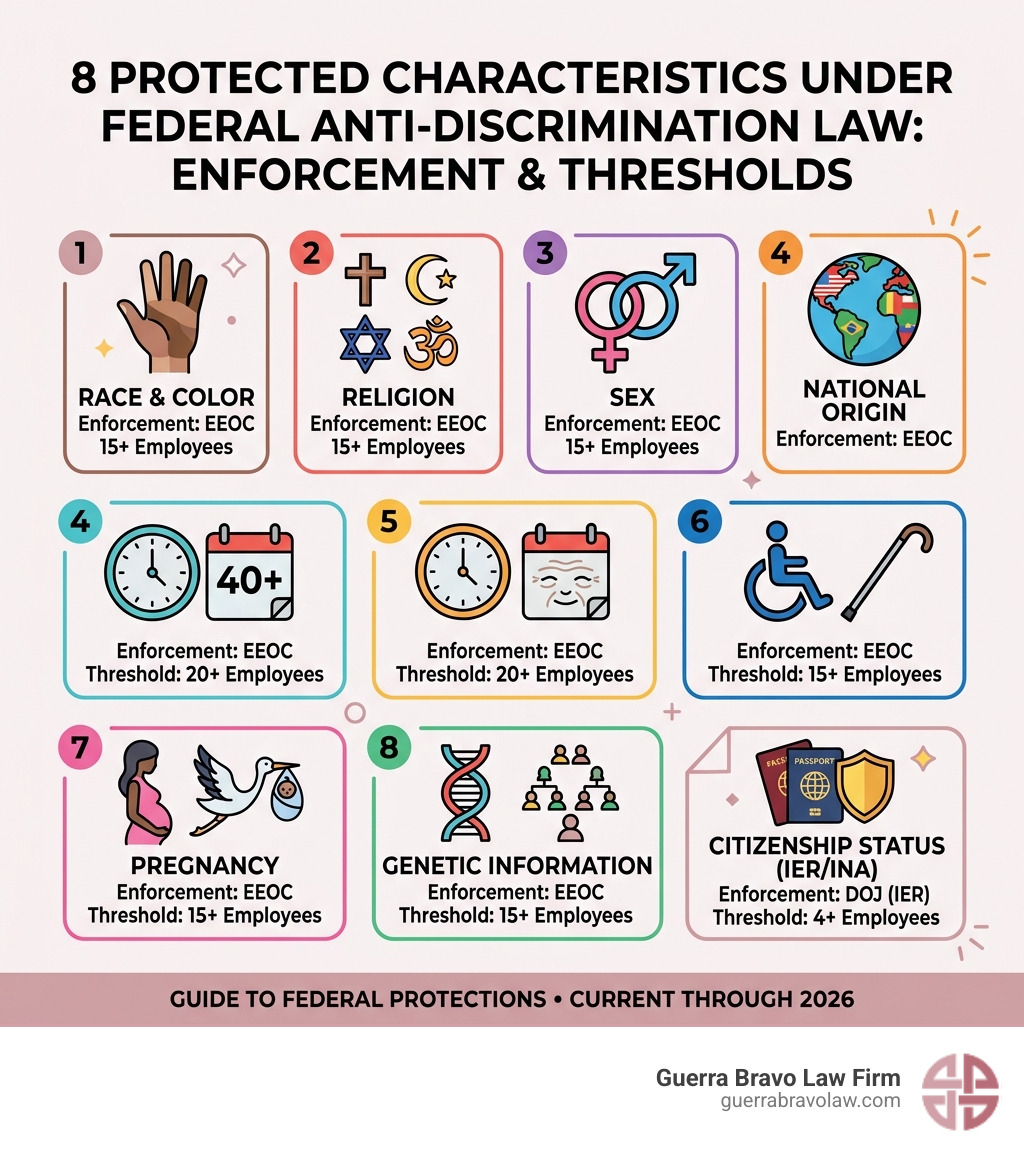
Title VII of the Civil Rights Act of 1964 — protects against discrimination based on race, color, religion, sex, and national origin
-
Age Discrimination in Employment Act (ADEA) — protects workers age 40 and older
-
Americans with Disabilities Act (ADA) — protects qualified individuals with disabilities
-
Equal Pay Act (EPA) — prohibits sex-based wage discrimination
-
Genetic Information Nondiscrimination Act (GINA) — protects against discrimination based on genetic information
-
Pregnancy Discrimination Act (PDA) — protects against discrimination related to pregnancy and childbirth
-
Immigration and Nationality Act (INA), anti-discrimination provision — protects workers from citizenship status and national origin discrimination
These laws apply to hiring, firing, pay, promotions, job assignments, training, and nearly every other aspect of employment.
Most private employers with 15 or more employees are covered. Some laws, like the ADEA, apply to employers with 20 or more. The INA’s anti-discrimination rules reach even smaller employers — those with as few as 4 employees.
And here’s what many people don’t know: these protections apply regardless of your citizenship or immigration status. Whether you were born here or arrived recently, the law is on your side.
If you think your rights have been violated, the Equal Employment Opportunity Commission (EEOC) and the Department of Justice’s Immigrant and Employee Rights Section (IER) are the main agencies that can help.
This guide breaks down exactly how these laws work, what they protect, and what you can do if your employer crosses the line.
The Foundation of Federal Anti-Discrimination Laws: Title VII and Beyond
When we talk about workplace fairness in the Rio Grande Valley, we are standing on a foundation built over 60 years ago. The landmark Civil Rights Act of 1964 | Legal Information Institute changed everything. Before this law, it wasn’t uncommon for employers to post “Help Wanted” ads that openly excluded people based on their race or gender.
Today, that foundation has expanded into a comprehensive Federal Employment Law framework. While Title VII is the “big one,” several other laws fill in the gaps to ensure that your DNA, your age, or even your paycheck aren’t used against you unfairly. We often see cases where multiple laws overlap, such as when an older woman faces discrimination based on both her age (ADEA) and her sex (Title VII).
Protected Characteristics Under Title VII
Title VII is the heavy hitter of federal anti-discrimination laws. It specifically prohibits “unlawful employment practices” based on five original “protected characteristics,” which have since been expanded by the courts.
The Protected “Big Five” (Plus Modern Expansions):
-
Race and Color: This includes discrimination based on physical characteristics or even marriage to someone of a certain race.
-
Religion: Employers must accommodate your sincerely held religious beliefs unless it causes “undue hardship.”
-
Sex: This now includes pregnancy, sexual orientation, and gender identity.
-
National Origin: This protects you if you are discriminated against because of your birthplace, ancestry, culture, or even your linguistic characteristics (like having an accent).
Age and Genetic Information Protections
As we move through 2026, the workforce is staying active longer than ever. The Age Discrimination in Employment Act (ADEA) is vital for our community in McAllen and Edinburg, protecting those of us who are 40 years of age or older. It is illegal for an employer to favor a 25-year-old over a 50-year-old simply because of a “youthful” company image.
Then there is the Genetic Information Nondiscrimination Act (GINA). Think of this as your “sci-fi” protection. It prevents employers from using your genetic tests or your family’s medical history to make employment decisions. They can’t fire you because they found out your family has a history of heart disease and they’re worried about future insurance costs.
Understanding Prohibited Practices and the Scope of Federal Anti-Discrimination Laws

It isn’t just about the “You’re fired” moment. Federal anti-discrimination laws cover the entire “life cycle” of employment. From the moment you see a job ad in a Brownsville newspaper to the day you retire, the law is watching.
Common Prohibited Practices Include:
-
Job Advertisements: An ad cannot say “Seeking young, energetic males” because it discourages women and older applicants.
-
Recruitment: Relying solely on “word-of-mouth” recruitment in a workplace that is 100% of one race can sometimes be seen as discriminatory if it excludes other groups.
-
Pay and Benefits: The Equal Pay Act requires that men and women in the same workplace receive equal pay for equal work.
-
Discipline and Discharge: You cannot be disciplined more harshly than a coworker of a different race for the exact same mistake.
For more details on how these rules apply to your specific situation, you can check out the Federal Laws Prohibiting Job Discrimination Questions And Answers | U.S. Equal Employment Opportunity Commission.
Disparate Treatment vs. Disparate Impact
In the legal world, we look at discrimination in two main ways. Sometimes it’s obvious, and sometimes it’s hidden behind “neutral” rules.
Disparate Treatment (Intentional): This is when an employer treats you differently because of a protected trait. For example, if a supervisor in Harlingen refuses to promote any Hispanic employees to management roles simply because of their heritage, that is disparate treatment.
Disparate Impact (Unintentional but Illegal): This happens when an employer has a “neutral” policy that ends up hurting one group more than others.
- Example: A company requires all applicants to pass a physical lifting test that isn’t actually necessary for the job. If this test ends up disqualifying significantly more women than men, it might be illegal unless the employer can prove it is a “business necessity.”
How Federal Anti-Discrimination Laws Protect Against Retaliation
This is perhaps the most important section of this guide. Many people in the Rio Grande Valley are afraid to speak up because they fear losing their jobs. Retaliation is illegal.
The EEOC reports that retaliation is the most common type of charge filed. You are protected if you:
-
File a charge of discrimination.
-
Complain to your supervisor about harassment.
-
Participate as a witness in an internal or federal investigation.
-
Refuse to follow an order that would result in discrimination.
If you speak up and suddenly your hours are cut, you’re demoted, or you’re given the “night shift” out of spite, that is an adverse action that the law prohibits.
Enforcement Agencies and the Process of Seeking Justice
Navigating the federal alphabet soup (EEOC, DOJ, IER, OSC) can be dizzying. Each agency has a specific “beat” they cover. If you need help in Spanish or English, we provide specialized Federal Employment Law services to help you determine which agency fits your case.
The EEOC Filing Process and Remedies
The Equal Employment Opportunity Commission (EEOC) handles most private-sector discrimination claims.
The Clock is Ticking: In most cases, you only have 180 days from the date the discrimination happened to file a charge. In Texas, because we have state laws that also prohibit discrimination, this deadline can sometimes be extended to 300 days, but you should never wait.
What Happens Next?
-
Investigation: The EEOC may investigate your claim.
-
Mediation: They might suggest a voluntary settlement.
-
Right to Sue: If they can’t resolve it, they will give you a “Notice of Right to Sue,” allowing you to take your employer to court.
Remedies (What you can win):
-
Back Pay: The money you lost from being fired or denied a promotion.
-
Compensatory Damages: Money for emotional distress or out-of-pocket costs.
-
Punitive Damages: Money meant to punish the employer (only for very bad cases).
-
Reinstatement: Getting your old job back.
The Role of the DOJ’s Immigrant and Employee Rights Section (IER)
While the EEOC focuses on Title VII, the Department of Justice’s Immigrant and Employee Rights Section (IER) focuses on the Immigration and Nationality Act (INA). This is crucial for our border community. The IER protects against:
-
Citizenship Status Discrimination: Firing someone because they are a refugee or asylee rather than a U.S. citizen.
-
National Origin Discrimination: Specifically for smaller employers (4 to 14 employees) not covered by the EEOC.
-
Unfair Documentary Practices: When an employer asks for more or different documents than the law requires during the I-9 process just because you look or sound “foreign.”
Special Protections: Disability, Religion, and Immigration Status
Some federal anti-discrimination laws require employers to go a step further than just being “fair” — they actually have to make changes to help you do your job.
The Intersection of Immigration and Federal Anti-Discrimination Laws
At Guerra Bravo Law Firm, we see the intersection of Worksite Enforcement and anti-discrimination every day. Employers often get nervous about Maintaining I9 Compliance and end up discriminating by mistake — or on purpose.
What Employers CANNOT Do:
-
Demand a “Green Card” only, refusing to accept other valid documents like a driver’s license and Social Security card.
-
Run an E-Verify check before a job offer is made.
-
Target only “foreign-looking” employees for re-verification.
Following Employer Immigration Compliance Best Practices means treating every new hire the same way, regardless of their accent or skin color.
Pregnancy and Childbirth Accommodations
The Pregnancy Discrimination Act (PDA) ensures that you cannot be fired just because you’re expecting. If you are temporarily unable to perform your job due to a pregnancy-related condition, the employer must treat you the same as any other temporarily disabled employee. This might mean light duty, alternative assignments, or disability leave.
Disability and Religious Accommodations
The Americans with Disabilities Act (ADA) and Title VII require “Reasonable Accommodations.”
Reasonable Accommodation Examples:
-
Disability: Providing a screen reader for a visually impaired employee or allowing a flexible schedule for dialysis.
-
Religion: Allowing a worker to swap shifts to observe the Sabbath or allowing a religious head covering that violates a standard dress code.
The only “out” an employer has is if they can prove the accommodation causes an undue hardship — meaning it is significantly difficult or expensive. In 2026, with remote work and modern tech, “undue hardship” is becoming much harder for employers to claim!
Defenses, Exceptions, and Recent Legal Developments
Not every “unfair” situation is illegal. Employers do have some defenses under federal anti-discrimination laws. Knowing these helps you understand if you have a winning case or if the employer is legally “covered.”
Bona Fide Occupational Qualifications (BFOQ)
A BFOQ is a very narrow exception where an employer can discriminate if it’s absolutely necessary for the job.
-
Example: A movie director can hire only men for a male role.
-
Example: A religious school may be able to require that its teachers share the same faith.
-
Note: Race is never a BFOQ. You can’t hire only “white people” for a job and call it a BFOQ.
Impact of Bostock v. Clayton County
The legal landscape changed dramatically with the Supreme Court’s decision in Bostock v. Clayton County. The Court ruled that Title VII’s prohibition against discrimination “because of sex” naturally includes sexual orientation and gender identity.
As we look at the US Immigration Law landscape in 2026, this ruling provides vital protection for LGBTQ+ individuals in the workforce, ensuring that who you love or how you identify cannot be a reason for termination.
Frequently Asked Questions about Federal Anti-Discrimination Laws
Which employers are covered by federal anti-discrimination laws?
It depends on the law, but here is the general breakdown:
-
Title VII, ADA, GINA: Employers with 15 or more employees.
-
ADEA (Age): Employers with 20 or more employees.
-
Equal Pay Act: Almost all employers.
-
INA (Immigration/Citizenship): Employers with 4 or more employees.
-
Federal Government: Covered by different but similar rules (like the Rehabilitation Act instead of the ADA).
What is the difference between “regarded as” disabled and having a disability?
Under the ADA, you are protected even if you don’t actually have a disability, but your employer thinks you do.
-
Scenario: An employer fires you because they heard a rumor you have cancer. Even if you are perfectly healthy, you are protected because you were “regarded as” having a disability.
-
Key Difference: If you are only “regarded as” disabled, the employer doesn’t have to provide a reasonable accommodation, but they still can’t fire or demote you based on their perception.
Can an employer require an “English-only” rule?
Generally, no. An “English-only” rule is often seen as national origin discrimination. However, an employer can have such a rule only if it is a “business necessity.” This usually means it’s required for safety (like a dangerous construction site where everyone needs to understand emergency commands) or for efficient communication in specific job duties. They must also tell employees when the rule applies and what the consequences are for breaking it.
Conclusion
The world of federal anti-discrimination laws is complex, but the core message is simple: you deserve to be judged on your skills and your hard work, not on characteristics you were born with or your personal beliefs.
Whether you are in McAllen, Brownsville, or anywhere else in the Rio Grande Valley, these protections are your shield. At Guerra Bravo Law Firm, we know the “insider” tactics because our founding attorney, Iris Guerra Bravo, spent 14 years working within the systems of ICE and DHS. We bring that battle-tested experience to every case, ensuring that your rights — and your dignity — are protected.
Don’t let a lack of legal knowledge leave you vulnerable. If you feel you have been treated unfairly, stay informed, document everything, and remember that the law is designed to level the playing field.
Protect your rights with our federal employment law experts
[