

Work Your Way to a Green Card: Mastering the I-140 Petition
What Is Form I-140 and Why It Matters for Your Green Card
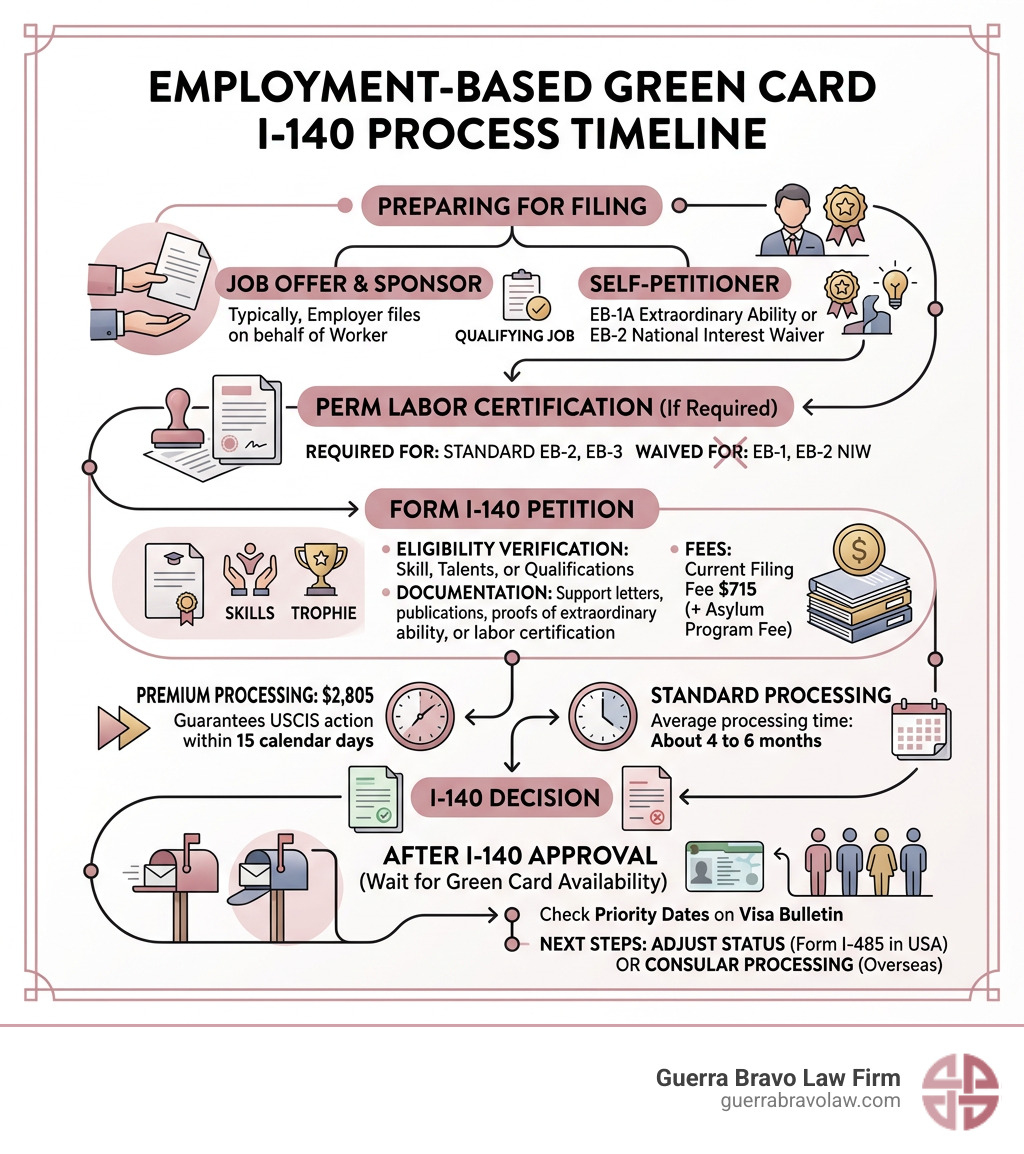
Form I-140 is the official USCIS petition that starts your journey toward an employment-based green card in the United States.
Quick answer for those ready to act:
What it is: Form I-140, Immigrant Petition for Alien Workers, is filed with U.S. Citizenship and Immigration Services (USCIS) to classify a foreign national for permanent residence based on employment.
Who files it:
A U.S. employer (for most categories)
The worker themselves (for EB-1A Extraordinary Ability or EB-2 National Interest Waiver)
Key employment-based categories:
EB-1 (Priority Workers):
EB-1A - Aliens of Extraordinary Ability
EB-1B - Outstanding Professors and Researchers
EB-1C - Multinational Executives and Managers
EB-2 (Advanced Degree or Exceptional Ability):
Standard EB-2 (requires PERM labor certification)
EB-2 NIW - National Interest Waiver (no labor cert needed)
EB-3 (Skilled and Other Workers):
Skilled Workers (2+ years training/experience)
Professionals (bachelor's degree)
Other (Unskilled) Workers
Current filing fee: $715 base fee (plus applicable Asylum Program Fee)
Premium processing: Available for $2,805 — guarantees USCIS action within 15 calendar days
Average processing time: About 4 to 6 months without premium processing
Getting a green card through work is one of the most powerful paths to permanent residency in the U.S. But it's also one of the most document-heavy, detail-driven processes in immigration law. One wrong move — an expired labor certification, a missing signature, a vague job description — can set you back months or even years.
At Guerra Bravo Law Firm, we've helped countless workers and employers navigate this process. This guide breaks down everything you need to know about filing Form I-140 — from eligibility and evidence to fees, timelines, and what happens after approval.
═══
Understanding the Purpose and Eligibility of the I-140
The form i-140 serves as the legal backbone for most employment-based (EB) immigrant visas under section 203(b) of the Immigration and Nationality Act (INA). Its primary purpose is to prove to the U.S. government that a foreign worker has the necessary skills for a specific job or possesses extraordinary talents that benefit the United States.
Navigating these categories requires a strategic approach. As a Business Immigration Lawyer can explain, choosing the wrong category can lead to longer wait times or even a denial if the evidence doesn't perfectly align with the strict regulatory criteria.
Main Employment-Based Categories:
EB-1: Priority Workers
EB-1A (Extraordinary Ability): For those at the very top of their field in sciences, arts, education, business, or athletics. No job offer is required.
EB-1B (Outstanding Professors and Researchers): For those recognized internationally for outstanding achievements in a particular academic field. Requires at least three years of experience and a job offer.
EB-1C (Multinational Managers or Executives): For managers or executives who have been employed outside the U.S. in the three years preceding the petition for at least one year by a firm or corporation.
EB-2: Professionals with Advanced Degrees or Exceptional Ability
This category is for jobs requiring an advanced degree (beyond a baccalaureate) or for persons with exceptional ability in the sciences, arts, or business.
Most EB-2 petitions require a job offer and a labor certification from the Department of Labor (DOL).
EB-3: Skilled Workers, Professionals, and Other Workers
Skilled Workers: Persons whose jobs require a minimum of two years training or work experience.
Professionals: Persons whose jobs require at least a U.S. baccalaureate degree or a foreign equivalent.
Other Workers (Unskilled Workers): Persons performing unskilled labor requiring less than two years training or experience.
Who Can File a Form I-140: Employers vs. Self-Petitioners?
In immigration, "who holds the pen" matters. For the majority of cases, the U.S. employer is the "petitioner," and the foreign worker is the "beneficiary." This means the employer must sponsor the worker and prove they have a valid, permanent job opening.
However, there are two prestigious "golden tickets" where the worker can file on their own behalf without a sponsoring employer. These are known as self-petitions. An Immigration Lawyer for Work Visas often recommends these for highly talented individuals who want more control over their career path:
EB-1A Extraordinary Ability: You do not need a job offer if you can show you are coming to the U.S. to continue work in your area of expertise.
EB-2 National Interest Waiver (NIW): You can request that the job offer and labor certification requirements be waived because your work has "substantial merit and national importance."
Specific Petition Types and Classifications
When filling out the form i-140, you must select one (and only one) classification in Part 2. Choosing multiple boxes or the wrong one will result in a rejection. The Instructions for Form I-140 provide technical details, but here are the highlights:
Outstanding Professors and Researchers: Private employers must show they employ at least three full-time researchers and have achieved documented accomplishments in an academic field.
Multinational Managers: The U.S. employer must have been doing business for at least one year.
Schedule A: This is a "fast track" for specific occupations like Professional Nurses and Physical Therapists. Because the DOL has already determined there aren't enough U.S. workers in these fields, you can skip the lengthy PERM recruitment process and file the labor certification directly with USCIS.
═══
Navigating the PERM Labor Certification and Evidence Requirements

For most EB-2 and all EB-3 petitions, the form i-140 cannot be filed until the employer completes the PERM Labor Certification process. This is a rigorous test of the U.S. labor market conducted by the Department of Labor (DOL).
The employer must prove they actively recruited for the position but could not find a qualified, willing, and available U.S. worker. This involves obtaining a Prevailing Wage Determination and filing Form ETA-9089. You can learn more about this stage at the Permanent Labor Certification portal.
Labor Certification Exceptions and Schedule A
Not every petition requires the PERM headache. We often look for "waivers" or "exceptions" to speed things up for our clients. As noted in our guide on Employment Petitions, the following categories are exempt:
EB-1 Petitions: Extraordinary ability, outstanding researchers, and multinational managers never require a labor certification.
EB-2 National Interest Waiver (NIW): By definition, the "waiver" means you skip the PERM process.
Schedule A Occupations: While they still need a "labor certification," it is uncertified by the DOL and filed directly with USCIS, saving months of processing time.
Crucial Timing Tip: Once a PERM labor certification is approved by the DOL, it is only valid for 180 days. If USCIS does not receive your form i-140 within that window, the certification expires, and you have to start the entire PERM process over from scratch. If the 180th day falls on a Saturday, Sunday, or federal holiday, USCIS will accept it on the next business day.
Initial Evidence and Supporting Documents
USCIS is famously picky about documentation. We recommend organizing your evidence by regulatory criteria using colored coversheets (but don't use plastic tabs, as they gum up the USCIS scanners!).
The Checklist of Must-Have Evidence:
1. Ability to Pay the Proffered Wage The U.S. employer must prove they can afford to pay you. This is usually done through:
Annual reports
Federal income tax returns
Audited financial statements
Note: If the employer has 100 or more workers, a letter from a financial officer may suffice.
2. Proof of Qualifications
Copies of degrees and transcripts (with U.S. equivalency evaluations for foreign degrees).
Experience letters from former employers detailing your job titles and duties.
3. Category-Specific Evidence
EB-1A: Evidence of a major award (like a Nobel Prize) or at least 3 out of 10 criteria (e.g., memberships in exclusive associations, published material about you, high salary, or artistic exhibitions).
EB-1B: Evidence of at least 2 out of 6 criteria (e.g., original scientific contributions or authorship of scholarly books/articles).
NIW: Evidence that your "endeavor" has substantial merit and that you are well-positioned to advance it.
═══
Step-by-Step Guide to Filing Your Form I-140 Petition
Filing the form i-140 is a technical exercise. As of 2025, you must ensure you are using the Edition 06/07/24. Using an outdated form is one of the fastest ways to get an immediate rejection.
When completing the 11 parts of the form, accuracy is everything. For example, in Part 1, you must provide the North American Industry Classification System (NAICS) code for the employer's business and the Standard Occupational Classification (SOC) code for the job in Part 6. If these codes don't match the labor certification, you're headed for an RFE (Request for Evidence).
We always recommend filing Form G-1145 along with your petition. This allows USCIS to send you an e-notification (email or text) the moment they accept your package, giving you peace of mind while waiting for the official receipt in the mail. This is a standard part of our Corporate Immigration Law services.
How and Where to File: Online vs. Mail
You have two main options for filing:
1. Online Filing You can file electronically through a USCIS online account, but only if the form i-140 is filed as a standalone petition. This means you cannot file it online if you are also filing for Adjustment of Status (I-485) at the same time. Also, you cannot upload the I-485 as evidence for an online I-140.
2. Filing by Mail (Paper) This is the most common method, especially for concurrent filings. The mailing address depends on the visa category and where the beneficiary will work. Always check the Direct Filing Addresses for Form I-140 on the USCIS website before mailing, as these change frequently.
Packaging Tips for Pro-Level Submission:
Use a separate envelope for each form (I-140, I-485, etc.) even if mailing them in one box.
Do not use staples; use paper clips or ACCO fasteners.
Include a clear table of contents.
Sign in ink: While USCIS accepts photocopies of signatures, the original must be a handwritten, "wet" signature. Typed names or digital stamps (like DocuSign) are generally not accepted.
Current Fees and Premium Processing for Form I-140
The fee structure for form i-140 became more complex in 2024.
Base Filing Fee: $715.
Asylum Program Fee: This is a newer fee intended to fund the asylum system.
$600 for employers with more than 25 full-time employees.
$300 for small employers (25 or fewer full-time employees).
$0 for non-profit organizations.
Premium Processing (Form I-907): If you don't want to wait 6 months, you can pay $2,805 for Premium Processing. This guarantees that USCIS will take "initial action" (approval, denial, RFE, or NOID) within 15 calendar days.
Payment Methods: For paper filings, USCIS prefers Form G-1450 for credit card payments or checks/money orders. Warning: USCIS has moved away from personal checks for many filings unless you qualify for an exemption. Using Form G-1450 is often the safest bet to avoid payment-related rejections.
Common Mistakes That Lead to Rejection or Denial
Even the strongest cases can fail due to "clerical" errors. Based on our experience with Employer Immigration Compliance Best Practices, watch out for these:
Expired Labor Cert: Filing on day 181 after PERM approval.
Missing Signatures: Forgetting to sign Part 8.
Incorrect Fee Amount: Failing to include the correct Asylum Program Fee based on company size.
Ability to Pay: If the company's net income is less than the offered wage and they don't have enough net current assets to cover the difference, the petition will likely be denied.
Vague Job Descriptions: The job duties on the I-140 must perfectly mirror the duties listed on the labor certification.
═══
Life After Approval: Priority Dates, Portability, and Successor Rules
Approval of the form i-140 is a massive milestone, but it doesn't mean you get your green card the next day. The approval sets your Priority Date—your place in the "green card line."
You must then monitor the monthly Visa Bulletin issued by the State Department. You can only file for your green card (Adjustment of Status or Consular Processing) when your Priority Date is "current." For workers from countries with high demand (like India or China), this wait can last years. During this time, an approved I-140 is vital, as it can allow for H-1B extensions beyond the standard 6-year limit. For more on high-level visa strategies, see our O1 Visa Lawyer Complete Guide.
Job Portability Under INA 204(j)
One of the biggest fears for workers is being "tied" to an employer for years while waiting for a green card. Fortunately, the AC21 Act provides "job portability."
Under INA 204(j), you can change employers and keep your green card process alive if:
Your form i-140 has been approved (or has been pending for 180 days and is eventually approvable).
Your I-485 Adjustment of Status application has been pending for 180 days or more.
The new job is in the "same or a similar" occupational classification as the job for which the petition was filed.
To do this, you file Form I-485 Supplement J to confirm the new job offer.
Successor-in-Interest (SII) Rules for Employers
What happens if your sponsoring company is bought by another firm? Under Successor-in-Interest (SII) rules, the new company can "inherit" the approved labor certification and I-140 if:
The new employer assumes all the rights, duties, and liabilities of the original employer.
The job opportunity remains essentially the same.
The new employer proves they have the ability to pay the wage.
═══
Managing Challenges: RFEs, Appeals, and 2025 Updates
If USCIS isn't convinced by your initial filing, they won't deny you immediately. Instead, they usually send a Request for Evidence (RFE) or a Notice of Intent to Deny (NOID).
You typically have 30 to 87 days to respond. This is where "battle-tested" legal help is essential. If a petition is denied, you can file an appeal or a motion to reopen using Form I-290B within 30 days. These appeals go to the Administrative Appeals Office (AAO), which currently aims to process them in 6 months or less. Having an experienced L-1 Visa Attorney or EB specialist can make the difference between a successful appeal and a final door-closing.
2025 Updates, Tips, and Trends for Success
The immigration landscape in 2025 is shifting toward "storytelling." USCIS officers are looking beyond just a list of degrees; they want to see a narrative of how your work benefits the U.S. economy or national interest.
Key 2025 Trends:
Increased Scrutiny on Small Employers: USCIS is looking closer at the "Ability to Pay" for startups and small businesses.
Digital Filing: While mail is still king for concurrent filings, the USCIS online system is becoming more robust for standalone petitions.
Professional Athletes: New guidance requires that labor certifications for professional athletes must specifically include the minimum job requirements to avoid RFEs.
═══
Frequently Asked Questions about Form I-140
Does Form I-140 ever expire?
Technically, no. An approved form i-140 remains valid indefinitely as long as the employer doesn't withdraw it within 180 days of approval and there is no fraud involved. Even if the employer withdraws it after 180 days, you can often keep your Priority Date for a future petition.
Can I change employers while my I-140 is pending?
It’s risky. If you leave before the I-140 is approved and before your I-485 has been pending for 180 days, you generally lose the petition and must start over with a new employer.
What is the current processing time for Form I-140?
Standard processing is roughly 4 to 6 months, though it varies by service center. With Premium Processing, it is slashed to 15 calendar days.
═══
Conclusion
The form i-140 is more than just a piece of paper; it is the gateway to your future in the United States. Whether you are an employer looking to retain top talent or a professional seeking to self-petition through an NIW, the stakes are incredibly high.
At Guerra Bravo Law Firm, attorney Iris Guerra Bravo brings over 14 years of "insider" experience from her time with ICE and DHS. We don't just fill out forms; we build individualized, battle-tested legal strategies designed to withstand the toughest USCIS scrutiny. From our offices in McAllen and throughout the Rio Grande Valley, we are ready to help you secure your permanent place in the U.S. workforce.
Start your petition today and take the first step toward your green card with confidence.