
May 19, 2026
Stay a Little Longer with an F1 Visa Extension
Stay a Little Longer with an F1 Visa Extension
Understanding the Difference Between F-1 Visa and F-1 Status
An F1 visa extension is how international students in the U.S. extend their authorized period of study beyond the program end date on their Form I-20.
Here’s the quick answer on how to extend your F-1 status:
-
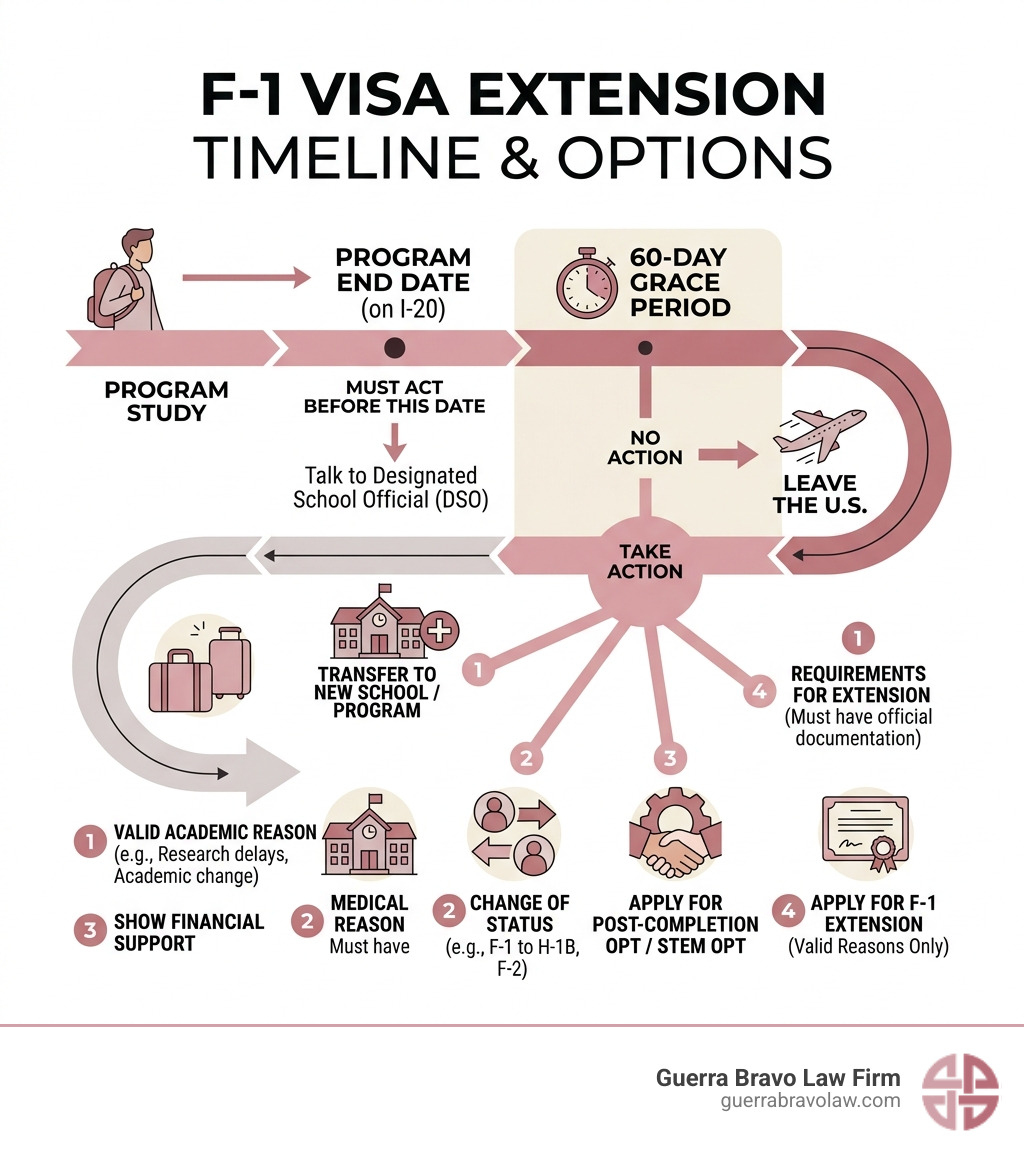
Talk to your Designated School Official (DSO) before your I-20 program end date
-
Provide a valid reason — academic delays, medical issues, or a change of major
-
Show proof of financial support
-
Your DSO updates your record in SEVIS and issues a new Form I-20
-
No USCIS application is needed in most cases
You worked hard to get to the U.S. to study. The last thing you want is to fall out of status because of a delayed graduation, an unexpected illness, or a research setback.
The good news? In most cases, extending your F-1 status does not require filing anything with USCIS. Your school handles it. But the timing matters — a lot.
The U.S. currently hosts over 1.1 million international students, and the 2023 SEVIS report confirmed enrollment is still rising. With that growth comes more complexity — more students navigating program extensions, visa renewals, and post-graduation options like OPT and STEM OPT.
Whether you need a few extra months to finish your thesis, you’re recovering from a medical issue, or you’re planning your next steps after graduation, understanding how F-1 extensions work before your deadline hits can save you from serious legal trouble.
This guide walks you through exactly what to do — and what to avoid.
One of the most common points of confusion for international students in the Rio Grande Valley and across the U.S. is the difference between a “visa” and “status.” While they sound the same, they serve very different legal purposes.
The F-1 Visa (The Entry Document) Think of your F-1 visa stamp in your passport like a key to a house. You only need the key to unlock the door and walk inside. Once you are inside the “house” (the United States), the key can expire, but you can stay as long as you remain a welcome guest. The visa is strictly for travel and entry. If it expires while you are in McAllen or Edinburg, you don’t need to leave immediately, but you will need a new one if you travel abroad and want to return.
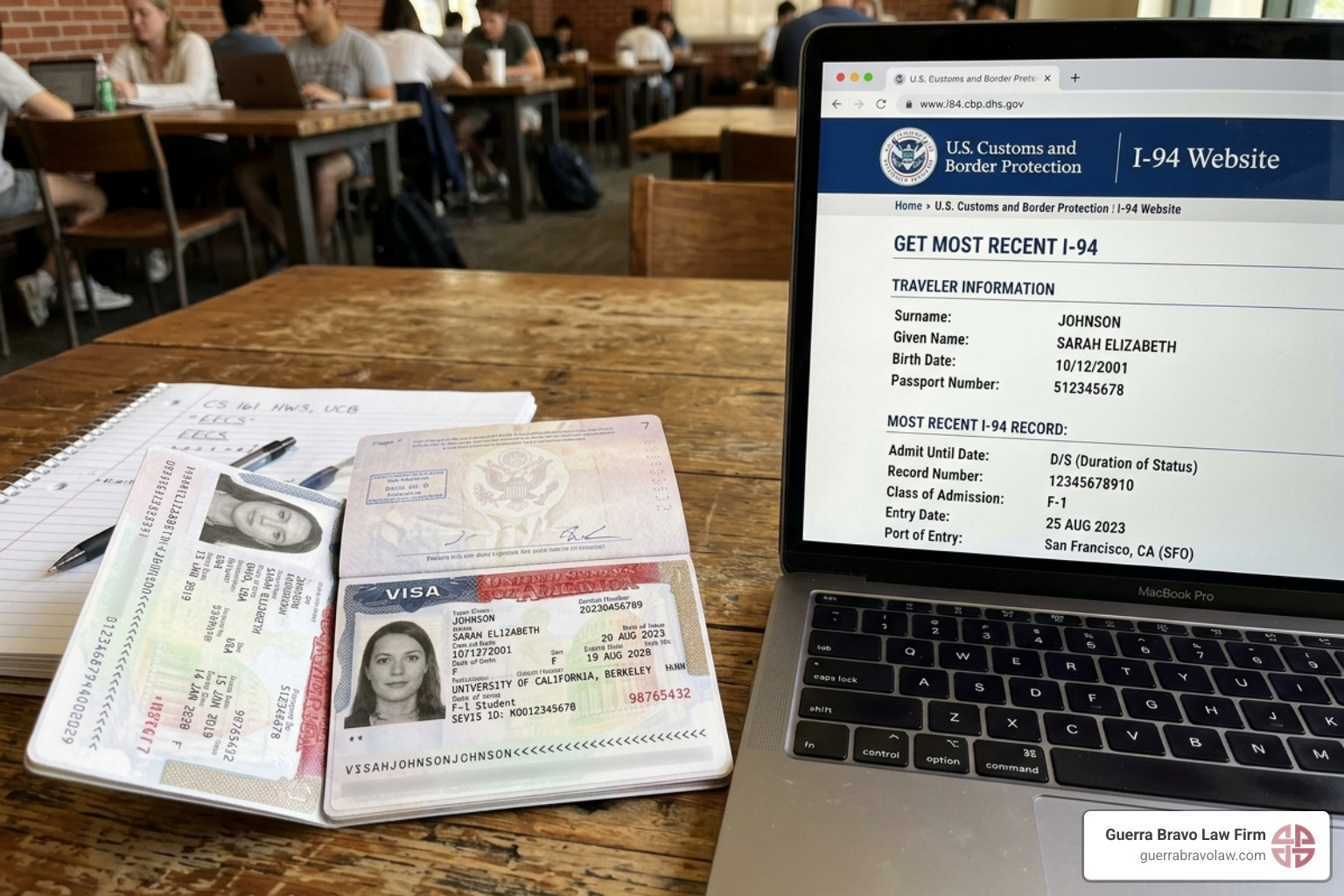
F-1 Status (The Right to Stay) Your status is governed by your Form I-20 and your I-94 record. When you enter the U.S., a Customs and Border Protection (CBP) officer typically marks your I-94 with “D/S,” which stands for Duration of Status. This means you are legally allowed to stay in the U.S. as long as you are following the rules of your F-1 program and your I-20 has not expired.
According to the U.S. Student Visa Duration and Extensions – USCIS Guide, as long as you are making “normal progress” toward your degree, you are in status. However, if your I-20 program end date is approaching and you aren’t finished with your studies, you must take action. Failing to do so is a major Student Visa Compliance issue that could lead to deportation.
Maintaining Lawful Presence in 2026
To keep your status valid as we move through the 2026 academic year, you must adhere to these core requirements:
-
Full-Time Enrollment: You must be enrolled in a full course of study at a SEVP-approved school.
-
Valid I-20: The “Program End Date” on your I-20 must always be in the future.
-
I-94 Accuracy: Your electronic I-94 record should always reflect F-1 status and D/S.
-
Report Changes: You must report any change of address or major to your school within 10 days.
Staying compliant is the bedrock of US Immigration Law. If you lose your status, the road back is much harder than a simple extension.
How to Request an F1 Visa Extension for Your I-20
If you realize you won’t graduate by the date listed on your I-20, don’t panic. The process for an f1 visa extension (technically a program extension) is handled internally by your school’s Designated School Official (DSO).
The Extending the F-1 Form I-20 | Study in the States guidelines clarify that DSOs can extend a student’s program in the SEVIS system without needing direct adjudication from the government, provided there is a valid reason. This makes the process relatively smooth for students who plan ahead. At Guerra Bravo Law Firm, we often assist students with Trámites de Visa to ensure their paperwork is bulletproof.
Valid Reasons for an F1 Visa Extension
You cannot extend your stay just because you want more time in the U.S. Regulations require a “compelling academic or medical reason.” Valid reasons include:
-
Academic Delays: Changes in research topics, unexpected research problems, or a change in your major.
-
Medical Issues: A documented illness or medical condition that prevented you from taking a full course load.
-
DSO Error: A mistake made by the school that needs correction.
Note: You generally cannot get an extension for delays caused by academic probation or failing classes.
Required Documents for Your F1 Visa Extension
When you meet with your DSO to request an extension, come prepared. While every school in the Rio Grande Valley—from UTRGV to local colleges—might have slightly different internal forms, you will generally need:
-
Current Form I-20: Your original document.
-
Financial Support Evidence: Bank statements or scholarship letters showing you have enough money to cover the extra time (tuition and living expenses).
-
Passport: Must be valid for at least six months into the future.
-
Academic Recommendation: A letter or form from your academic advisor confirming why you need more time and your new expected graduation date.
For more details on specific university requirements, you can check resources like Extending Your I-20 | Texas Global.
Renewing Your F-1 Visa Stamp Outside the U.S.
Let’s say your I-20 is successfully extended, but your visa stamp in your passport has expired. If you plan to travel home to visit family and then return to the U.S., you must renew the visa stamp at a U.S. Embassy or Consulate.
You cannot renew a visa stamp while inside the United States. You must go through consular processing. This involves:
-
Form DS-160: Completing the online nonimmigrant visa application.
-
The Interview: Scheduling and attending an interview at a U.S. consulate, often in your home country.
-
Evidence of Ties: Proving that you intend to return home after your studies are finished.
Many students in our region look into Applying to Renew Your Student Visa at a U.S. Consulate … in Mexico, but be aware that “third-country national” processing can be risky if your case is complex.
The Visa Renewal Interview Process
The renewal interview is similar to your first one. You’ll need to show your updated I-20 and proof that you’ve maintained your status. Be prepared for “administrative processing,” which can sometimes delay your return by several weeks. If your visa is denied, understand your rights regarding a Visa Denial Appeal.
Special Extensions: OPT, STEM, and the H-1B Cap-Gap
Sometimes, an f1 visa extension isn’t about more time in the classroom—it’s about the transition to the professional world.
Optional Practical Training (OPT)
F-1 students are eligible for 12 months of OPT to work in their field of study. If you have a degree in Science, Technology, Engineering, or Math, you may be eligible for a 24-month STEM OPT extension, giving you a total of 36 months of work authorization. To qualify, your employer must be enrolled in E-Verify. You can find more on this via OPT Advisement resources.
The H-1B Cap-Gap Extension
This is a “bridge” for students whose OPT is ending but who have been selected for an H-1B visa.
-
How it works: If an employer files a timely H-1B petition for you (usually in April) and your OPT expires before the H-1B starts on October 1, the “Cap-Gap” automatically extends your F-1 status and work authorization.
-
Eligibility: Your H-1B must be “cap-subject” and filed with a request for a Change of Status.
According to the F-1 Cap Gap Extension | Study in the States, this extension is automatic in SEVIS, but you should still get an updated I-20 from your DSO to prove you are authorized to work.
Transitioning from F-1 to Professional Status
Moving from a student to a professional worker involves filing Form I-129. This is a critical transition where having an experienced attorney can prevent errors that lead to status violations. The Extension of Post Completion Optional Practical Training (OPT) and F-1 Status for Eligible Students under the H-1B Cap-Gap Regulations | USCIS provides the official regulatory framework for these transitions.
Frequently Asked Questions about F-1 Extensions
Can I stay in the U.S. if my F-1 visa stamp is expired?
Yes. As long as you have a valid I-20 and are maintaining your “Duration of Status” (D/S), you can stay in the U.S. indefinitely. You only need a valid visa stamp if you leave the country and want to re-enter. If you are staying in McAllen or Brownsville to finish your degree, an expired stamp in your passport is not an immediate problem.
What is the 60-day grace period for F-1 students?
Once you complete your program (or your OPT), you are granted a 60-day grace period. This time is intended for:
-
Preparing to depart the U.S.
-
Transferring to another SEVP-certified school.
-
Changing your visa status (e.g., to an H-1B or marriage-based green card).
-
Note: You cannot work during the grace period.
What are the consequences of overstaying F-1 status?
Overstaying is a serious violation. If you stay even one day past your I-20 end date (plus the grace period) without an extension, you begin accruing unlawful presence.
-
180+ days of unlawful presence: Can result in a 3-year ban from the U.S.
-
1 year+ of unlawful presence: Can result in a 10-year ban.
-
Deportation: You could be placed in removal proceedings and forced to leave.
To avoid these pitfalls, keep an eye on our Immigration Education Blog Category for the latest updates on policy changes.
Common Pitfalls to Avoid
Failing to Apply Early
- You should start the extension process at least 30 days before your I-20 expires. If you wait until the day of, your DSO might not be able to process it in time.
Unauthorized Employment
- Working off-campus without an EAD (Employment Authorization Document) is a fast track to losing your status. Even with an extension, your work rules remain strict.
Ignoring the “Normal Progress” Rule
- If you are taking fewer than the required credits without a “Reduced Course Load” (RCL) authorization, you are technically out of status, making an extension impossible without reinstatement.
Conclusion
Navigating an f1 visa extension can feel like a high-stakes game of paperwork. While your school’s DSO is your primary point of contact, complex cases involving medical issues, research delays, or transitions to H-1B status often require a deeper level of legal strategy.
At Guerra Bravo Law Firm, we understand the stress international students face. Our founder, Iris Guerra Bravo, brings over 14 years of insider experience working with ICE and DHS. We don’t just fill out forms; we provide battle-tested, individualized legal strategies for students across the Rio Grande Valley—from McAllen and Edinburg to Brownsville and Harlingen.
If you are worried about your status, facing a visa denial, or planning a complex transition to a work visa, don’t leave your future to chance. Contact an Experienced Immigration Lawyer who knows the system from the inside out.
Explore Our Services today and let us help you stay on the path to your American dream. We are proud to serve the communities of Mission, Pharr, Weslaco, and the entire South Texas region.
[