

January 12, 2026
Policy Power: Crafting Effective Immigration Compliance Frameworks
Policy Power: Crafting Effective Immigration Compliance Frameworks
Why Immigration Compliance Programs Matter More Than Ever
An immigration compliance program is a structured framework that employers use to ensure they meet all legal requirements when hiring and employing foreign nationals in the United States. This includes proper documentation, adherence to employment authorization conditions, accurate record-keeping, and diligent preparation for government audits.
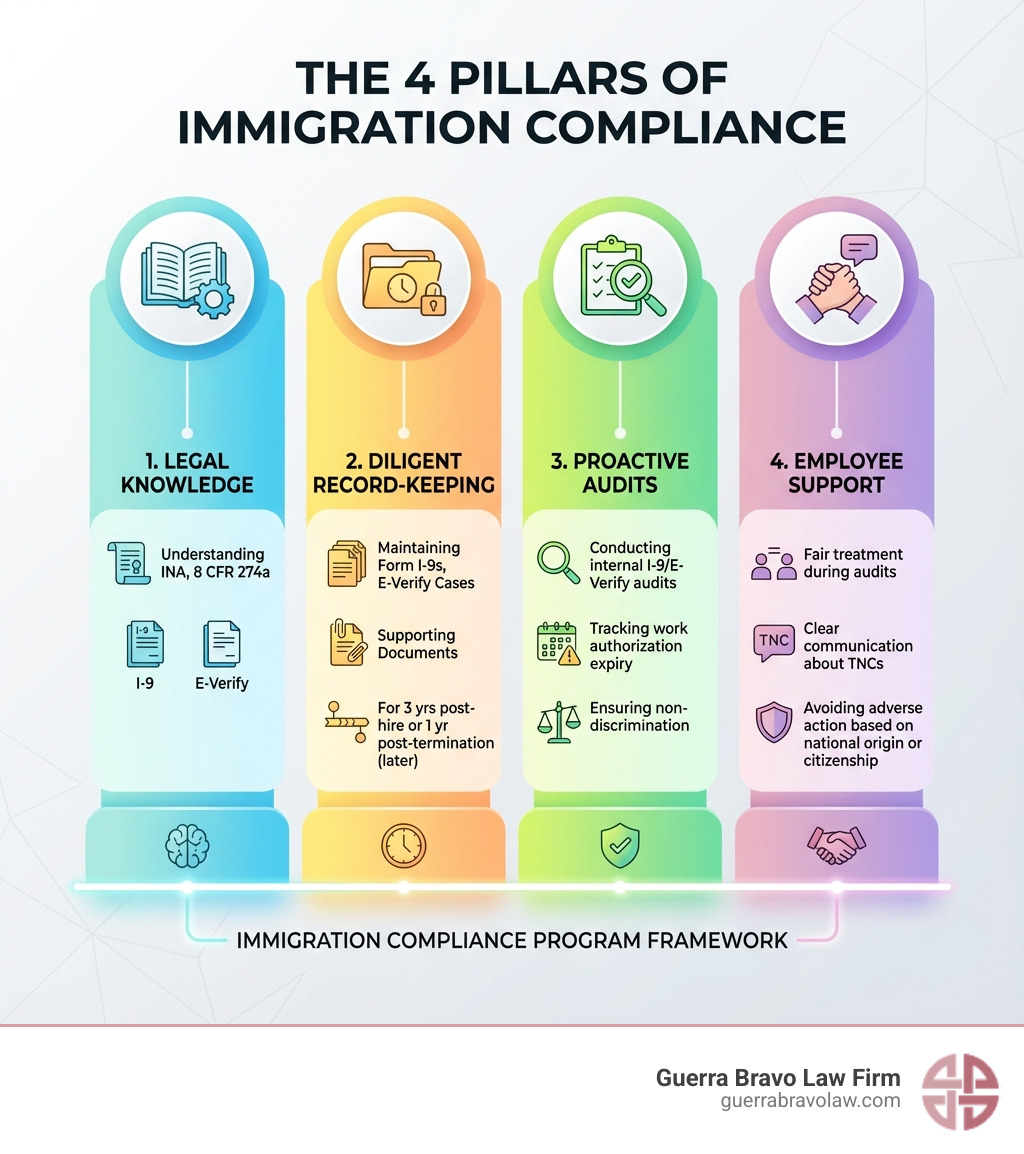
Key Elements of an Immigration Compliance Program:
-
Legal Knowledge - Understanding the Immigration and Nationality Act (INA), 8 CFR Part 1274a, and I-9/E-Verify requirements.
-
Document Management - Maintaining all records (Form I-9s, E-Verify cases, supporting documents) for required periods.
-
Proactive Monitoring - Tracking employment authorization expiry dates and verifying ongoing eligibility.
-
Audit Preparedness - Preparing for and responding to government inspections and worksite enforcement actions.
-
Employee Protection - Ensuring fair treatment of all employees, avoiding discrimination, and understanding employee rights during audits.
The stakes have never been higher for employers hiring foreign nationals in the United States, especially here in Texas. Federal agencies like Immigration and Customs Enforcement (ICE) and the Department of Justice (DOJ) are intensifying their oversight, signaling a strong stance on employer accountability.
The Immigration and Nationality Act (INA) and its regulations (8 CFR Part 1274a) explicitly state that employers who “fail to exercise due diligence” to determine whether employment is authorized are deemed to know that it is unauthorized. This legal presumption shifts the burden entirely onto you. Ignorance is not a defense. Penalties for violations can be severe, including substantial monetary fines, and even criminal charges for serious offenses.
Whether you’re hiring through various visa programs or employing lawful permanent residents, your compliance obligations are complex and constantly evolving. A single missing or improperly completed Form I-9, an E-Verify error, or a failure to verify employment authorization can trigger inspections, fines, and enforcement actions that can devastate your business. Our firm, with attorney Iris Guerra Bravo’s 14+ years of insider experience with ICE and DHS, understands these challenges firsthand.
This guide will walk you through the legal frameworks, your specific employer responsibilities, the real costs of non-compliance, and how to build a proactive system that protects both your business and your workforce, particularly within the context of the Rio Grande Valley and Texas.
The Legal Bedrock: U.S. Immigration Compliance Framework
Navigating the intricacies of U.S. immigration law can feel like traversing a labyrinth. For employers, understanding the fundamental legal frameworks and the roles of the various government agencies is the first critical step in building a robust immigration compliance program. It’s about more than just checking boxes; it’s about safeguarding your business and ensuring a fair, legal workplace for everyone.

The cornerstone of employer immigration compliance in the United States is the Immigration and Nationality Act (INA), found in federal law at 8 U.S.C. 1101 and 8 U.S.C. 1103. Specifically, Section 274A of the INA addresses the unlawful employment of aliens, making it illegal for employers to knowingly hire or continue to employ individuals who are not authorized to work in the U.S. The regulations implementing these provisions are detailed in 8 CFR Part 1274a. These regulations, first published in 1987 (52 FR 16221), outline the employer requirements for employment eligibility verification.
For a deeper dive into the foundational principles, you can explore our resources on what is immigration compliance.
Understanding Key Government Agencies
Several federal agencies play crucial roles in employer immigration compliance, each with distinct responsibilities that impact your business.
Department of Homeland Security (DHS)
-
Role: Oversees immigration enforcement and benefits, including U.S. Citizenship and Immigration Services (USCIS) and Immigration and Customs Enforcement (ICE). DHS sets the overarching regulations for employment eligibility verification.
-
Impact on Compliance: Your business directly interacts with DHS regulations through processes like Form I-9 completion and E-Verify.
U.S. Citizenship and Immigration Services (USCIS)
-
Role: Administers legal immigration, including processing visa petitions, green card applications, and managing the E-Verify program. USCIS provides guidance and resources for Form I-9 and E-Verify compliance.
-
Impact on Compliance: USCIS is your go-to source for official Form I-9 instructions and E-Verify program updates.
Immigration and Customs Enforcement (ICE)
-
Role: The principal investigative arm of DHS, responsible for enforcing immigration laws within the U.S. This includes conducting worksite enforcement audits (like Form I-9 inspections) and investigations. ICE has a significant presence in Texas, particularly in the Rio Grande Valley, with offices in McAllen, Brownsville, and the Rio Grande Processing Center.
-
Impact on Compliance: ICE is the primary agency that will conduct audits of your Form I-9 records and can impose fines or pursue criminal charges for non-compliance. We’ve seen how active ICE is in our region.
Department of Justice (DOJ) - Immigrant and Employee Rights Section (IER)
-
Role: Protects against discrimination in employment based on citizenship status or national origin during the I-9 and E-Verify process. While ICE focuses on employer sanctions, IER ensures that employers do not engage in unfair employment practices when verifying work authorization.
-
Impact on Compliance: Employers must ensure their compliance practices are non-discriminatory, treating all employees fairly regardless of perceived immigration status or background.
Core Employer Responsibilities: Form I-9 and E-Verify
Every employer in the U.S. has a fundamental responsibility to ensure their workforce is legally authorized to work. This isn’t just a good business practice; it’s a legal mandate. Our immigration compliance program hinges on mastering two key components: the Form I-9 and, for many, the E-Verify program.
The Form I-9, Employment Eligibility Verification
The Form I-9 is the cornerstone of employment eligibility verification. It’s a simple, yet critical, document that every employer must complete for every new hire.
-
Purpose: The Form I-9 serves to verify the identity and employment authorization of individuals hired for employment in the United States. It’s a federal requirement designed to prevent the hiring of unauthorized workers.
-
Core Requirement: All U.S. employers must complete and retain a Form I-9 for each person they hire for employment in the United States after November 6, 1986. This isn’t optional, regardless of the employee’s citizenship or immigration status.
-
Compliance Focus: Proper completion involves three sections:
-
Section 1 (Employee Information and Attestation): Completed by the employee on their first day of employment. They attest to their work authorization status (e.g., U.S. citizen, lawful permanent resident, alien authorized to work).
-
Section 2 (Employer or Authorized Representative Review and Verification): Completed by the employer (or an authorized representative) within three business days of the employee’s first day of employment. The employer must physically examine original, unexpired documents from the Lists of Acceptable Documents to establish both identity and employment authorization.
-
Section 3 (Reverification and Rehire): Used to re-verify employment authorization for employees whose work authorization has expired or to record rehires.
-
-
Key Document: The completed and signed Form I-9.
-
Retention: You must retain each employee’s Form I-9 for either three years after the date of hire or one year after the date employment is terminated, whichever date is later. Secure storage is paramount.
The E-Verify Program
E-Verify is an additional layer of employment verification that builds upon the Form I-9 process.
-
Purpose: E-Verify is an online, internet-based system operated by USCIS that compares information from an employee’s Form I-9 to data from DHS and Social Security Administration (SSA) records to confirm employment eligibility.
-
Core Requirement: While voluntary for most private sector employers, E-Verify is mandatory for some federal contractors and subcontractors, and in certain states (including Texas for state agencies and some public contractors). Even if not mandated, many employers choose to participate for improved compliance.
-
Compliance Focus:
-
Timeliness: Creating an E-Verify case no later than the third business day after the employee begins work for pay.
-
Accuracy: Ensuring the information entered into E-Verify precisely matches the Form I-9.
-
TNC Handling: Properly handling Tentative Nonconfirmations (TNCs) by informing the employee, providing required notices (like the Further Action Notice), and allowing them to contest the mismatch. Employees must be allowed to continue working without changes in working conditions while contesting a TNC.
-
Case Closure: Correctly closing every E-Verify case with the appropriate case closure statement.
-
-
Key Document: E-Verify case records, including the verification number, Further Action Notices, and Referral Date Confirmations.
-
Associated Cost: There is no direct fee to use E-Verify, but it requires administrative resources for training, case creation, and follow-up.
Understanding the nuances of these programs is vital for any immigration compliance program. For more insights into employer responsibilities in this area, you can visit our page on corporate immigration law.
The High Cost of Non-Compliance: Risks and Penalties
Ignoring immigration compliance is not a strategy; it’s a gamble with your business’s future. The consequences of non-compliance with U.S. immigration laws are severe and can impact both employers and employees. Here in Texas, where federal agencies like ICE are particularly active, these risks are amplified.

The Immigration and Nationality Act (INA) is explicit: “a person [which can be either a natural person or a corporation] who fails to exercise due diligence to determine whether employment is authorized… is deemed to know that it is unauthorized.” This means even if you didn’t know you were employing an unauthorized worker, a lack of proper checks and procedures can lead to a finding of “constructive knowledge” and significant penalties.
Employer Consequences
The penalties for non-compliance are designed to deter violations and can escalate rapidly.
-
Monetary Fines: Civil penalties for Form I-9 paperwork violations (e.g., missing information, incorrect dates) can range from hundreds to thousands of dollars per violation. Fines for “knowing hire” violations (knowingly hiring or continuing to employ an unauthorized worker) are substantially higher, ranging from thousands to tens of thousands of dollars per unauthorized employee for initial offenses, increasing for repeat violations.
-
Criminal Charges: Employers who engage in a “pattern or practice” of knowingly hiring or continuing to employ unauthorized workers can face severe criminal penalties, including significant fines and imprisonment. For instance, in 2018, a businesswoman in Alberta (Canada) was sentenced to two years’ imprisonment for similar offenses, demonstrating the seriousness with which these violations are treated. While this specific example is Canadian, it illustrates the potential for severe criminal outcomes for employers.
-
Worksite Enforcement Actions: ICE conducts worksite enforcement operations, which can include audits, investigations, and even raids. These actions can lead to significant business disruption, employee apprehension, and a damaged public image. The Rio Grande Valley, given its border location, is a frequent focus of such enforcement.
-
Reputational Damage: Being found non-compliant can severely harm your business’s reputation, affecting customer trust, employee morale, and your ability to attract future talent.
-
Loss of Business Licenses: In some cases, severe or repeated immigration violations can lead to the suspension or revocation of state business licenses.
-
Debarment from Federal Contracts: For federal contractors, non-compliance can result in debarment, meaning your business can no longer bid on or receive federal contracts.
Employee Consequences
Non-compliance also carries severe implications for the workers involved, even if they are unaware of the employer’s violations.
-
Termination: Employees found to be unauthorized to work will be immediately terminated.
-
Deportation: Unauthorized workers finded during worksite enforcement actions may face detention and removal (deportation) from the U.S.
-
Inadmissibility: Individuals who have violated immigration laws may face bars from re-entering the U.S. for a set period, impacting their future immigration prospects.
-
Exploitation: Workers in non-compliant workplaces are often more vulnerable to wage theft, unsafe working conditions, and other forms of exploitation, as they may fear reporting abuses due to their immigration status.
For more information on the serious consequences of non-compliance, visit our page on worksite enforcement.
Building a Robust Immigration Compliance Program
Given the severe penalties and heightened enforcement, establishing a proactive and comprehensive immigration compliance program is not merely advisable—it’s essential for the survival and integrity of your business in Texas. This isn’t a one-time fix; it’s an ongoing commitment to diligence and accuracy.
Key Components of an Effective Immigration Compliance Program
A strong compliance program integrates seamlessly into your hiring and HR processes, creating safeguards at every turn.
-
Due Diligence as a Core Principle: As mandated by the INA, you are “deemed to know” if employment is unauthorized if you fail to exercise due diligence. This means you must actively implement and follow procedures to verify authorization. Our firm’s experience with ICE and DHS emphasizes that demonstrating good faith effort and a structured approach is crucial.
-
Meticulous Document Management: Maintain all Forms I-9 and related E-Verify records for the legally required period: three years after the date of hire or one year after the date employment is terminated, whichever is later. These records must be stored securely, protected from unauthorized access, and readily accessible for inspection.
-
Vigilant Date Tracking: Implement a system to monitor employment authorization expiry dates for all temporary foreign workers (e.g., H-1B, L-1, TN visa holders). This proactive tracking allows for timely re-verification or petition filing, preventing gaps in work authorization.
-
Regular Internal Audits: Conduct periodic internal audits of your Forms I-9 and E-Verify records. This allows you to identify and correct technical errors or omissions before a government inspection. The Guidance for Employers Conducting Internal Employment Eligibility Verification Form I-9 Audits provides excellent best practices for this.
-
Clear Policy Development: Establish written internal policies for I-9 completion, E-Verify usage, and handling any discrepancies or Tentative Nonconfirmations (TNCs). These policies should also address anti-discrimination principles to ensure fair treatment of all employees throughout the verification process.
-
Comprehensive Training: Provide regular training to all HR staff, hiring managers, and anyone involved in the I-9 or E-Verify process. This ensures they understand their responsibilities, the correct procedures, and the importance of compliance. Training should cover Form I-9 instructions, E-Verify user manuals, and anti-discrimination rules.
Crucial Documentation to Maintain
When an audit comes knocking, having your ducks in a row is paramount. The following documents are absolutely crucial for your immigration compliance program:
-
Completed and Corrected Forms I-9: Ensure every Form I-9 is complete, signed, and dated in all required sections. Any corrections should be made according to USCIS guidance (e.g., drawing a line through incorrect information, entering correct information, and initialing/dating).
-
E-Verify Case Records: For each employee for whom an E-Verify case was created, retain the E-Verify case verification number, any Further Action Notices, Referral Date Confirmations, and the final case closure statement.
-
Copies of Identity and Work Authorization Documents: While not always legally mandatory to make copies of supporting documents for Form I-9, it is a recommended best practice for employers, as it can help demonstrate good faith efforts during an audit.
-
Employer’s E-Verify Memorandum of Understanding (MOU): If you participate in E-Verify, this document outlines your responsibilities and should be kept on file.
-
Internal Audit Records: Document all internal I-9/E-Verify audits, including dates, findings, and the corrective actions taken. This demonstrates a proactive commitment to compliance.
-
Correspondence with Government Agencies: Keep copies of all communications with USCIS, ICE, or the DOJ, especially regarding specific employees, compliance issues, or audit responses.
For more detailed best practices, explore our guide on employer immigration compliance best practices.
Navigating Government Audits and Inspections
Receiving a Notice of Inspection (NOI) from ICE can be a daunting experience, but with a well-structured immigration compliance program and the right legal guidance, your business can steer these challenges effectively. Our experience with ICE and DHS in South Texas equips us to help you prepare for and manage these situations.
What to Expect During an ICE Worksite Enforcement Audit
ICE audits are a primary tool for enforcing employer sanctions. Being prepared means understanding the process.
-
Trigger: An ICE audit can be initiated for various reasons: a random selection, a tip from a disgruntled employee or competitor, a lead from another investigation, or even a review of public records.
-
Notice of Inspection (NOI): ICE typically begins an audit by serving your business with an NOI. This document officially notifies you that ICE will be inspecting your Forms I-9 and other related documents. You usually have at least three business days to produce the requested documents.
-
Production of Documents: Upon receiving an NOI, you will need to gather and produce all requested Forms I-9 and supporting documentation. It’s crucial that these are accurate, complete, and readily available.
-
Document Review: ICE agents will carefully review your Forms I-9 for both technical violations (e.g., missing signatures, incorrect dates) and substantive violations (e.g., employing unauthorized workers, using fraudulent documents).
-
Employee Interviews: During an audit, ICE agents may also conduct interviews with employees, supervisors, and management to gather additional information or corroborate documentation.
-
Notice of Technical or Procedural Failures: If ICE finds technical or procedural errors on your Forms I-9, they may issue this notice, giving you 10 business days to correct the identified errors.
-
Notice of Intent to Fine (NIF): If ICE finds substantive violations or uncorrected technical violations, they will issue an NIF. This document outlines the alleged violations and proposes civil monetary penalties. You have the right to contest an NIF.
-
Final Order: After any negotiations or hearings, a final decision on penalties will be issued.
In the Rio Grande Valley, where our offices are located (McAllen, Brownsville, Edinburg, Harlingen, Weslaco), ICE maintains a visible presence. For instance, the Rio Grande Processing Center - ICE is a key facility, and local law enforcement often cooperates with federal agencies, as evidenced by news of ICE sharing funds with South Texas police departments. This heightened activity underscores the importance of a robust immigration compliance program for businesses in our region.
Proactive Steps in Your Immigration Compliance Program
Preparation is your best defense.
-
Be “Audit Ready”: The best way to survive an audit is to prevent major issues beforehand. Keep all your Forms I-9, E-Verify records, and internal audit documentation organized, accurate, and readily accessible. This means regular checks and updates.
-
Develop an Audit Plan: Have a clear, transparent process for how your business will handle an audit. This includes designating key personnel, understanding how to communicate with employees during an audit, and ensuring consistent, non-discriminatory standards are applied. (Refer to the Employer Best Practices During Worksite Enforcement Audits for detailed guidance).
-
Respond Promptly and Thoroughly: If you receive an NOI or NIF, do not delay. Respond within the specified deadlines, providing accurate and complete information, along with any evidence to support your compliance efforts.
-
Seek Legal Counsel: This is perhaps the most critical proactive step. Engaging experienced immigration counsel, like us at Guerra Bravo Law Firm, can make a significant difference. We can help you prepare for an audit, review your documentation, advise on responding to NOIs and NIFs, and represent your interests throughout the entire process. Attorney Iris Guerra Bravo’s 14+ years of insider experience with ICE and DHS provides invaluable insight into the government’s enforcement strategies.
Frequently Asked Questions about Immigration Compliance
We often hear similar questions from employers striving to maintain a compliant workforce. Here are some of the most common inquiries regarding your immigration compliance program:
How long must I keep records for an employee’s employment eligibility?
You must retain Form I-9 for either three years after the date of hire or one year after the date employment is terminated, whichever date is later. E-Verify case records, including the verification number and any related notices, should be kept with the corresponding Form I-9 for the same duration. Proper retention is crucial for demonstrating compliance during an audit.
What is the difference between “work” for immigration purposes and general employment definitions?
For U.S. immigration purposes, “employment” is broadly defined. It generally means any service or labor performed by an employee for an employer within the United States, including but not limited to, service or labor performed for wages or other remuneration. This definition is expansive and covers most activities where there is an employer-employee relationship. The key focus for immigration compliance is whether an individual is authorized by the U.S. government to perform that specific service or labor, regardless of how it might be defined under other labor laws.
Can I use E-Verify to check the employment eligibility of all my existing employees?
Generally, no. E-Verify can only be used for newly hired employees (specifically, within three business days of their first day of employment) and for employees working under a federal contract that explicitly requires E-Verify participation. You cannot use E-Verify to re-verify existing employees or to check employees who were hired before your company enrolled in E-Verify, unless you are a federal contractor subject to the FAR E-Verify clause. Misuse of E-Verify, such as selectively checking employees or using it for existing staff without proper authorization, can lead to penalties and discrimination claims from the Department of Justice’s Immigrant and Employee Rights Section (IER).
Conclusion: Fortify Your Business with Proactive Compliance
In today’s dynamic regulatory environment, a robust immigration compliance program is no longer a luxury—it’s a necessity for any business employing foreign nationals in the United States, especially in a region as active for enforcement as the Rio Grande Valley. The severe financial penalties, potential criminal charges, and reputational damage associated with non-compliance can pose an existential threat to your operations.
Our experience with ICE and DHS has shown us that being proactive is always more effective than being reactive. By understanding the legal frameworks, diligently maintaining your documentation, conducting regular internal audits, and knowing what to expect during a government inspection, you can protect your business and foster a compliant, ethical workplace.
Don’t wait for an audit to find your vulnerabilities. For expert guidance on building your compliance framework, preparing for potential audits, and navigating complex immigration challenges, we invite you to explore our worksite enforcement services or contact us directly. We are here to help you ensure your business thrives within the bounds of immigration law.
[