

January 27, 2026
Your Roadmap to Halting Removal Proceedings
Your Roadmap to Halting Removal Proceedings
Why Understanding How to Stop Removal Proceedings Can Save Your Future
Learning how to stop removal proceedings is a lifeline for families facing deportation. Receiving a Notice to Appear in immigration court is frightening, but it’s crucial to remember that removal proceedings are not a final verdict. It is the start of a legal process where you have the right to defend yourself and fight to stay in the U.S.
Quick Answer: Main Ways to Stop Removal Proceedings
-
Cancellation of Removal - For long-term residents who can prove extreme hardship to U.S. citizen family members.
-
Asylum or Withholding of Removal - If you fear persecution in your home country.
-
Adjustment of Status - If you’re eligible for a green card through family or employment.
-
Waivers of Inadmissibility - To forgive certain violations that make you removable.
-
U Visa - For victims of serious crimes who have helped law enforcement.
-
Prosecutorial Discretion - Requesting DHS to close your case based on positive factors.
-
Challenging Defects - Arguing the Notice to Appear was improperly served or incomplete.
-
Voluntary Departure - Leaving on your own terms to avoid a formal deportation order.
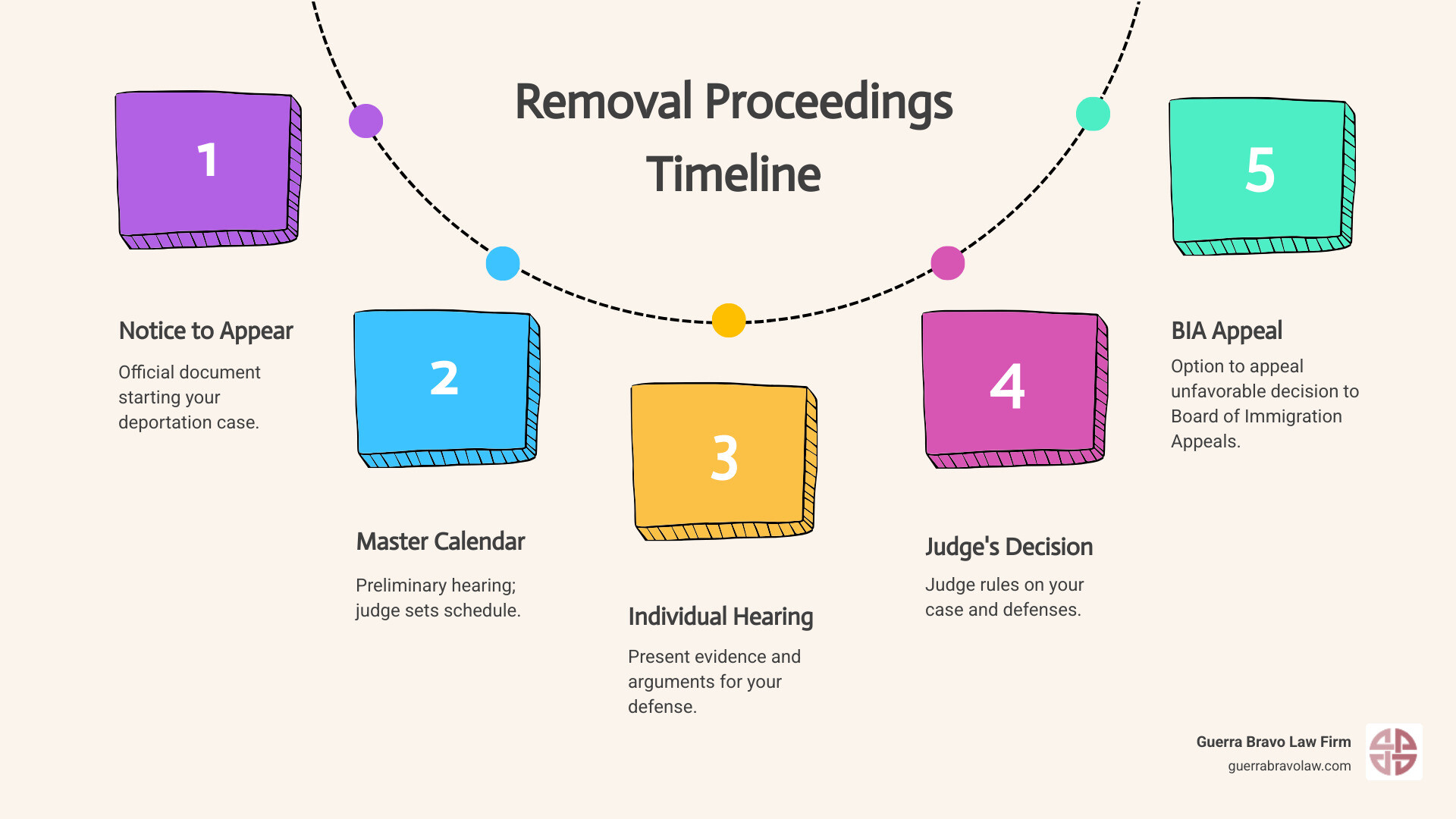
Removal proceedings are the formal process where the U.S. government tries to deport a non-citizen, starting with a Notice to Appear filed with the immigration court. Research shows that legal representation is the single most important factor in winning a removal case, yet the government is not required to provide an attorney.
This guide explains the removal process and the legal strategies available to fight deportation. Missing a court date or ignoring notices can result in an automatic removal order. However, with the right knowledge and legal help, you can build a powerful defense and secure your right to remain in the United States.
Understanding the Battlefield: Your Rights and the Court Process
To learn how to stop removal proceedings, you must first understand the court process, the key players, and your fundamental rights.

What Triggers Removal?
Removal proceedings begin when the U.S. government seeks to deport a non-citizen for violating immigration laws. Common reasons include:
-
Overstaying a Visa: Remaining in the U.S. beyond your authorized stay.
-
Criminal Convictions: Certain criminal offenses can make you deportable.
-
Unauthorized Employment: Working without proper authorization.
-
Immigration Fraud: Making false claims or providing false statements to gain immigration benefits.
-
Violation of Visa Conditions: Failing to follow the terms of your visa.
-
Being Present Without Documentation: Being in the country without legal status.
The Key Players
-
Immigration Judge (IJ): The decision-maker who presides over your case and determines if you can stay in the U.S.
-
DHS Trial Attorney: The government’s lawyer from ICE who argues for your deportation.
-
You (The Respondent): The non-citizen facing removal who must defend against the charges.
Your Fundamental Rights
Even in removal proceedings, you have important rights:
-
The Right to an Attorney (at your own expense): You can hire a lawyer, but the government will not provide one.
-
The Right to a Hearing: You can present your case before an Immigration Judge.
-
The Right to Present Evidence and Witnesses: You can submit documents and testimony to support your case.
-
The Right to Appeal an Unfavorable Decision: You can appeal a negative decision to the Board of Immigration Appeals (BIA).
-
The Right to Remain Silent: You are not required to answer questions without your lawyer present.
The Notice to Appear (NTA)
The Notice to Appear (NTA) is the official document that starts your removal proceedings. It lists the government’s allegations and the legal grounds for your removal. It should also state the date, time, and location of your first hearing. Take this document seriously, as it is the formal start of your case. You can find more information on the Notice to Appear.
Consequences of Inaction
Ignoring notices or missing court dates has severe consequences. If you fail to appear for a hearing, the judge will likely issue an “in absentia” order of removal, meaning you are ordered deported without presenting your case. This order is very difficult to appeal and can bar you from returning to the U.S. in the future. Act immediately on any communication from immigration authorities.
Building Your Defense: Key Strategies on How to Stop Removal Proceedings
Exploring the various legal strategies is key to understanding how to stop removal proceedings. An experienced attorney will examine your case to find the best defense.
Procedural Challenges: Your First Line of Defense
Government errors can sometimes be used to your advantage.
-
Challenging a Defective NTA: The Notice to Appear (NTA) might be flawed. If it was improperly served or is missing critical information (like the hearing’s time or date), its validity can be challenged. A successful challenge could lead to the termination of your case. Learn more by reviewing resources on Challenging a Deficient NTA.
-
Requesting Prosecutorial Discretion: This involves asking the DHS attorney to close your case based on positive factors. These can include your length of time in the U.S., strong family ties, community contributions, and lack of a serious criminal record. A compelling request can convince the government to focus its resources elsewhere. Stay informed with Updates on Prosecutorial Discretion.
Cancellation of Removal: A Path for Long-Term Residents
This powerful relief, if granted, “cancels” your removal and can grant you a green card. There are two main types:
-
For Lawful Permanent Residents (LPRs): You may be eligible if you have been an LPR for at least five years, resided in the U.S. for at least seven years after being admitted, and have not been convicted of an aggravated felony. See our guide on Green Card Deportation for more details.
-
For Non-Permanent Residents: Often called “10-year cancellation,” this requires you to prove:
-
10 Years of Continuous Physical Presence in the U.S.
-
Good Moral Character during that period.
-
Exceptional and Extremely Unusual Hardship to a U.S. citizen or LPR spouse, parent, or child if you were removed. This is a very high standard, requiring proof of suffering far beyond the normal difficulties of deportation. Evidence may include medical records, psychological evaluations, and financial documents showing your qualifying relative’s dependence on you. Learn more about how to Cancel a Deportation Order. More information is also available on Cancellation of Removal for Nonpermanent Residents.
-
Asylum, Withholding of Removal, and CAT: Protection from Persecution
If you fear returning to your home country, these protections may be available.
-
Asylum: Available to those who have suffered persecution or have a well-founded fear of future persecution based on race, religion, nationality, political opinion, or membership in a particular social group. You must generally apply within one year of arriving in the U.S. If granted, you can work legally and later apply for a green card. Learn more from USCIS about asylum.
-
Withholding of Removal and Convention Against Torture (CAT): If you are ineligible for asylum, you might qualify for these protections. They have a higher standard of proof and prevent you from being sent to a country where it is “more likely than not” you would be persecuted or tortured. These do not lead to a green card but stop your deportation to that specific country. For more insight, see this webinar on Withholding of Removal and CAT.
Other Important Defenses and Waivers
-
U Visa: For victims of certain serious crimes who have suffered substantial abuse and have been helpful to law enforcement.
-
Adjustment of Status: If you are eligible for a green card through a family member or employer, you may be able to apply for it in court to terminate proceedings.
-
Waivers of Inadmissibility: These applications can “forgive” certain issues that make you removable, such as unlawful presence or some criminal convictions. Our page on Deportation Waiver Application has more information.
-
Impact of Criminal History: A criminal record can severely limit your options. Certain crimes, like “aggravated felonies,” can make you ineligible for most forms of relief. It is crucial to understand the immigration consequences of any criminal conviction. Read our article on What Crimes Are Eligible for Deportation for an Immigrant.
After the Decision: Appeals and Alternative Endings
An unfavorable decision from the Immigration Judge is not always the final word. Understanding these next steps is part of knowing how to stop removal proceedings.
-
Appealing a Removal Order: You have the right to appeal a removal order to the Board of Immigration Appeals (BIA). You must file a Notice of Appeal within 30 calendar days of the judge’s decision. This deadline is strict. Your attorney will then file a legal brief arguing why the decision was incorrect.
-
Motion to Reopen/Reconsider: You can ask the judge or BIA to re-examine your case.
-
A Motion to Reopen is based on new evidence that was not available during your hearing. It generally must be filed within 90 days.
-
A Motion to Reconsider argues that the original decision contained a legal or factual error. It must be filed within 30 days.
-
-
Voluntary Departure: If other options are unlikely to succeed, you can request to leave the U.S. at your own expense. The main benefit is avoiding a formal deportation order, which can make it easier to return legally in the future. However, if you fail to depart on time, it becomes a final order of removal with additional penalties.
Avoiding Critical Mistakes & The Power of an Experienced Attorney
Navigating removal proceedings is not a DIY project. The system is complex, and mistakes can have permanent consequences. Understanding how to stop removal proceedings means recognizing the need for professional legal guidance.

Common Mistakes to Avoid
-
Ignoring Notices or Missing Deadlines: Missing a court date will likely result in an “in absentia” removal order, which is a default deportation. Always respond to notices and attend all hearings.
-
Lying or Providing False Documents: Never provide false information or fraudulent documents to the court. This can lead to criminal charges and permanent bars from future immigration benefits.
-
Navigating the System Alone: Immigration law is intricate and constantly changing. Representing yourself is a huge risk that can jeopardize your case.
Why You Need an Attorney
Statistics show that legal representation is the single most important factor in winning a removal case. An experienced attorney is your greatest asset.
-
Identify All Defenses: A lawyer can find all potential forms of relief, even ones you don’t know exist, and craft a custom strategy.
-
Steer Complex Procedures: They ensure all documents are properly prepared and filed on time, and they know how to argue effectively before the judge.
-
Gather and Present Evidence: An attorney knows what evidence is needed to build a persuasive case and how to present it effectively.
-
Insider Experience: At Guerra Bravo Law, attorney Iris Guerra Bravo’s 14+ years of insider experience with ICE and DHS gives us an unparalleled understanding of how the government operates. This allows us to build powerful strategies for complex cases in the Rio Grande Valley. Learn more about how a lawyer can help in our article on Can a Lawyer Stop Deportation?.
Don’t face this process alone. Find out more about finding an Experienced Immigration Lawyer to protect your future.
Frequently Asked Questions about Halting Removal Proceedings
Here are answers to common questions about how to stop removal proceedings.
Can I stop my removal proceedings if I marry a U.S. citizen?
Yes, marrying a U.S. citizen can be a defense, but it is not automatic. You must prove the marriage is bona fide (genuine) and not just for immigration benefits. You also must be otherwise eligible to adjust your status to a lawful permanent resident. If you are, your spouse can petition for you, and you can ask the Immigration Judge to adjust your status. If granted, the removal proceedings are terminated. This process is complex, and legal guidance is highly recommended.
How long does it take to fight a removal case?
The timeline varies from months to several years. It depends on the complexity of your case, the type of relief you are seeking, and the backlog at the specific immigration court. Appeals can extend the process by several more years. While waiting is frustrating, it provides time to build a strong case.
What happens if I lose my appeal?
If the Board of Immigration Appeals (BIA) denies your appeal, it’s a setback, but you may still have options. You might be able to file a Petition for Review with a federal Circuit Court of Appeals to review legal errors. You may also have a limited time to file a Motion to Reopen (with new evidence) or a Motion to Reconsider (for legal errors). If all appeals and motions are exhausted, the removal order becomes final, and ICE can enforce your deportation.
Take Control of Your Future Today
Halting removal proceedings is a challenging but achievable goal. Understanding your rights, exploring every legal defense, and avoiding critical errors are your roadmap to success. The journey through immigration court is daunting, but you don’t have to face it alone.
Your strongest asset is a battle-tested legal advocate. The insider knowledge of a firm like Guerra Bravo Law, with deep experience from within ICE and DHS, provides a unique advantage in crafting a winning strategy for your case in the Rio Grande Valley and throughout Texas.
Don’t let fear paralyze you. Protect your future in the United States by securing an expert legal defense. Contact us to schedule a consultation and build your removal defense strategy. We are ready to fight for you.
[