
The I-212 and Beyond: Your Deportation Waiver Application
Why Your Deportation Waiver Application Could Be Your Path Forward
Facing deportation or being denied entry to the United States doesn't have to be the end of your American dream. A deportation waiver application is a legal pathway to ask the U.S. government for forgiveness for specific immigration violations, offering a critical second chance to reunite with loved ones.
These complex applications can overcome bars to entry caused by visa overstays, prior removals, or a criminal history. The two primary forms are:
Form I-601: Waives specific grounds of inadmissibility (e.g., criminal history, fraud, unlawful presence). It typically requires proving "extreme hardship" to a U.S. citizen or LPR spouse/parent and is used when seeking a visa or adjustment of status.
Form I-212: Requests permission to reapply for admission after a deportation or removal. It addresses the bar from the removal order itself and is a discretionary decision based on positive vs. negative factors in your case.
The stakes are incredibly high, as the process often takes months of preparation. A single mistake can lead to rejection or denial. This guide will walk you through the essential forms, requirements, and strategies, explaining when to use Form I-601 versus Form I-212, what evidence is needed, and the critical filing details that can make or break your case.
Understanding Inadmissibility: The First Step in Your Waiver Journey
Before starting a deportation waiver application, you must understand why you are "inadmissible." This legal term means the U.S. government has a specific reason under the Immigration and Nationality Act (INA) to deny you entry or legal status. When a USCIS or Consular Officer finds such a reason, they will deny your visa or adjustment of status application.
A waiver is a formal request for the government to forgive that specific violation. Identifying why you are inadmissible is the most critical first step, as it allows you to build a targeted strategy to fix the problem.
If you're concerned about how past criminal issues might affect your immigration status, our guide on What Crimes Are Eligible for Deportation for an Immigrant offers detailed insights into this complex area.
Common Reasons You Might Need a Waiver
The INA lists numerous grounds of inadmissibility. The most common ones requiring a deportation waiver application include:
Health-Related Grounds: This includes certain communicable diseases, failure to receive required vaccinations, or physical or mental disorders with associated harmful behavior. Drug abuse and addiction also fall into this category.
Criminal History: This is a complex area. Convictions for crimes involving moral turpitude (like theft or fraud), controlled substance violations, and multiple criminal convictions can make you inadmissible.
Immigration Fraud and Misrepresentation: Providing false information or fake documents to gain an immigration benefit is a serious violation that requires a waiver.
Unlawful Presence: Being in the U.S. without authorization for over 180 days can trigger a three- or ten-year bar to re-entry once you depart the country.
Prior Removal Orders: If you have been deported, you are barred from re-entering for a set period (e.g., 5, 10, 20 years, or permanently) and need permission to reapply.
Public Charge Concerns: This applies if the government believes you are likely to become primarily dependent on public assistance.
Other Grounds: These can include alien smuggling, document fraud, and other immigration violations.
Each ground requires a specific approach, and some violations cannot be waived. Identifying your exact ground of inadmissibility is essential for building a successful case.
If you're a green card holder concerned about deportation risks, our page on Green Card Deportation provides essential information about how lawful permanent residents can lose their status and what protections are available.
The Key Forms: I-601 vs. I-212
For a deportation waiver application, choosing the right form is crucial. The two main forms, I-601 and I-212, address different issues: one forgives the reason you are inadmissible, while the other asks for permission to return after being removed.
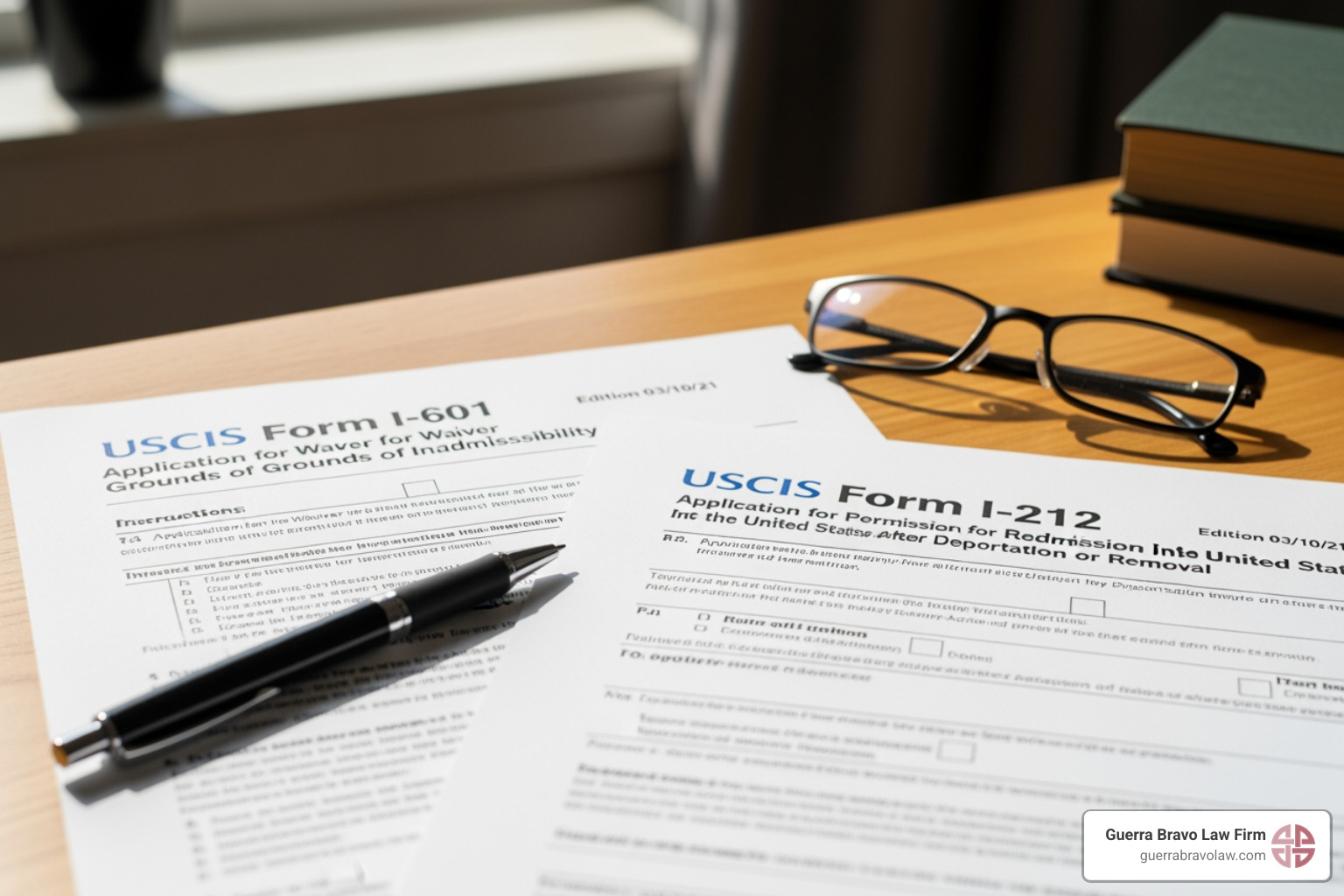
Form I-601: Application for Waiver of Grounds of Inadmissibility
Form I-601 asks the government to forgive the specific violation that makes you inadmissible.
Who Needs It? Individuals inadmissible for reasons like health issues, certain criminal convictions, immigration fraud, or unlawful presence who are seeking an immigrant visa or adjustment of status.
The "Extreme Hardship" Requirement: Most I-601 applications require proving that denying your application would cause "extreme hardship" to your U.S. citizen or Lawful Permanent Resident (LPR) spouse or parent. This must be more than the normal separation anxiety and requires extensive evidence of medical, financial, emotional, and other impacts. VAWA self-petitioners must prove hardship to themselves.
Related Forms: The Form I-601A, Application for Provisional Unlawful Presence Waiver, allows certain applicants to seek a waiver for unlawful presence while in the U.S. Form I-602, Application by Refugee for Waiver of Inadmissibility Grounds, is for refugees.
Form I-212: Application for Permission to Reapply for Admission
Form I-212 is used to ask for permission to reapply for admission before a statutory bar from a prior removal has expired.
Who Needs It? Anyone inadmissible under INA section 212(a)(9)(A) or (C) due to a prior removal or for re-entering illegally after a prior removal or accumulating over a year of unlawful presence.
A Discretionary Decision: Unlike the I-601, there is no single "extreme hardship" standard. An officer weighs positive factors (e.g., family ties, rehabilitation, hardship to relatives) against negative ones (e.g., criminal history, reason for removal). A strong case must show that granting the waiver is warranted.
Modern Filing Options: When filing with U.S. Customs and Border Protection (CBP), you can submit your application online via the Electronic Secured Adjudication Forms Environment (e-SAFE) or in person at designated ports of entry.
Sometimes, an individual may need to file both forms. Determining the correct strategy is complex, which is why experienced legal guidance is so valuable.
Navigating Your Deportation Waiver Application
The paperwork for a deportation waiver application is intensive. Getting the details right from the start can save you months of delays.
If you or a loved one is in immigration detention while preparing a waiver, our guide on ICE Detention Release may be helpful.
Gathering Essential Evidence for Your Application
The power of your application lies in the evidence. You need compelling, organized documentation to support your legal arguments.

For Form I-601: The focus is on proving "extreme hardship." Key evidence includes proof of your relationship to a qualifying relative (spouse/parent), medical records, financial documents showing economic loss, psychological evaluations, country condition reports, and personal statements detailing the emotional toll of separation. You must also include documents related to your inadmissibility, like certified court dispositions.
For Form I-212: The goal is to show you deserve a second chance. Important evidence includes letters of support attesting to your good moral character, proof of rehabilitation (e.g., counseling records, treatment program certificates), evidence of stable employment, and documentation of hardship your absence causes U.S. family members. Always include copies of your prior removal order.
Universal Requirements: All foreign-language documents must have a certified English translation. Submit clear photocopies unless originals are specifically requested.
Filing Fees, Locations, and Payment
Administrative details are critical. An error here can cause your application to be rejected before it's even reviewed.
Filing Fees: Fees change, so always check the official USCIS Fee Schedule website before filing. Fees are generally non-refundable.
Payment Methods: Be aware of changing rules. For mailed forms, USCIS is phasing out checks and money orders in favor of credit/debit card payments (Form G-1450) or ACH transactions (Form G-1650) by late 2025. Check the current requirements.
Fee Waivers: Certain applicants, such as VAWA self-petitioners and T visa applicants, may be eligible for a fee waiver.
Filing Location: Where you file depends entirely on your situation. The wrong address will cause your application to be returned. Consult the form instructions on the U.S. Citizenship and Immigration Services (USCIS) website for the correct mailing address. You may need to file with USCIS, U.S. Customs and Border Protection (CBP) via their e-SAFE portal, or with the immigration court (EOIR) if you are in removal proceedings.
Critical Filing Tips and Avoiding Common Pitfalls
The success of a deportation waiver application often hinges on small details. Simple oversights can cause months of delays or outright rejection. Most of these pitfalls are avoidable if you know what to look for. For those in removal proceedings, our approach to Removal Defense can provide needed strategic guidance.
Why Details Matter in Your Deportation Waiver Application
Immigration officers reject incomplete applications. To avoid this, pay close attention to the following:
Use the Correct Form Edition: USCIS regularly updates forms. Submitting an outdated version (e.g., not the 01/20/25 edition for Forms I-601 and I-212) will lead to automatic rejection. Always download the latest version from the USCIS website.
Complete Every Question: Do not leave fields blank. Write "N/A" for "not applicable" or "None" if the answer is zero. This shows you have reviewed the entire form.
Sign Your Form: An unsigned application is an incomplete application and will be rejected. Double-check for all required signatures before submitting.
Follow Special Instructions: Vulnerable populations like VAWA self-petitioners or T visa applicants may have different filing procedures and be eligible for fee waivers. Don't overlook these important provisions.
The Serious Consequences of Mistakes or Misrepresentation
Errors on your deportation waiver application can have life-altering consequences.

Rejection vs. Denial: A rejection is a procedural issue (e.g., wrong fee, missing signature) that sends your application back to you, causing delays. A denial is a decision on the merits of your case, meaning you failed to meet the legal standard.
Criminal Penalties for Falsification: Knowingly providing false information is a federal crime. It can result in massive fines, imprisonment, and a permanent bar from all future U.S. immigration benefits. There is no waiver for this.
Consequences of Not Filing: Failing to obtain a necessary waiver will lead to a denied visa or adjustment of status. It can also result in being placed in removal proceedings, leading to deportation and long-term bars from re-entry.
After You File: Potential Outcomes and Next Steps
Once your deportation waiver application is submitted, the waiting period begins. Understanding the process can help you manage expectations. For general immigration legal assistance, our Abogados de Migración are ready to help.
Understanding the Decision on Your Waiver
The post-filing period requires you to stay alert for notices and appointments.
Receipt Notice: Shortly after filing, you will receive a Form I-797C, Notice of Action. This confirms USCIS has your application and provides a receipt number to track your case online.
Biometrics Appointment: You will likely be scheduled for an appointment at an Application Support Center (ASC) to provide fingerprints, a photo, and a signature. Missing this appointment will delay your case.
Request for Evidence (RFE): USCIS may issue an RFE if more information is needed. This is an opportunity to strengthen your case, but you must respond thoroughly by the deadline to avoid a denial.
Approval: An approval notice means the ground of inadmissibility has been waived. You can now proceed with the next step in your immigration process, such as your visa interview or adjustment of status application.
Denial: A denial notice will explain the reasons for the decision. It is not always the end of the road. You may be able to file an appeal with the Administrative Appeals Office (AAO), a motion to reopen with new evidence, or a motion to reconsider.
These post-denial actions are legally complex and require careful analysis. An experienced attorney can be invaluable in navigating these challenges and understanding how to effectively contest a negative decision.
Conclusion
Successfully navigating a deportation waiver application is a meticulous and high-stakes process where details are paramount. Understanding the difference between Form I-601 and Form I-212, gathering compelling evidence of hardship, and avoiding common filing errors are crucial for a positive outcome. Given the complexity and the life-altering consequences, seeking expert legal guidance is not just a good idea—it's a strategic necessity. An experienced attorney can build the strongest possible case, leveraging deep knowledge of immigration law to fight for your future in the United States.
At Guerra Bravo Law Firm, our founding attorney's 14+ years of insider experience with ICE and DHS provides the battle-tested insight needed for these complex cases. We understand the nuances of immigration law, particularly in our communities across the Rio Grande Valley, including McAllen, Brownsville, Edinburg, and Harlingen, TX. If you are facing inadmissibility or a removal order, don't leave your future to chance. Contact us to explore your options for Defensa Contra Deportación.