

April 7, 2026
Don't Just Consult, Connect: Finding Your Ideal Immigration Attorney
Don’t Just Consult, Connect: Finding Your Ideal Immigration Attorney
Why Finding the Right Immigration Attorney Can Change Everything
If you need to find immigration attorney help, here’s the fastest way to get started:
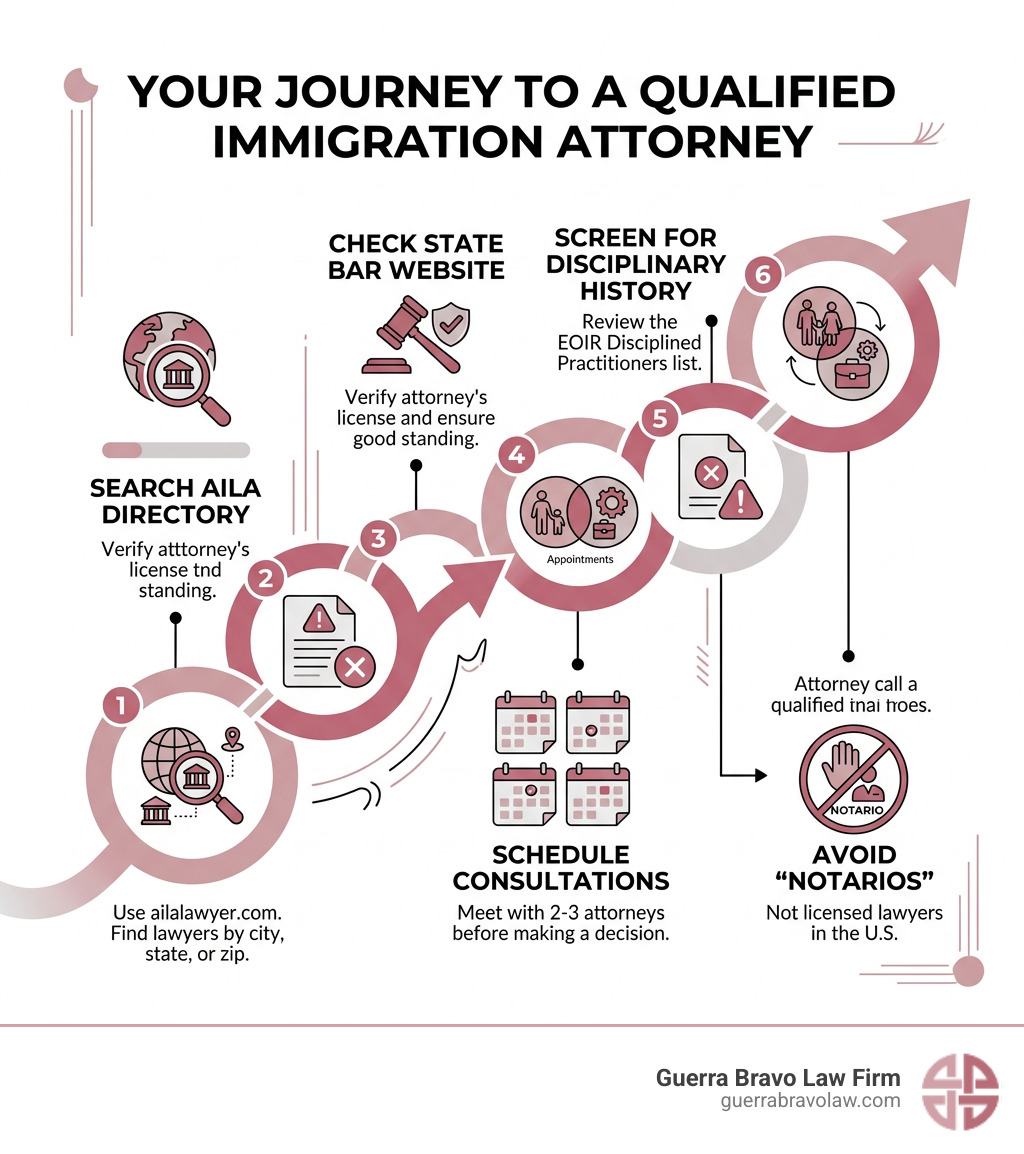
How to Find an Immigration Attorney — Quick Steps
-
Search AILA’s directory at ailalawyer.com by city, state, or zip code
-
Check your state bar website to verify any attorney’s license and good standing
-
Review the EOIR Disciplined Practitioners list to screen for disciplinary history
-
Ask about specialization — make sure they handle your specific case type (family, employment, removal defense, etc.)
-
Schedule consultations with at least 2-3 attorneys before deciding
-
Avoid “notarios” — in the U.S., they are not licensed lawyers and cannot legally represent you
Immigration law is one of the most high-stakes areas of law there is. A wrong move — a missed deadline, an improperly filed form, or the wrong legal strategy — can mean deportation, family separation, or years of delays.
And yet, many people pick an attorney the same way they’d pick a restaurant: a quick Google search and a few reviews.
That’s not enough.
The reality is that immigration attorneys vary widely in their experience, specialization, and quality. Some focus exclusively on family visas. Others handle deportation defense. The attorney who helped your neighbor get a green card may not be the right fit for your asylum case or your business visa.
This guide will walk you through exactly how to find, evaluate, and connect with the right immigration attorney for your specific situation — so you can move forward with confidence.
Essential Qualifications to Find Immigration Attorney Professionals
When you start your search to find immigration attorney experts, the first thing you must confirm is whether the person is actually authorized to provide legal advice. In the United States, immigration law is federal, but the people who practice it must meet very specific criteria.
Generally, there are two types of authorized representatives:
Licensed Attorneys These are individuals who have graduated from law school and passed a state bar exam. To practice immigration law, an attorney must be a member in “good standing” of the bar of the highest court of any U.S. state, possession, territory, or the District of Columbia. They do not necessarily have to be licensed in the state where they live (since immigration is federal), but they must be licensed somewhere in the U.S.
DOJ-Accredited Representatives These are non-lawyers who work for recognized non-profit, religious, charitable, or social service organizations. To help you, both the organization and the individual must be officially recognized by the Department of Justice (DOJ). These representatives are often a great resource for straightforward cases if you are on a tight budget.
You can verify these organizations through the official List of Recognized Organizations and Accredited Representatives.
How to Verify Credentials and Disciplinary History
It is not enough for someone to tell you they are a lawyer. We always recommend that you verify their credentials yourself. Think of it like checking the “Carfax” before buying a car; you want to know if there have been any “accidents” in their professional history.
Check the State Bar Every state has a “Bar Association” or a state agency that keeps a public record of every licensed attorney. You can search these websites by the attorney’s name. You are looking for two things:
-
Status: It should say “Active” or “In Good Standing.”
-
Disciplinary History: If the attorney has been suspended, disbarred, or publicly reprimanded for unethical behavior, it will be listed here.
Check the EOIR List The Executive Office for Immigration Review (EOIR) maintains a “List of Currently Disciplined Practitioners.” These are attorneys who have been banned or suspended from practicing specifically in immigration courts. Even if an attorney has a high-ranking profile on a review site, if they are on this list, you should walk away immediately.
For more details on what makes a legal professional truly qualified, you can read More info about experienced immigration lawyers.
Avoiding Red Flags and Unauthorized ‘Notarios’
In many Latin American countries, a “notario público” is a high-ranking attorney with significant legal authority. However, in the United States, a “notary public” is simply someone authorized by the state to witness the signing of documents. They are not lawyers.
Fraudulent “notarios” often prey on immigrant communities by claiming they can provide legal help. They might offer “special connections” at USCIS or guarantee a green card for a high fee.
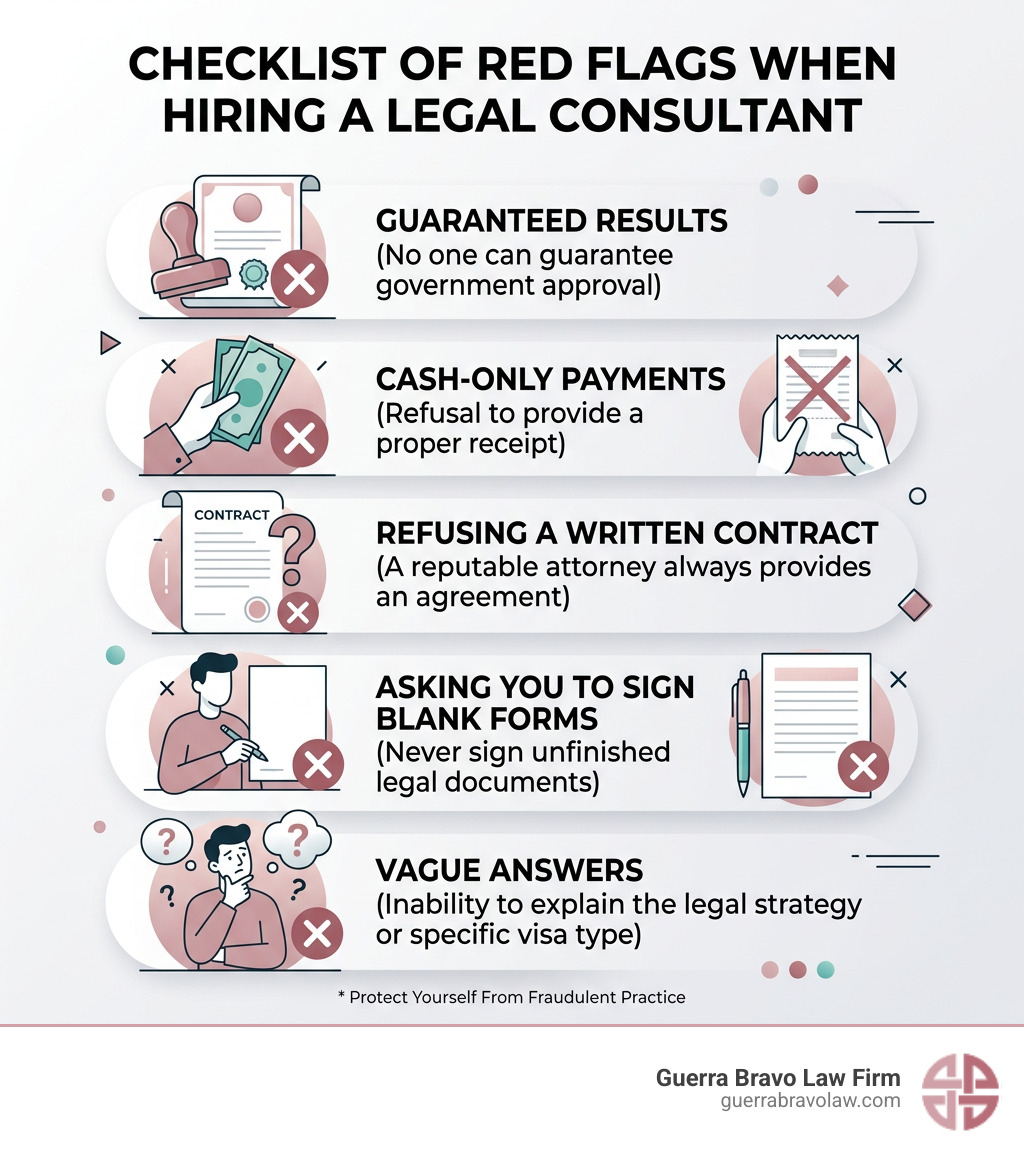
Red Flags to Watch Out For:
-
Guaranteed Results: No one can guarantee that the government will approve your application. If a lawyer promises a 100% success rate, they are being dishonest.
-
Cash-Only Payments: If they refuse to give you a receipt or only take cash under the table, be careful.
-
Refusing a Written Contract: A reputable attorney will always provide a written representation agreement that outlines exactly what they will do and how much it will cost.
-
Asking You to Sign Blank Forms: Never, ever sign a document that has not been filled out. This is a common tactic used by scammers to file fraudulent information in your name.
-
Vague Answers: If they can’t explain the legal strategy or the specific visa you are applying for, they likely don’t have the expertise you need.
Key Factors to Consider for Your Case
Once you’ve confirmed an attorney is legitimate, you need to determine if they are the right fit for you. Immigration law is incredibly broad. Some attorneys are great at helping tech companies hire engineers, but they might be completely lost in a deportation hearing.
When you try to find immigration attorney help, consider these personal factors:
-
Communication Style: Do they explain things in a way you understand? Do they return your calls? You are trusting this person with your future; you need to feel heard.
-
Language Skills: If English is not your first language, it is often helpful to find a firm that is bilingual. While interpreters can be used, being able to speak directly to your lawyer in your native tongue ensures nothing is “lost in translation.”
-
Cultural Competence: An attorney who understands your background and the specific challenges of your home country can often build a stronger case, especially in asylum or hardship waiver situations.
You can explore the full range of legal support options by checking More info about immigration services.
Evaluating Specialization to Find Immigration Attorney Experts
Think of an immigration lawyer like a doctor. You wouldn’t go to a dermatologist for a broken leg. Similarly, you should look for an attorney who specializes in the “sub-field” of immigration that matches your needs.
Family-Based Immigration This includes marriage-based green cards, bringing parents or children to the U.S., and fiancé visas. These cases require a deep understanding of how to prove the “bona fides” (authenticity) of a relationship.
Employment-Based Immigration This is for people coming to the U.S. for work, such as H-1B visas, L-1 transfers, or EB-1/EB-2 green cards. These cases are highly technical and often involve complex interactions with the Department of Labor.
Removal (Deportation) Defense This is the most intense area of immigration law. If you or a loved one is in immigration court, you need a “litigator” — someone comfortable arguing before a judge and countering the government’s efforts to remove you. This requires a specific set of skills that not all immigration lawyers possess.
Asylum and Humanitarian Relief These cases (including U Visas for crime victims or VAWA for domestic violence survivors) are incredibly sensitive. They require an attorney who knows how to gather evidence of persecution or hardship and who can handle the emotional weight of these stories.
The Importance of Client Reviews and Ratings
While a fancy website is nice, the best way to judge an attorney’s reputation is to see what their past clients and peers have to say.
Testimonials Look for detailed reviews. A review that says “They were great!” isn’t as helpful as one that says, “They helped me navigate a difficult RFE (Request for Evidence) after my first lawyer messed up my application.”
Professional Ratings Websites like AVVO, Justia, and Super Lawyers provide ratings based on peer reviews and professional achievements. These sites often list how many years an attorney has been practicing and what their specific areas of focus are. For example, some attorneys have been practicing for over 30 or 40 years, which brings a level of “battle-tested” wisdom to your case.
If you are looking for local help, you can find More info about an immigration attorney lawyer near me to see how local reputation plays a role.
Navigating the Search: How to Find Immigration Attorney Services Locally
If you live in South Texas — whether it’s McAllen, Edinburg, Mission, or Brownsville — your search for an attorney is unique. We live in a region where immigration issues are part of daily life. This means there are many options, but it also means you need to be extra diligent.
Use Professional Directories
-
AILA (American Immigration Lawyers Association): This is the gold standard. Their “AILA Lawyer Search” allows you to filter by location and language.
-
State Bar of Texas: You can search specifically for attorneys in the Rio Grande Valley who are board-certified in Immigration and Nationality Law.
-
Justia: This directory lists attorneys by city, making it easy to find someone in Harlingen, Pharr, or Weslaco.
You can also use the American Bar Association’s resources for Finding an attorney through the ABA.
Resources for Free or Low-Cost Legal Help
We understand that private legal fees can be a barrier for some families. If you cannot afford a private attorney, there are still ways to get authorized legal help.
Pro Bono Providers The Department of Justice maintains a List of pro bono legal service providers. These are lawyers and organizations that have committed to providing at least some of their services for free to those who qualify based on income.
Non-Profit Organizations In the Rio Grande Valley and surrounding areas, organizations like the South Texas Immigration Council provide low-cost assistance. Always ensure that the non-profit is “Recognized” and their staff is “Accredited” by the DOJ.
Understanding Fee Structures to Find Immigration Attorney Value
When you finally find immigration attorney options that you like, you need to talk about money. Don’t be shy; a good lawyer expects this conversation.
Flat Fees Most immigration lawyers use a flat fee for standard cases (like a naturalization application or a green card petition). This means you pay one set price for the entire process, regardless of how many hours the lawyer spends on it. This is great for budgeting because there are no surprises.
Hourly Rates For complex litigation, such as a long-running deportation defense case, an attorney might charge by the hour. If this is the case, ask for an estimate of the total hours and a “cap” if possible.
Payment Plans Many firms (including ours!) understand that immigration costs are a significant investment. Ask if the firm offers monthly payment plans to help spread out the cost.
What is Included? Always ask if the fee includes:
-
Government filing fees (which can be hundreds or thousands of dollars).
-
Postage and translation costs.
-
Travel fees (if the lawyer has to go to a distant immigration court).
Preparing for Your Initial Consultation
The consultation is your “first date” with the law firm. It’s your chance to see if you click and their chance to see if they can actually help you.
To make the most of it, bring every document related to your immigration history, including:
-
Your passport and any visas.
-
Your I-94 arrival/departure record.
-
Any notices you’ve received from USCIS or the Immigration Court.
-
Records of any arrests or “brushes with the law” (even if you weren’t convicted).
If you are facing a court date, you should specifically look for More info about deportation defense attorneys before your meeting.
What to Ask During Your First Meeting
Don’t let the lawyer do all the talking. Use this Essential Consultation Checklist to vet them:
-
Experience: “How many cases similar to mine have you handled in the last year?”
-
Strategy: “What is the primary challenge you foresee in my application, and how will we overcome it?”
-
Communication: “Who will be my primary point of contact? Will I speak to you or a paralegal most of the time?”
-
Timeline: “What is the estimated processing time for this type of visa or defense based on current USCIS trends?”
-
Success Likelihood: “Based on the facts, what are the chances of a positive outcome? Are there risks I should be aware of?”
Frequently Asked Questions about Finding an Immigration Lawyer
Can I handle my immigration case without an attorney?
Technically, yes. USCIS allows individuals to file their own forms. However, immigration law is often compared to tax law in its complexity. If your case is perfectly straightforward — no criminal history, no prior deportations, no missed deadlines — you might be fine. But if your case involves removal defense, asylum, or a “Request for Evidence,” a professional legal strategy is essential. One small mistake can lead to a permanent bar from entering the U.S.
What is the difference between a lawyer and a ‘notario’?
This is the most important distinction for our community in South Texas. In the U.S., a “notario” is not a lawyer. They cannot represent you in court, they cannot sign legal briefs, and they cannot give you legal advice on which visa you qualify for. Only a licensed attorney or a DOJ-accredited representative can legally help you navigate the immigration system.
How much does an immigration attorney typically cost?
Fees vary wildly based on the complexity of the case and the experience of the lawyer. A simple naturalization (citizenship) case might cost a few thousand dollars in legal fees, while a complex deportation defense trial could cost significantly more. Most reputable attorneys will provide a clear, written fee schedule during your consultation.
Conclusion
Finding the right legal partner is the most important step you will take on your journey to the American Dream. In the Rio Grande Valley, you have many choices, but experience matters more than anything else.
At Guerra Bravo Law Firm, we don’t just fill out forms. We build “battle-tested” strategies. Our lead attorney, Iris Guerra Bravo, brings over 14 years of insider experience working within ICE and DHS. This means we understand the “other side’s” playbook. We know how the government evaluates cases because we’ve been in those rooms.
Whether you are in McAllen, Edinburg, Brownsville, or any of the surrounding areas like Alamo, San Juan, or Hidalgo, we are here to provide individualized, compassionate, and aggressive representation. We believe that every client deserves a strategy as unique as their story.
Don’t leave your future to chance or an unqualified “notario.” Connect with a team that has the experience to win.
Start your journey toward U.S. citizenship today or contact us to schedule your personalized consultation. We look forward to helping you call the United States “home” for good.
[