

February 14, 2026
Finding a Top Deportation Defense Attorney Close to You
Finding a Top Deportation Defense Attorney Close to You
Facing Deportation? Here’s What You Need to Know
If you’re searching for a deportation defense attorney near me, understand that time is critical. Deportation proceedings move fast, and the decisions made now could determine whether you stay with your family or are forced to leave the United States.
Quick Answer: How to Find a Deportation Defense Attorney Near You
-
Search for immigration attorneys specializing in removal defense in your city or county.
-
Verify their experience with cases similar to yours (criminal issues, visa violations, etc.).
-
Check if they practice in your local immigration court—familiarity with local judges matters.
-
Schedule consultations with 2-3 attorneys to compare their approach and fees.
-
Ask about their track record—attorneys with deportation defense experience have significantly better outcomes.
-
Act immediately—you have critical deadlines, often only 30 days to file appeals.
After building a life in the United States, the prospect of deportation is terrifying. Your home, family, and job all hang in the balance.
The statistics are sobering: Over 80% of people who received deportation orders did not have legal representation, while 93% of people granted relief from deportation had a lawyer. This proves that the right attorney can be the difference between staying with your loved ones and being forced to leave.
Each year, Immigration and Customs Enforcement (ICE) detains approximately 500,000 immigrants, with up to 50,000 in detention on any given day. Many don’t know their rights or the defenses available to them.
This guide explains deportation defense, your rights, and how to find the right attorney to fight for you.
Understanding Deportation, Your Rights, and Potential Defenses

When facing removal from the United States, it’s crucial to understand the terminology, your rights, and potential defense strategies.
What is the Difference Between Deportation and Removal?
Legally, “deportation” is now called “removal proceedings.” This current term covers all situations where the government seeks to remove a non-citizen from the U.S. under the Immigration and Nationality Act (INA). It applies to those found inadmissible at the border and those already in the U.S. who are found to be removable for violating immigration laws.
Essentially, if an immigration judge decides you are not allowed to stay, you are in removal proceedings.
What Are the Most Common Reasons for Deportation?
Many actions can lead to removal proceedings, even for those with valid visas. Common grounds include:
-
Immigration Violations:
-
Overstaying a visa: Remaining in the U.S. past your visa’s expiration date.
-
Violating visa terms: Working without authorization, failing to maintain student status, or not reporting a change of address to U.S. Citizenship and Immigration Services (USCIS).
-
Unlawful entry or re-entry: Entering without inspection or after a prior deportation.
-
Failure to depart: Not leaving after being granted voluntary departure.
-
-
Criminal Convictions:
-
Aggravated felonies: A category of serious crimes that almost always results in deportation.
-
Crimes of moral turpitude (CMT): Offenses involving dishonesty or fraud.
-
Drug offenses: Most drug-related convictions are grounds for removal.
-
Domestic violence or firearm offenses: These are specific grounds for deportation.
-
Human trafficking: A severe offense leading to removal.
-
Misdemeanor criminal violations: Even some misdemeanors can trigger removal proceedings.
-
-
Fraud and Misrepresentation:
-
Immigration fraud: Lying on applications or entering a fraudulent marriage for immigration benefits.
-
Errors or misstatements: Even unintentional mistakes on paperwork can be seen as fraud.
-
-
Other Grounds:
-
Denial of an asylum application: If your claim is denied with no other relief available.
-
Failure to remove conditions on a green card: Not filing the required paperwork for a conditional green card.
-
What Are Your Rights When Facing Deportation?
Even in removal proceedings, you have fundamental rights:
-
The Right to a Hearing: You can challenge your deportation order before an immigration judge.
-
The Right to an Attorney: You have the right to hire your own attorney, but the government will not provide one for you.
-
The Right to Present Evidence: You can present evidence and testimony and cross-examine witnesses.
-
The Right to Remain Silent: You have the right to remain silent when questioned by immigration agents.
-
The Right to Appeal: You can generally appeal a decision you disagree with.
-
Due Process: You are entitled to fair treatment under the law.
What Are the Potential Defenses Against Deportation?
An experienced deportation defense attorney near me can explore various strategies, including:
-
Cancellation of Removal: Available for those with long-term U.S. presence, good moral character, and whose removal would cause exceptional hardship to a qualifying U.S. citizen or permanent resident relative.
-
Asylum or Withholding of Removal: For those who fear persecution in their home country based on race, religion, nationality, political opinion, or social group.
-
Waivers of Inadmissibility or Removability: These can excuse certain violations, such as unlawful presence (I-601A) or some criminal convictions.
-
Adjustment of Status: If a qualifying family member can petition for you, you may be able to get a green card while in proceedings.
-
Prosecutorial Discretion: ICE attorneys may agree to close your case based on humanitarian factors.
-
Challenging the Notice to Appear (NTA): Your attorney can argue the government has not proven its case against you.
-
Motions to Suppress: If your rights were violated during an arrest, evidence may be excluded.
-
Temporary Protected Status (TPS): Available if your home country is designated as unsafe due to conflict or disaster.
-
U or T Visas / VAWA: Protections for victims of certain crimes, human trafficking, or domestic violence.
Who Handles Deportations: USCIS or ICE?
Understanding which agency does what is key:
U.S. Citizenship and Immigration Services (USCIS)
-
Role: USCIS handles immigration benefits like visas, green cards, and citizenship.
-
Deportation Authority: USCIS does not initiate deportations. They grant or deny benefits and may refer cases to ICE if they find a violation.
U.S. Immigration and Customs Enforcement (ICE)
-
Role: ICE is the enforcement arm of the Department of Homeland Security (DHS).
-
Deportation Authority: ICE is the agency that investigates, apprehends, and carries out deportations. They issue the documents that start removal proceedings.
What Are the Consequences of a Deportation Order?
A deportation order has severe, life-altering consequences:
-
Re-entry Bans: A deportation order bars you from re-entering the U.S. for a set time, or even permanently. The length of the ban depends on the reason for your removal:
-
5-year ban: For removal upon arrival or failure to appear at a hearing.
-
10-year ban: For being ordered deported by a judge after a hearing.
-
20-year ban: For re-entering illegally after a prior removal or for an aggravated felony conviction.
-
Permanent inadmissibility: For severe or repeated violations.
-
-
Family Separation: Deportation often separates families, leaving U.S. citizen spouses and children behind.
-
Loss of Employment and Life: You lose the job, home, and community you have built in the U.S.
-
Impact on Future Immigration Applications: A deportation order makes it extremely difficult to get any future U.S. immigration benefit.
The Deportation Process Explained Step-by-Step
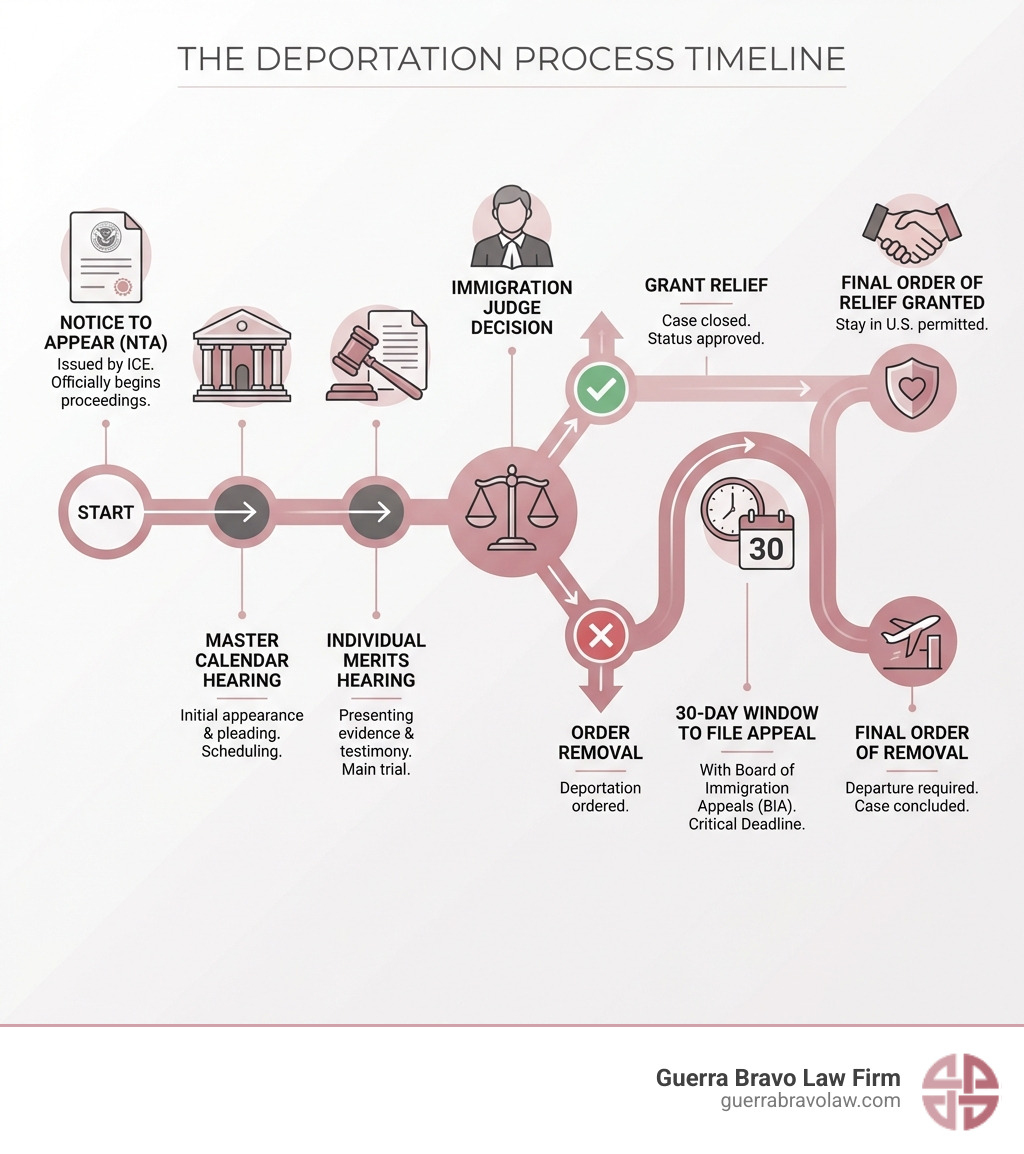
The deportation process can be confusing, but understanding its stages helps you prepare. The process involves several key steps, from receiving a notice to potential appeals.
What Happens When You Receive a Notice to Appear (NTA)?
Receiving a Notice to Appear (NTA) from ICE is the official start of removal proceedings. This critical document lists the government’s allegations and charges of removability against you. It will also state the date and time for your first court appearance, the Master Calendar Hearing. You must act quickly and contact a deportation defense attorney near me as soon as you receive an NTA to understand the charges and prepare your defense.
What Is the Typical Deportation Hearing Process?
The removal process in immigration court involves two main hearings:
Master Calendar Hearing (MCH)
-
This is your first, brief appearance before an immigration judge.
-
The judge confirms your identity, reviews the NTA, and asks you to admit or deny the charges.
-
You will state what relief from deportation you are seeking and can ask for time to find a deportation defense attorney near me.
Individual Merits Hearing (IMH)
-
This is your main trial.
-
Your attorney will present evidence, testimony, and witnesses to support your case for relief.
-
The government’s attorney will argue for your removal and can cross-examine you and your witnesses.
-
The judge then decides whether to grant relief or order your removal.
What is the Role of the Board of Immigration Appeals (BIA)?
If the immigration judge orders your removal, you generally have the right to appeal to the Board of Immigration Appeals (BIA), the highest administrative body for immigration law.
-
30-Day Deadline: You must file a Notice of Appeal within 30 days of the judge’s decision. This deadline is strict.
-
BIA Review: The BIA reviews the case based on the written record and legal briefs. They do not usually hold new hearings.
-
Potential Outcomes: The BIA can affirm (uphold), remand (send back), or reverse (overturn) the judge’s decision.
Can You Travel While in Removal Proceedings?
Traveling outside the U.S. during removal proceedings is extremely risky. Leaving without permission can be seen as abandoning your case, resulting in an automatic deportation order (“in absentia” removal order). In very limited cases, you might apply for Advance Parole (Form I-131) to travel temporarily. Never travel without first consulting a deportation defense attorney near me to understand the significant risks.
How Long is a Deportation Order Valid For?
A deportation order results in a ban from re-entering the United States. As mentioned earlier, these re-entry bars are typically for 5, 10, or 20 years, and can even be permanent depending on the specific grounds for your removal and your immigration history.
How a Deportation Defense Attorney Near Me Can Make the Difference
Facing the federal government alone is a losing battle. The government will have experienced attorneys fighting for your removal. You deserve equally formidable representation. This is where a skilled deportation defense attorney near me becomes your most vital asset.
Why is Legal Representation So Crucial?
The statistics are clear:
-
93% of people granted relief from deportation had legal representation.
-
Over 80% of people who received deportation orders did not.
An attorney is critical because:
-
Laws are Complex: Immigration law is intricate and constantly changing.
-
The Government Has an Attorney: An experienced ICE attorney will argue for your removal. You need an advocate to level the playing field.
-
Your Rights are Protected: An attorney ensures due process and can challenge illegally obtained evidence.
-
Strategic Defense: A lawyer can identify all available defenses and build the strongest case for you.
How Exactly Can an Attorney Help Your Case?
A deportation defense attorney near me provides comprehensive support. At Guerra Bravo Law Firm, we use our unique “insider experience” with ICE and DHS to build effective strategies. We can help by:
-
Evaluating Your Case: We analyze your situation to find the best path forward.
-
Identifying Defenses: We determine all possible defenses, such as cancellation of removal, asylum, or waivers.
-
Gathering Evidence: We help you compile the documents needed to support your case.
-
Filing Motions: We prepare and file all necessary legal documents and applications.
-
Court Representation: We represent you at all hearings, making legal arguments on your behalf.
-
Negotiating with ICE: We can negotiate for outcomes like prosecutorial discretion to close your case.
-
Handling Appeals: If needed, we can file appeals with the BIA or in federal court.
-
Providing Guidance: We offer support and clear communication throughout the process.
For more detailed information on how we can assist you, please explore our services dedicated to More info about removal defense services.
What to Look for When Searching for a “Deportation Defense Attorney Near Me”
Choosing the right deportation defense attorney near me is vital. Look for:
-
Specialization in Removal Defense: Ensure the attorney focuses on deportation cases.
-
Proven Track Record: Look for experience with cases similar to yours.
-
Local Court Knowledge: Familiarity with local immigration courts (McAllen, Harlingen, Port Isabel) and judges is a major advantage.
-
Positive Client Testimonials: Reviews show an attorney’s effectiveness and client care.
-
Insider Experience: At Guerra Bravo Law Firm, our attorney’s 14+ years with ICE and DHS provides a unique, “battle-tested” perspective.
-
Bilingual Support: Clear communication in English and Spanish is essential.
-
Personalized Approach: You need an attorney who understands the law and the human impact of your case.
Understanding the Costs of Hiring a Local Deportation Defense Attorney
The cost of a deportation defense attorney is an investment in your future.
-
Consultation Fees: Many firms charge an initial fee to assess your case.
-
Fee Structures: Attorneys may use flat fees for specific services or charge hourly for complex cases.
-
Payment Plans: We understand the financial burden and offer payment plans to make representation more accessible.
-
Cost Factors: The total cost depends on your case’s complexity, the strategy used, and if appeals are needed.
-
Value of Investment: While fees are a factor, the cost of deportation—losing your family, home, and job—is far greater. An attorney dramatically increases your chance of success.
Frequently Asked Questions about Deportation
Here, we address some of the most common questions we hear regarding deportation and removal proceedings.
Can I be deported if I have a green card?
Yes. A green card (Lawful Permanent Resident status) does not guarantee immunity from deportation. You can be placed in removal proceedings for:
-
Criminal Convictions: Including aggravated felonies, crimes of moral turpitude, and drug offenses.
-
Abandonment of Residency: Spending too much time outside the U.S. or indicating you no longer intend to live here permanently.
-
Immigration Fraud: If your green card was obtained through misrepresentation.
-
Failure to Remove Conditions: Not filing the proper paperwork for a conditional green card.
What happens if I miss my immigration court date?
Missing a court date is a critical error. The judge will almost certainly issue an “in absentia” removal order, which is an automatic deportation order. Reopening such an order is extremely difficult and requires proving “exceptional circumstances” for your absence within a very short timeframe. If you miss a court date, contact a deportation defense attorney near me immediately, as time is of the essence.
Can a deportation order be reversed or canceled?
Yes, but it is challenging. An experienced attorney can help you file:
-
A Motion to Reopen: Based on new facts or evidence, typically filed within 90 days.
-
A Motion to Reconsider: Based on a legal or factual error in the original decision, typically filed within 30 days.
-
An Appeal to the BIA: You can appeal the judge’s decision to the Board of Immigration Appeals within 30 days.
Success often depends on proving your eligibility for a form of relief from removal. These processes are complex and require an attorney’s help.
Take the First Step to Defend Your Future in the U.S.
Facing deportation is frightening. The process is complex, the stakes are high, and you are up against the U.S. government’s vast resources. You do not have to face this alone.
Acting quickly is critical. The sooner you hire a qualified deportation defense attorney near me, the more options you will have. Statistics prove that the right legal team is your best defense.
At Guerra Bravo Law Firm, we understand the unique challenges faced by residents in the Rio Grande Valley, including language barriers and the fear of the unknown. We are committed to providing personalized legal representation and strong advocacy in areas like McAllen, Brownsville, Edinburg, Harlingen, Mission, Pharr, Weslaco, Mercedes, Alamo, San Juan, Donna, Hidalgo, Palmview, La Joya, and Penitas, Texas.
Our attorney, Iris Guerra Bravo, brings over 14 years of invaluable “insider experience” working with ICE and DHS. This unique background allows us to craft “battle-tested, individualized legal strategies” for even the most complex deportation cases. We know how the system works from the inside out, and we use that knowledge to fight tirelessly for you and your family.
Don’t let fear or confusion prevent you from defending your future.
Schedule a consultation to discuss your removal defense case with us today.
[