

May 11, 2026
Your Family's Future: A Guide to Finding the Best Family Visa Attorney
Your Family’s Future: A Guide to Finding the Best Family Visa Attorney
Why Finding the Right Family Visa Attorney Is Critical for Your Success
When you need a family visas attorney, you’re making a critical decision for your family’s future. The right legal help can mean the difference between reuniting with loved ones quickly or facing years of uncertainty and potential denial due to administrative errors.
Quick Answer - What to Look for in a Family Visa Attorney:
-
Experience with your specific visa type (K-1, IR, F categories)
-
A strong track record of successful cases
-
Local expertise in your immigration court’s jurisdiction
-
Clear communication about the process, timeline, and costs
-
Membership in the American Immigration Lawyers Association (AILA)
-
Transparent pricing, preferably with flat fees
-
Bilingual services if your family needs them
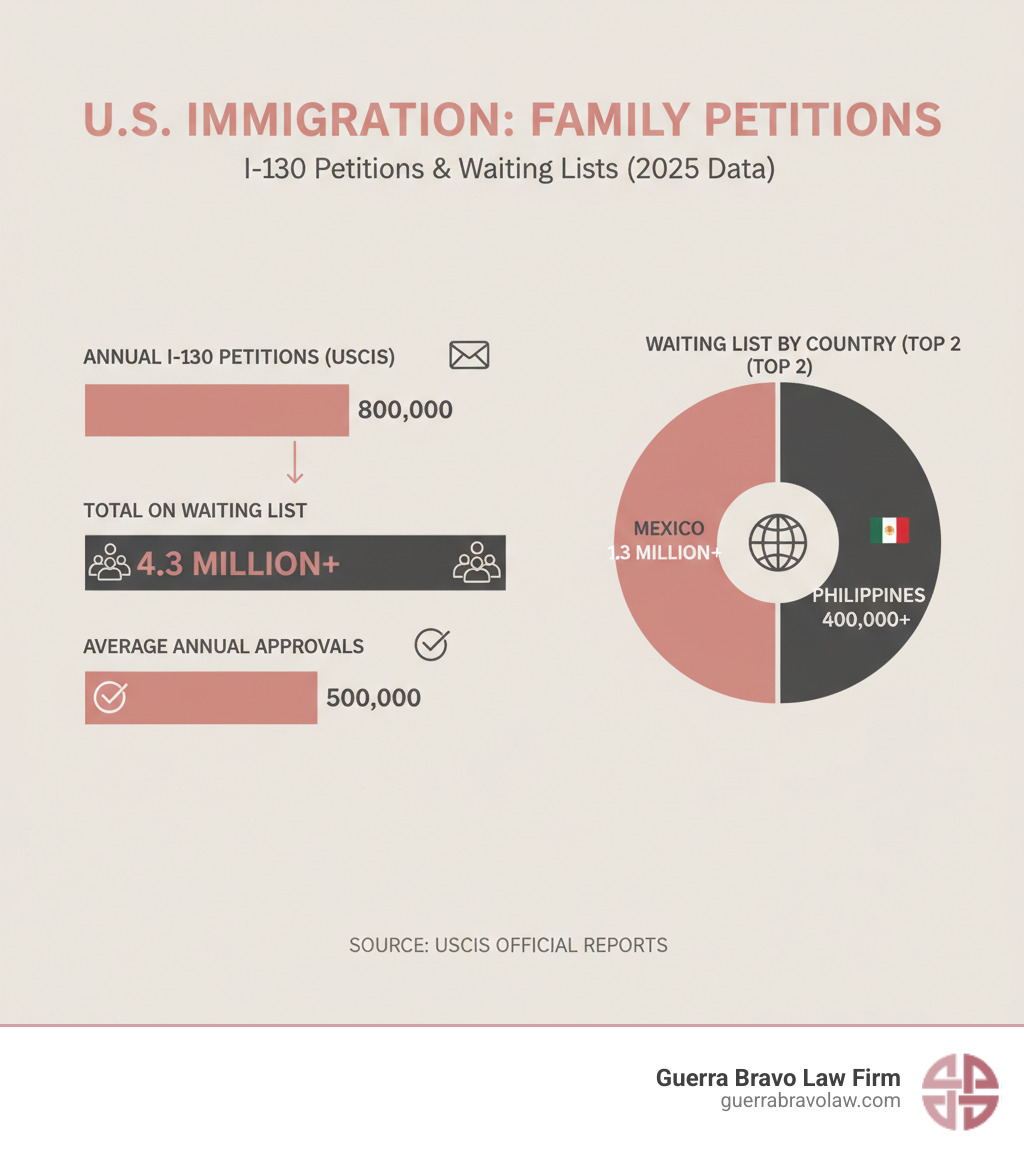
The immigration system is complex and backlogged. USCIS receives around 800,000 Form I-130 petitions annually, contributing to a waiting list of over 4.3 million applications. This represents real families separated by bureaucracy.
The process involves strict deadlines and detailed documentation. Immediate Relative Visas can take 6-12 months, while Family Preference Visas may take 1-10+ years. An experienced attorney helps you steer this system efficiently.
Understanding Family Visas: What They Are and Who Qualifies
A family visa is a legal bridge that allows your foreign family members to become lawful permanent residents (Green Card holders) in the United States, based on the principle of family reunification.
Your family visas attorney will refer to you, the U.S. citizen or permanent resident, as The Petitioner. Your loved one abroad is The Beneficiary.
Not all family relationships are treated equally, and your immigration status is key.
Who is Eligible to Apply?
The relationship to your family member and your own status determine eligibility and processing time.
If you’re a U.S. citizen (at least 21 years old for parents/siblings), you can petition for:
-
Spouse
-
Unmarried children under 21
-
Parents
-
Married children of any age
-
Siblings
If you’re a lawful permanent resident, you can petition for:
-
Spouse
-
Unmarried children of any age
This distinction is critical. For example, a permanent resident cannot petition for their parents or married children at all. Understanding these rules from the start can save years of frustration, which is why expert legal guidance is so valuable.
For families ready to take the next step, Guerra Bravo Law Firm offers comprehensive guidance through Family Petitions, and for Spanish-speaking families, detailed support through Peticiones Basadas en la Familia.
Navigating the Landscape: Types of Family Visas
The family visa system has two main tracks: an express lane for immediate relatives and slower lanes for other family members. A family visas attorney can identify the correct path for your family, which dictates the waiting time.
Immediate Relatives (IR) of U.S. Citizens
This is the fastest category because there are no annual numerical limits.
-
IR-1/CR-1: For spouses of U.S. citizens. A CR-1 is issued if the marriage is less than two years old, granting conditional residency.
-
IR-2: For unmarried children under 21 of U.S. citizens. Be aware of the risk of a child “aging out” if they turn 21 during the process.
-
IR-5: For parents of U.S. citizens, provided the citizen child is at least 21.
USCIS offers more details on Immediate relatives.
Family Preference Categories
These categories have annual quotas, leading to significant backlogs and long waits, especially for applicants from countries like Mexico, the Philippines, and India.
-
First Preference (F1): Unmarried adult children (21+) of U.S. citizens.
-
Second Preference (F2): F2A is for spouses and minor children of permanent residents; F2B is for unmarried adult children of permanent residents.
-
Third Preference (F3): Married children of U.S. citizens.
-
Fourth Preference (F4): Siblings of U.S. citizens (citizen must be 21+). Wait times can be decades long.
Learn more from USCIS about Family preference visas.
Special Cases: K-1 and K-3 Visas
-
K-1 Fiancé(e) Visas: Allow a foreign fiancé(e) to enter the U.S. to marry a U.S. citizen within 90 days. After marriage, they can apply for permanent residency.
-
K-3 Spouse Visas: A less common option that allows a foreign spouse of a U.S. citizen to come to the U.S. while their immigrant visa petition is pending.
Understanding these nuances is key to reuniting your family as quickly as possible.
The Path to Reunification: General Family Visa Process
The family visa process follows a general roadmap. While each journey is unique, understanding these stages makes the process less intimidating. A family visas attorney can prevent costly pitfalls at each step.
Step 1: Petition Filing (Form I-130)
This journey starts with Form I-130, Petition for Alien Relative. As the petitioner, you must prove your U.S. status (citizen or permanent resident) and your relationship to the beneficiary. Accuracy is critical to avoid delays. You can find Form I-130 and instructions on the USCIS website.
Step 2: National Visa Center (NVC) Processing
After USCIS approves the I-130, the case moves to the NVC. Here, you will pay fees, submit the DS-260 immigrant visa application, and upload required civil documents and the Affidavit of Support (Form I-864). The NVC will not schedule an interview until your case is “documentarily qualified,” meaning all paperwork is complete and correct.
Step 3: Interview and Decision
The path now splits based on your family member’s location.
-
Consular Processing: For those outside the U.S., the interview occurs at a U.S. embassy or consulate in their home country. The officer confirms the application details and the authenticity of the relationship.
-
Adjustment of Status: For those already legally in the U.S., they may be eligible to file Form I-485 to get their green card without leaving the country. This involves an interview at a local USCIS office. For more, see our posts on Top Immigration Marriage Questions or Ajuste de Estatus con Visa de Turista.
Step 4: Visa Issuance / Green Card
After a successful interview, the beneficiary receives an immigrant visa in their passport (consular processing) or their green card is approved and mailed (adjustment of status).
Required Documentation
Key documents include: proof of your U.S. status, proof of the family relationship (birth/marriage certificates), the beneficiary’s passport and police clearances, a medical exam, and the petitioner’s financial documents for the Affidavit of Support. An attorney ensures this extensive paperwork is correctly prepared and submitted.
The Indispensable Guide: Roles and Benefits of a Family Immigration Attorney
Handling a family immigration case alone is risky. A skilled family visas attorney is not a luxury but a crucial asset for success. At Guerra Bravo Law Firm, we’ve seen how proper legal guidance prevents unnecessary delays, denials, and family separation.
Navigating Complexity and Avoiding Pitfalls
U.S. immigration law is intricate and constantly changing. Our attorney, Iris Guerra Bravo, brings over 14 years of insider experience with ICE and DHS, offering real-world knowledge of how these agencies operate. This insight helps us present your case in the strongest possible light, avoiding common clerical errors that can delay a case for months and effectively responding to a Request for Evidence (RFE).
Strategic Guidance and Case Preparation
An attorney does more than fill out forms. We ensure all your documentation—from financial records to proof of relationship—is accurate, complete, and tells a compelling story. We also provide comprehensive interview preparation, so you or your loved one can answer an officer’s questions confidently and correctly.
Addressing Challenges and Seeking Waivers
Life is complex, and issues like a prior visa overstay or an old arrest can complicate a case. These problems don’t always mean disqualification. We are experienced in filing waivers of inadmissibility to overcome these barriers by proving “extreme hardship.” We also handle sensitive cases under the Violence Against Women Act (VAWA), allowing abuse victims to self-petition for status safely and confidentially.
Peace of Mind and Advocacy
Perhaps the greatest benefit is peace of mind. Knowing a professional is managing the details allows you to focus on your family. We advocate for you, work to expedite cases when appropriate, and fight back against unreasonable delays or denials. We’ve reunited thousands of families and understand the emotional weight of this process. You’re not just a case number to us; you’re a family we are dedicated to helping.
For local resources, see our McAllen Family Immigration: Your Essential Guide.
Understanding Timelines and Costs
Two key questions for every family are: “How long will this take, and how much will it cost?” The answers vary based on your specific case, but here is a general guide.
Processing Times
Timelines depend heavily on the visa category and the applicant’s country of origin.
-
Immediate Relative Visas: This is the fastest route for spouses, minor children, and parents of U.S. citizens. With no annual caps, cases are typically completed in 6 to 12 months.
-
Family Preference Visas: These have annual limits, creating significant backlogs. Wait times can be:
-
F1 (unmarried adult children of U.S. citizens): 2-7 years
-
F2A (spouses/minor children of LPRs): 2-3 years
-
F2B (unmarried adult children of LPRs): 5-10+ years
-
F3 (married children of U.S. citizens): 9-12 years
-
F4 (siblings of U.S. citizens): 10-15+ years
-
Per-country limits mean applicants from high-demand countries like Mexico (1.3 million waiting) and the Philippines (400,000 waiting) face even longer delays. With 800,000 new petitions filed annually and a 4.3 million application backlog, an efficient, error-free filing by a family visas attorney is critical.
Associated Costs
Plan for both government fees and other expenses.
-
Government Fees: These include the I-130 petition (
$675), DS-260 visa application ($325), Affidavit of Support ($120), and the USCIS Immigrant Fee ($220). -
Other Costs: Expect to pay for a medical exam, document translations, and travel for interviews.
-
Attorney Fees: These vary by case complexity. We provide transparent, flat-fee pricing to avoid surprises. Investing in a family visas attorney often saves money by preventing costly mistakes and refiling fees.
Sponsor Eligibility and Documentation for Relationship Proof
When working with a family visas attorney, your case will be built on two pillars: proving your eligibility to sponsor and the authenticity of your family relationship.
Sponsor Requirements
As a sponsor, you make a financial promise to the U.S. government. Only U.S. citizens and lawful permanent residents (LPRs) can sponsor relatives, but their abilities differ. Citizens can petition for a wider range of relatives (spouses, children, parents, siblings), while LPRs are limited to spouses and unmarried children.
Financially, you must file Form I-864, Affidavit of Support, demonstrating an income of at least 125% of the federal poverty guidelines for your household size. If you don’t meet this threshold, you can use a joint sponsor who does meet the requirements and agrees to share the financial responsibility.
Proving Family Relationship
This requires more than just a certificate; you must tell a convincing story to immigration officials.
-
For Spouses: You must prove your marriage is bona fide (real). Evidence includes shared financial documents (joint bank accounts, leases, tax returns), insurance policies, photos together over time, and statements from friends and family.
-
For Parent-Child Relationships: The primary evidence is a birth certificate showing the connection. For stepchildren, a marriage certificate to the natural parent is needed. For adopted children, the final adoption decree is required. Petitions from fathers for children born out of wedlock may require additional proof of an ongoing parent-child relationship. Our guide on Green Card para Hijos Mayores offers more details.
-
For Siblings: Birth certificates for you and your sibling must show a common parent.
An experienced attorney ensures all documentation is complete, correctly formatted, and properly translated, leaving no room for doubt.
Consular Processing vs. Adjustment of Status
Your family visa journey will follow one of two paths: Consular Processing or Adjustment of Status. The right path depends on your loved one’s current location and immigration history. A family visas attorney can help you choose the best strategy.
Consular Processing is for family members living outside the United States. After the petition is approved, the case goes to a U.S. embassy or consulate in their home country. The process culminates in an in-person interview. If approved, an immigrant visa is placed in their passport, allowing them to travel to the U.S. as a permanent resident. A denial at the consular level is final and cannot be appealed, making upfront preparation critical.
Adjustment of Status (AOS) is for eligible family members who are already physically present in the United States. This allows them to obtain a Green Card without leaving the country by filing Form I-485. A major benefit of AOS is the ability to apply for work authorization and travel permission while the case is pending, allowing the family to remain together. USCIS denials can be appealed.
KEY DIFFERENCES
Consular Processing
-
Location: Beneficiary is outside the U.S.
-
Process: Interview at a U.S. consulate abroad.
-
During Wait: Family is separated; no U.S. work authorization.
-
Risk: No appeal for a denial.
Adjustment of Status
-
Location: Beneficiary is inside the U.S. (with legal entry).
-
Process: Interview at a local USCIS office.
-
During Wait: Family stays together; can apply for work/travel permit.
-
Risk: Denials can be appealed.
SPECIAL CONSIDERATIONS
Unlawful presence in the U.S. creates major complications. For many, leaving for consular processing can trigger a 3 or 10-year re-entry bar. However, Immediate Relatives of U.S. Citizens who entered legally may have their unlawful presence forgiven through Adjustment of Status. Choosing the correct path is a strategic decision that requires careful legal analysis of your unique situation.
Special Cases and Waivers: When an Attorney’s Expertise Shines
Not all immigration cases are straightforward. Past mistakes or complex personal situations require the expertise of a seasoned family visas attorney. We know how to steer these challenges.
When Love Comes First: K-1 and K-3 Visas
-
K-1 Fiancé(e) Visa: This visa allows your foreign fiancé(e) to enter the U.S. to marry you. You must marry within 90 days of their arrival, after which they can apply for a Green Card. The timeline is strict and requires precise documentation.
-
K-3 Spousal Visa: This less common visa allows the foreign spouse of a U.S. citizen to come to the U.S. and wait here while their main immigrant visa petition is being processed, reducing family separation.
Protection for Abuse Survivors: VAWA Self-Petitions
The Violence Against Women Act (VAWA) is a critical protection for victims of abuse (all genders) by a U.S. citizen or permanent resident spouse, parent, or adult child. VAWA allows the victim to self-petition for immigration status confidentially, without the abuser’s knowledge or control. We handle these sensitive cases with the utmost care, prioritizing your safety and security.
Overcoming Barriers: Waivers of Inadmissibility
Certain issues can make a person “inadmissible,” even with a valid family petition. Common barriers include:
-
Unlawful Presence: Being in the U.S. without status can trigger 3 or 10-year bars to re-entry.
-
Criminal History: Certain criminal convictions can be grounds for inadmissibility.
-
Misrepresentation: Providing false information to immigration officials.
Many of these barriers can be overcome with a waiver, such as Form I-601 or I-601A. To get a waiver approved, you must prove that a qualifying U.S. relative would suffer “extreme hardship” if the waiver is denied. This is a high legal standard that requires extensive documentation of medical, financial, emotional, and other hardships. Building a successful waiver case is complex and is one of the most valuable services an experienced immigration attorney can provide.
Addressing Delays, Denials, and Expediting the Process
Even a perfectly filed case can face delays or denial. These setbacks are frustrating, but they are often not the end of the road. A skilled family visas attorney knows how to respond strategically to get your case back on track.
Common Roadblocks
Cases are most often delayed or denied due to:
-
Missing or incorrect documentation
-
Insufficient proof of a bona fide relationship
-
Financial sponsorship issues (Affidavit of Support)
-
Inadmissibility concerns (criminal history, immigration violations)
-
Unexpectedly long security checks
How We Fight Back
When your case hits a roadblock, we take strategic action.
-
Requests for Evidence (RFEs): We analyze the RFE, gather the precise evidence needed, and submit a comprehensive response to fully address USCIS’s concerns.
-
Appeals and Motions: If a case is denied, we can file an appeal with the Board of Immigration Appeals (BIA) or a motion to reopen or reconsider with the office that issued the denial.
-
Unreasonable Delays: If your case is stuck beyond normal processing times, we can make official inquiries. In extreme cases, we can file a mandamus action in federal court to compel the agency to make a decision.
Expedite Requests
In certain situations, we can request expedited processing from USCIS. This is reserved for cases with severe humanitarian reasons, urgent personal needs, or a significant public benefit. While not guaranteed, a well-documented request can significantly speed up a decision.
At Guerra Bravo Law Firm, attorney Iris Guerra Bravo’s 14+ years of insider experience with ICE and DHS provides unique insight into resolving these challenges effectively.
Choosing Your Advocate: Qualifications of a Family Immigration Attorney
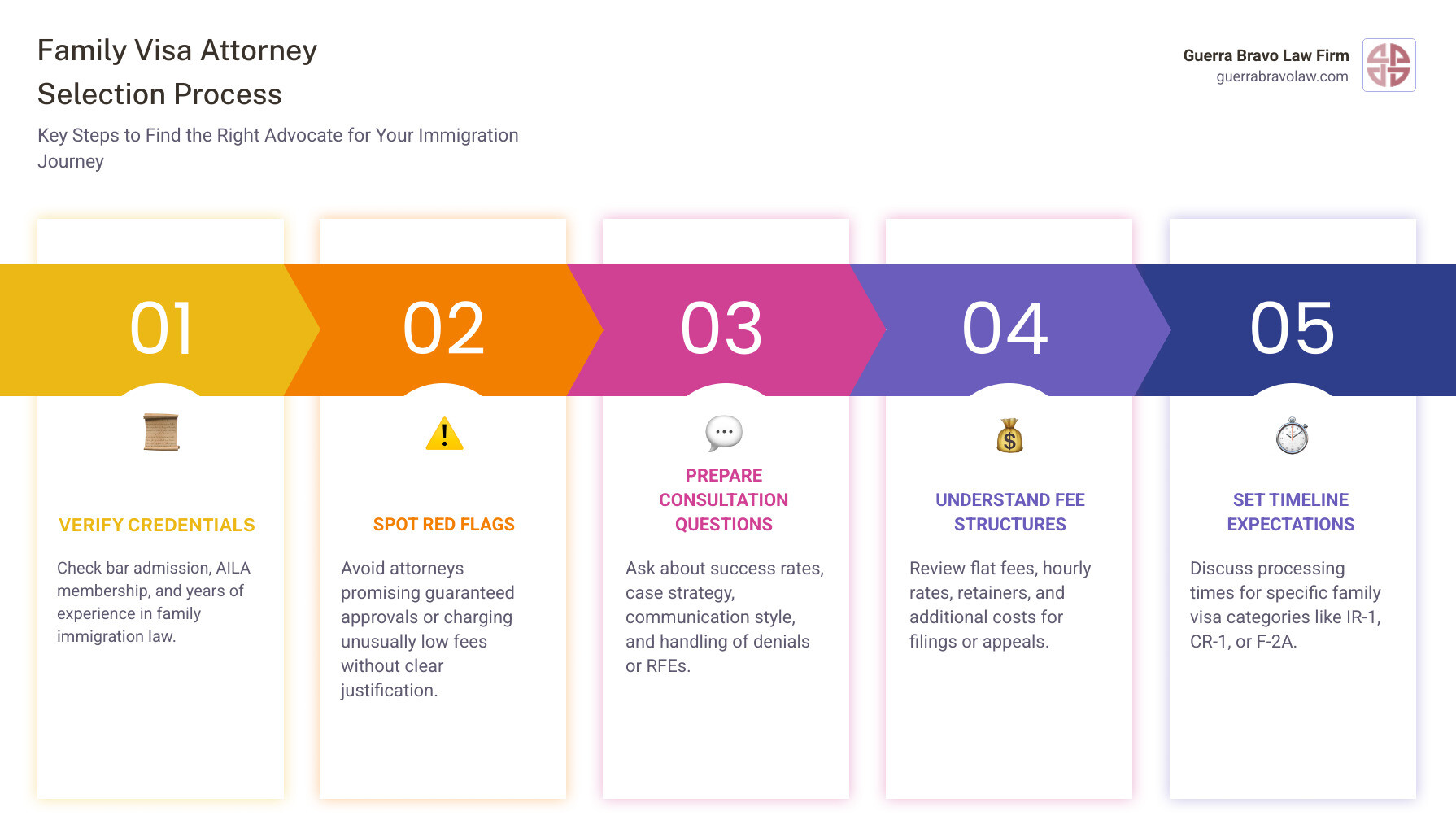
Choosing the right family visas attorney is a critical decision. You need a dedicated advocate with the right expertise to steer the complex immigration system. Here’s what to look for.
Legal Credentials and Specialization
First, ensure any attorney is licensed and in good standing with their state bar. For non-attorneys, verify they have DOJ accreditation. You can check the DOJ’s List of Recognized Organizations and Accredited Representatives.
Look for an attorney with significant experience specifically in family immigration law. A general practitioner who only dabbles in immigration may lack the deep knowledge required. Membership in the American Immigration Lawyers Association (AILA) is a good sign of commitment to the field. Our attorney, Iris Guerra Bravo, has over 14 years of dedicated immigration law experience, including invaluable insider knowledge from her time with ICE and DHS.
Communication, Care, and Costs
A good attorney should explain complex issues clearly, keep you updated, and be responsive. You deserve a personalized approach, not a one-size-fits-all solution. We offer bilingual services to ensure clear communication for all our clients.
Reputable attorneys are transparent about fees. Look for firms that offer flat fees for predictable costs. We believe in transparent and affordable pricing and will discuss all costs upfront.
Local Presence and Reputation
A local attorney understands the nuances of your community and local USCIS offices. Our firm is deeply rooted in the Rio Grande Valley, with locations in McAllen, Brownsville, Edinburg, Harlingen, Mission, Pharr, Weslaco, Mercedes, Alamo, San Juan, Donna, Hidalgo, Palmview, La Joya, and Penitas, Texas. This allows us to serve our border community effectively.
Finally, check client testimonials and reviews to gauge an attorney’s reputation and client satisfaction. If you’re ready to discuss your family’s future, Contact Us or Contáctanos for Spanish speakers. Choosing the right advocate is about finding a skilled partner who is dedicated to reuniting your family.
Conclusion
The journey to reunite your family in the United States is profoundly important, but the legal process can be overwhelming. You don’t have to steer this complex system alone. An experienced family visas attorney is your strategic partner, handling the legal complexities so you can focus on your family’s future.
At Guerra Bravo Law Firm, we believe every family deserves to be together. Our attorney, Iris Guerra Bravo, leverages over 14 years of insider experience with ICE and DHS to create battle-tested, individualized legal strategies. This real-world perspective allows us to anticipate challenges and build the strongest possible case for your family.
Deeply rooted in McAllen and serving the entire Rio Grande Valley, we understand the unique immigration challenges our community faces. With the right legal guidance and a team that genuinely cares, your dream of family reunification can become a reality.
Ready to take the next step? We’d love to hear your story and explore how we can help bring your family together.
To learn more about how we can assist you with your family visa needs, please visit our services page: https://guerrabravolaw.com/services
Your family’s future is waiting. Let’s make it happen together.
[