

Your Guide to Understanding Deportation and Removal
What Deportation and Removal Really Mean for You
Deportation and removal are two terms that often cause confusion, but understanding them is critical if you or a loved one faces immigration proceedings. While both mean the U.S. government is trying to force a noncitizen to leave the country, their legal meanings differ based on timing.
Key Differences:
Deportation refers to proceedings that started before April 1, 1997.
Removal is the current legal term for all proceedings that began after April 1, 1997.
This change happened with the 1996 Illegal Immigration Reform and Immigrant Responsibility Act (IIRIRA), which combined two older systems—deportation (for people inside the U.S.) and exclusion (for people at the border)—into one streamlined removal process.
Today, all cases fall under removal proceedings. The government issues a Notice to Appear (NTA), and an immigration judge decides if you must leave the U.S. The legal framework affects your rights and options, so even if you hear the word "deportation," your case is likely governed by modern removal law unless it began before 1997. Understanding this history empowers you to work effectively with your attorney.
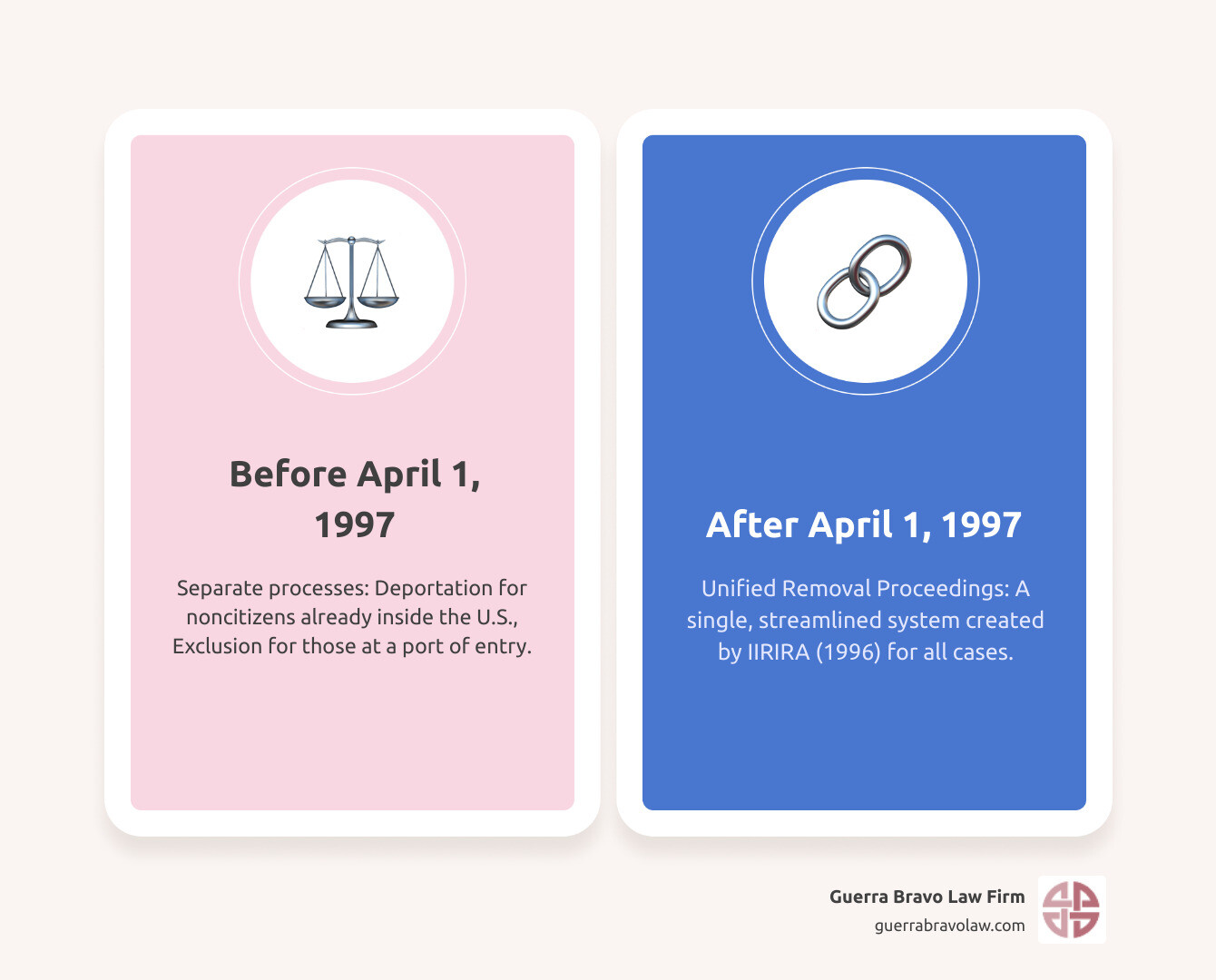
The Shift in Immigration Law: From Deportation/Exclusion to Removal
For decades, the U.S. had two separate systems for forcing a noncitizen to leave: one for those already inside the country and another for those seeking to enter. This changed dramatically with the Illegal Immigration Reform and Immigrant Responsibility Act (IIRIRA) of 1996. Effective April 1, 1997, IIRIRA eliminated the separate deportation and exclusion processes and created a single, unified system: removal proceedings.
This history is important because cases that began before April 1, 1997, are still handled under the old rules. Understanding the old system helps clarify the current one. If you're navigating these complex rules, seeking expert guidance in Removal Defense is crucial.
The Old System: Deportation vs. Exclusion
Before 1997, the process depended on where you encountered immigration enforcement.
Deportation Proceedings: Applied to noncitizens already inside the U.S. The government had to prove the person was deportable, and hearings were generally public.
Exclusion Proceedings: Applied to individuals seeking admission at a port of entry. The noncitizen had to prove they were admissible, and hearings were generally private.
These two systems had different burdens of proof, forms, and relief options, making the legal landscape complex.
The New System: Unified Removal Proceedings
The IIRIRA of 1996 created a single, streamlined system called removal proceedings for all cases initiated after April 1, 1997.
Key Aspects of the Unified System:
Single Process: All cases, whether at the border or within the U.S., are now removal proceedings.
Initiation: Proceedings begin with a Notice to Appear (NTA) issued by the Department of Homeland Security (DHS).
Merged Concepts: The old ideas of "deportability" and "inadmissibility" (formerly "excludability") are now categories within the single "removability" framework.
Appeals: Decisions in both old and new proceedings can generally be appealed to the Board of Immigration Appeals (BIA).
This unification simplified terminology but integrated different standards into one system. Navigating these nuances requires deep expertise in both historical and current frameworks.
The Modern Deportation and Removal Process: From Notice to Hearing
The modern deportation and removal process begins with a formal document and leads to court proceedings driven by the Department of Homeland Security (DHS) and its agencies, like Immigration and Customs Enforcement (ICE).

The journey through immigration court can be intimidating. Understanding each step is crucial for anyone facing this process. Our firm specializes in Understanding Removal Defense in Texas Immigration Courts and offers battle-tested strategies for these complex cases.
How Proceedings Begin: The Notice to Appear (NTA)
Removal proceedings formally start with a Notice to Appear (NTA), a critical legal document that contains:
Immigration Charges: Why the government believes you are removable.
Factual Allegations: The facts supporting the charges (e.g., entry without inspection, visa overstay, criminal conviction).
Court Information: The date, time, and location of your initial hearing.
The NTA can be served by mail or in person. It is vital to keep your address updated with immigration agencies and the immigration court. Failing to do so can lead to a removal order in absentia if you miss a hearing.
What Happens When Detained by Immigration Authorities?
Being detained by ICE is a stressful but common part of the deportation and removal process in the Rio Grande Valley. While detained, you will appear before an Immigration Judge for a series of hearings:
Master Calendar Hearing: The initial hearing to confirm your identity, review the NTA, and identify potential forms of relief.
Individual Merits Hearing: A trial-like hearing where you present your case, evidence, and testimony if you are contesting the charges or applying for relief.
Crucially, if you miss a court date, the judge can order your removal in absentia (without you present). This makes attending all hearings non-negotiable. Even while detained, you have legal options, including seeking ICE Detention Release.
Grounds for Removal: Inadmissibility vs. Deportability
"Inadmissible" and "deportable" are two key concepts that determine the grounds for deportation and removal. While IIRIRA merged them under "removability," the distinctions still matter for legal strategy. Inadmissibility
Who it affects: Primarily applies to those seeking entry or who entered without authorization.
Examples: Entering without a valid visa, overstaying a visa, or in some cases, a Lawful Permanent Resident (LPR) returning after a long trip abroad. Deportability
Who it affects: Applies to those already in the U.S. (even lawfully) who later violate immigration or criminal laws.
Examples: Committing certain crimes after entry, visa fraud, or being a threat to public safety.
The specific charge—inadmissible or deportable—can affect the types of relief available. Even minor offenses can have severe immigration consequences, as we explore in What Crimes Are Eligible for Deportation for an Immigrant?.
Accelerated Removal: Understanding Expedited and Reinstated Orders
Not all deportation and removal cases go through the full immigration court process. The government can use "accelerated removal" processes, largely established by the IIRIRA of 1996, to fast-track removal without a judge's involvement.

These summary procedures are common in the Rio Grande Valley and are designed for efficiency, but they raise due process concerns. They can lead to swift removal with limited recourse, making knowledgeable legal representation vital. You can learn more from resources like a toolkit published by the Immigrant Legal Resource Center.
What is Expedited Removal?
Expedited removal allows immigration officers to remove certain noncitizens without a court hearing. It primarily applies to:
Individuals at a Port of Entry who lack proper documents or are suspected of fraud.
Individuals who Entered Without Inspection (EWI) and cannot prove they have been in the U.S. for at least two years.
This process bypasses the Immigration Court system, making it incredibly swift and difficult to challenge.
Potential Consequences of an Expedited Removal Order
An expedited deportation and removal order has severe consequences due to its summary nature:
Five-Year Reentry Bar: The order typically bars you from reentering the U.S. for at least five years.
No Formal Appeal: Unlike standard removal orders, an expedited order generally cannot be appealed.
Risk of Errors: The fast-tracked process increases the risk of erroneous deportations of individuals who may have a right to be in the U.S.
Inadequate Asylum Protection: Asylum seekers may not have a sufficient opportunity to express a fear of persecution, which can affect their ability to seek relief like a Green Card and Deportation waiver later.
Protections and Reinstatement of Removal
While limited, some protections exist.
Credible Fear: If you express a fear of persecution or torture, you must be referred for a Credible Fear Interview (CFI) with an asylum officer. If you pass, you are placed in standard removal proceedings to apply for asylum.
Reinstatement of Removal
This is another accelerated process for individuals who illegally reenter the U.S. after a prior removal order.
Process: An immigration officer can reinstate the old order without a new court hearing, leading to immediate removal.
Reasonable Fear: If you express a fear of persecution, you are referred for a "reasonable fear" interview. If you pass, you may be eligible for certain forms of protection.
Both processes give the government powerful tools for quick removal with limited judicial oversight. If you are under an order of expedited removal or facing reinstatement, seek legal counsel immediately.
Building a Defense: Key Strategies and Relief from Removal
Facing deportation and removal is an uphill battle, but you have rights and potential avenues for relief. Building a strong defense means understanding legal strategies and proving your eligibility for protection. This is where experienced legal counsel is invaluable, as a lawyer Can a Lawyer Stop Deportation? by exploring every available defense. Our firm offers robust Deportation Defense to help you through this challenging time.
Key Forms of Relief from Removal
Several forms of relief may be available, each with specific requirements.
1. Cancellation of Removal
For Non-Permanent Residents: Requires 10 years of continuous physical presence, good moral character, and showing that removal would cause "exceptional and extremely unusual hardship" to a qualifying U.S. citizen or LPR spouse, parent, or child. This is a very high standard to meet.
For Permanent Residents: Requires being an LPR for at least 5 years, residing in the U.S. for 7 years after admission, and not having been convicted of an aggravated felony.
2. Asylum
Eligibility: For those with a well-founded fear of persecution in their home country based on race, religion, nationality, political opinion, or membership in a particular social group.
3. Withholding of Removal & CAT Protection
Eligibility: For those who can show it is "more likely than not" they would be persecuted (Withholding) or tortured (Convention Against Torture) if returned home.
Benefit: Prevents removal to a specific country but does not grant a path to permanent status. This is often a fallback for those ineligible for asylum.
Voluntary Departure and Other Options
Voluntary Departure
This allows you to leave the U.S. at your own expense by a set date, avoiding a formal order of deportation and removal. This is a significant benefit for future immigration attempts. It is not the same as simply leaving on your own ("self-deportation"). Failure to depart as agreed results in severe penalties. Read how voluntary departure works..
Other Options
Administrative Closure: Pauses a case to allow you to pursue another benefit.
Stays of Removal: Temporarily halts removal while an appeal is pending.
Motions to Reopen/Reconsider: Used to challenge a removal order based on new evidence or legal error. This is one way to try and Cancel Deportation Order.
Practical Steps and Checking Your Case Status
Proactive steps can make a significant difference.
Find Legal Help: The system is complex; seek an experienced attorney. You can find legal services or look for reputable nonprofit legal organizations.
Check Your Case Status: Use the Automated Case Information System with your A-Number to check your court case status. Missing a hearing has severe consequences.
Know Your Rights: You can contact a USCIS office for procedural questions or file a complaint with the Department of Homeland Security if you feel your rights were violated.
Frequently Asked Questions about Deportation and Removal
Here are answers to common questions about deportation and removal.
What is the main difference between a deportation order and a removal order?
The main difference is timing.
A deportation order comes from proceedings that began before April 1, 1997.
A removal order comes from proceedings that began after April 1, 1997.
"Removal" is the modern, correct legal term for forcing a noncitizen to leave the U.S., established by the IIRIRA of 1996. It replaced the older, separate deportation and exclusion processes.
Can a lawful permanent resident (green card holder) be deported?
Yes. A Green Card does not provide absolute immunity from deportation and removal. A Lawful Permanent Resident (LPR) can be placed in removal proceedings for several reasons, including:
Criminal Convictions: This is a common reason, especially for "aggravated felonies," crimes of moral turpitude, or drug offenses.
Immigration Fraud: Obtaining a Green Card through misrepresentation.
Abandonment of Residency: Spending too much time outside the U.S.
National Security Grounds.
The consequences are severe, often leading to a permanent bar from the U.S. Our firm assists LPRs facing Green Card and Deportation challenges.
What happens if I miss my immigration court date?
Missing a court date has immediate and severe consequences. The Immigration Judge can issue an order of removal in absentia (in your absence). This is a final order allowing the government to physically remove you.
An in absentia order also typically results in a ten-year bar from most forms of immigration relief. While it's sometimes possible to reopen such a case, it is very difficult. It is critical to attend all hearings and keep your address updated with the court.
Conclusion
The journey through the U.S. immigration system, particularly when facing deportation and removal, is undeniably complex and fraught with uncertainty. From the historical distinctions between deportation and exclusion to the modern, unified removal proceedings, and the accelerated processes of expedited removal, every step is governed by intricate laws and regulations. Understanding these nuances is not just a matter of legal curiosity; it's essential for protecting your rights and your future.
We at Guerra Bravo Law Firm know this firsthand. Our firm's unique strength lies in attorney Iris Guerra Bravo's 14+ years of insider experience with ICE and DHS. This battle-tested perspective allows us to craft individualized legal strategies custom to the complex cases our clients face every day in McAllen, Brownsville, and throughout the Rio Grande Valley. We believe that informed clients are empowered clients, and that's why we dedicate ourselves to explaining this challenging area of law.
You don't have to face the complexities of deportation and removal alone. Whether you're trying to understand an NTA, exploring options for relief, or navigating the appeals process, having an experienced legal advocate by your side can make all the difference.
If you or a loved one needs guidance on deportation and removal matters, we invite you to Contact us for a consultation on your Removal Defense case. Let us put our insider knowledge and battle-tested strategies to work for you.