

Your Guide to Fighting Back: Stopping Deportation and Removal
When You Need to Stop Removal Proceedings: What You Can Do Right Now
Stop removal proceedings is possible through several legal paths — and knowing your options quickly can make all the difference.
Ways to stop or fight removal proceedings:
Cancellation of Removal - Apply if you've lived in the U.S. for 10+ years (non-permanent residents) or hold LPR status for 5+ years
Asylum - File within 1 year of entry if you fear persecution in your home country
Adjustment of Status - Change your immigration status through a qualifying family or employment petition
Prosecutorial Discretion - Request that the Department of Homeland Security (DHS) close or dismiss your case based on humanitarian factors
Voluntary Departure - Leave on your own terms to avoid a formal removal order and future reentry bars
Appeal to the Board of Immigration Appeals (BIA) - Challenge a judge's removal order within 30 days
Motion to Reopen - Present new evidence or legal arguments within 90 days of a removal order
Facing deportation is one of the most frightening things a person or family can experience. Your entire future — your job, your home, your children's lives — can feel like it's on the line.
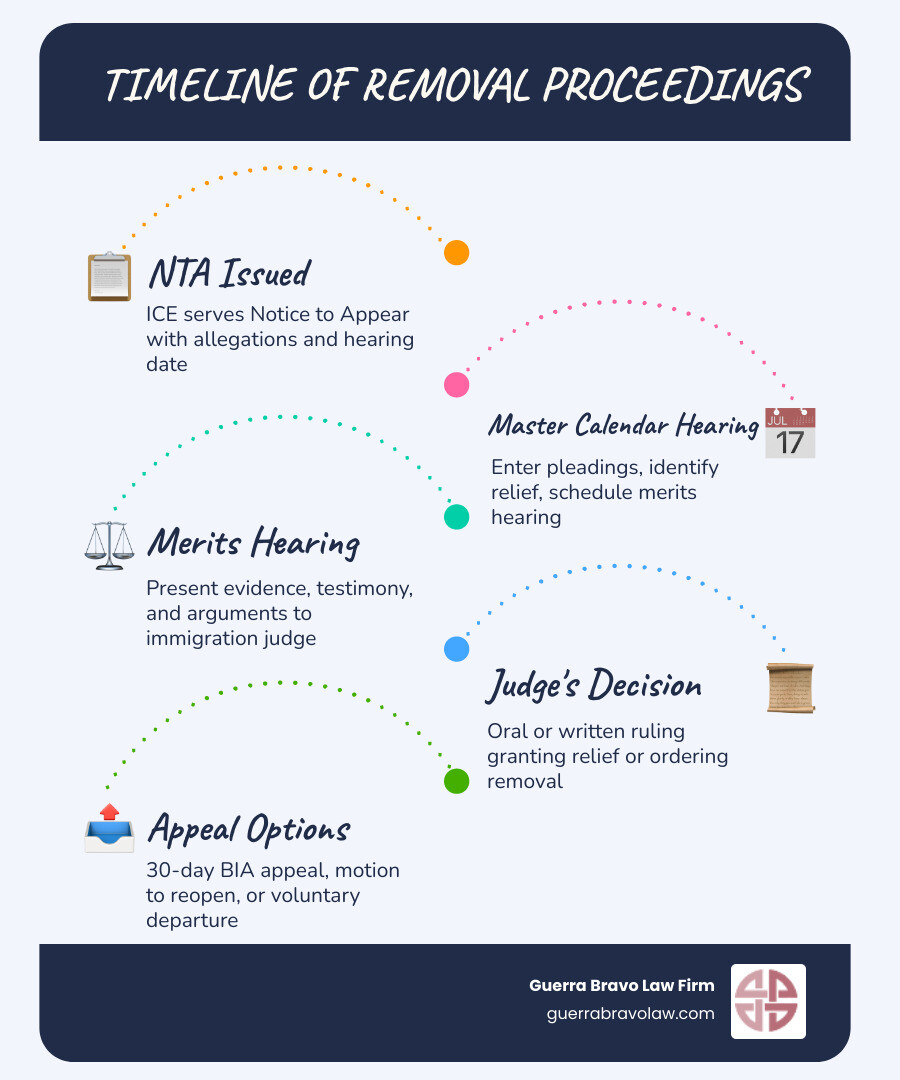
When Immigration and Customs Enforcement (ICE) issues a Notice to Appear (NTA), the clock starts ticking. From that moment, you're in formal removal proceedings before an immigration court. The U.S. government will be working to remove you. You have the right to fight back — but the process is complex, the deadlines are strict, and the stakes couldn't be higher.
The good news: there are real, proven legal strategies to stop removal proceedings. This guide walks you through each one — clearly and honestly — so you understand what options may apply to your situation.
═══
Understanding the Process to Stop Removal Proceedings
To fight a case effectively, we first need to understand how the system works. In the Rio Grande Valley, many of our neighbors find themselves entering this system through local checkpoints or interactions with law enforcement.
Removal proceedings are the legal process the U.S. government uses to decide whether a non-citizen should be deported. These cases are handled by the Executive Office for Immigration Review (EOIR), which is the official name for the immigration court system. Unlike criminal court, you do not have the right to a government-appointed attorney. You must find your own representation to help you stop removal proceedings.
The rules governing these cases are found in the Immigration and Nationality Act, which outlines who is subject to deportation and what defenses are available.
How Removal Proceedings Begin: The Notice to Appear (NTA)
The process officially begins when you receive a Notice to Appear (NTA). This document is issued by Immigration and Customs Enforcement (ICE) or other branches of the Department of Homeland Security (DHS).
What is inside an NTA?
Factual Allegations: These are statements the government believes are true about you (e.g., your country of citizenship, when you entered the U.S.).
Grounds of Removability: This is the specific section of the law the government says you violated (e.g., entering without a visa or overstaying).
Date and Location: It should list the court where your case will be heard.
It is critical to review this document for errors. Sometimes, an NTA is "improvidently issued," meaning it was a mistake. If we can prove the NTA is legally flawed, we may be able to have it canceled before the judge even takes jurisdiction. You can learn more about how USCIS handles these files in Chapter 9 - Applicants in Removal Proceedings.
Navigating the Immigration Court: Master and Merits Hearings
Once the NTA is filed with the court, you will be scheduled for a series of hearings.
1. The Master Calendar Hearing (MCH) Think of this as an "initial check-in." It usually lasts about 15 minutes. During this hearing:
The judge will ask you to "plead" to the charges in the NTA.
You will identify which forms of relief (like asylum or cancellation of removal) you intend to apply for.
The judge will set deadlines for filing your applications.
2. The Individual Merits Hearing This is the "trial." It is much longer and more intense.
Testimony: You and your witnesses will testify under oath.
Evidence: We present documents, photos, and records to support your case.
Cross-Examination: The government attorney (representing DHS) will ask you questions to try to find weaknesses in your story.
The Decision: At the end, the immigration judge will usually issue a decision on whether you can stay in the U.S. or if you must be removed.
═══
Cancellation of Removal: A Powerful Defense Strategy
One of the most common ways we stop removal proceedings is through a benefit called Cancellation of Removal. If granted, the judge stops the deportation and gives you a Green Card (Lawful Permanent Residency).
However, this is a discretionary benefit. This means the judge doesn't have to give it to you just because you meet the basic rules — you have to prove you deserve it.
Requirements for Lawful Permanent Residents (LPRs)
If you already have a Green Card but the government is trying to take it away (usually due to a criminal conviction), you may qualify for LPR Cancellation of Removal if:
You have been a Lawful Permanent Resident for at least 5 years.
You have resided in the U.S. continuously for at least 7 years after being admitted in any status.
You have not been convicted of an aggravated felony.
We focus on "discretionary factors" here. We show the judge your deep community ties in places like McAllen or Edinburg, your steady work history, and evidence of rehabilitation if a crime was committed.
Strict Requirements for Non-Permanent Residents to Stop Removal Proceedings
For those without a Green Card, the bar is much higher. This is often called the "10-year rule." To qualify, you must meet four strict criteria:
Continuous Presence: You must have lived in the U.S. for at least 10 years before the NTA was issued.
Good Moral Character: You must show you have been a person of good character during those 10 years.
Qualifying Relatives: You must have a spouse, parent, or child who is a U.S. Citizen or Lawful Permanent Resident.
Exceptional and Extremely Unusual Hardship: You must prove that your removal would cause "exceptional and extremely unusual hardship" to your qualifying relatives.
The 4,000 Approval Limit It is important to know that the government only allows 4,000 approvals per year for non-permanent residents. Because of this quota, even if a judge wants to grant your case, you might have to wait on a list for several years before your Green Card is actually issued.
Proving "Exceptional and Extremely Unusual Hardship"
This is the hardest part of the case. "Exceptional" means much more than the normal sadness of a family being separated. We must show that the impact on your family would be truly devastating.
Evidence we use to prove hardship includes:
Medical Records: If your child or parent has a chronic illness (like diabetes or asthma) that requires specialized care in the U.S.
Psychological Evaluations: Reports from experts showing the mental health toll removal would take on your children.
Special Education Needs: Documentation (IEPs) showing a child needs U.S. school resources.
Financial Records: Proof that you are the sole provider for your U.S. family.
Country Conditions: Evidence that your home country cannot provide the medical or educational support your family needs.
═══
Alternative Legal Strategies to Stop Removal Proceedings
Cancellation of removal isn't the only way to fight back. Depending on your history and how you entered the country, other strategies might be a better fit.
Using Prosecutorial Discretion to Stop Removal Proceedings
In some cases, the best strategy isn't to "win" a Green Card in court, but to get the government to walk away. This is called Prosecutorial Discretion (PD).
Because the court system is so backed up, DHS has the authority to focus its resources on high-priority cases (like people with serious criminal records). If you are a "low priority" case — perhaps you have been here a long time, have a clean record, and have strong family ties — we can ask the government to:
Dismiss the NTA: Effectively ending the case.
Administratively Close the Case: Putting it "on the shelf" indefinitely.
Terminate Proceedings: Allowing you to pursue a Green Card through USCIS instead of the court.
Asylum, Adjustment of Status, and NACARA Relief
Asylum If you fear returning to your home country because of persecution based on your race, religion, nationality, political opinion, or membership in a "particular social group," you may apply for Asylum. You must generally apply within one year of arriving in the U.S.
Adjustment of Status If you have a qualifying relative (like a U.S. citizen spouse) who has filed a petition for you (Form I-130), we may be able to stop removal proceedings by asking the judge to let you "adjust status" to permanent resident right there in the courtroom.
NACARA The Nicaraguan Adjustment and Central American Relief Act (NACARA) provides special rules for certain nationals from:
Guatemala
El Salvador
Former Soviet Bloc countries
If you entered the U.S. in the early 1990s and meet specific registration deadlines, the requirements for cancellation are much easier to meet.
Special Considerations: T-Visas and S-Nonimmigrants
Sometimes, a person’s history of being victimized provides a path to legal status.
T-Visas: These are for victims of human trafficking. The law recognizes that "coercion" isn't always physical. As noted in United States v. Dann (PDF), threats of deportation can be considered a form of legal coercion used to force someone to work.
S-Nonimmigrants: These are "witness" visas for people who provide critical information to law enforcement about criminal organizations. There is a strict 10-day rule for filing certain applications once a warrant of removal is served in these cases.
═══
What Happens After the Judge’s Decision?
Once the judge makes a ruling, the case isn't necessarily over. Both you and the government have the right to challenge the outcome.
Appealing to the BIA and Motions to Reopen
If the judge orders you removed, you have 30 days to file an appeal with the Board of Immigration Appeals (BIA).
The Stay of Removal: In many cases, filing a timely appeal "stays" (pauses) your deportation while the BIA reviews the case.
Briefing: We file written legal arguments explaining why the judge made a mistake.
Motion to Reopen: If new evidence comes to light after your case is over (like a new medical diagnosis for a child), we can file a motion to reopen to ask the court to look at the case again.
The Reality of Voluntary Departure
If it looks like you cannot win your case, we might negotiate for Voluntary Departure. This means you agree to leave the U.S. on your own and pay for your own travel.
Why choose this?
No Reentry Bar: A formal removal order usually bars you from returning for 10 years (or more). Voluntary departure avoids this specific penalty.
Clean Record: It looks better on your immigration record for future visa applications.
Comparison: Voluntary Departure vs. Removal Order
Voluntary Departure
Cost: You pay for your own flight.
Future Reentry: No automatic 10-year bar for "removal."
Rights: You must waive your right to appeal.
Consequences: If you don't leave by the deadline, it turns into a removal order and a heavy fine.
Formal Removal Order
Cost: The government pays for transportation.
Future Reentry: Mandatory 5, 10, or 20-year bar from the U.S.
Rights: You can appeal the decision.
Consequences: It is a permanent mark on your record that makes returning very difficult.
═══
Frequently Asked Questions about Stopping Removal
What is the 10-year rule for cancellation of removal?
It requires you to prove you have been physically present in the U.S. for a continuous 10-year period. However, the "stop-time rule" says that the clock stops the moment you are served with an NTA. Also, a single absence of more than 90 days, or multiple absences totaling 180 days, can break your "continuous" presence.
Can I stop removal if I have a criminal record?
It depends on the crime. Certain "Aggravated Felonies" are automatic bars to relief. However, many other crimes (like some DUIs or petty thefts) can be overcome with evidence of rehabilitation and "good moral character." We often look for a "petty offense exception" or specific waivers to help stop removal proceedings.
How does the 4,000-person annual limit affect my case?
Because the limit is so low, many people stay in a "pending" status for years. You may be eligible for a work permit while you wait for a "slot" to open up in a future fiscal year.
═══
Conclusion: Why Experience Matters
Stopping a deportation is a battle. You are up against government attorneys who do this every single day. To win, you need a strategy that is built on more than just hope — it needs to be built on a deep understanding of how the other side thinks.
At Guerra Bravo Law Firm, we provide comprehensive immigration services across the Rio Grande Valley, including McAllen, Brownsville, Edinburg, and beyond. Our unique advantage is attorney Iris Guerra Bravo’s 14+ years of insider experience working within ICE and the DHS. She knows the tactics the government uses because she has seen them from the inside.
We don't believe in "one-size-fits-all" legal help. Whether we are fighting for Cancellation of Removal, seeking Prosecutorial Discretion, or filing a complex appeal, we provide battle-tested, individualized strategies for every family we represent.
If you or a loved one are facing the threat of deportation, don't wait until your next hearing. Your future in the U.S. is too important to leave to chance.
More info about removal defense services
Contact us today at our McAllen office to start building your defense.