

To Lawyer or Not to Lawyer: Your Guide to Renouncing US Citizenship
Why Understanding Your Legal Options Matters Before Renouncing
Do I need a lawyer to renounce US citizenship? The short answer is no—the law does not require you to hire an attorney to complete the renunciation process. Most people successfully renounce their US citizenship without legal representation by working directly with a US consular officer abroad. However, whether you should hire a lawyer depends entirely on your personal circumstances, particularly your tax situation and financial complexity.
Quick Answer:
Legally required? No. You can renounce on your own.
Recommended if: You have significant assets, complex tax obligations, or might be a "covered expatriate."
Simple cases: Most people handle it themselves with embassy guidance.
Cost consideration: Government fee is $2,350; lawyers charge additional fees for consultation and preparation.
Renouncing US citizenship is one of the most serious and irrevocable decisions you can make. Under Section 349(a)(5) of the Immigration and Nationality Act, you must appear in person before a US diplomatic or consular officer in a foreign country and take a formal oath of renunciation. Once the Department of State approves your Certificate of Loss of Nationality, there is no turning back.
The consular officer's role is to ensure you understand the consequences and are acting voluntarily—not to provide legal or tax advice. This is where many people face a critical gap. While the renunciation process itself is straightforward, the tax implications can be extraordinarily complex. If you have a net worth exceeding $2 million, average annual tax liability above $190,000 over the past five years, or fail to certify five years of tax compliance, you may be classified as a covered expatriate subject to an exit tax.
The difference between a smooth transition and a costly mistake often comes down to understanding what you don't know. You might not need a lawyer to sign the oath, but you may desperately need one to avoid inadvertently triggering tens or hundreds of thousands of dollars in unexpected tax liability—or worse, being barred from ever returning to the United States under the Reed Amendment.
═══
Do I Need a Lawyer to Renounce US Citizenship?
The question of whether you do I need a lawyer to renounce US citizenship is a common one, and distinguish between what is legally required and what is strategically advisable. Legally speaking, the U.S. government does not mandate legal representation for the renunciation process. The core requirements involve appearing in person before a U.S. diplomatic or consular officer in a foreign country, demonstrating your voluntary intent to relinquish citizenship, and signing an oath of renunciation. The consular officer's role is to ensure you understand the gravity and irrevocability of this act, but they are not there to provide legal or tax advice custom to your personal situation.
Most cases, especially those with straightforward financial and tax histories, can proceed smoothly without an attorney. The U.S. Department of State provides comprehensive guidance on the legal requirements for renunciation, detailing the forms and steps involved. However, the simplicity of the process doesn't always reflect the complexity of the consequences. This is where legal counsel becomes invaluable.
When do i need a lawyer to renounce us citizenship for tax reasons?
This is perhaps the most critical area where legal assistance moves from "optional" to "highly recommended." Renouncing U.S. citizenship has significant and often complex tax implications. While the goal for many is to sever ties with the U.S. tax system, it's not always a clean break.
Covered Expatriate Status: A major concern is whether you will be classified as a "covered expatriate." This designation can trigger the "exit tax," which treats you as having sold all your worldwide property on the day before your renunciation, potentially leading to substantial tax liabilities. You may be deemed a covered expatriate if any of the following apply:
Your average annual net income tax liability for the five tax years ending before the date of renunciation is greater than $190,000 (adjusted for inflation).
Your net worth is $2 million or more on the date of renunciation.
You fail to certify under penalty of perjury that you have complied with all U.S. federal tax obligations for the five tax years preceding the date of renunciation.
IRS Compliance and Form 8854: Even if you don't meet the financial thresholds for a covered expatriate, you are still required to certify five years of tax compliance. This means ensuring all your U.S. federal tax obligations, including filing all necessary forms like Form 8854, Initial and Annual Expatriation Information Statement, are up-to-date and accurate. Failure to do so can result in significant penalties or even render your renunciation ineffective for tax purposes. A lawyer specializing in expatriation tax can help you steer these complex rules and ensure you meet all requirements. We emphasize that you must have zero past tax liabilities to avoid the renunciation process being considered tax evasion.
FDAP Income: It's also crucial to understand that even after renunciation, certain types of U.S.-sourced income, known as Fixed, Determinable, Annual, or Periodical (FDAP) income, may still be subject to a 30 percent withholding tax rate. This includes things like interest, dividends, and royalties from U.S. sources. An attorney can help you understand these ongoing obligations and plan accordingly. For detailed information, refer to the Expatriation Tax Guidance provided by the IRS.
Do i need a lawyer to renounce us citizenship if I have complex assets?
If your financial life involves more than a simple savings account, then the answer to "Do I need a lawyer to renounce US citizenship?" leans heavily towards "yes." Complex assets introduce layers of difficulty that can have unforeseen consequences if not managed correctly before and after renunciation.
Financial Review and Estate Planning: If you possess a diverse portfolio of assets, such as real estate, investments, trusts, or business interests, both within the U.S. and abroad, a thorough financial review by a legal professional is indispensable. Renouncing citizenship can drastically alter the tax treatment of these assets, both for you and your heirs. For example, U.S. estate tax rules can be particularly intricate for former citizens. An attorney can help you understand how renunciation impacts your long-term estate planning goals, ensuring your assets are protected and transferred according to your wishes without triggering unexpected tax burdens.
Dual Nationality and Business Ownership: Individuals with dual nationality, especially those with business ownership or significant investments in multiple countries, face unique challenges. The interplay between U.S. tax law and the laws of your other country of citizenship can be a minefield. A lawyer can advise on how renunciation might affect your business operations, international contracts, and any cross-border financial transactions. They can also help you understand how your dual nationality status might be perceived by both governments and guide you through the process to ensure compliance and minimize adverse impacts.
Cross-Border Planning: Our firm understands the intricacies of cross-border planning. While we serve clients in the Rio Grande Valley, including McAllen, Edinburg, and Brownsville, the principles of managing complex assets during expatriation apply universally. Our seasoned legal team can provide the individualized legal strategies needed to steer these waters, drawing on experience in immigration and financial matters.
═══
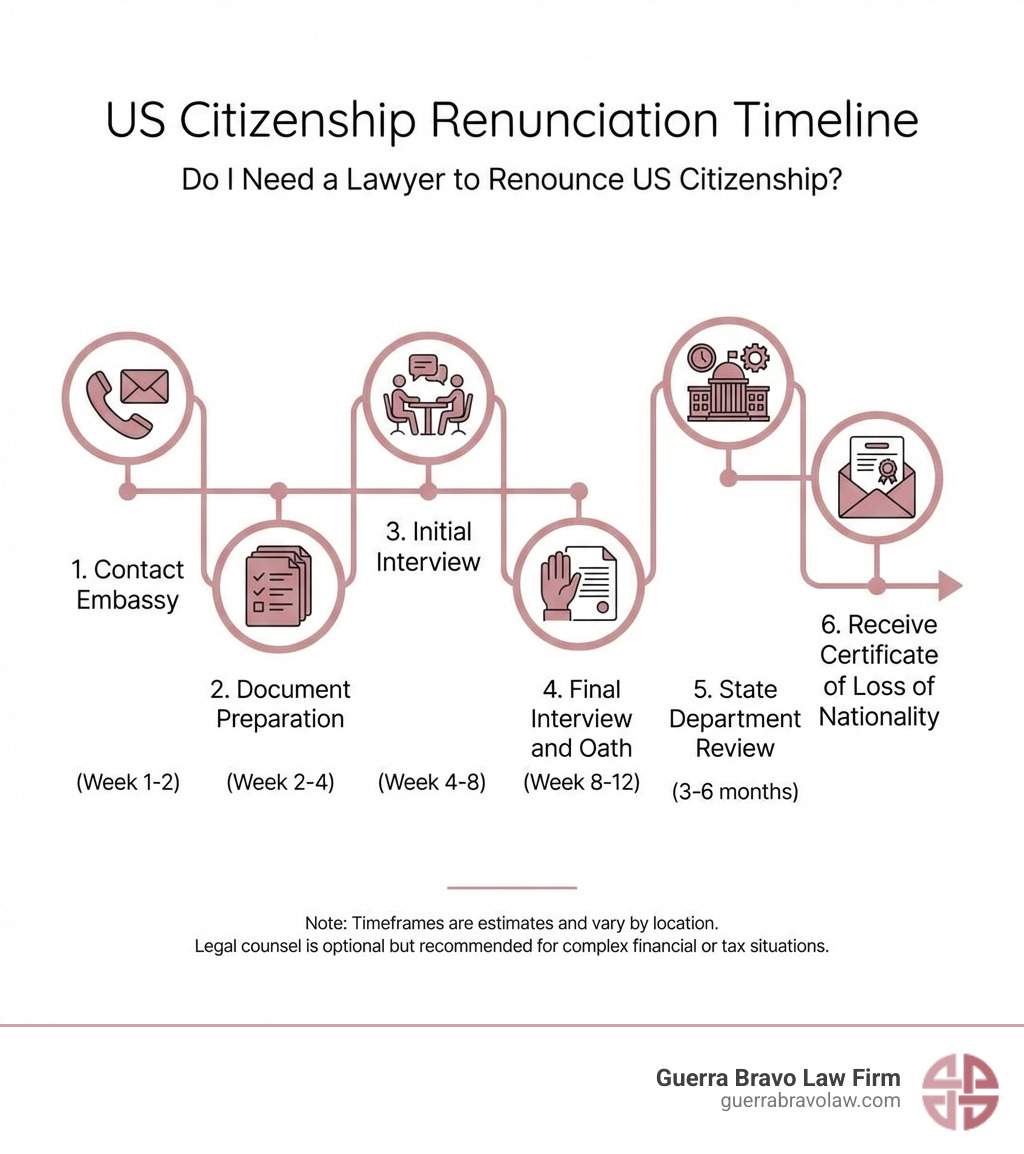
The Step-by-Step Process of Renouncing Abroad
Renouncing U.S. citizenship is a formal, in-person process that must occur at a U.S. embassy or consulate in a foreign country. It's a structured procedure designed to ensure you fully understand the implications of your decision.

• Step 1: Initial Inquiry
Your first move is to contact the nearest U.S. embassy or consulate in the country where you reside. Many embassies have specific email addresses or online portals for renunciation inquiries. You'll typically receive an information packet that outlines the process, required forms, and consequences. This is your chance to ask initial questions and understand the scope of the undertaking. Their role is to facilitate the process, not provide legal advice.
• Step 2: Document Preparation
Before your appointments, you'll need to gather a series of documents to prove your identity and U.S. citizenship. This usually includes your current U.S. passport, your U.S. birth certificate or Report of Birth Abroad, and/or Certificate of Naturalization. If you've had any name changes, you'll need supporting documents like marriage or divorce certificates. Crucially, you'll also need to provide evidence of your foreign nationality, such as a foreign passport or certificate of citizenship. This is vital because the U.S. government generally aims to avoid rendering individuals stateless. You will also need to complete forms such as DS-4080 (Oath/Affirmation of Renunciation of Nationality) and DS-4081 (Statement of Understanding Concerning the Consequences and Ramifications of Relinquishment or Renunciation of U.S. Citizenship), and potentially DS-4079 (Questionnaire – Loss of United States Nationality, Attestations).
• Step 3: The Interviews
The renunciation process typically involves two interviews with a U.S. diplomatic or consular officer. The first might be a telephone or initial in-person orientation to discuss your intent and ensure you understand the seriousness of the act. The second, and most critical, is a formal in-person interview. During this meeting, the consular officer will review your documents, confirm your identity, and assess your intent and voluntariness. They will ensure you are not acting under duress or undue influence and fully comprehend the irrevocable nature of renouncing your citizenship.
• Step 4: The Oath and Fee
If the consular officer is satisfied that your intent is clear and voluntary, you will then sign the Oath of Renunciation (DS-4080). This is the moment where you formally declare your intent to relinquish all rights and privileges of U.S. nationality. At this stage, you will also be required to pay the non-refundable administrative fee of $2,350 USD. This fee covers the processing of your request for a Certificate of Loss of Nationality (CLN) and is subject to change. It's important to be prepared for this payment, as renunciation cannot proceed without it.
• Step 5: Final Adjudication
After your in-person interview and the taking of the oath, your case file, including all submitted documents and the consular officer's report, is sent to the Department of State in Washington, D.C., for review and final approval. This administrative processing can take several months, often ranging from 3 to 6 months or even longer. Once approved, the Department of State will issue your Certificate of Loss of Nationality (CLN). This document is the official confirmation that you are no longer a U.S. citizen. Until you receive your CLN, you are still considered a U.S. citizen and retain all associated rights and obligations.
═══
Risks and Consequences of Relinquishing Nationality
Renouncing U.S. citizenship is not a decision to be taken lightly. It is a profound and irrevocable act with far-reaching consequences that extend beyond simply giving up your passport. Understanding these risks is paramount before proceeding.
• Loss of Rights and Benefits
Upon renunciation, you will immediately lose all rights and benefits associated with U.S. citizenship. This means you will no longer be eligible for U.S. government protection abroad, such as consular assistance in emergencies. You will also lose the fundamental right to vote in U.S. elections, serve on a jury, or hold public office in the United States. Crucially, your automatic right to work or reside in the U.S. without a visa is terminated. This means that for any future visits, you will need to apply for a visa, just like any other foreign national, and there's no guarantee it will be granted.
• Travel and Re-entry Barriers
One of the most significant practical consequences is the impact on your ability to travel to the United States. As a former U.S. citizen, you will no longer be able to enter the country freely. You will need to apply for a visa or be eligible under programs like the Visa Waiver Program (if your new nationality qualifies). However, there's a serious hurdle known as the "Reed Amendment" (INA Section 212(a)(10)(E)). This provision states that if the U.S. government determines that your principal purpose for renouncing citizenship was to avoid U.S. taxes, you could be deemed inadmissible and permanently barred from entering the United States. This is a critical reason why understanding the tax implications and having proper legal advice is so important.
• Financial and Legal Obligations
Renouncing U.S. citizenship does not absolve you of past legal or financial responsibilities. You cannot escape prosecution for any crimes committed prior to or after renunciation. Similarly, any financial debts owed to the U.S. government or private entities in the U.S. remain your obligation. Furthermore, your U.S. tax obligations, particularly for the period leading up to renunciation and any potential exit tax, will remain unchanged. If you had U.S. military service obligations (e.g., Selective Service registration), these may also persist. It's a common misconception that renunciation is a clean slate; in reality, it's a forward-looking act, not a retroactive one.
═══
Alternatives to Renouncing US Citizenship
For many individuals contemplating renunciation, the primary drivers are often complex tax obligations, the desire to simplify their legal status, or a feeling of disconnect from the U.S. While renunciation is a definitive solution, it's not the only path. Our firm believes in exploring all viable alternatives to ensure you make the most informed decision for your unique circumstances.
• Maintaining Dual Nationality
The U.S. generally permits dual nationality, meaning you can hold both U.S. citizenship and citizenship of another country. For many, this offers the best of both worlds: retaining the rights and protections of U.S. citizenship while enjoying the benefits of another nationality. This allows you to access two sets of consular services, benefit from different labor markets, and maintain ties to both nations. While this doesn't eliminate U.S. tax filing obligations (as U.S. citizens are taxed on worldwide income regardless of residence), it avoids the irrevocable step of renunciation.
• Cross-Border Tax Planning
Often, the perceived burden of U.S. citizenship stems from its complex tax system for citizens living abroad. However, there are numerous strategies available to mitigate these tax liabilities without renouncing:
Foreign Earned Income Exclusion (FEIE): This allows qualifying U.S. citizens living abroad to exclude a certain amount of their foreign earned income from U.S. taxation.
Foreign Tax Credits: You can often claim credits for income taxes paid to a foreign government, which can offset your U.S. tax liability dollar-for-dollar.
Tax Treaty Benefits: The U.S. has tax treaties with many countries that can help prevent double taxation.
A qualified tax professional or legal expert can help you understand and use these provisions, along with other cross-border tax planning strategies, to significantly reduce or even eliminate your U.S. tax burden. This approach allows you to address your tax concerns without severing your citizenship ties.
• Relinquishment vs. Renunciation
While often used interchangeably, there's a subtle but important distinction between "renunciation" and "relinquishment" of U.S. citizenship, primarily concerning the effective date of loss.
Renunciation: This is the formal, voluntary act of taking an oath before a consular officer, explicitly stating your intent to give up U.S. citizenship. The loss of nationality is effective on the date the oath is taken.
Relinquishment: This occurs when a U.S. citizen performs a "potentially expatriating act" with the intent to lose U.S. citizenship. Examples of such acts under INA Section 349(a)(1)-(4) include:
Obtaining naturalization in a foreign state after age 18.
Taking an oath of allegiance to a foreign state after age 18.
Serving in the armed forces of a foreign state engaged in hostilities against the U.S.
Accepting employment with a foreign government requiring an oath of allegiance.
In cases of relinquishment, the loss of nationality is often retroactively effective to the date the expatriating act was performed, provided there was clear intent to relinquish citizenship at that time. This can have different tax and legal implications than formal renunciation. Understanding which path, if any, is right for you requires careful consideration and expert advice.
═══
Frequently Asked Questions about Renunciation
Navigating the complexities of renouncing U.S. citizenship can raise many questions. Here, we address some of the most common inquiries to help clarify the process and its implications.
Can I renounce my citizenship while staying in the United States?
Generally, no. The Immigration and Nationality Act (INA) Section 349(a)(5) specifically states that formal renunciation must occur "before a diplomatic or consular officer of the United States in a foreign state." This means you must be physically outside the United States to take the oath of renunciation.
While INA Section 349(a)(6) does mention renunciation "while in the United States," this provision is administered by the Department of Homeland Security (DHS) and is extremely rare and typically reserved for exceptional circumstances, often in a judicial or administrative context, rather than a straightforward administrative process for individuals seeking to voluntarily renounce. For practical purposes, and for nearly all individuals seeking to voluntarily renounce their citizenship, the process must be completed abroad at a U.S. embassy or consulate. Attempting to renounce by mail or through an agent while in the U.S. is not legally effective.
What is the total cost of renouncing US citizenship?
The primary, non-refundable government fee for processing a Certificate of Loss of Nationality (CLN) is $2,350 USD. This fee is paid directly to the U.S. embassy or consulate at the time of your final renunciation interview.
However, this is only the government's administrative fee. The total cost can be significantly higher if you opt for professional assistance. These additional costs may include:
Legal Fees: If you hire an attorney to advise you on the process, ensure tax compliance, or steer complex financial situations, their fees will be separate from the government fee. These can range widely depending on the complexity of your case and the attorney's hourly rate or flat fee structure.
Tax Professional Costs: Engaging a tax accountant or an attorney specializing in expatriation tax is often crucial, especially if you have significant assets, high income, or a history of non-compliance. Their services ensure you meet all IRS requirements, understand exit tax implications, and file all necessary forms (like Form 8854) correctly.
Travel Expenses: Since the process must occur in a foreign country, you'll incur costs for travel to and from the U.S. embassy or consulate.
It's vital to factor in all these potential expenses when considering renunciation, as the $2,350 government fee is just one piece of the financial puzzle.
Can I get my US citizenship back after renouncing?
Renouncing U.S. citizenship is a serious and irrevocable act. Once your Certificate of Loss of Nationality (CLN) is approved by the Department of State, your U.S. citizenship is permanently severed, and it cannot simply be "reinstated" or undone. The U.S. government views this action as final.
There is one very narrow exception, outlined in Section 351 of the INA, which applies specifically to minors:
If an individual renounces U.S. citizenship before the age of eighteen, they have a limited window to potentially reclaim it. They must alert the Department of State of their desire to have their citizenship reinstated within six months after attaining the age of eighteen. This provision is designed to protect minors who may not fully comprehend the gravity of their actions.
For adults who renounce, however, there is generally no pathway to regain U.S. citizenship short of going through the standard naturalization process, which is a lengthy and complex procedure typically reserved for foreign nationals who have established permanent residency in the U.S. and meet strict eligibility criteria. This underscores the importance of thoughtful consideration and, if necessary, legal counsel before taking such an irreversible step.
═══
Conclusion
The decision to renounce U.S. citizenship is monumental, affecting every aspect of your life—from your tax obligations and financial planning to your travel freedom and fundamental rights. While the U.S. government states that you do not need a lawyer to renounce US citizenship in a purely procedural sense, the complexities, particularly surrounding tax implications, asset management, and potential inadmissibility to the U.S., often make legal counsel not just advisable, but essential.
At Guerra Bravo Law Firm, we understand the weight of such a decision. Our firm, serving the Rio Grande Valley—including McAllen, Brownsville, Edinburg, and surrounding areas—is dedicated to providing clear, comprehensive guidance for complex immigration matters. Attorney Iris Guerra Bravo brings over 14 years of invaluable insider experience with ICE and DHS, offering battle-tested, individualized legal strategies that can make all the difference.
Whether you're exploring alternatives, seeking to understand the intricate tax landscape, or preparing for the renunciation process itself, our team is here to help you steer these challenging waters. We believe in empowering you with knowledge and a robust legal strategy to ensure your decisions are well-informed and your future is secure. Don't leave such a critical life decision to chance.
For more information and to discuss your unique situation, we invite you to explore More info about US citizenship claims or contact us for a consultation.