

May 14, 2026
The Compliance Compass: Navigating Immigration Law and Policy
The Compliance Compass: Navigating Immigration Law and Policy
Why Immigration Law Compliance Is Your Business’s First Line of Defense
Immigration law compliance is a high-stakes issue for any business hiring foreign workers. A single mistake can lead to thousands of dollars in fines and lengthy legal battles. With government agencies increasing audits and investigations, employers face a complex web of regulations that demand constant attention.
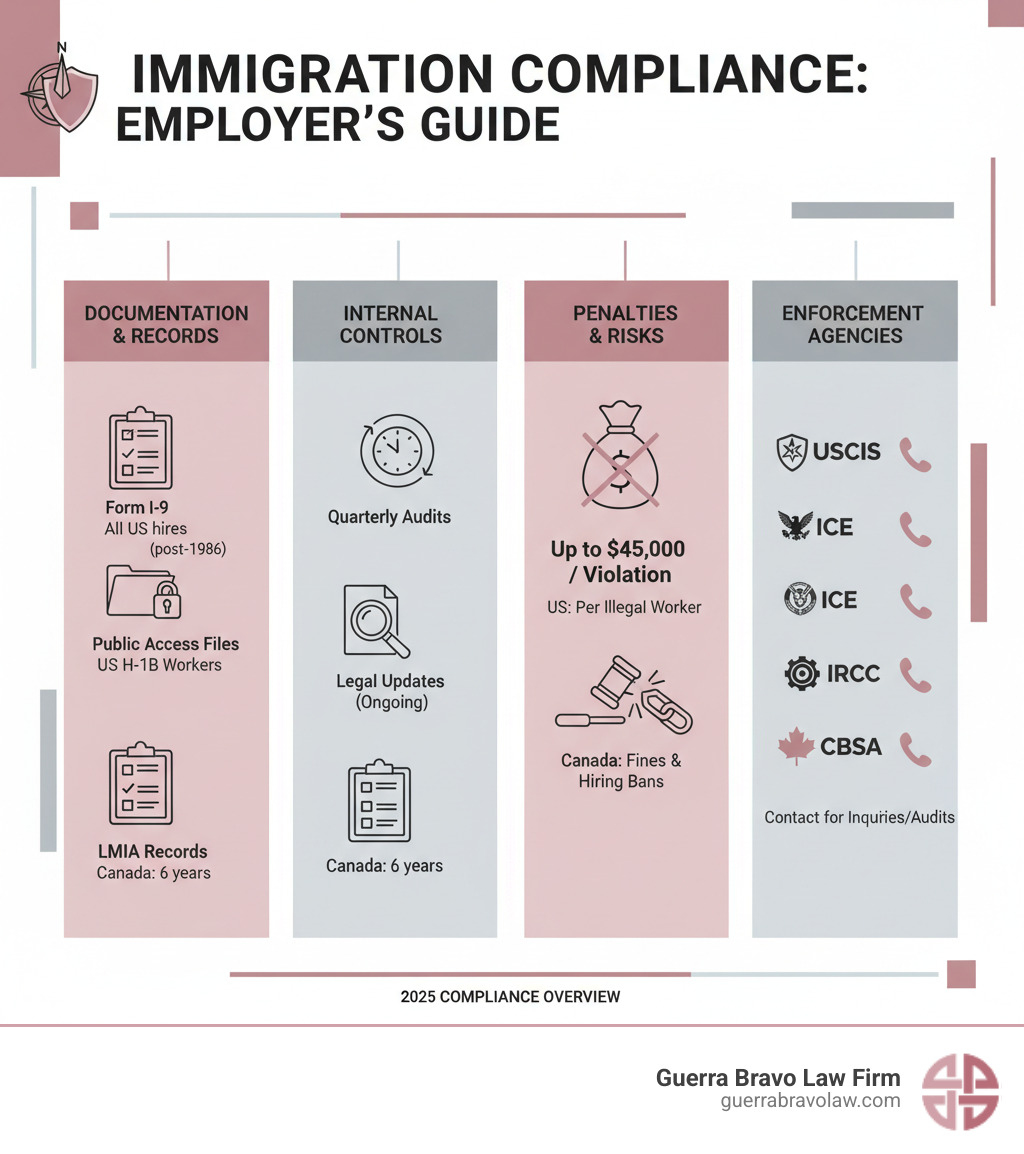
Quick Compliance Checklist:
-
Form I-9 - Complete for every employee hired after 1986.
-
Public Access Files - Maintain for all H-1B workers.
-
LMIA Documentation - Keep Canadian job offer records for 6 years.
-
Internal Audits - Review compliance quarterly.
-
Legal Updates - Stay current with changing regulations.
The penalties are severe. U.S. employers can face fines up to $45,000 per illegal worker, while Canadian businesses risk monetary penalties and bans from hiring foreign workers. Enforcement is accelerating, with the Department of Homeland Security and Department of Labor ramping up I-9 audits and unannounced site visits.
“While immigration rules are constantly changing, the requirement that employers of foreign workers comply with immigration laws remains constant.”
A single compliance failure can shut down your ability to hire international talent. However, proactive compliance is more than just avoiding penalties. It’s a competitive advantage that allows you to hire top global talent while others are tied up in enforcement actions.
Foundations of Employer Compliance: A Tale of Two Countries
Building a global workforce means navigating the different immigration law compliance frameworks of each country. While the U.S. and Canada both require employers to verify work authorization, their enforcement agencies, documentation, and penalties are vastly different.
Key U.S. Compliance Agencies and Their Roles
Multiple agencies create a complex web of requirements for U.S. employers.
-
U.S. Citizenship and Immigration Services (USCIS): Its Fraud Detection and National Security (FDNS) teams conduct surprise site visits to verify information on H-1B, L-1, and other visa petitions. They check for fraud and ensure sponsored employees are performing the jobs described.
-
U.S. Immigration and Customs Enforcement (ICE): As the enforcement arm for Form I-9 compliance, ICE conducts audits, issues heavy fines, and can pursue criminal charges for knowingly hiring unauthorized workers. Our team’s insider knowledge of ICE operations is critical for preparing for worksite enforcement.
-
The Department of Labor (DOL): The DOL audits wage practices for H-1B employers through Labor Condition Applications (LCAs) and oversees the PERM labor certification process for green cards. Violations can lead to debarment from visa programs.
-
The Department of Homeland Security (DHS): This umbrella organization coordinates enforcement efforts, leading to increased I-9 audits and FDNS site visits, signaling that employer compliance is a national security priority.
Key Canadian Compliance Agencies and Their Roles
Canada’s approach is more streamlined but equally strict, with agencies working in concert.
-
Immigration, Refugees and Citizenship Canada (IRCC): IRCC sets the rules for the Temporary Foreign Worker Program (TFWP) and International Mobility Program (IMP). Its inspectors conduct compliance reviews to verify wages, working conditions, and job duties match the original offer.
-
The Canada Border Services Agency (CBSA): The CBSA handles enforcement, including arresting and removing foreign nationals working without authorization. Understanding CBSA’s operations is vital for employers, especially when workers enter Canada or compliance issues arise.
-
Employment and Social Development Canada (ESDC): ESDC processes Labour Market Impact Assessments (LMIAs), which are the foundation of hiring authority under the TFWP. IRCC inspections often verify that employers have met the commitments made to ESDC.
Core Documentation: Your Compliance Armor
Think of your immigration law compliance documentation as armor. Meticulous record-keeping is your lifeline when investigators arrive. After 14+ years of insider experience with ICE and DHS, I know that battle-ready paperwork is the key to surviving an audit.
U.S. Documentation Requirements
Form I-9: Employment Eligibility Verification The Immigration Reform and Control Act (IRCA) requires employers to complete a Form I-9 for every employee hired after November 6, 1986.
-
Completion: Section 1 is due on the employee’s first day; Section 2 must be completed by the employer within three business days.
-
Retention: You must keep the form for three years after the hire date or one year after termination, whichever is later.
-
Audits: Regular internal I-9 audits are crucial for finding and fixing errors before ICE does.
H-1B Public Access Files (PAFs) For each H-1B worker, the Department of Labor requires a Public Access File (PAF) that must be available for inspection within one business day. Key contents include:
-
The certified Labor Condition Application (LCA).
-
Documentation of the wage rate paid to the H-1B worker.
-
Proof of the prevailing wage determination.
-
A summary of the company’s benefits plan.
PERM Audit Files The PERM labor certification process, a step toward a green card, requires extensive recruitment documentation to prove no qualified U.S. workers were available. You must keep all ads, résumés, interview notes, and rejection reasons. The employer must pay all PERM-related costs. For detailed guidance, see our employment petitions services.
Canadian Documentation Requirements
Offer of Employment & LMIA Records Whether hiring through the TFWP (which usually requires a Labour Market Impact Assessment) or the IMP, you must prove the truthfulness of your job offer. This includes maintaining records of job duties, wages, and working conditions. For TFWP positions, you must also keep proof of your recruitment efforts to hire Canadians first.
Record-Keeping Obligations Canada’s strict six-year retention rule requires you to keep all compliance-related documents for six years from the foreign worker’s first day. These records are your proof of compliance during an IRCC inspection. The official regulation on document retention is clear. Being able to produce these documents quickly is critical to passing an inspection.
Navigating the Maze of Immigration Law Compliance
The path to perfect immigration law compliance is full of traps. My 14+ years of insider experience with ICE and DHS have shown me that most violations are not intentional but stem from misunderstandings of the complex and ever-changing rules.
Common Reasons for a Non-Compliant Finding
Most compliance failures result from common administrative errors:
-
Misrepresenting Job Offers: The worker’s actual duties drift from what was stated in the original visa petition or LMIA.
-
Wage Violations: Failing to pay the required prevailing wage for H-1B workers or not adhering to wage promises in Canada.
-
Not Cooperating with Inspectors: Rescheduling meetings, providing incomplete documents, or failing to respond promptly can lead to an automatic non-compliance finding, as noted in Canadian regulations for failing to attend an inspection.
-
Inadequate Record-Keeping: Missing I-9s, incomplete Public Access Files, or failing to keep Canadian records for the required six years can destroy your defense.
-
Worker Rights Violations: This includes charging prohibited recruitment fees or failing to provide a workplace free from abuse.
The High Cost of Non-Compliance
The consequences of a compliance failure are severe and multi-faceted.

Financial Penalties Fines can be staggering. I-9 paperwork errors can cost thousands per form, while knowingly hiring unauthorized workers can lead to fines of up to $45,000 per worker. In the most serious cases, criminal liability can result in imprisonment for company executives.
Operational Consequences The biggest operational risk is debarment, or losing your ability to sponsor foreign workers through programs like H-1B or the TFWP. This can last for years, crippling businesses that rely on global talent. Investigations also cause significant business disruption, consuming management time and resources.
Reputational Damage The damage to your brand can be permanent. Canada maintains public lists of non-compliant employers, and U.S. enforcement actions often receive negative press coverage. This makes it difficult to attract new talent, customers, and investors, as compliance failures are often seen as a red flag about company ethics.
Proactive Strategies: Building a “Battle-Tested” Compliance Program
The best defense is a good offense, and that’s especially true when it comes to immigration law compliance. Rather than waiting for a government inspector to knock on your door, smart employers build robust compliance programs that turn potential vulnerabilities into competitive advantages. With our 14+ years of insider experience at ICE and DHS, we’ve seen what works—and what doesn’t—when businesses face enforcement scrutiny.
The Importance of Internal Audits for immigration law compliance
Internal audits are your dress rehearsal for a government inspection, allowing you to find and fix problems on your own terms.
-
Self-auditing I-9s: We recommend quarterly reviews of all Forms I-9 to catch common errors like missing signatures or incorrect dates.
-
Reviewing Public Access Files: For H-1B employers, ensure your PAFs are complete, accurate, and ready for inspection at a moment’s notice.
-
Simulating a Government Audit: A mock audit can reveal gaps in your processes. Can you locate all required documents quickly? Are your records organized?
-
Correcting Errors Proactively: Finding and documenting corrections shows good faith and responsible business practices that enforcement agencies value. A strong understanding of federal employment law is foundational to this process.
Developing a Corporate Immigration Policy
A clear corporate immigration policy acts as a roadmap, ensuring consistency and reducing errors.

-
Create Clear Procedures: Document every step of the foreign worker employment process, from recruitment and I-9 completion to termination.
-
Train Staff and Managers: A policy is useless if your team doesn’t understand it. Regular training is essential to explain the “what” and the “why” of your compliance protocols.
-
Establish Protocols: Have clear guidelines for E-Verify implementation and for handling Social Security No-Match letters to avoid discrimination claims.
-
Demonstrate Good Faith: A well-implemented policy, backed by training and audits, is powerful evidence of your commitment to following the law.
Your Guide to immigration law compliance
Ongoing compliance requires constant vigilance and expert guidance.
-
Use Visa Tracking Systems: Monitor expiration dates and renewal deadlines to prevent gaps in work authorization.
-
Maintain Centralized Records: Store all immigration-related documents in a secure, organized system for instant retrieval during an audit.
-
Stay Updated on Rule Changes: The legal landscape changes constantly. Partnering with legal experts who provide current information is crucial. Our firm’s unique insider experience gives us unparalleled insight to build battle-tested defenses. Explore our full range of services to see how we can help.
Frequently Asked Questions about Immigration Compliance
As attorneys guiding employers through the complexities of immigration law compliance, we frequently address the same pressing concerns. Here are clear answers to some of the most common questions.
What is the difference between a USCIS site visit and an ICE I-9 audit?
Though both involve federal agents at your workplace, their goals are different.
-
A USCIS FDNS site visit is an investigation into a specific visa petition (like an H-1B or L-1). Officers verify the legitimacy of the job, the company, and the employee’s duties to check for fraud or misrepresentation in the original application.
-
An ICE I-9 audit is a comprehensive review of your entire workforce’s employment eligibility documentation. Auditors scrutinize all Forms I-9 for technical errors and evidence of knowingly hiring unauthorized workers, with penalties applying to each incorrect form.
How long must I keep I-9 forms for terminated employees?
The I-9 retention rule is: you must keep the form for three years after the date of hire, or one year after the date of termination, whichever is later.
For example, if an employee works for five years, you must keep their I-9 for one year after they leave. If they work for only one year, you must keep it for three years from their hire date. A tracking system for these dates is essential to avoid fines.
Can my business be inspected without any advance notice?
Yes. Unannounced inspections are a key reason why your business must be audit-ready at all times.
-
USCIS FDNS officers and DOL investigators often arrive without any warning to conduct site visits or wage compliance checks.
-
ICE I-9 audits typically start with a three-day Notice of Inspection, but ICE can conduct unannounced raids if they suspect serious violations.
-
In Canada, IRCC inspectors can also conduct unannounced visits, particularly if a complaint has been filed.
This constant possibility of an unannounced visit means your compliance program must be a part of your daily operations, not something you prepare only when you receive a notice.
Conclusion: Charting a Course for Confident Compliance
Navigating immigration law compliance is complex, with high stakes including massive fines, business disruption, and reputational harm. But the key takeaway is this: compliance isn’t a burden; it’s your competitive edge.
While your competitors struggle with surprise audits and enforcement actions, a robust compliance program allows you to operate with confidence. It’s the foundation that lets you attract the world’s best talent without fear. Seeing compliance as an investment builds a fortress around your ability to hire internationally, providing peace of mind and operational stability.
Our firm offers a unique advantage: 14+ years of insider experience within ICE and DHS. We’ve seen enforcement from the inside, and we know what it takes to build a battle-tested defense. We don’t guess what works; we draw on real-world knowledge of how agencies operate.
Immigration enforcement is accelerating. Don’t let your business become another cautionary tale. The cost of preparation is always less than the price of being unprepared. Let’s work together to build a compliance program that turns vulnerabilities into strengths.
Ready to transform your approach? It’s time to develop your worksite enforcement defense strategy with a team that brings insider knowledge to your side. Contact Guerra Bravo Law Firm today to chart your course for confident, sustainable growth.
[