

May 10, 2026
The Role of an Immigration Attorney in Deportation Proceedings
The Role of an Immigration Attorney in Deportation Proceedings
Why Legal Representation Is Critical When Facing Deportation
An immigration attorney for deportation can be the difference between staying with your family and being forcibly removed from the United States. Legal representation is the single most important factor in determining whether someone will win or lose their deportation case.
Quick Answer: What Does an Immigration Attorney for Deportation Do?
-
Secure your release from ICE detention through bond hearings
-
Build your defense by identifying all forms of relief you qualify for
-
Represent you in court before immigration judges
-
File appeals if your case is denied
-
Steer complex laws that change frequently
-
Protect your rights throughout the entire process
As one immigration attorney puts it: “It is hard to conceive of a situation that causes more panic than the threat of deportation. It crushes dreams and tears families apart.”
The prospect of deportation affects hundreds of thousands of people every year. Unlike criminal court, the immigration system does not provide free attorneys for those facing removal. You must find and hire your own legal representation or face the government’s experienced attorneys alone.
The stakes couldn’t be higher. A deportation order can separate you from your family for years or even permanently. It can destroy the life you’ve built in America and force you to return to dangerous conditions in your home country.
But there’s hope. With skilled legal representation, many people successfully fight their deportation cases and remain in the United States. The key is acting quickly and choosing the right attorney who specializes in deportation defense.
Understanding Deportation and the Removal Process
The word “deportation” strikes fear into the hearts of millions of families across America. When we talk about deportation, we’re referring to the formal process by which the U.S. government orders a non-citizen to physically leave the country.
Today, immigration lawyers and courts officially use the term “removal” instead of deportation, but both words mean the same thing. The consequences are severe, often including a bar on returning to the U.S. for many years - sometimes permanently.
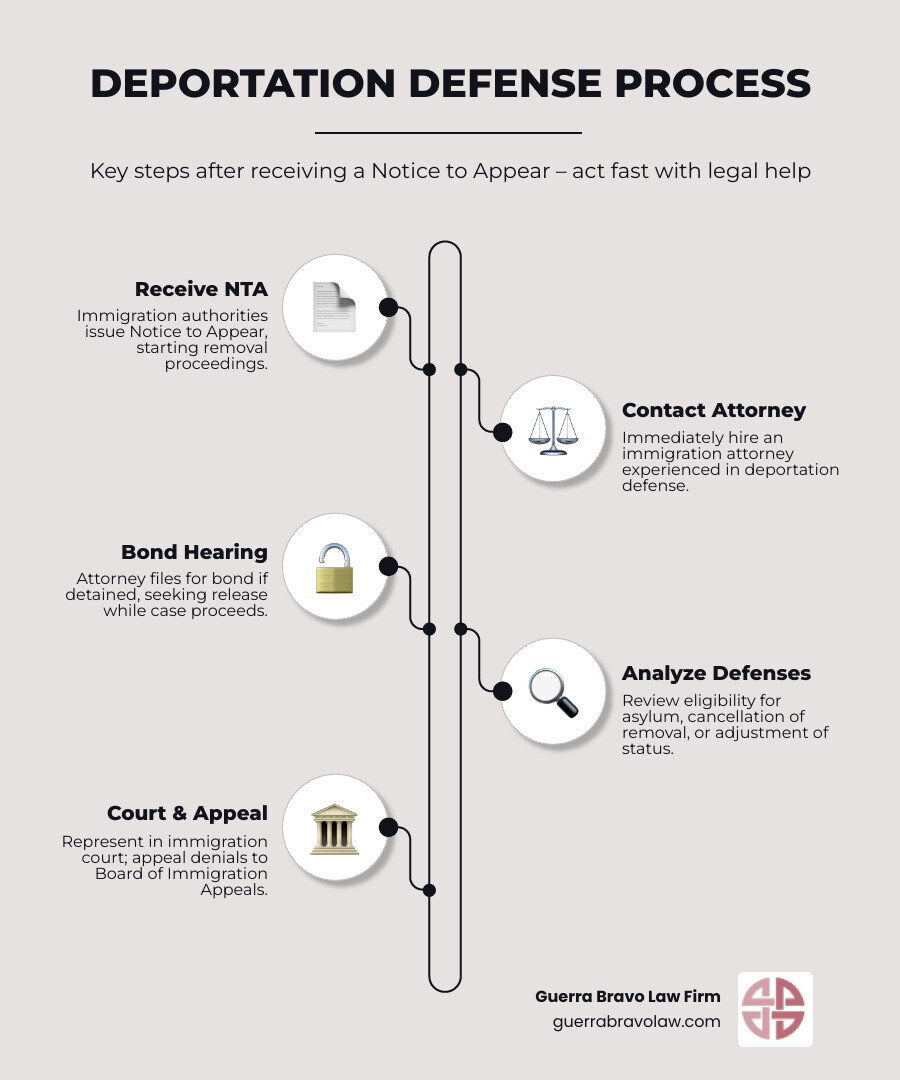
This life-changing process typically begins with a knock on your door or a notice in your mailbox. U.S. Immigration and Customs Enforcement (ICE) issues what’s called a Notice to Appear (NTA) - your official summons to appear before an Immigration Judge.
Think of the NTA as the government’s formal accusation against you. It outlines exactly why they believe you should be removed from the country. From there, your case enters the immigration court system, where you’ll face a series of hearings before an Immigration Judge. If things don’t go well, your case might eventually reach the Board of Immigration Appeals (BIA) for a final decision.
The entire process can feel overwhelming and confusing. Unlike criminal court, you’re not guaranteed a free attorney - you must find and hire your own immigration attorney for deportation or face the government’s experienced lawyers alone.

Common Reasons for Facing Deportation
Here’s something that surprises many people: anyone living in the United States who is not a U.S. citizen can face deportation. This includes people on tourist visas, students, workers with temporary permits, and even lawful permanent residents (green card holders). You don’t have to commit a serious crime to find yourself in removal proceedings.
Immigration violations are the most common trigger for deportation cases. Maybe you entered the country without proper inspection at a border crossing, or you overstayed your visa - even by just one day. Perhaps you violated the terms of your status by working without authorization, skipping school on a student visa, or forgetting to notify USCIS about your address change. Even unlawful presence - being in the U.S. for more than 180 days after your authorized stay expired - can lead to removal proceedings.
Criminal convictions create another major pathway to deportation. The government considers certain crimes as “deportable offenses,” ranging from aggravated felonies to crimes involving moral turpitude. This includes drug crimes, firearms offenses, domestic violence, and other serious crimes. Surprisingly, even a crime punishable by more than one year in jail can trigger removal proceedings, especially if you committed it within five years of entering the U.S. The intersection of criminal and immigration law is incredibly complex - you can learn more about what crimes are eligible for deportation.
Fraud or misrepresentation cases often involve marriage fraud to obtain immigration benefits, using false documents, lying on immigration applications, or helping someone else enter the U.S. illegally. Even seemingly minor dishonesty can have devastating consequences.
Finally, national security concerns can lead to removal if the government considers you a threat to public safety. This might involve alleged terrorist activities or associations with organizations the government deems dangerous.
The reality is that each deportation case is unique, with its own set of circumstances and challenges. There are no cookie-cutter solutions when your life in America is on the line.
What to Do Immediately After Receiving a Deportation Notice
Getting that deportation notice feels like the world is crashing down around you. Your hands might shake as you read it, and panic might set in. Take a deep breath - what you do next can determine whether you stay in America or get sent away.
Whatever you do, don’t ignore that notice. We can’t stress this enough. Missing your court date - called a Master Calendar Hearing - results in an automatic deportation order issued “in absentia” (without you there). Once that happens, reopening your case becomes incredibly difficult. The judge won’t care that you were scared, confused, or didn’t understand the paperwork.
Start gathering your documents immediately. You’ll need every piece of immigration paperwork you have - visas, green cards, work permits, notices from USCIS or ICE. Find your passport, birth certificate, marriage certificate, and anything proving your ties to the U.S. This includes proof of where you live, where you work, tax returns, and evidence of family relationships. These documents become the building blocks of your defense.
Remember your rights, even in this frightening situation. You have the right to remain silent when immigration officials question you (beyond giving your name and date of birth). You have the right to an attorney. Don’t sign anything from immigration officials without talking to a lawyer first. Signing documents you don’t understand could waive crucial rights or even lead to your immediate removal from the country.
Contact an experienced immigration attorney for deportation immediately. This isn’t the time to try to save money or handle things yourself. An attorney can explain the specific charges against you, identify potential defenses you might not know exist, and start building a strategy to fight for your right to stay in America.
Time is not on your side when facing deportation. Every day you wait makes building a strong defense more difficult. The sooner you act, the more options you’ll have to protect yourself and your family.
The Critical Role of an Immigration Attorney for Deportation Defense
Navigating the immigration court system alone is like bringing a butter knife to a gunfight. The government will be represented by an immigration attorney who has been through hundreds, if not thousands, of deportation proceedings. Without a skilled and experienced immigration attorney for deportation with a proven track record, you’re facing an uphill battle that could cost you everything.
Research shows that having legal representation is the single most important factor in the outcome of a deportation case. Think about it this way: would you perform surgery on yourself? Would you represent yourself in a criminal trial? Immigration law is just as complex, and the stakes are just as high. An attorney acts as your advocate, strategist, and guide, helping you to “get life back to normal.”

The difference between having representation and going it alone is staggering. People with attorneys are far more likely to remain in the United States than those who face the government’s lawyers without help. Your attorney becomes your voice in a system that can feel overwhelming and hostile.
Fighting for Your Release: Detention and Bond Hearings
If you or a loved one is detained by ICE, getting out of detention becomes the first battleground. Being locked up while fighting your case is like trying to swim with concrete boots on. It makes everything harder and more stressful for you and your family.
An experienced immigration attorney for deportation can quickly file a motion to request a bond hearing before an immigration judge. Time is critical here. Our firm understands the urgency of these situations, and in most cases, we can determine within 48 hours whether an individual will be released on bond.
At the bond hearing, your lawyer becomes your champion. They’ll present evidence of your ties to the community - your family members (especially U.S. citizens or lawful permanent residents), your job, any property you own, and your involvement in the community. The goal is to paint a picture of someone who belongs here, someone who isn’t going to disappear into the night.
Your attorney will argue that you’re not a flight risk and don’t pose a danger to anyone, advocating for your release on a reasonable bond. This isn’t just paperwork - it’s about reuniting families and giving you the best chance to fight your case from the outside. The government’s goal is often to keep people detained, so having a skilled advocate is essential.
Building a Defense: How an immigration attorney for deportation can help
Once you’re released, or if you weren’t detained in the first place, the real work begins. Your attorney becomes a detective, carefully analyzing every detail of your case to build the strongest possible defense. They’ll identify forms of relief you might not even know exist.
Cancellation of Removal can be a lifeline for people who have built deep roots in America. For non-permanent residents, this means proving you’ve been physically present in the U.S. for at least 10 years continuously, showing good moral character, and demonstrating that your removal would cause “exceptional and extremely unusual hardship” to a qualifying U.S. citizen or permanent resident family member. For green card holders, the requirements are different - seven years of continuous residence after becoming a permanent resident and no aggravated felony convictions.
Asylum, Withholding of Removal, and CAT protection offer hope for those fleeing danger. If you fear persecution or torture back home because of your race, religion, nationality, political beliefs, or membership in a particular social group, these protections might apply. The standards are different for each, and an experienced attorney knows how to present your story in the most compelling way. You can learn more about Withholding of Removal and CAT protections.
Adjustment of Status might be possible if you’re eligible for a green card through a U.S. citizen spouse, parent, child, or through an employer. Your attorney can help you adjust your status right within the removal proceedings, turning a deportation case into a path to permanent residence.
Waivers can forgive past mistakes. Maybe you had a criminal conviction, committed immigration fraud, or accumulated unlawful presence. Many of these issues can be “waived” under specific circumstances. Your attorney will know which waivers apply and how to meet their requirements.
Prosecutorial Discretion is like getting the other side to agree that your case isn’t worth pursuing. Sometimes, your attorney can persuade the government’s lawyer to administratively close or terminate your case. It’s not guaranteed, but when it works, it’s incredibly powerful.
Voluntary Departure might sound like giving up, but it’s actually strategic. If other defenses aren’t viable, leaving voluntarily avoids a formal deportation order. This matters because a deportation order typically bars you from returning for 10 years and makes future immigration benefits nearly impossible.
At Guerra Bravo Law Firm, we offer comprehensive Removal Defense strategies custom to your unique situation. Our attorneys work tirelessly to contest charges of removability, challenge deficient Notices to Appear, and explore every possible avenue to keep you and your family together. With Attorney Iris Guerra Bravo’s 14+ years of insider experience with ICE and DHS, we know how the government thinks and how to beat them at their own game.
How to Find and Choose the Right Deportation Defense Attorney
When your family’s future hangs in the balance, choosing the right legal representation isn’t just important—it’s everything. Not all lawyers are equipped to handle deportation cases. Immigration law is a highly specialized field that changes constantly, with new regulations, court decisions, and policy updates happening regularly.
An attorney who splits their time between multiple practice areas might miss a crucial detail that could mean the difference between staying with your family and being forced to leave the country. You need someone who lives and breathes immigration law every single day.

Beware of “Notarios” and Unauthorized Practitioners
Here’s something that could save you from disaster: in the United States, a “notario publico” is NOT a lawyer and cannot provide legal advice. This is completely different from some Latin American countries where a “notario” is a highly trained legal professional.
These unauthorized immigration consultants might seem helpful and charge lower fees, but they can destroy your case. They file incorrect applications, miss critical deadlines, and give advice that can lead directly to deportation. The money you think you’re saving could cost you everything.
Always verify that your attorney is licensed to practice law in the United States. Don’t let someone who isn’t qualified gamble with your family’s future.
Where to Find Qualified Legal Help
Finding a qualified immigration attorney for deportation doesn’t have to feel overwhelming. Start with these trusted sources:
State Bar Associations are your first line of defense. Every state has a bar association that verifies attorneys are licensed and in good standing. This simple check ensures your lawyer hasn’t been disbarred or faced serious disciplinary action.
Non-profit organizations can be a lifeline, especially if money is tight. Many offer free or low-cost legal services specifically for immigrants facing removal. The Department of Justice maintains a comprehensive list of recognized organizations and accredited representatives who are authorized to help with immigration cases.
Personal referrals from trusted community sources often lead to the best matches. Ask immigrant advocacy groups, community leaders, or even other attorneys who don’t specialize in immigration law. When someone’s family has been through deportation proceedings successfully, their recommendation carries real weight.
Client testimonials can give you insight into how an attorney actually treats their clients. Do they return phone calls? Do they explain things clearly? Do they fight hard when it matters most?
Understanding the Costs and Finding Affordable Help
Let’s talk honestly about money. The cost of hiring a deportation defense attorney varies widely based on your case’s complexity, the attorney’s experience, and how much time your defense requires. Many attorneys offer flat-fee arrangements for deportation defense, so you’ll know upfront what you’re paying.
Yes, experienced attorneys cost more. But think of it this way: the difference between an inexperienced lawyer and a seasoned immigration attorney for deportation could be the difference between staying in America or being separated from your family for years.
If You Can’t Afford an Attorney
Don’t give up hope if money is tight. Real help exists for people who qualify:
The Department of Justice provides a list of pro-bono legal service providers that includes organizations like Catholic Charities and local YMCA branches. These groups specifically help low-income individuals facing removal proceedings.
Legal aid societies in many cities and states provide free immigration services to qualifying individuals. University law schools often run clinics where supervised students provide legal services at reduced rates or completely free.
At Guerra Bravo Law Firm, we understand that legal fees can create stress during an already difficult time. We work with families to create payment plans that fit their budgets because we believe everyone deserves expert legal representation when facing deportation.
The attorney you choose will be fighting for your right to stay in the country you call home. With Attorney Iris Guerra Bravo’s 14+ years of insider experience with ICE and DHS, you’re getting someone who knows exactly how the government thinks and operates. That battle-tested experience can make all the difference in your case.
Frequently Asked Questions about Hiring an Immigration Attorney for Deportation
When families face deportation, we understand that countless questions race through your mind. The uncertainty can feel overwhelming, but having clear answers helps you make informed decisions about your future. Here are the most common concerns we hear from clients and their families.
Can a criminal conviction be overcome in immigration court?
Yes, in many cases a criminal conviction doesn’t have to end your dreams of staying in America. This is one of the most hopeful messages we can share with our clients who feel defeated by past mistakes.
An experienced immigration attorney for deportation will carefully examine your specific conviction under the complex rules of immigration law. We don’t just accept that a conviction means automatic deportation – we fight back with proven strategies.
Post-conviction relief is often our first line of defense. This legal process can actually vacate or modify your original criminal plea, essentially erasing its immigration consequences. We’ve seen remarkable success with this approach, and you can learn more about winning a case after post-conviction relief to understand how powerful this strategy can be.
Specific waivers are another path forward. These legal tools can literally forgive certain crimes for immigration purposes, allowing you to remain in the United States despite a conviction. Every case is different, which is why our detailed analysis of your situation is so crucial.
Can a deportation order be appealed?
Absolutely, and this is where timing becomes everything. If an Immigration Judge orders your removal, you have exactly 30 days to file an appeal with the Board of Immigration Appeals (BIA). Missing this deadline can close the door on your case permanently.
An attorney is essential for crafting a compelling legal brief that demonstrates why the judge’s decision was wrong. This isn’t just paperwork – it’s your lifeline. We pour over every detail of your case, examining the law and facts to build the strongest possible argument for why you deserve to stay.
If the BIA denies your appeal, we can sometimes take your case even higher to a U.S. Circuit Court of Appeals. While this process is incredibly complex, we’ve seen families reunited through persistent, skilled advocacy.
How long does the deportation process take?
The honest answer is that it varies dramatically – from a few months to several years. We know this uncertainty is one of the hardest parts of the process for families.
Several factors influence your timeline. Immigration courts often have significant backlogs, which means longer waits but also more time to build your defense. Complex cases with multiple forms of relief naturally take longer, but this complexity often means more opportunities to win.
Your detention status makes a big difference too. Detained cases typically move faster through the system, while non-detained cases may take longer but give you the advantage of remaining with your family while we fight.
Appeals add significant time to the process, sometimes years. But if an appeal is your best chance at staying in America, that time is worth it.
Our role is to manage this process strategically, ensuring we meet every deadline while building the strongest possible case. We’ll keep you informed every step of the way, though court backlogs remain beyond anyone’s control. What we can control is making sure your case is perfectly prepared when your moment comes.
The immigration system can feel cold and impersonal, but remember – you’re not just a case number to us. Every delay is time we use to strengthen your defense, and every hearing is an opportunity to fight for your right to remain in the United States with your family.
Conclusion
Facing deportation is a fight for your future in the United States. The legal process is complex and adversarial, but you do not have to face it alone. An experienced immigration attorney for deportation is your most important ally, providing the knowledge, strategy, and advocacy needed to protect your rights and explore every possible path to remain with your family and community.
The stakes are incredibly high. A deportation order doesn’t just mean leaving the country - it means being separated from your children, your spouse, your job, and everything you’ve worked to build. It can mean returning to dangerous conditions you fled years ago. But with the right legal representation, many people successfully fight their cases and stay in America.
What makes the difference? Experience matters. An attorney with insider experience, like those at Guerra Bravo Law Firm who have worked within agencies like ICE and DHS, can provide a unique, battle-tested advantage in your defense. When your attorney understands how the government thinks and operates from the inside, they can anticipate strategies and build stronger defenses.
Time is critical. Every day that passes without proper legal representation is a day that could cost you your case. Immigration courts move quickly, and deadlines are unforgiving. Missing a single court date can result in an automatic deportation order that’s extremely difficult to reverse.
You have rights, even in removal proceedings. You have the right to an attorney, the right to an interpreter, and the right to present evidence in your defense. But these rights are meaningless if you don’t have someone who knows how to use them effectively.
Your case is unique, and cookie-cutter solutions don’t work in immigration court. Whether you’re eligible for cancellation of removal, asylum, adjustment of status, or another form of relief, an experienced attorney will analyze every detail of your situation to find the strongest possible defense.
If you or a loved one is facing removal, taking immediate action to secure expert legal help is the most critical step you can take. Don’t wait until it’s too late. Your family’s future depends on the decisions you make today.
Contact us for a consultation on your Removal Defense case.
[