
May 5, 2026
The State of Family Immigration Detention Across America
The State of Family Immigration Detention Across America
Understanding Family Immigration Detention in America Today
Family immigration detention in the United States refers to holding parents and children in specialized facilities during their immigration proceedings.
Current Status (2025):
-
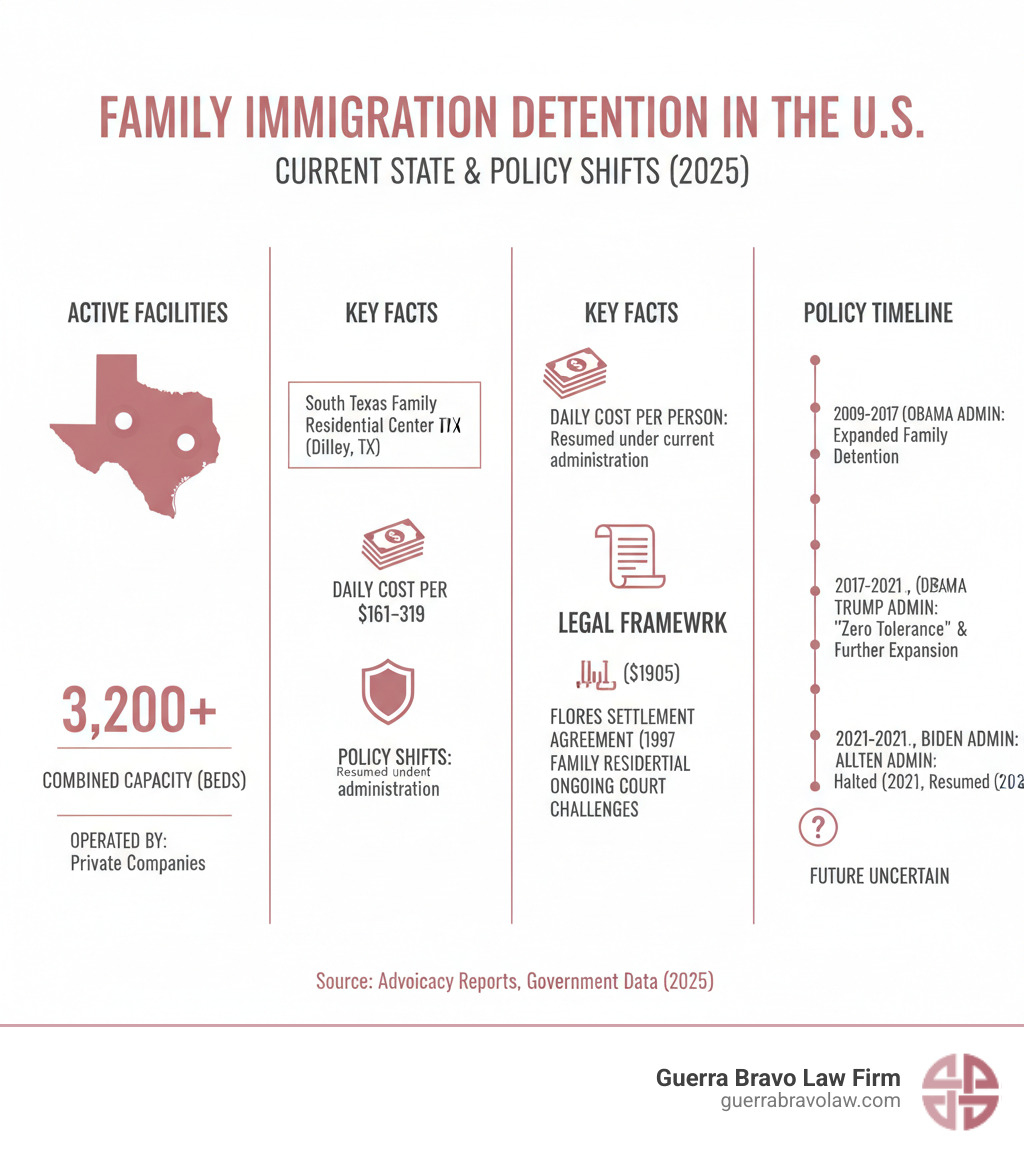
Two active facilities: South Texas Family Residential Center (Dilley, TX) and Karnes County Immigration Processing Center (TX).
-
Combined capacity of over 3,200 beds.
-
Operated by private companies: CoreCivic and GEO Group.
-
Policy shifts are frequent, with the practice being halted in 2021 and later resumed.
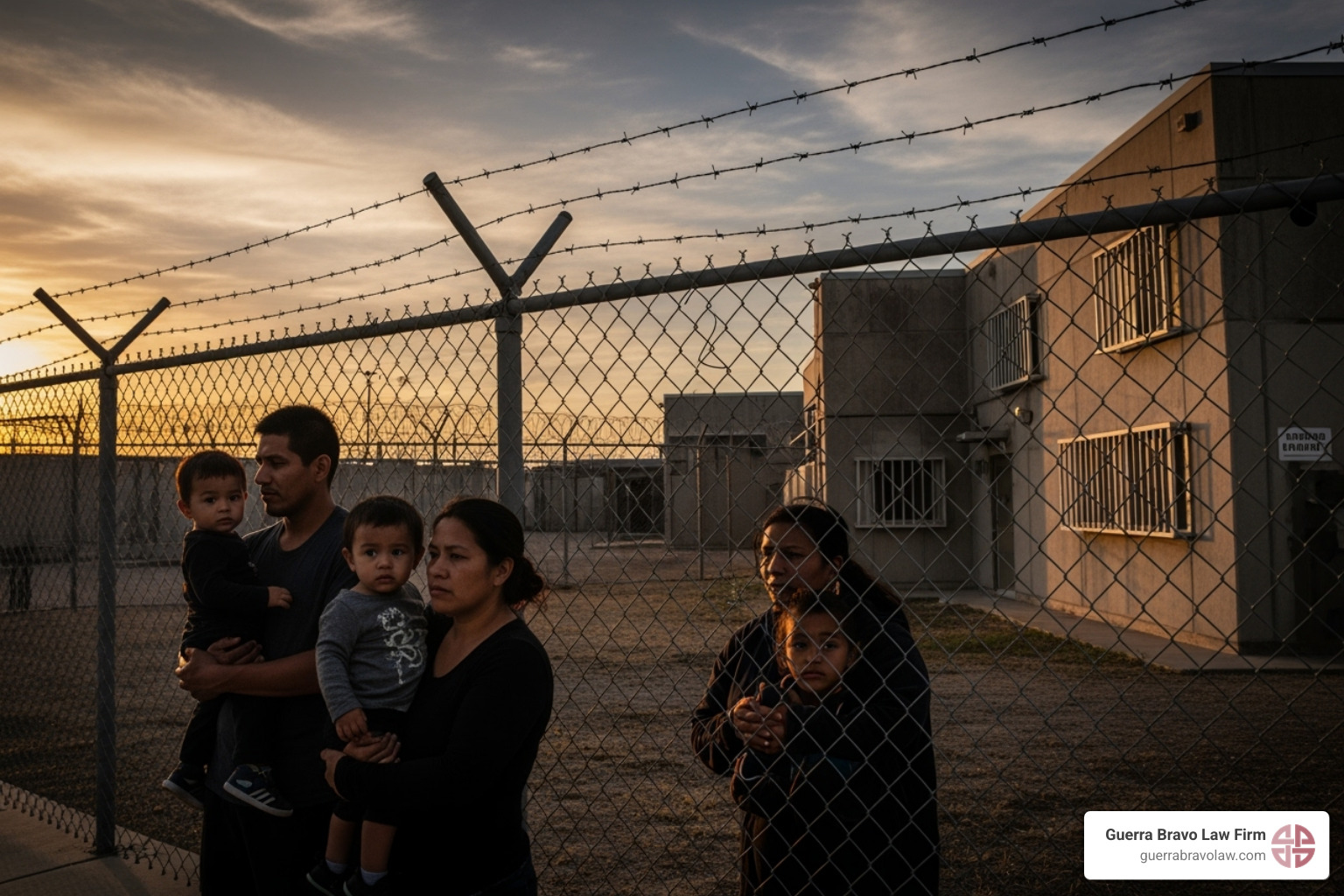
The system primarily houses mothers with children apprehended at the border. The stated purpose is to ensure families appear for immigration hearings. However, the practice is highly controversial. Advocacy reports describe a “prison-like environment” where families struggle to steer the legal system and care for their children.
Critics argue it traumatizes children and violates human rights, while supporters claim it’s necessary for immigration enforcement. This ongoing debate affects real families caught in an increasingly complex system.
1. What is Family Immigration Detention and How is it Defined in the U.S. Context?
Family immigration detention is the U.S. government’s practice of holding parents and children together in secure facilities while their immigration cases are processed. This typically affects families apprehended at the border or within the country without authorization. The government’s stated goal is to ensure families attend their court hearings.
However, the Department of Homeland Security uses a very narrow definition of a “family unit,” generally only including children with their biological parents or legal guardians. This strict rule has heartbreaking consequences. A child arriving with a grandmother or an older sibling who raised them is often not considered part of a family unit.
Instead, these children are separated and placed into the Unaccompanied Children Program (ORR/HHS), despite arriving with loving caregivers. As an attorney with over 14 years in this field, I’ve seen how these definitions can tear families apart. Understanding how the government classifies your family is a critical first step in any legal strategy, as these policies impact real people—mothers, fathers, and children who just want to feel safe.
2. What is the History of Family Immigration Detention in the United States?
The history of family immigration detention is a political pendulum, swinging with each administration.
Early Beginnings (George W. Bush): The practice began quietly, leading to the 2007 Family Residential Standards (FRS), which attempted to create humane guidelines for detaining families.
Expansion (Obama): In 2013-2014, a surge in Central American families led to a massive expansion, with capacity exploding from 90 to 3,700 beds. A key 2015 court ruling affirmed that the Flores Settlement Agreement’s 20-day detention limit applied to all children, creating a major legal challenge for the administration.
“Zero Tolerance” (First Trump Administration): This era saw the controversial 2018 family separation policy and a sustained legal assault on the Flores Settlement itself, aiming for indefinite family detention. Courts blocked most of these efforts.
A Brief Halt (Biden): In a major reversal, the Biden administration halted family detention in 2021, converting facilities into short-term staging centers and shifting resources to Alternatives to Detention (ATD).
Revival (Second Trump Administration, 2025): The practice was immediately revived in 2025. The Karnes and Dilley facilities reopened to families, and the administration filed a motion to terminate the Flores Settlement entirely, backed by a $45 billion legislative package to expand detention capacity. This history shows how dramatically policies change, leaving families in a constant state of uncertainty.
3. Which Specific Facilities Have Been Used for Family Detention, and What Are Their Capacities and Operational Statuses?
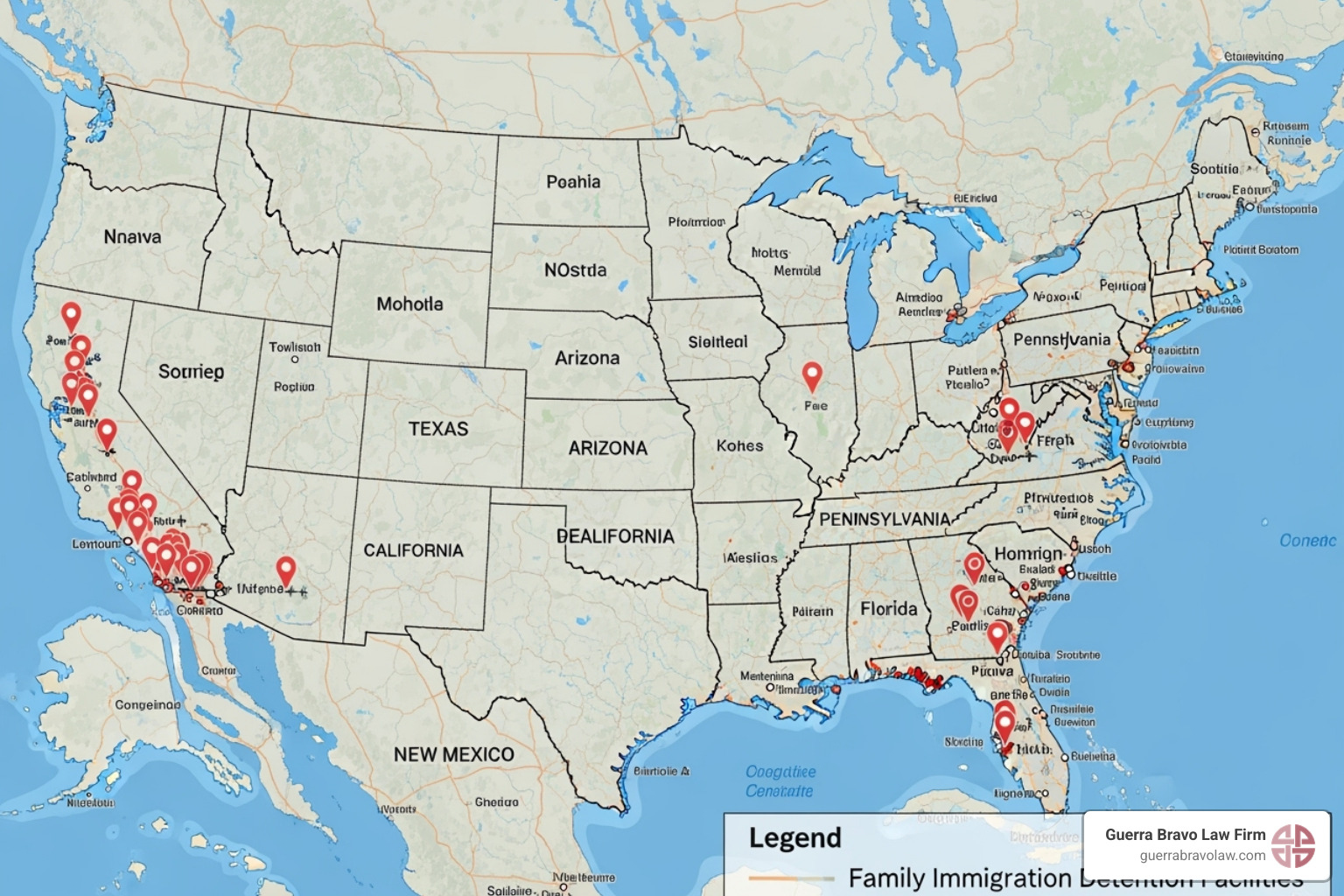
Understanding where family immigration detention in the United States takes place helps paint a clearer picture of this complex system. The landscape of these facilities has shifted dramatically over the years, with some closing, others reopening, and new ones being built as policies change with each administration.
Currently Operating Family Detention Facilities (as of June 2025)
Two major facilities in rural Texas, run by private companies, are currently operating:
-
South Texas Family Residential Center (Dilley, TX): The nation’s largest facility, operated by CoreCivic, with a capacity of 2,400 people. Families live in modular housing units on a remote fifty-acre campus.
-
Karnes County Immigration Processing Center (Karnes County, TX): Operated by GEO Group, this facility holds 830 people in a more compact, barrack-like layout.
Former Family Detention Facilities
Several other facilities have played key roles in this history:
-
Berks County Residential Center (Leesport, PA): A small, 90-bed facility that operated for two decades before being shuttered for family use in 2021.
-
T. Don Hutto Residential Center (Taylor, TX): A former criminal facility that held families from 2006, sparking public outcry over its conditions. It now detains adult women.
-
Artesia Family Residential Center (Artesia, NM): A temporary 700-person facility that operated for just six months in 2014, highlighting the rapid expansion under the Obama administration.
Customs and Border Protection (CBP) also operates temporary holding facilities where families are often held beyond the 72-hour limit before being transferred to the larger detention centers.
4. What Are the Current and Past Standards of Care and Detention for Families, Particularly Children, and How Do They Compare to Legal Agreements Like the Flores Settlement?
The standards of care for family immigration detention in the United States are governed by legal agreements and internal policies, but a significant gap often exists between the rules and reality.
The Flores Settlement Agreement: A Child’s Legal Shield
The Flores Settlement Agreement is the most critical legal protection for children in immigration custody. This 1997 agreement guarantees:
-
Placement in the least restrictive environment possible.
-
Safe and sanitary conditions.
-
Prompt release to a guardian, generally limiting detention in unlicensed facilities to 20 days.
A federal judge actively oversees compliance, making it a powerful tool for advocates.
Family Residential Standards (FRS)
ICE also has its own internal guidelines, the 2020 Family Residential Standards (FRS), which cover daily operations like meals, education, and safety. Each facility has compliance officers, and ICE conducts regular inspections. See ICE’s overview of detention standards: ICE Family Residential Standards.
When Standards Meet Reality: The Troubling Gap
Despite these frameworks, reports consistently reveal major failures. Medical care is a frequent concern, with families reporting negligent treatment and long delays. Educational and recreational services often fall short, and the 20-day Flores limit has been repeatedly challenged by different administrations. The current administration has even filed motions to terminate the Flores Settlement entirely, arguing it is no longer necessary—a move that threatens the core legal protections for detained children.
5. What Are the Reported Conditions Within Family Detention Facilities?
Upon arrival, families are often held in temporary Customs and Border Protection (CBP) facilities, which are notoriously harsh. Detainees describe them as “iceboxes” for their cold temperatures or “dog pounds” for their chain-link enclosures. Families report sleeping on concrete floors with inadequate food and water, often for longer than the legal 72-hour limit. Independent oversight has repeatedly flagged dangerous overcrowding and prolonged detention in CBP facilities (see DHS OIG management alert: dangerous overcrowding and prolonged detention).
Conditions in longer-term ICE facilities like Dilley and Karnes are not much better. Despite being called “residential centers,” they maintain a prison-like atmosphere with restricted movement. Overcrowding is a persistent issue, straining all resources.
Medical care is dangerously inadequate. Studies have documented malnutrition and poor treatment for chronic conditions. The term “Dilley-ish” was even coined by hospital staff to describe health issues in children released from the Dilley facility. Tragically, 19-month-old Mariee died in 2018 after leaving Dilley, sparking investigations into the quality of care.
The psychological impact is severe. Public health experts state “there is no humane way to detain children.” The American Academy of Pediatrics has repeatedly warned of the profound harms detention causes to children’s health. Children in detention show signs of depression, anxiety, and behavioral regression. Compounding these issues is a lack of oversight, as administrations have resisted external monitoring, making it difficult to assess the true conditions inside.
6. What Are the Cost Implications of Family Detention for Taxpayers?
The financial cost of family immigration detention in the United States is a staggering burden on taxpayers, especially when compared to more effective and humane options. The entire immigrant detention system costs over $2 billion annually (see background on immigration detention in the United States).
Detaining a single family member costs approximately $161 per day. For a mother and two children, that’s nearly $480 daily. In stark contrast, Alternatives to Detention (ATD) programs cost an average of just $4.33 per person per day. The highly successful Family Case Management Program cost only $38 per family per day before it was discontinued.
This means family detention can be ten times more expensive than proven alternatives. The majority of this money flows to private prison companies like CoreCivic and GEO Group, which operate about 90% of immigrant detention beds. CoreCivic’s Dilley facility is expected to generate $180 million annually, while GEO Group’s Karnes facility anticipates $79 million.
Recent legislation has only deepened this financial commitment, with $45 billion appropriated over four years to expand detention capacity. This system is not just morally questionable—it’s financially irresponsible, enriching private corporations with taxpayer dollars that could be better spent on effective, community-based solutions.
7. What Are the Alternatives to Family Detention, and How Effective Have They Been?
Family immigration detention in the United States isn’t the only option for ensuring families appear in court. Several proven, cost-effective, and humane alternatives exist.
Release Options That Work
Instead of detention, families can be released into communities with supervision. These methods include:
-
Release on bond, parole, or own recognizance.
-
Electronic monitoring via ankle bracelets.
-
Telephonic reporting and in-person check-ins.
Community-Based Programs: The Gold Standard
The most successful approach involves community-based case management, often run by non-profits. Case managers help families steer the legal system, enroll children in school, and understand their obligations. This support-based model has proven incredibly effective.
The Numbers Don’t Lie
The former Family Case Management Program (FCMP) had a stunning 99% compliance rate for court appearances and check-ins, disproving the claim that families will disappear if not detained. The cost savings are also dramatic: while detention can cost over $300 per person per day, FCMP cost only $38 per family per day. For current federal alternatives, see ICE’s Alternatives to Detention overview.
While some advocates raise valid concerns about intensive electronic monitoring feeling like “digital imprisonment,” the evidence overwhelmingly shows that alternatives work. They prove we can maintain immigration enforcement without the trauma and expense of locking up children and families.
8. What Are the Legal Challenges and Court Rulings Related to Family Immigration Detention?
The legal battles over family immigration detention in the United States have been intense, with children’s rights often hanging in the balance.
The Enduring Influence of the Flores Settlement
The Flores Settlement Agreement of 1997 is the cornerstone of legal protections for immigrant children. It requires that children be held in the “least restrictive” and “safe and sanitary” conditions, and it generally limits detention in unlicensed facilities to 20 days.
Key Court Rulings
-
June 2015: A federal court ruled that Flores protections, including the 20-day limit, apply to children detained with their parents. This was a major blow to the Obama administration’s expansion of family detention (see discussion related to Flores v. Lynch).
-
Trump Administration: Courts repeatedly blocked the administration’s attempts to terminate the Flores agreement and allow for indefinite family detention (see legal challenges).
Recent Legal Battles (as of 2025)
The fight has escalated. On April 12, 2025, the Department of Justice filed a motion to terminate the Flores Settlement entirely. In response, advocates filed a lawsuit to preserve it, citing ongoing issues like medical neglect.
Furthermore, a July 2025 legislative package appropriated $45 billion for detention but deliberately did not comply with the Flores 20-day limit. This represents a direct legislative challenge to the agreement. These ongoing battles show that the fundamental rights of detained children remain hotly contested, making experienced legal counsel more critical than ever.
9. What Are the Arguments For and Against Family Detention?
The debate over family immigration detention in the United States is deeply polarized, with strong arguments on both sides.
The Government’s Case for Family Detention
Proponents, typically federal agencies, argue that detention is necessary to:
-
Ensure families appear for court hearings and do not abscond.
-
Deter others from making dangerous border crossings or filing weak asylum claims.
-
Protect public safety and national security.
-
Promote family unity by keeping families together during proceedings, even if in a detention setting.
The Opposition’s Humanitarian Concerns
A broad coalition of medical professionals, legal experts, and human rights advocates argues against detention, citing:
-
Severe physical and mental health trauma to children, with experts stating “there is no humane way to detain children.”
-
Damage to the parent-child bond as parents are stripped of their ability to care for their children.
-
Barriers to legal representation, as remote facilities make it difficult for families to access lawyers.
-
Extreme cost, especially when compared to cheaper, more effective community-based alternatives that have a 99% success rate.
-
Moral and religious objections to incarcerating vulnerable families, particularly asylum seekers fleeing violence.
While both sides may agree on the need for a functional immigration system, they fundamentally disagree on whether detention is a humane or effective tool to achieve it.
10. How Has the Biden Administration’s Approach to Family Detention Differed from Previous Administrations, and What is the Current Status of Family Detention Under This Administration?
The Biden administration’s approach to family immigration detention in the United States has been a story of dramatic policy shifts.
A Bold Start: Ending Family Detention (2021)
Upon taking office, the administration moved swiftly to end long-term family detention. It shuttered the Berks County facility and converted the large Texas centers from Family Residential Centers (FRCs) into short-term Family Staging Centers (FSCs), holding families for less than 72 hours. By December 2021, the long-term family detention population reached zero. The administration pivoted to Alternatives to Detention (ATD), using case management and monitoring to supervise families in communities.
Reality Bites: The Challenges of 2023
By 2023, facing record arrivals at the border and political pressure, the administration began considering a return to family detention. Instead of a full reversal, it expanded the use of tracking methods like ankle bracelets and traceable cellphones for released families.
The Political Reality
This back-and-forth demonstrates the extreme volatility of U.S. immigration policy. By 2025, under a new administration, the pendulum swung back completely. The Texas facilities were converted back to long-term detention centers, and the Flores Settlement came under renewed attack. This history underscores a critical point for families: policies can change overnight, but the need for experienced legal guidance that can steer these shifts remains constant.
11. What Are the Potential Impacts of Family Detention on the Physical and Mental Well-being of Children and Parents?
The impact of family immigration detention in the United States on the physical and mental well-being of children and parents is severe and well-documented.
The Physical Toll on Children
Detention environments are harmful to a child’s physical health. Documented issues include:
-
Malnutrition and significant weight loss, with infants sometimes losing a dangerous percentage of their body weight.
-
Rapid spread of communicable diseases like the flu in overcrowded conditions.
-
Inadequate medical care, leading to delayed treatment and tragic outcomes. The term “Dilley-ish” was even created by hospital staff to describe the unique health problems seen in children released from the Dilley facility.
-
Developmental delays due to poor sanitation, hygiene, and stress.
The Invisible Wounds: Mental and Emotional Impact
The psychological harm is profound and can be lifelong. Children often exhibit depression, anxiety, and behavioral regression, such as bedwetting or refusing to eat. The detention environment undermines the parent-child relationship, as parents lose their ability to protect and nurture their children, leading to feelings of helplessness and guilt.
Public health experts are unified in their conclusion: “there is no humane way to detain children and no version of family detention that is acceptable.” As a law firm in the Rio Grande Valley, we see the real-world consequences of these policies. The documented harm reminds us why compassionate and effective immigration solutions are so critical.
12. What Role Do Private Prison Firms Play in Operating Family Detention Facilities, and What Are the Financial Implications of These Contracts?
Private corporations play a dominant and controversial role in family immigration detention in the United States, turning a government function into a profitable enterprise.
The Corporate Takeover of Detention
Two firms, CoreCivic and GEO Group, manage the vast majority of immigrant detention beds—about 90%. These for-profit companies are responsible for the daily operations of facilities that house vulnerable families, creating a system where their primary duty is to shareholders, not to the people in their care.
The Money Behind the Misery
The financial incentives are enormous. CoreCivic’s contract for the Dilley, Texas facility is expected to generate $180 million in annual revenue. GEO Group’s Karnes County facility is projected to bring in $79 million annually. These massive profits are funded entirely by U.S. taxpayers.
The Perverse Incentive Problem
This business model creates a fundamental conflict of interest. Because revenue depends on keeping beds filled, these corporations have a powerful financial incentive to lobby for policies that expand detention, rather than supporting more humane and cost-effective alternatives. As we at Guerra Bravo Law Firm have seen, when profit motives drive detention decisions, it is families who pay the ultimate price in trauma and lost hope.
13. What Are the Current Debates and Future Outlook Regarding Family Immigration Detention in the U.S.?
The future of family immigration detention in the United States is being shaped by intense debates and points toward a significant expansion of the practice.
Current Debates
The core debate is over the effectiveness and humanity of detention.
-
Proponents argue it’s necessary for ensuring court appearances and deterring migration.
-
Opponents point to the trauma it inflicts on children and the proven success of cheaper, community-based alternatives with 99% compliance rates.
-
The legal battle over the Flores Settlement Agreement is at a critical juncture, with the government seeking to terminate the decades-old child protection agreement.
-
The role of private prison companies and their profit motives remains a highly contentious issue.
Future Outlook
The future looks grim for those opposing detention.
-
A $45 billion budget allocation for expanding detention capacity signals a clear intent to grow the system.
-
Intense legal battles over the fate of Flores will determine whether families could face indefinite detention.
-
Political volatility means that future elections could dramatically reshape these policies yet again.
For families caught in this uncertain system, the message is clear: the rules are changing rapidly. As we’ve seen at Guerra Bravo Law Firm, having experienced legal representation that understands these shifts is more crucial than ever. Whether you need help with Family Petitions or Removal Defense, our insider knowledge can help you steer what’s ahead.
[