
March 10, 2026
The 10-Year Rule: A Guide to Cancellation of Removal
The 10-Year Rule: A Guide to Cancellation of Removal
Why Understanding Deportation Cancellation of Removal Could Save Your Family
Deportation cancellation of removal is a legal lifeline that allows certain individuals in removal proceedings to remain in the United States and obtain permanent residency—but only if they meet strict eligibility requirements.
Quick Answer: Key Requirements for Cancellation of Removal
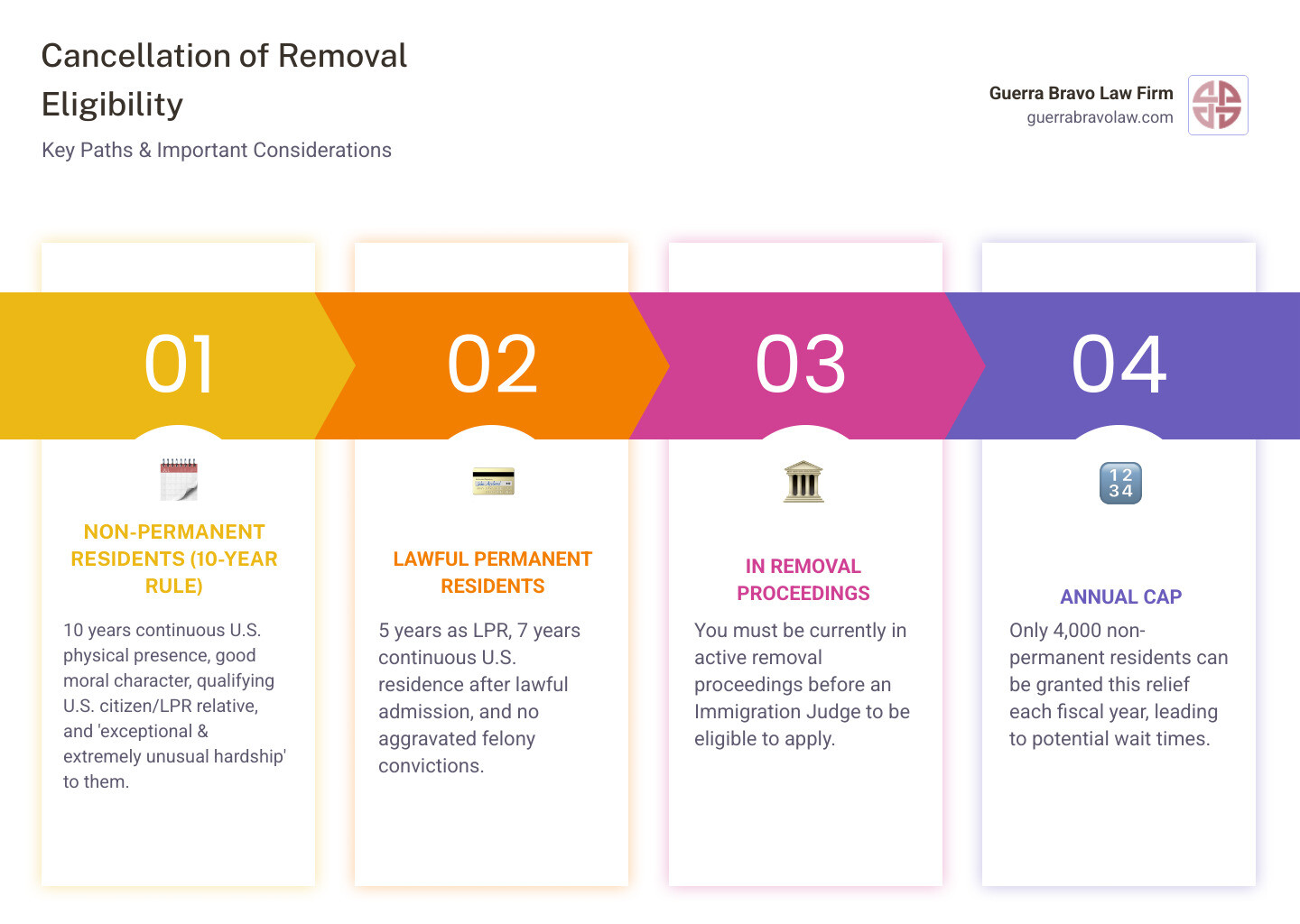
For Non-Permanent Residents (10-Year Rule):
-
10 years of continuous physical presence in the U.S.
-
Good moral character throughout those 10 years
-
A U.S. citizen or Lawful Permanent Resident spouse, parent, or child
-
Proof that your removal would cause “exceptional and extremely unusual hardship” to that qualifying relative
-
No disqualifying criminal convictions
For Lawful Permanent Residents:
-
At least 5 years as a Lawful Permanent Resident
-
7 years of continuous residence in the U.S. after lawful admission
-
No aggravated felony convictions
Important: You can only apply for cancellation of removal if you are currently in removal proceedings before an Immigration Judge. Only 4,000 non-permanent residents can receive this relief each year.
Facing deportation is one of the most terrifying experiences an immigrant can endure. The fear of family separation, leaving behind children who were born here, or returning to a country you barely remember—these aren’t just legal problems. They’re deeply personal crises that affect entire families.
The good news: Cancellation of removal exists as a form of relief that can stop your deportation and allow you to stay in the United States legally.
The challenge: This relief is difficult to obtain. The burden of proof is on you, and the government will actively oppose your case. Immigration judges have broad discretion, and the hardship standards are among the highest in immigration law.
This guide will walk you through everything you need to know about cancellation of removal—from understanding whether you qualify under the 10-year rule, to proving exceptional hardship, to navigating the court process. Whether you’re a permanent resident fighting to keep your green card or an undocumented individual who has built a life here over the past decade, understanding your options is the first step toward protecting your future.
Understanding Deportation Cancellation of Removal and Its History

To understand where we are today, we have to look back at how the law has changed. Before the late 1990s, the process was a bit different and, in many ways, more accessible.
From Suspension to Cancellation
Before April 1, 1997, individuals facing deportation sought what was known as suspension of deportation. Under the old rules, you only needed to show seven years of presence and “extreme hardship” to yourself or a family member.
Everything changed when Congress passed the Illegal Immigration Reform and Immigrant Responsibility Act (IIRIRA) of 1996. This law, which became effective on April 1, 1997, replaced suspension with what we now call “cancellation of removal.” The 734 F.3d 259 Othi v. Holder case highlights these major changes. The biggest shift was the introduction of much stricter standards, specifically the “exceptional and extremely unusual hardship” requirement for non-permanent residents. This is a much higher bar to clear than the old “extreme hardship” standard.
The Nature of the Relief
It is important to remember that deportation cancellation of removal is not an automatic right. It is a discretionary benefit. This means that even if you meet every single technical requirement, an Immigration Judge still has the power to say “no” if they believe you don’t deserve it based on your overall record.
Furthermore, this is a “defensive” relief. You cannot simply walk into a USCIS office and apply for it to get a Green Card. You must already be in active removal proceedings—meaning the government is currently trying to deport you—to ask the judge for this help.
Eligibility Requirements for Permanent and Non-Permanent Residents
The law treats people differently depending on whether they already have a Green Card or not. The rules for Lawful Permanent Residents (LPRs) are found in § 1229b(a) INA § 240A(a), while the rules for non-permanent residents are in § 1229b(b) INA § 240A(b).
Requirements for Lawful Permanent Residents (LPRs)
If you already have a Green Card but the government is trying to take it away (usually due to a criminal conviction), you may be eligible for cancellation under the “5/7 Rule.”
The 5/7 Rule:
-
You must have been a Lawful Permanent Resident for at least 5 years.
-
You must have resided in the U.S. continuously for at least 7 years after being admitted in any status (for example, if you entered on a visa and then got a Green Card later, the 7 years starts from your first legal admission).
The Criminal Bar:
- You are ineligible if you have been convicted of an “aggravated felony.” This is a specific category of crimes in immigration law that can include serious offenses like murder or rape, but also certain theft or filing false tax return charges depending on the sentence or loss involved.
Discretionary Factors: The judge will look at the “equities” of your case. They will weigh your family ties in the U.S., your employment history, any community service, and your rehabilitation against the reasons the government wants to deport you.
The 10-Year Rule for Non-Permanent Resident Deportation Cancellation of Removal
For those without a Green Card, the process is often called the “10-Year Rule.” This requires filing Form EOIR-42B.
Continuous Physical Presence: You must prove you have been physically present in the U.S. for at least 10 years immediately preceding the date of your application. Departures from the U.S. exceeding 90 days in a single trip, or 180 days in total, can “break” this continuity.
The “Stop-Time” Rule: This is a tricky one. The 10-year clock stops ticking the moment you are served with a Notice to Appear (NTA) in court or if you commit certain criminal offenses. If you have only been here 9 years when you get that NTA, you generally cannot reach the 10-year mark while your case is pending.
Good Moral Character: You must prove you have been a person of good moral character during that entire 10-year period. Things like multiple DUIs, failing to pay child support, or lying to a government official can jeopardize this.
Qualifying Relatives: You must have a “qualifying relative” who is a U.S. citizen or LPR. This includes your spouse, parent, or child. If you don’t have one of these relatives, you cannot apply for this specific type of relief, no matter how long you’ve lived here.
Proving Exceptional and Extremely Unusual Hardship
This is the hardest part of the case. For non-permanent residents, you must prove that your deportation would cause “exceptional and extremely unusual hardship” to your qualifying relatives.
Defining the Standard
The law is very clear: the hardship must be “substantially beyond” what would normally be expected when a family member is deported. It isn’t enough to say your children will be sad or that you will make less money in your home country. Almost everyone facing deportation deals with those issues. To win, the hardship must be truly unique or severe.
Crucial Point: The judge only looks at the hardship to your U.S. citizen or LPR relatives. Hardship to you (the applicant) does not count toward this specific legal requirement.
Common Evidence for Hardship
We often help our clients gather evidence in the following categories:
Medical Evidence: If your child or parent has a serious, chronic illness that requires specialized care only available in the U.S., this is strong evidence. We provide medical records, doctor letters, and proof that the home country cannot provide the necessary treatment.
Special Education: If your U.S. citizen child has severe learning disabilities or special needs and receives specific services in U.S. schools that are non-existent in your home country, this can demonstrate exceptional hardship.
Financial Destitution: If you are the sole provider for an elderly LPR parent or a disabled child, and your removal would leave them completely destitute or without a caregiver, the judge will consider this.
Country Conditions: If your home country is experiencing extreme violence, civil unrest, or lacks basic infrastructure (like clean water or electricity) in a way that would specifically endanger your qualifying relative, this must be documented.
Special Rule Deportation Cancellation of Removal for Battered Spouses and Children
There are special protections for vulnerable individuals under the Violence Against Women Act (VAWA) and other specific laws like NACARA.
VAWA Cancellation
If you have been subjected to battery or extreme cruelty by a U.S. citizen or LPR spouse or parent, you may qualify for a special type of cancellation.
-
Lower Presence Requirement: You only need 3 years of continuous physical presence instead of 10.
-
Lower Hardship Standard: You only need to show “extreme hardship” to yourself or your child. This is a much easier standard to meet than the “exceptional and extremely unusual” standard used in 10-year cases.
NACARA
The Nicaraguan Adjustment and Central American Relief Act (NACARA) provides a “Special Rule” for certain nationals from Guatemala, El Salvador, and former Soviet bloc countries. This often involves filing Form I-881. Eligibility usually depends on when you entered the U.S. (typically around 1990) and whether you registered for certain benefits or asylum by specific deadlines.
Derivative Benefits
Under these special rules, if a principal applicant is granted relief, their spouses and children may also be eligible to stay, provided certain relationship requirements are met.
The Application Process and the Role of the Immigration Judge
The process is a marathon, not a sprint. It often takes years to reach a final decision.
Filing the Application
You file your application directly with the Immigration Court. LPRs use Form EOIR-42A, and non-LPRs use Form EOIR-42B. You must also pay the required fees (or request a waiver) and complete your biometrics (fingerprints) so the government can run a background check. You can handle some payments through Online Payment portals if applicable to your specific court’s instructions.
The Role of the Judge
Your case will typically involve at least two types of hearings:
-
Master Calendar Hearing: A short, preliminary hearing where you tell the judge what relief you are seeking.
-
Individual Hearing: This is your “trial.” You will testify, your witnesses will testify, and your attorney will present all your evidence. The judge acts as the fact-finder and decides if you meet the legal standards and if you deserve the judge’s favorable discretion.
The 4,000 Annual Cap
Here is a frustrating fact: by law, only 4,000 non-permanent residents can be granted deportation cancellation of removal and adjustment of status each fiscal year. Because there are many more than 4,000 deserving people, judges often “reserve” their decisions. They might tell you that you’ve won your case, but you have to wait in a virtual line for a visa number to become available before you actually get your Green Card.
Frequently Asked Questions about Deportation Cancellation of Removal
Can I apply for cancellation of removal if I am not in court?
No. As we mentioned, this is a defensive relief. You must be in removal proceedings. If you are not in court, you cannot affirmatively apply for the “10-year rule” Green Card.
What happens if my application is denied?
If the judge denies your case, they will likely issue an order of removal. However, you have 30 days to file an appeal with the Board of Immigration Appeals (BIA). It is vital to act quickly, as missing this deadline usually means the removal order becomes final.
Does winning my case lead to a Green Card?
Yes! For non-permanent residents, a grant of cancellation of removal results in an “adjustment of status,” meaning you become a Lawful Permanent Resident. For those who were already LPRs, winning the case simply means you get to keep your Green Card and the deportation process is terminated.
Conclusion
We understand the stakes are your family’s future. Whether you are in McAllen, Brownsville, or anywhere in the Rio Grande Valley, we are here to fight for you. If you or a loved one are facing removal proceedings, contact us to explore your options for removal-defense.
[